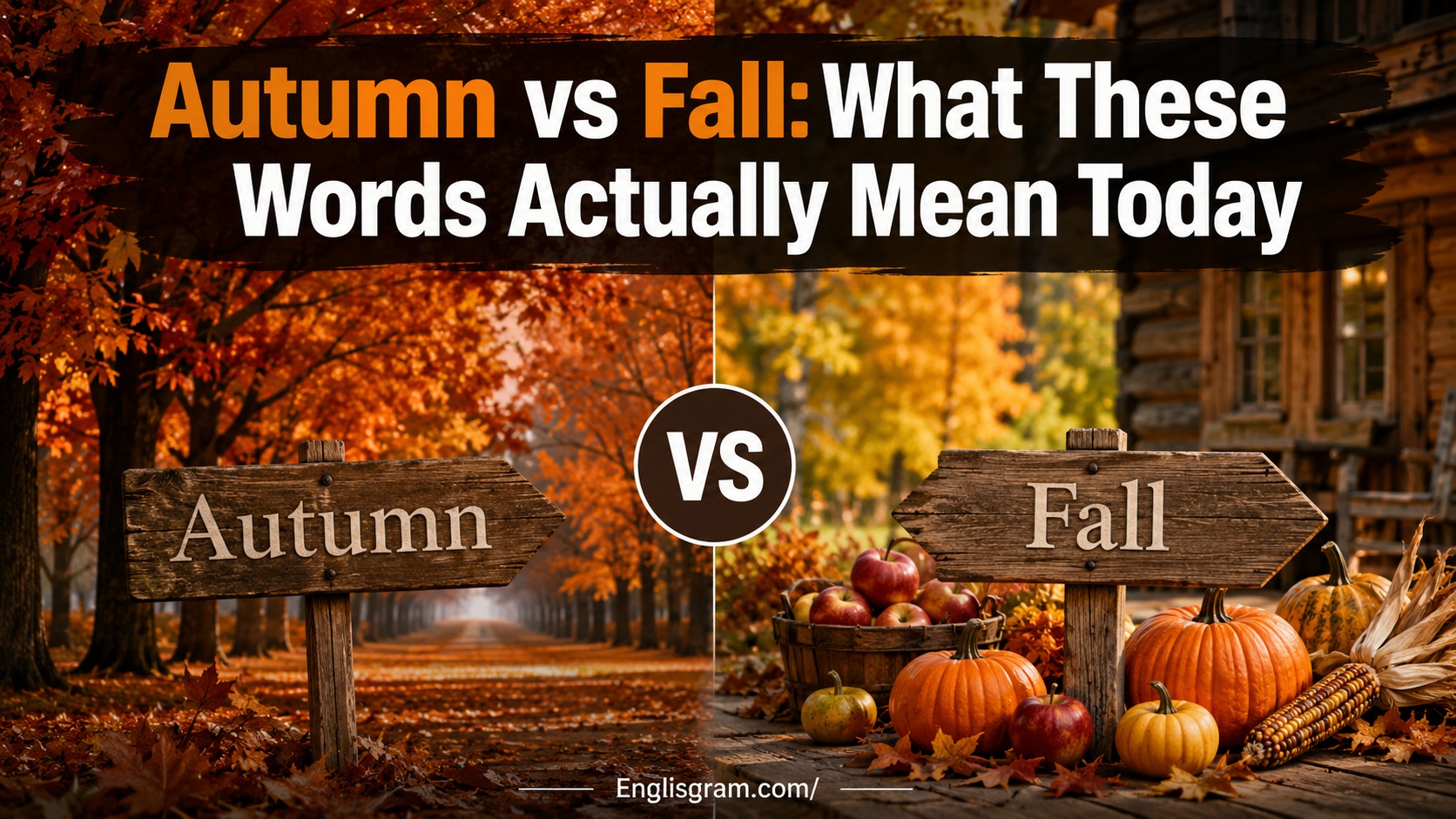
Autumn vs Fall is often seen as same seasonal words in English writing used by American English and British English writers today. globallyIn English writing, both Autumn and Fall work as seasonal labels for the same season. Writers and authors often switch between them in American English and British English usage. In British publications, Autumn appears more often, while Fall is common in Canada, Australia, and other regions.
Many readers pay close attention to detail. Some even use a fine-toothed comb approach and look for a moment. They question whether AUTUMN or FALL is correct, especially around September, the start of autumn in the Northern Hemisphere. This shows how usage, attitude, and region shape how people understand words in real writing practice.
From an etymological view, both words carry long history and origin across centuries like 15th century, 16th century, 17th century, and 18th century. Terms like automne, fall of the year, and fall of the leaf show clear language development. Over time, both became considered, prevalent,.
Autumn vs Fall Meaning: What These Words Really Represent
Both autumn and fall describe the same season between summer and winter. The scientific definition does not change.
In the Northern Hemisphere, it runs roughly from:
- September to December
In the Southern Hemisphere, the timing flips:
- March to June
So why two names?
Because English evolved in layers. Latin, French, and Germanic influences shaped different vocabulary streams. “Autumn” came through scholarly language. “Fall” came through spoken English.
Think of it like two roads leading to the same destination. One is scenic and formal. The other is direct and practical.
The Linguistic Roots of Autumn: A Latin Journey Through Time
Latin Origins of Autumn
The word “autumn” traces back to the Latin term autumnus. Ancient Romans used it to describe the harvest period.
From Latin, it moved into Old French as autompne, then entered Middle English as autumn or autumpne.
This path matters because Latin-based words often carried prestige in medieval Europe.
Why “Autumn” Sounded More Formal
In early English history, Latin was the language of:
- Education
- Religion
- Law
So words derived from Latin naturally felt more refined.
“Autumn” became associated with:
- Academic writing
- Poetry
- Formal documents
Even today, dictionaries like Oxford English Dictionary and Cambridge Dictionary list “autumn” as the more formal term in British English usage.
Literary Influence of Autumn
Writers often preferred “autumn” because it carried emotional depth.
For example:
- Romantic poets used it to symbolize change and decay
- Victorian writers linked it to reflection and maturity
- Modern literature still uses it for mood and imagery
In literature, “autumn” rarely just means a season. It often represents transition or emotional shift.
How Fall Was Born: A Purely English Expression
The Original Phrase Behind Fall
Unlike “autumn,” the word “fall” started as a phrase:
- “Fall of the leaf”
Over time, English speakers shortened it to simply “fall.”
This is a common pattern in language evolution. People naturally reduce long phrases into efficient speech.
Why People Adopted Fall Quickly
“Fall” spread because it was:
- Easier to say
- More natural in conversation
- Direct and descriptive
English speakers often favor efficiency. So “fall of the leaf” became just “fall.”
It reflects how spoken language drives real change more than formal writing does.
Key Linguistic Pattern Behind Fall
This process is called lexical shortening.
You can see the same pattern in other English words:
| Original Phrase | Modern Word |
| gymnasium | gym |
| omnibus | bus |
| refrigerator | fridge |
“Fall” follows the same logic. It is language compression in action.
Autumn vs Fall: The Historical Split Between Britain and America
Britain: Why Autumn Stayed Dominant
British English preserved “autumn” because:
- Latin influence stayed strong in education
- Universities preferred formal vocabulary
- Literature shaped language standards
By the 18th century, “autumn” became the standard written form in Britain.
Today, UK newspapers like The Guardian and BBC News consistently use “autumn.”
America: Why Fall Took Over
American English developed differently.
Early settlers used simpler, spoken English. They prioritized clarity and speed.
So “fall” remained common because:
- It matched everyday speech
- It felt natural in farming communities
- It avoided formal European influence
American English often favors practicality over tradition.
The Linguistic Divide Solidified
By the 19th century:
- Britain standardized “autumn” in writing
- America standardized “fall” in speech and informal writing
This created one of the cleanest vocabulary splits in English history.
Read More:On a Wing and a Prayer Idiom Meaning, Origin, and Real Usage Explained
Why America Held Onto Fall Instead of Switching Back
Efficiency of Speech
“Fall” is short and quick.
- One syllable
- Easy pronunciation
- Works in fast conversation
People rarely change words once they become natural in speech.
Everyday Language Dominance
In the US, “fall” dominates:
- School calendars
- Weather reports
- Daily conversation
For example, universities say:
- “Fall semester” instead of “autumn term”
Cultural Independence in Language
After independence, American English gradually moved away from British standards.
This included vocabulary choices like:
- color vs colour
- center vs centre
- fall vs autumn
Language became part of identity.
Why Britain Continued Using Autumn
Academic Influence
British education systems reinforced “autumn” as the correct written form.
It appears in:
- textbooks
- exams
- formal essays
Publishing and Literature
British publishers preferred consistency. “Autumn” became the default in books and journalism.
Modern Continuation
Today, UK institutions still use “autumn” almost exclusively in formal writing.
For example:
- BBC Weather: “autumn forecast”
- UK government documents: “autumn statement”
Autumn vs Fall in Literature, Poetry, and Media
British Literature
British writers use “autumn” to create mood.
Example usage themes:
- decay
- reflection
- nostalgia
American Literature
American authors use “fall” in more grounded storytelling.
It often appears in:
- rural settings
- everyday dialogue
- realistic narratives
Modern Media Influence
Media reinforces regional preference:
| Region | Common Usage in Media |
| UK | Autumn campaigns, autumn fashion |
| US | Fall sales, fall TV lineup |
Streaming platforms and global brands sometimes mix both depending on target audience.
Modern Usage of Autumn vs Fall Around the World
United States
- “Fall” dominates spoken English
- Used in marketing and education
- More casual tone overall
United Kingdom
- “Autumn” is standard in writing
- Used in official communication
- Strong literary preference
Global English Usage
Non-native speakers often learn:
- “Autumn” first in textbooks
- “Fall” through American media
So global usage depends on exposure.
Style Guides and Official Language Preferences
Different institutions set different standards.
| Source | Preferred Term |
| Oxford Style Guide | Autumn |
| Cambridge Dictionary | Autumn (UK), Fall (US) |
| AP Stylebook (US media) | Fall |
| BBC Style Guide | Autumn |
This split reinforces regional identity in writing.
Autumn vs Fall Cultural Meaning: Emotional Differences
Autumn Feels Like
- reflective
- poetic
- elegant
- literary
It often appears in branding that wants sophistication.
Example: luxury fashion brands use “Autumn Collection.”
Fall Feels Like
- casual
- friendly
- conversational
- grounded
Example: retail ads in the US say “Fall Sale.”
Marketing Insight Example
A simple experiment shows the difference:
- “Autumn Elegance Line” → luxury appeal
- “Fall Discount Event” → mass-market appeal
Same season. Different emotional triggers.
FAQs
1. Autumn aur Fall mein kya farq hai?
Autumn aur Fall dono ek hi season ke naam hain. “Autumn” zyada British English mein use hota hai, jabke “Fall” American English mein common hai.
2. “Fall” shabd kyun use kiya jata hai?
“Fall” is liye kaha jata hai kyunki is season mein darakhton ke patte girte hain (fall down). Isi wajah se Americans ne is naam ko popular banaya.
3. Kaunsa lafz zyada purana hai: Autumn ya Fall?
“Autumn” Latin aur French zaban se aya aur zyada purana mana jata hai. “Fall” baad mein English mein use hona shuru hua.
4. Kya Autumn aur Fall ka weather same hota hai?
Ji haan, dono ek hi season ko represent karte hain. Is dauran mausam thanda hone lagta hai aur patton ka rang badalta hai.
5. School aur exams mein kaunsa word use karna chahiye?
Agar aap British English follow kar rahe hain to “Autumn” likhna behtar hai. American English mein “Fall” zyada suitable hota hai.
Conclusion
Autumn aur Fall dono ek hi khoobsurat season ke do alag naam hain. Dono ka matlab ek hi hai, bas inka istemal mukhtalif regions mein alag hota hai. British English mein “Autumn” aur American English mein “Fall” zyada mashhoor hai. Yeh season thande mausam, rang-birange patton aur nature ki khoobsurti ki wajah se pasand kiya jata hai.