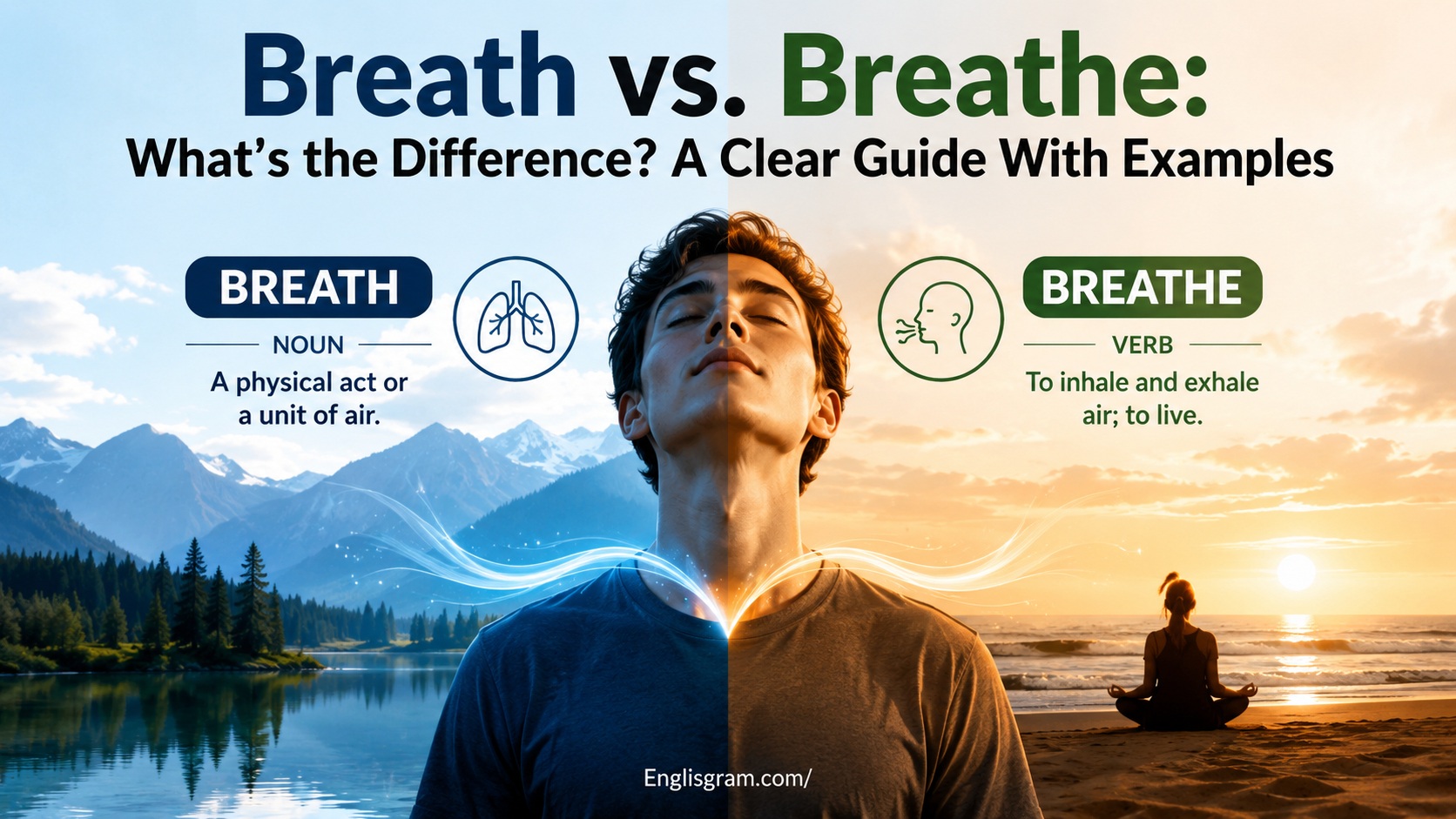
Breath vs. Breathe: What’s the Difference? A Clear Guide With Examples helps learners master English with simple rules and clear examples. In English, breath and breathe are commonly confused words because they look the same, sound close, and belong to the same family of words. Even so, they have different meanings, perform different jobs in a sentence, and that difference, even a slight difference, improves English grammar, English vocabulary, language, and clear communication.
Breath is a noun that names the air used in the act of breathing, while breathe is a verb that describes the action of inhaling, exhaling, taking air into the lungs and letting it out. I often notice these confused words used interchangeably in school, work, emails, and everyday conversation, where one small error can make writing feel awkward.A tiny final e at the end changes the spelling, pronunciation, and meaning of the word. In standard American English,
THIS simple rule encourages correct usage, proper usage, careful use, and better word usage in different contexts. A helpful guide explains, breaks down, and shows what each word means, how to pronounce it, and the most practical way to use it correctly. Following this rule also helps you avoid common mistakes that happen fast when you miss a small detail hidden in plain sight.
Breath vs. Breathe: The Fast Answer
Here is the short version:
- Breath = a noun
- Breathe = a verb
Think of it this way:
- You take a breath
- You breathe deeply
That is the core difference. Simple on paper. Easy to mix up in real life.
Breath vs. Breathe at a Glance
| Word | Part of Speech | Meaning | Example |
| breath | Noun | The air you inhale or exhale | She took a deep breath. |
| breathe | Verb | To inhale and exhale | Please breathe slowly. |
A quick grammar check usually solves the problem. If you need a thing, use breath. If you need an action, use breathe.
What Does Breath Mean?
Breath is a noun. It names the air you take in or let out. It can also refer to a short pause, a tiny amount of air, or a sign of life in a more figurative sense.
You can think of breath as the result or the unit of breathing.
Breath in simple words
When someone says:
- “Take a breath,”
they are referring to one inhalation or exhalation. They are talking about a thing you can count or notice.
Common meanings of breath
Breath can mean:
- one inhale or exhale
- a short pause to rest
- a sign that someone is alive
- a small trace of air or scent in older or literary usage
Examples of breath in sentences
- She took a deep breath before speaking.
- He paused for a breath and then continued.
- I was out of breath after climbing the stairs.
- Her breath smelled like mint.
- For one breath, everything felt still.
Why breath matters in writing
Writers often use breath in both literal and emotional ways. A single breath can suggest calm, fear, relief, or exhaustion. That is why this word appears often in stories, health writing, sports writing, and everyday speech.
For example:
- Literal: He held his breath under water.
- Emotional: She took a breath and tried to stay calm.
The word carries more than air. It often carries mood.
What Does Breathe Mean?
Breathe is a verb. It describes the action of taking air into the lungs and letting it out. It is something you do.
If breath is the object, breathe is the action.
Breathe in simple words
When someone says:
- “Breathe slowly,”
they are giving instructions. The person must do something. That is why the verb form fits.
Common uses of breathe
You use breathe when talking about:
- the act of inhaling and exhaling
- calming down
- medical instructions
- physical activity
- metaphorical action, such as giving life or energy to something
Examples of breathe in sentences
- Try to breathe slowly.
- It was hard to breathe in the smoke.
- She stopped to breathe between sentences.
- The doctor told him to breathe deeply.
- That new idea helped breathe life into the project.
Why breathe matters in writing
Breathe shows action, movement, and rhythm. It is a dynamic word. You will see it in fitness writing, medical advice, mindfulness content, and everyday conversation.
For example:
- Calming: Breathe in. Breathe out.
- Urgent: He could barely breathe after the sprint.
- Figurative: The redesign breathed new life into the brand.
Breath vs. Breathe: The Main Difference
The easiest way to separate these two words is to ask a simple question:
- Is this a thing or an action?
If it is a thing, use breath.
If it is an action, use breathe.
Noun vs. verb made simple
| Question | Use |
| Is it something you can take, catch, hold, or lose? | breath |
| Is it something you do? | breathe |
Compare these examples
- Take a deep breath.
Here, breath is the thing being taken. - Please breathe deeply.
Here, breathe is the action being done.
That difference is tiny in spelling but huge in grammar.
How to Pronounce Breath and Breathe
Pronunciation helps too. These words do not sound identical.
Pronouncing breath
Breath has a short e sound, like the e in bed.
You say it like:
- breth
Pronouncing breathe
Breathe has a long ee sound. The ending also sounds voiced and softer.
You say it like:
- bree-th
Why pronunciation helps
If you say the words out loud, the difference becomes easier to feel.
- Breath feels shorter and clipped.
- Breathe feels longer and more active.
That little sound change often gives you a clue when reading or speaking.
Pronunciation table
| Word | Sound | Helpful clue |
| breath | short e | Like bed |
| breathe | long ee | Like breeze at the start |
Breath vs. Breathe: Common Mistakes People Make
People mix these words up all the time. That is normal. They are near twins. Still, grammar does not care how similar they look.
Here are the most common mistakes.
Mistake with breath instead of breathe
Incorrect:
- I need to breath.
- Please breath slowly.
- She can barely breath after running.
Correct:
- I need to breathe.
- Please breathe slowly.
- She can barely breathe after running.
Mistake with breathe instead of breath
Incorrect:
- Take a deep breathe.
- I lost my breathe.
- He caught his breathe after the race.
Correct:
- Take a deep breath.
- I lost my breath.
- He caught his breath after the race.
Why these mistakes happen
There are three big reasons:
- The words look almost the same.
- The meanings sit in the same topic.
- Many people hear them more often than they read them carefully.
So the brain sees a familiar pattern and fills in the wrong word. It happens fast. That is exactly why a simple rule helps.
A Simple Rule to Remember Breath vs. Breathe
Use this quick memory trick:
- Breath = thing
- Breathe = action
Or even shorter:
- Breath is a noun.
- Breathe is a verb.
Easy memory trick
Think of the final e in breathe as a little tail that keeps the action going. It stretches the word out just like breathing stretches in and out.
Think of breath as a single unit. Short. Compact. A noun you can point to.
Another trick
Try replacing the word with another noun or verb.
- Can you say take a deep thing? No. So breath must be the noun.
- Can you say please action slowly? No. So breathe must be the verb.
It sounds silly. That is the point. Silly tricks stick.
Breath vs. Breathe in Everyday English
These words appear constantly in real speech. You hear them in moments of stress, rest, exercise, and emotion.
Everyday uses of breath
- “Take a breath.”
- “He was out of breath.”
- “Hold your breath.”
- “Catch your breath.”
Everyday uses of breathe
- “Breathe in.”
- “Breathe out.”
- “Try to breathe slowly.”
- “Just breathe.”
Notice the pattern. When the phrase names a thing or result, it often uses breath. When it gives an instruction or describes an action, it often uses breathe.
Breath vs. Breathe in Health and Fitness Writing
These words are common in wellness, exercise, and medical contexts. That is why the difference matters so much.
In medical writing
- Breathe is often used in instructions:
- Breathe in deeply.
- Breathe out slowly.
- Breathe through your nose.
- Breath is often used to describe a state or symptom:
- Shortness of breath
- Loss of breath
- Rapid breath
In fitness writing
Coaches often say:
- “Keep breathing.”
- “Don’t hold your breath.”
- “Breathe through the movement.”
They may also write:
- “Take a breath between reps.”
- “Catch your breath before the next set.”
In mindfulness and yoga
Breathing is central in these spaces, so the words show up constantly.
- Breathe to guide the action.
- Breath to describe awareness of the air moving in and out.
For example:
- Breathe in for four counts.
- Focus on your breath.
- Return to your breath when your mind wanders.
That last phrase is especially common in meditation. It turns a physical action into a point of attention.
Read More:Someday vs. Some Day: What’s the Difference? A Complete Grammar Guide
Breath vs. Breathe in Figurative Language
English loves metaphor. These words go far beyond lungs and oxygen.
Figurative uses of breath
- A breath of fresh air
This means something new, refreshing, or welcome. - Out of breath
This can mean literally breathless, but it can also describe being rushed or overwhelmed. - Hold your breath
This can mean waiting nervously for news.
Figurative uses of breathe
- Breathe life into
This means to give energy, purpose, or excitement to something. - Breathe easy
This means relax or feel relieved. - Breathe down someone’s neck
This means to pressure or hover over someone.
Example sentences
- Her voice was a breath of fresh air in a room full of noise.
- The new manager helped breathe life into the team.
- After the exam, he could finally breathe easy.
These expressions show how flexible English can be. One word stays a noun. The other stays a verb. Yet both travel into idioms and figurative speech.
Breath vs. Breathe: Real-Life Case Studies
A good rule is useful. A real case makes it stick.
Case study one: The workout app
A fitness app wanted to add a short reminder before interval training. The draft said:
- “Take a deep breathe before starting.”
That sentence felt wrong because breathe is the verb form. The correct version was:
- “Take a deep breath before starting.”
Why? Because the app was asking users to take a thing before the workout began.
Case study two: The hospital brochure
A brochure for patients said:
- “Please breathe slowly while sitting upright.”
That was correct. It gave an action. The patient had to do something.
If the brochure had said:
- “Please take a slow breathe,”
the wording would have sounded off and ungrammatical.
Case study three: The speech coach
A speaking coach told a nervous student:
- “Pause, take a breath, and then begin.”
That advice works because it separates the noun from the action. The student takes a breath before speaking. Then speaking becomes the action that follows.
These small differences matter. In professional writing, the wrong form can make a sentence look sloppy even when the meaning is clear.
Breath vs. Breathe: How to Choose the Right Word Every Time
You do not need to memorize a giant grammar chart. A few questions will do the job.
Ask yourself these questions
- Am I naming a thing?
- Am I describing an action?
- Can I put the, a, or my before the word?
- Does the sentence need a verb?
Use breath when:
- you can say a breath
- you are talking about air, pause, or a single inhale/exhale
- the word acts like a noun
Use breathe when:
- you are talking about the act of inhaling and exhaling
- the sentence needs a verb
- you are giving an instruction
Quick decision guide
| Sentence need | Best choice |
| A thing you can take or lose | breath |
| An action someone does | breathe |
Breath vs. Breathe: Common Collocations
Words often travel in packs. Here are phrases that naturally go with each one.
Common phrases with breath
- take a breath
- deep breath
- hold your breath
- catch your breath
- out of breath
- shortness of breath
- under your breath
- one breath at a time
Common phrases with breathe
- breathe deeply
- breathe in
- breathe out
- breathe slowly
- breathe easy
- breathe life into
- breathe through
- learn to breathe
These collocations are helpful because they show you how native speakers actually use the words.
Breath vs. Breathe in Formal and Informal Writing
The difference matters in every style, but especially in polished writing.
In formal writing
Use the correct form carefully. Editing teams, teachers, and professional readers notice these mistakes quickly.
Incorrect:
- The patient could not breath.
Correct:
- The patient could not breathe.
In informal writing
People still expect the right form, even in texts or social posts.
Incorrect:
- Need to take a deep breathe.
Correct:
- Need to take a deep breath.
A small typo can change the rhythm of a sentence and make the writer look less careful. That is a tiny crack that can spread.
Breath vs. Breathe: A Quick Quote to Remember
Breath is the noun. Breathe is the action.
That one line solves most confusion. It is short enough to remember and clear enough to use in real writing.
Breath vs. Breathe: Extra Practice Sentences
Here are more examples so the pattern sinks in.
Sentences with breath
- She took a long breath before the interview.
- The cold air stole his breath.
- He was out of breath after the climb.
- We all waited for her next breath.
- The singer ended the line in one smooth breath.
Sentences with breathe
- Try to breathe through your nose.
- He could barely breathe in the crowded room.
- They told her to breathe slowly.
- I always breathe deeper when I walk outside.
- That speech helped breathe confidence into the team.
Practice matters because your brain learns patterns by repetition. The more examples you see, the faster you choose correctly without thinking.
Breath vs. Breathe: Mistakes to Avoid in Editing
When reviewing your own writing, check these points:
- Look for take a breathe and change it to take a breath
- Look for need to breath and change it to need to breathe
- Look for out of breathe and change it to out of breath
- Look for breathe deeply only when the sentence needs an action
- Make sure the sentence structure matches the part of speech
A fast editing pass like this can save you from embarrassing grammar slips.
Breath vs. Breathe: Why This Difference Matters
Some people think this is a tiny spelling issue. It is not.
Using the wrong word can:
- weaken your credibility
- make your writing look careless
- confuse readers
- break the flow of a sentence
- hurt clarity in professional or educational content
That matters in essays, blog posts, emails, captions, and health writing. Clear language builds trust. Messy language chips away at it.
Think of grammar like a road sign. If the sign points the wrong way, people may still guess the destination. But they will not trust the sign next time.
FAQS
Is breath a noun or a verb?
Breath is a noun. It refers to the air you inhale and exhale or a single act of breathing.
Example: Take a deep breath before speaking.
Is breathe a noun or a verb?
Breathe is a verb. It means to inhale and exhale air through your lungs.
Example: Remember to breathe slowly during exercise.
How can I remember the difference between breath and breathe?
A simple memory trick is to look for the extra “e” in breathe. That extra letter reminds you it is a verb, an action. Breath, without the final e, is a noun.
Why do people confuse breath and breathe?
They are often confused because they have similar spelling, nearly identical pronunciation, and are closely related in meaning. However, they play different roles in a sentence.
Are breath and breathe used differently in British and American English?
No. Both British English and American English use breath as the noun and breathe as the verb. The grammar rule is the same in both varieties of English.
Conclusion
The difference between breath and breathe is small but important. Breath is the noun, while breathe is the verb. Once you remember that the extra “e” in breathe signals an action, choosing the correct word becomes much easier. With regular practice, real-life examples, and careful proofreading, you can avoid this common mistake and write with greater confidence and accuracy.