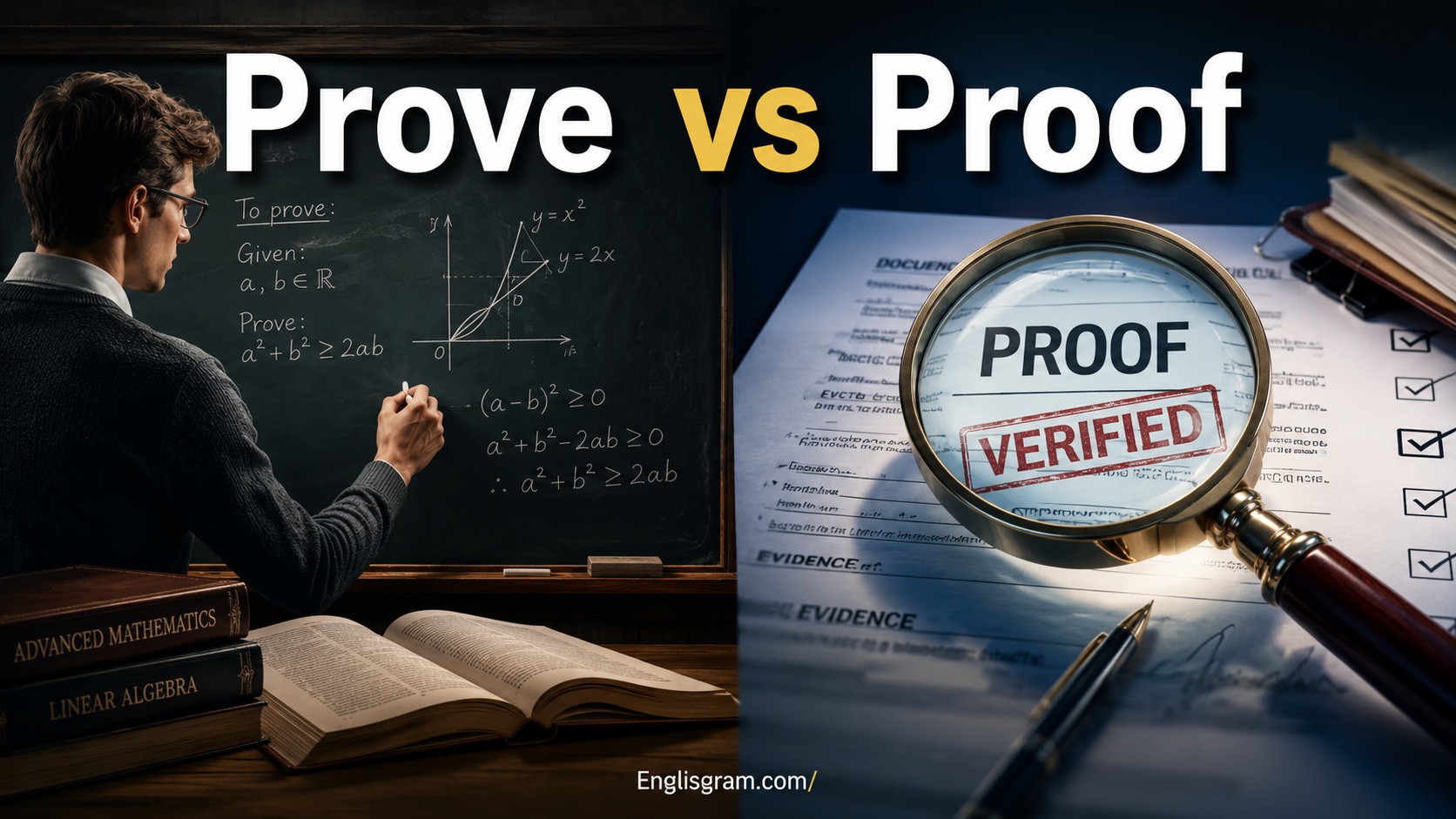
Prove vs Proof helps you understand prove and proof in English with simple examples that make correct word usage easy every daWhen I began learning English, I found that many English words looked alike, but these word pairs were like twins that only look and sound connected. That first bump is common for beginners because both words come from a common root, the same origin, and originated from the Latin Latin word probare. Even with their shared word origin, etymology, and etymological history, they have separate personalities in modern English.
Their relationship is easy to understand once you learn that their parts of speech are different. Prove is a verb that describes an action or process, while proof is a noun that refers to evidence, the result of showing something is true. This distinction becomes clear through real language and everyday writing.Many people believe these words are interchangeable or can be used interchangeably, but that often leads to confusion, an awkward sentence, weak sentence structure, and other common mistakes. A perfect example is trying to mix them in the same argument.
In real use, every use, usage, and grammar grammar rule matters because the verb helps convince someone, while the noun provides the evidence needed to support a theory or example. I often explain this comparison to students because knowing the difference, avoiding mistakes, and using each word correctly can improve communication, communication skills, and confidence in everyday language, everyday conversation, school, business, legal writing, law, and science.
Prove vs Proof at a Glance
Before going deeper, here is the quickest way to understand the difference.
| Word | Part of Speech | Core Meaning | Simple Use |
| prove | Verb | To show something is true | You prove a claim |
| proof | Noun | Evidence that supports truth | You need proof |
A helpful shortcut is this:
- Prove is the action
- Proof is the thing you use to support the action
Think of it like this.
You prove a point.
You present proof for the point.
What Does “Prove” Mean?
Prove is a verb. It describes an action. When you prove something, you show that it is true, correct, real, or valid.
In simple words, prove means to demonstrate truth.
Basic meaning of prove
You use prove when you want to:
- show that a statement is true
- confirm a fact
- demonstrate skill or worth
- establish a point
- remove doubt
Examples of prove in sentences
- The scientist will prove the theory with data.
- Can you prove your identity?
- She worked hard to prove herself.
- The evidence helped prove his innocence.
- This test can prove whether the water is safe.
Why “prove” feels strong
Prove is a strong word. It suggests certainty. That is why people use it in serious settings like law, science, and formal arguments. It does not mean “guess” or “assume.” It means to show something clearly enough that doubt goes away or gets much smaller.
Common verb forms of prove
| Form | Example |
| Base form | prove |
| Past tense | proved / proven |
| Present participle | proving |
| Third-person singular | proves |
Both proved and proven can appear as past forms. In modern English, proved is still very common in regular use. Proven often appears as an adjective in phrases like proven results or proven method, though it is also used as a past participle in some styles.
What Does “Proof” Mean?
Proof is a noun. It refers to the evidence, fact, or support that shows something is true.
If prove is the action, proof is the result or support behind the action.
Basic meaning of proof
You use proof when you mean:
- evidence
- confirmation
- supporting facts
- a document or test result
- a demonstration that something is true
Examples of proof in sentences
- Do you have proof of payment?
- The photo is proof that he was there.
- She showed proof of address.
- We still need proof before making a final decision.
- The document serves as proof of ownership.
Proof can be concrete or abstract
Proof can be something physical, like a receipt or certificate. It can also be more abstract, like logical proof in math or strong proof in an argument.
That flexibility makes it very useful. You might have:
- proof of identity
- proof of purchase
- proof of concept
- proof of innocence
- mathematical proof
A simple way to think about proof
If someone asks, “What is your proof?” they are asking, “What evidence do you have?”
That is the main job of the word.
Prove vs Proof: The Main Difference
The difference between prove and proof comes down to grammar and function.
- Prove = action
- Proof = evidence or result
Here is a practical comparison.
| Feature | Prove | Proof |
| Part of speech | Verb | Noun |
| Main job | Shows an action | Names evidence |
| Example form | I will prove it. | I need proof. |
| Common use | Arguments, science, law, writing | Documents, facts, results, support |
| Can it stand alone? | Yes, as a verb | Yes, as a noun |
| Related idea | To demonstrate | The thing that demonstrates |
Example pair
- You need to prove your claim.
- You need proof for your claim.
Both sentences talk about the same idea. The first uses the action. The second uses the evidence.
That is the heart of the difference.
When Should You Use “Prove”?
Use prove when you want to describe an action that shows truth.
Use prove to demonstrate truth
- The data will prove the model is accurate.
- This example helps prove the rule.
Use prove to establish a fact
- The documents prove that he owns the house.
- Her records prove she completed the course.
Use prove to confirm a claim
- Can you prove what you said?
- The test results prove the diagnosis.
Use prove to show ability
- He wants to prove that he can lead the team.
- She joined the race to prove her endurance.
Use prove in formal and academic writing
Writers often use prove in essays, reports, and research discussions when they want to make a strong statement supported by evidence.
For example:
- The experiment proved that the new method reduced waste.
- The results prove that the hypothesis was correct.
Use prove carefully
In some cases, writers use prove too strongly. In science, for example, people often prefer support, suggest, or indicate instead of prove because research usually adds evidence rather than absolute final certainty.
That is an important nuance.
When Should You Use “Proof”?
Use proof when you want to name the evidence itself.
Use proof for evidence
- The receipt is proof of purchase.
- The witness statement is proof of what happened.
Use proof for documentation
- Please bring proof of address.
- The airline asked for proof of identity.
Use proof for legal or official situations
- The court accepted the file as proof.
- You may need proof of insurance.
Use proof in science and math
- Mathematical proof explains why something is true.
- Scientific proof is often built from repeated testing and data.
Use proof in everyday speech
People use proof constantly in daily life.
For example:
- “Do you have proof?”
- “That is proof enough for me.”
- “I need proof before I believe it.”
It is a practical, everyday noun.
Prove vs Proof in Real Sentences
Seeing the words side by side makes the difference easier to remember.
| Situation | With prove | With proof |
| Identity | She must prove who she is. | She showed proof of identity. |
| Purchase | Can you prove you paid? | Keep your proof of purchase. |
| Truth | The facts prove it. | The facts are proof of it. |
| Ability | He wants to prove himself. | His results are proof of his skill. |
| Law | The lawyer must prove the case. | The lawyer presented proof to the court. |
A simple rule from these examples
If the sentence needs a doing word, use prove.
If the sentence needs a thing, use proof.
That rule works in most cases.
Common Grammar Patterns with Prove
Prove often appears in a few common patterns.
Prove + noun
- The test proved the theory.
- The records prove the claim.
Prove + that clause
- The evidence proves that she was there.
- The study proves that the method works.
Prove + adjective
- Time proved him right.
- The report proved them wrong.
Prove + to be
- The plan proved to be successful.
- The rumor proved to be false.
Prove + yourself
- She wanted to prove herself in a new job.
- He tried to prove himself after the mistake.
These patterns are useful because they show how flexible the verb is. Prove can link to claims, facts, people, and outcomes.
Common Grammar Patterns with Proof
Proof also follows predictable patterns.
Proof of + noun
- proof of payment
- proof of identity
- proof of address
- proof of ownership
Proof that + clause
- proof that the policy works
- proof that he was present
Adjective + proof
- strong proof
- clear proof
- enough proof
Without proof
This phrase often appears in arguments and legal settings.
- You cannot make that claim without proof.
- The accusation has no proof.
These patterns make proof very practical in official and everyday writing.
Can “Proof” Ever Be Used as a Verb?
Yes, but not in the same way most people use it in ordinary English.
In some specialized contexts, proof can function as a verb, especially in printing and publishing. There, it means to check a text or page before final printing.
For example:
- The editor will proof the article before it goes to print.
However, in everyday English, this use is much less common than proofread.
Difference between proof and proofread
- Proof = to check a text, mainly in publishing
- Proofread = to read a text carefully and correct errors
Most people use proofread far more often.
So yes, proof can be a verb in a narrow sense. Still, that is not the meaning most readers think of first.
Common Mistakes People Make
People often confuse prove and proof because both words belong to the same idea. Still, the errors are easy to avoid once you know the rule.
Mistake: using proof when prove is needed
Wrong:
- You need to proof your claim.
Correct:
- You need to prove your claim.
Why?
Because claim needs an action verb, not a noun.
Mistake: using prove when proof is needed
Wrong:
- I need to submit a prove of address.
Correct:
- I need to submit a proof of address.
Why?
Because of address describes evidence, so the noun proof fits.
Mistake: confusing past forms
Wrong:
- She has prove the point.
Correct:
- She has proved the point.
- She has proven the point.
Mistake: using proof where evidence is more natural
Wrong:
- He proved for his innocence.
Correct:
- He provided proof of his innocence.
Mistake: using proof as a general synonym for truth
Wrong:
- That is a proof.
Correct:
- That is proof.
- That is evidence.
The article a usually does not pair naturally with proof in this kind of meaning because proof is often uncountable when it means evidence.
Prove vs Proof in Academic Writing
In school and university writing, the difference matters a lot.
In essays
Use prove when discussing argument and analysis.
- The author proves the theme through character conflict.
Use proof when discussing supporting evidence.
- The essay includes proof from the text.
In research papers
Researchers often avoid saying they have “proved” everything unless the evidence is extremely strong and the field allows it.
Instead, they may say:
- The results support the hypothesis.
- The data suggest a pattern.
- The findings provide proof of the relationship.
That careful language helps keep writing accurate.
In reports
- The audit report proved the discrepancy.
- The report included proof of the missing funds.
Academic writing often requires precision. Choosing the right word makes your argument stronger.
Prove vs Proof in Legal English
Law uses both words often, but in very specific ways.
Burden of proof
This is a legal phrase that refers to the duty to provide evidence.
- The burden of proof is on the prosecution.
Here, proof means the evidence required to support a claim.
Prove a case
Lawyers and judges often say someone must prove a case.
- The lawyer must prove negligence.
- The defendant must prove the contract was valid.
That means show the truth through facts and evidence.
Proof beyond a reasonable doubt
This phrase appears in criminal law.
- The jury must be convinced beyond a reasonable doubt based on the proof presented.
This is a high standard because the stakes are serious.
Why law cares about the difference
Law depends on exact wording. A small grammar mistake can create confusion. That is why prove and proof must stay in their proper roles.
Read More:Dialog or Dialogue: Exploring Their Variations and Uses
Prove vs Proof in Mathematics
Math uses both words too, but the meaning is very exact.
What is a mathematical proof?
A mathematical proof is a logical explanation that shows why a statement must be true.
It is not a guess. It is not a rough idea. It is a step-by-step demonstration built on logic.
What does it mean to prove a theorem?
To prove a theorem means to show that it follows logically from accepted rules, definitions, and prior results.
Example:
- Mathematicians prove the theorem using equations and logic.
- The proof shows every step clearly.
Why this matters
In math, proof is not just support. It is a formal logical structure. That is why mathematics uses the word with such precision.
Everyday Expressions with Prove
Many common phrases use prove.
Prove yourself
This means to show your ability, value, or skill.
- She wanted to prove herself in a new role.
Prove a point
This means to show that an idea is true or that someone is wrong.
- He stayed late just to prove a point.
Prove someone wrong
This means to show that another person’s belief was incorrect.
- The results proved the critics wrong.
Prove your innocence
This means to show that you did not do something wrong.
- The accused tried to prove his innocence.
Time will prove
This means only time will show the truth.
- Time will prove whether the decision was wise.
These phrases are easy to understand once you remember that prove is an action.
Everyday Expressions with Proof
Proof also shows up in common phrases.
Proof of concept
This means a small example or test that shows an idea can work.
- The startup built a proof of concept before launching the product.
Proof of identity
This means evidence that confirms who a person is.
- A passport can serve as proof of identity.
Proof of purchase
This means a receipt or record showing you bought something.
- Keep your proof of purchase in case you need a refund.
Proof of address
This means a document that shows where you live.
- The bank asked for proof of address.
Proof positive
This means strong, clear evidence.
- The fingerprints were proof positive that he was present.
These phrases are common because proof is useful in real life.
Word Forms and Related Words
Here is a simple look at related forms.
| Base Word | Related Forms | Notes |
| prove | proved, proven, proving, proves | Verb forms |
| proof | proofs | Noun plural |
| Related words | proofread, proofreader, provable, unprovable | Different but connected ideas |
Proved vs proven
Both are acceptable past forms in modern English.
- proved is very common.
- proven often appears before a noun, especially in phrases like proven method or proven results.
Examples:
- The test proved the point.
- The method has proven useful.
- She is a proven leader.
Synonyms of Prove
These words can sometimes replace prove, depending on the sentence.
- demonstrate
- confirm
- verify
- establish
- validate
- substantiate
- show
How they differ
- Demonstrate often means to show clearly.
- Confirm often means to make sure something is true.
- Verify often means to check accuracy.
- Establish often means to set something as true or accepted.
- Validate often means to make something officially acceptable.
- Substantiate often means to support with evidence.
Each one has its own shade of meaning. That is why prove is still often the strongest and most direct choice.
Synonyms of Proof
These words can sometimes replace proof, depending on the context.
- evidence
- confirmation
- verification
- documentation
- support
- testimony
- corroboration
How they differ
- Evidence is broad and very common.
- Confirmation means something has been checked or verified.
- Verification focuses on checking truth or accuracy.
- Documentation refers to written records.
- Support means help or backing.
- Testimony means spoken or written witness evidence.
- Corroboration means support from another source.
These words overlap, but they are not perfect substitutes in every sentence.
A Simple Memory Trick
Here is an easy way to remember the difference:
- Prove is what you do
- Proof is what you show
Another trick:
- prove has a v sound in the middle, and verbs do actions
- proof ends like a noun object you can hold or present
Mini mnemonic
You prove with proof.
That sentence is short and easy to remember.
Case Studies: Prove vs Proof in Real Life
To make the difference more real, let’s look at a few everyday situations.
Case study: a job interview
A candidate says, “I can lead a team well.”
The interviewer replies, “Can you prove that?”
The candidate then shares past results, leadership awards, and team feedback. Those items become the proof.
Lesson:
You prove a claim by presenting proof.
Case study: online shopping
A customer returns a package and needs a refund.
The store asks for proof of purchase.
The receipt serves as proof. The customer does not “prove” the purchase in that moment. Instead, they show the evidence that proves it happened.
Lesson:
The receipt is the proof.
The act of showing it helps prove the purchase.
Case study: school essay
A student writes, “The novel proves that loneliness changes people.”
The teacher may ask whether the student has enough proof from the text.
The quote, character behavior, and events in the story all serve as proof.
Lesson:
The argument is proved through literary evidence.
Quick Practice Examples
Try choosing the correct word.
- Can you prove / proof your statement?
- I need prove / proof of address.
- The facts prove / proof the theory.
- She gave strong prove / proof of her work.
- The evidence will prove / proof his innocence.
Answers
- prove
- proof
- prove
- proof
- prove
If you got all five right, the difference is already sticking.
FAQs
What is the difference between prove and proof?
Prove is a verb that means to show that something is true. Proof is a noun that refers to the evidence that supports a claim.
Can prove and proof be used interchangeably?
No. They have different grammatical roles, so using one in place of the other can make a sentence incorrect.
Why do people confuse prove and proof?
People often confuse them because they share the same origin, have similar meanings, and look and sound alike.
Is prove a verb or a noun?
Prove is always a verb. It describes the action of demonstrating or confirming something.
Is proof a verb?
No. Proof is a noun that refers to evidence or confirmation. The verb form is prove.
Conclusion
Understanding Prove vs Proof is easier once you remember that prove is a verb and proof is a noun. Although both words share the same origin, they have different jobs in a sentence. Using the correct word improves your grammar, makes your writing clearer, and helps you communicate with confidence. With regular practice and real-life examples, choosing between prove and proof will soon become second nature.