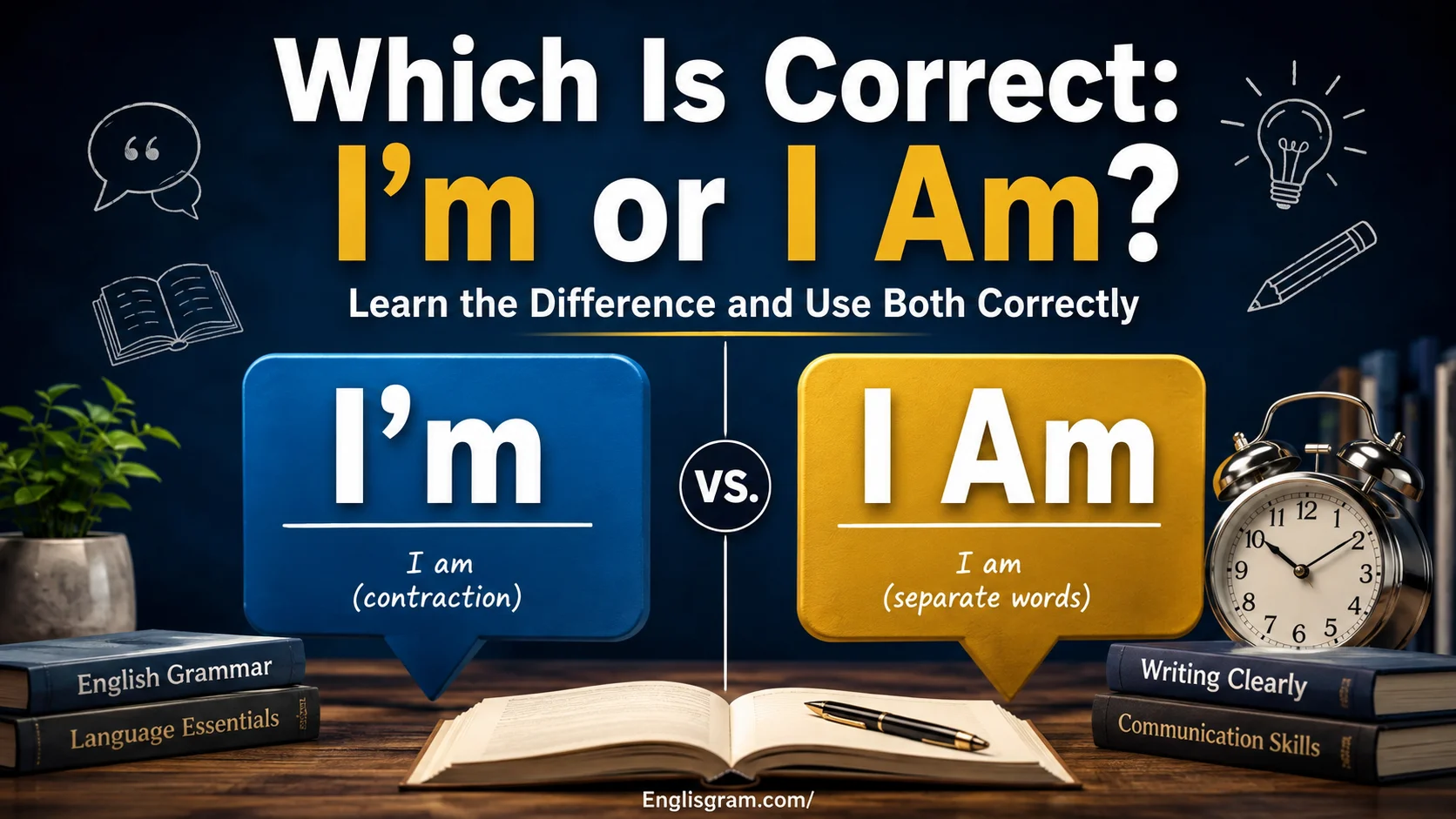
Which Is Correct: I’m or I am Both forms work, but English speakers choose them based on tone, formality, stress, and writing context. For English learners and beginners, the basic rule is clear: the subject I take the present form of the verb to be, which is am. Therefore, I am happy is the correct form, while I are happy is a common mistake. This grammar rule is important in everyday English, especially when talking about your name, age, feelings, job, location, or condition.
When introducing yourself to a friend or teacher, these words help you build sentences and answer questions while speaking with confidence. The good news is that the pattern is simple: I’m is a contraction of I am, and both are grammatically correct. In American English, the two expressions have the same grammatical meaning, but their choice, tone, emphasis, formality, and sentence position can differ.
I’m ready sounds natural and conversational, while I am ready may sound more deliberate when stress falls on me in speech. In English writing, a text, email, or business email, I often feels more relaxed, while formal writing may use I am for a stronger or more formal sound. The right choice depends on the situation and writing context, so while preparing a formal message or answering a question, consider whether you need a direct or relaxed writing style.
Quick Answer
“I’m” and “I am” are both correct. “I’m” is the standard contraction of “I am” and works naturally in everyday conversation and informal writing. “I am” is the complete form and can sound more formal, deliberate, or emphatic.
There’s one important exception to remember: “I’m” generally cannot stand alone as a positive short answer. For example, “Are you ready?” can be answered with “Yes, I am,” not “Yes, I’m.”
| Form | Correct? | Common use | Example |
| I’m | Yes | Everyday speech and informal writing | I’m tired. |
| I am | Yes | Formal, careful, or emphatic language | I am tired. |
| Im | No | Incorrect spelling | Im tired. |
| Yes, I’m. | No | Incorrect standalone positive answer | — |
| Yes, I am. | Yes | Positive short answer | Yes, I am. |
So, if you’re asking “Which is correct: I’m or I am?”, the answer isn’t that one is right and the other is wrong. They’re two forms of the same grammatical expression.
What Does “I’m” Mean?
“I’m” means “I am.” It’s a contraction created by combining the pronoun I with the verb am.
The apostrophe shows that letters have been omitted:
I am → I’m
Contractions are a normal part of English. They appear frequently in speech and everyday writing because they make language quicker and more fluid.
Consider these examples:
- I’m happy to see you.
- I’m working today.
- I’m a teacher.
- I’m at home.
- I’m feeling better.
- I’m not sure about that.
In each sentence, you could replace I’m with I am without changing the basic meaning.
For example:
I’m ready to leave.
becomes:
I am ready to leave.
The grammar remains sound in both versions.
Why Does “I’m” Have an Apostrophe?
The apostrophe marks the missing letters from am.
English contractions often use apostrophes to show that two words have been shortened. You see the same pattern in expressions such as:
- I’m = I am
- you’re = you are
- he’s = he is
- we’re = we are
- they’re = they are
- can’t = cannot
- don’t = do not
That means “Im” without an apostrophe is not the standard spelling of the contraction.
Correct:
I’m ready.
Incorrect:
Im ready.
The tiny apostrophe matters.
What Does “I Am” Mean?
“I am” is the full, uncontracted form of the same expression. Here, I functions as the first-person singular subject and am serves as the first-person singular present form of the verb be.
You can use I am in several common sentence patterns.
I Am + Adjective
The adjective describes the speaker’s condition, feeling, or quality.
- I am tired.
- I am excited.
- I am nervous.
- I am confident.
- I am hungry.
I Am + Noun
A noun can identify the speaker or describe their role.
- I am a student.
- I am a doctor.
- I am your neighbor.
- I am the person responsible for this project.
I Am + Location
A prepositional phrase can tell you where the speaker is.
- I am at home.
- I am in the office.
- I am near the entrance.
- I am on the second floor.
I Am + Verb Ending in -ing
This structure creates the present progressive tense.
- I am studying.
- I am working.
- I am waiting.
- I am writing an email.
In every one of these examples, “I’m” could replace “I am.”
I am studying.
I’m studying.
The grammar stays intact. The tone changes slightly.
I’m vs. I Am: What’s the Difference?
The fundamental difference between “I’m” and “I am” isn’t meaning. It’s form and usage.
“I’m” is contracted. “I am” is not.
That small grammatical difference can influence how a sentence sounds. In relaxed conversation, “I’m” usually feels more natural and effortless. The full form can create a little more weight, especially when the speaker stresses it.
| Feature | I’m | I am |
| Grammatical status | Contraction | Full form |
| Meaning | I am | I am |
| Everyday conversation | Very common | Common |
| Informal writing | Very common | Common |
| Formal writing | Sometimes appropriate | Often preferred |
| Strong emphasis | Less typical | More effective |
| Positive standalone answer | Generally not used | Used |
| Apostrophe | Required | Not applicable |
Think of the difference like this: “I’m” is the relaxed version, while “I am” gives the words a little more room to breathe.
That doesn’t make “I am” automatically formal. Nor does it make “I’m” automatically informal. Context matters.
When Should You Use “I’m”?
Use “I’m” when you want your English to sound natural, conversational, and relaxed.
It works especially well in everyday communication.
Casual Conversation
Native speakers frequently use contractions in ordinary speech.
I’m heading home now.
I’m really hungry.
I’m not sure what happened.
I’m glad you came.
Using “I am” isn’t wrong in these sentences. It may simply sound slightly more deliberate depending on the context and how you say it.
Text Messages
Contractions are perfectly natural in texting:
I’m almost there.
I’m running five minutes late.
I’m free after six.
There’s usually no reason to expand every contraction in a casual text. Doing so can make an ordinary message sound unusually stiff.
Social Media
The same principle applies to social posts and comments.
I’m finally starting my vacation.
I’m obsessed with this recipe.
I’m definitely trying this next weekend.
The contraction keeps the writing close to everyday speech.
Informal Emails
In a friendly email, “I’m” often sounds more approachable:
I’m sending the files you requested.
I’m happy to help.
I’m looking forward to hearing from you.
The audience matters more than an imaginary rule that says contractions are always informal.
Read More:Underwent or Undergone: What’s the Difference and Which Is Correct?
When Should You Use “I Am”?
Choose “I am” when the complete form better suits the context or when you want emphasis.
This happens in several situations.
Formal or Professional Writing
A business document may favor the full form when the writer wants a polished, deliberate tone.
For example:
I am writing to request additional information about your application.
That sentence is perfectly natural in professional correspondence.
However, this doesn’t mean the contracted version is grammatically wrong:
I’m writing to request additional information about your application.
The second sentence simply has a more conversational feel.
Strong Emphasis
The full form becomes particularly useful when am carries emphasis.
Compare:
I’m serious.
with:
I am serious.
The second sentence can sound firmer. In spoken English, a speaker may place strong stress on am to make the point unmistakable.
Another example:
“You’re not ready.”
“I am ready.”
Here, “I am” directly pushes back against the previous statement.
Formal Declarations
A full form can also sound more deliberate when someone makes a clear statement or declaration.
I am responsible for this decision.
I am committed to completing the project.
I am confident in our approach.
Again, the full form doesn’t magically make the sentence formal. Context, vocabulary, sentence structure, and audience all contribute to register.
Is “I’m” Correct in Formal Writing?
Yes. “I’m” is grammatically correct in formal writing, although some formal contexts may favor the full form.
This distinction matters because many English learners hear an oversimplified rule: “Never use contractions in formal writing.”
That’s too absolute.
Contractions are standard English. Whether you should use them depends on the publication, institution, assignment, style guide, and desired tone.
For example, these are both grammatically correct:
I’m writing to confirm the meeting.
I am writing to confirm the meeting.
The second may sound more formal. The first sounds more conversational.
For highly formal documents, legal writing, academic assignments with strict style requirements, or situations where an institution specifically discourages contractions, “I am” may be the safer stylistic choice.
The key is consistency.
“I’m” vs. “I Am” for Emphasis
Here’s where the distinction gets especially interesting.
English speakers don’t communicate only through vocabulary and grammar. Stress, rhythm, and intonation also shape meaning.
Consider this exchange:
“You aren’t responsible for the project.”
“I am responsible for the project.”
The speaker emphasizes am because the statement contradicts the previous claim.
Now compare:
“I’m responsible for the project.”
That sentence simply provides information. It doesn’t necessarily carry the same force.
The full form can therefore act like a verbal spotlight. It draws attention to the statement.
Examples of Emphatic “I Am”
- I am certain about this.
- I am telling the truth.
- I am ready.
- I am serious.
- I am the person you need to contact.
In each example, “I am” can sound stronger when spoken with emphasis.
However, don’t assume every occurrence of “I am” carries strong emphasis. Sometimes writers simply prefer the full form because it suits the context.
Can “I’m” Stand Alone at the End of a Sentence?
This is one of the most useful rules to remember.
“I’m” generally cannot stand alone as a positive short answer.
Suppose someone asks:
Are you tired?
The natural positive answer is:
Yes, I am.
Not:
Yes, I’m.
Why?
Because “I’m” is a contraction that normally needs the complement that follows it.
For example:
I’m tired.
Here, “I’m” is followed by tired.
But in:
Yes, I am.
the full form can function naturally as the complete short answer.
Compare These Examples
| Question | Correct Positive Answer | Correct Negative Answer |
| Are you ready? | Yes, I am. | No, I’m not. |
| Are you busy? | Yes, I am. | No, I’m not. |
| Are you hungry? | Yes, I am. | No, I’m not. |
| Are you responsible? | Yes, I am. | No, I’m not. |
Notice something important: “I’m not” works perfectly well.
That’s because the contraction isn’t standing alone. It combines naturally with not.
I’m not tired.
I’m not ready.
I’m not available.
I’m vs. I Am in Questions and Short Answers
Questions involving be follow their own word order.
You normally use am before I in direct questions:
- Am I late?
- Am I wrong?
- Am I allowed to enter?
- Am I supposed to wait?
- Am I doing this correctly?
You don’t normally turn these into questions by simply placing “I’m” at the beginning.
Incorrect:
I’m I late?
Correct:
Am I late?
The auxiliary verb am moves before the subject I in the question.
Short Answer Examples
Am I early?
Yes, you are.
Are you ready?
Yes, I am.
Are you coming?
Yes, I am.
Are you tired?
No, I’m not.
This pattern is worth memorizing because it appears constantly in everyday English.
I’m vs. I Am With Different Sentence Structures
The choice between the two forms doesn’t change the underlying sentence structure.
With an Adjective
I’m happy.
I am happy.
Both are correct.
With a Noun
I’m an engineer.
I am an engineer.
Both are correct.
With a Location
I’m at the store.
I am at the store.
Both are correct.
With a Present Participle
I’m studying English.
I am studying English.
Both are correct.
With a Prepositional Phrase
I’m in the kitchen.
I am in the kitchen.
Again, both work.
The contraction changes the form, not the basic grammatical function.
Common Mistakes With “I’m” and “I Am”
Most mistakes involving these expressions aren’t difficult grammar problems. They’re usually small spelling, punctuation, or usage errors.
Writing “Im” Instead of “I’m”
Incorrect:
Im ready for the meeting.
Correct:
I’m ready for the meeting.
The apostrophe belongs in the contraction.
Using “I’m” as a Standalone Positive Answer
Incorrect:
“Are you hungry?”
“Yes, I’m.”
Correct:
“Are you hungry?”
“Yes, I am.”
Assuming “I Am” Is Always More Correct
That’s another common misconception.
I’m happy to help.
is not grammatically inferior to:
I am happy to help.
The difference is mainly stylistic and contextual.
Assuming “I’m” Is Always Too Informal
That’s also too broad.
Contractions appear throughout ordinary professional communication. A workplace email can use “I’m” without becoming grammatically incorrect.
Confusing “I’m” With “Im”
“I’m” is the contraction.
“Im” lacks the required apostrophe and isn’t the standard spelling.
FAQs
Is “I’m” grammatically correct?
Yes, I’m grammatically correct. It is the contraction of I am and is commonly used in everyday and spoken English.
Is “I am” more correct than “I’m”?
No. Both forms are correct. I can sound more formal or emphatic, while I usually sounds more natural and conversational.
Is “I am” correct English?
No. I have a grammatical error. With the subject I, you should use am, as in I am ready or I’m ready.
When should I use “I am” instead of “I’m”?
Use I am when you want stronger emphasis or a more formal tone, especially in certain types of formal writing or when stressing am in speech.
When is “I’m” a better choice?
I work well in conversations, texts, emails, and other situations where a natural, relaxed writing style or speaking style is appropriate.
Conclusion
Understanding which is correct between I’m and I am is simple: both forms are grammatically correct. I’m is the contraction of I am and usually sounds natural in everyday and spoken English, while I am can add emphasis or create a more formal tone. Remember that I are is incorrect. By choosing between I’m and I am according to the situation, you can make your English sound clearer, more natural, and more confident.