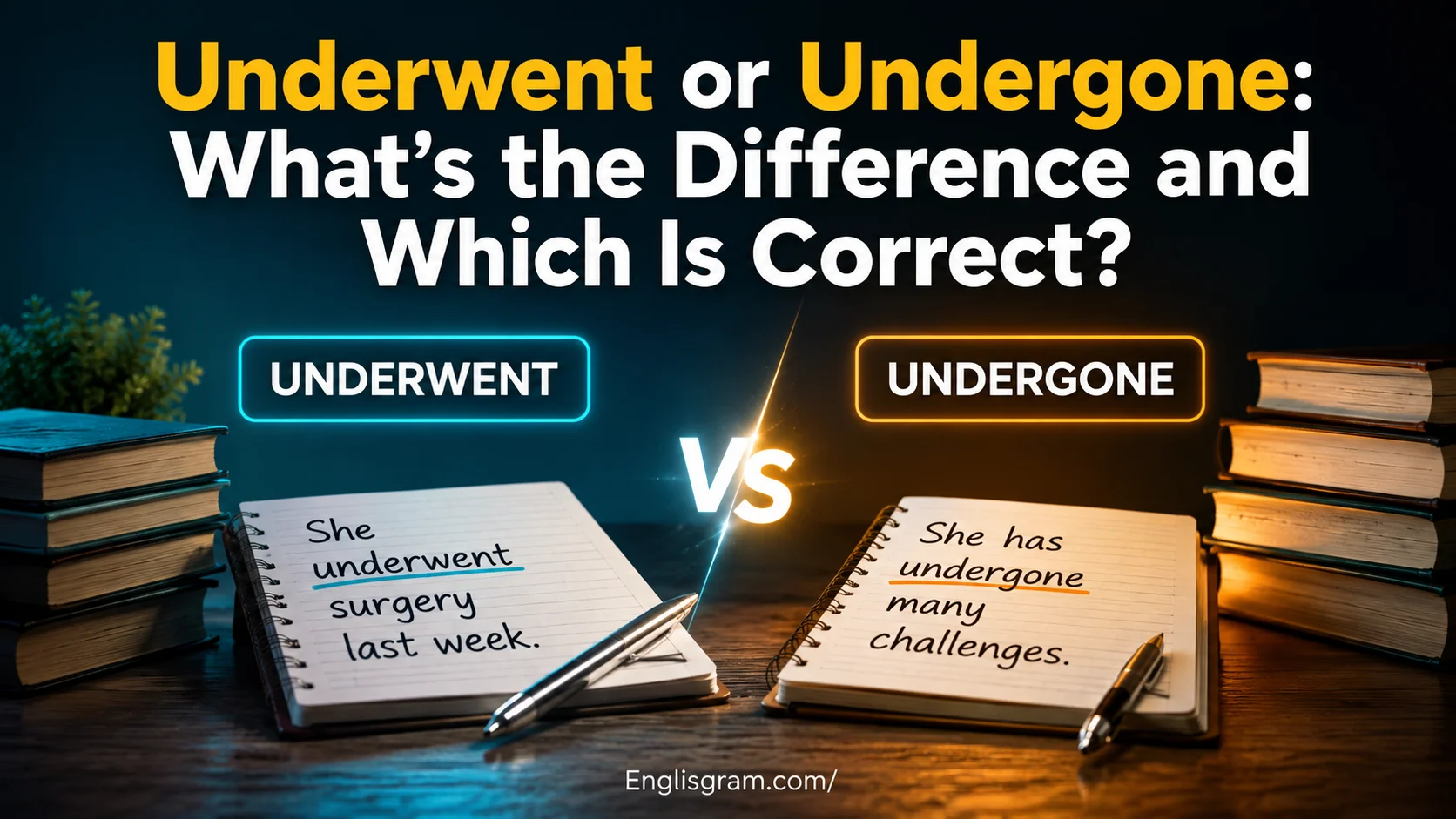
Underwent or Undergone confuses English learners, ESL learners, students, native speakers, fluent speakers, and professional writers because these two words share the same root verb, undergo, but serve different grammatical situations. Underwent is the simple past tense, while undergone is the past participle and needs helping verbs such as have, has, or had, and sometimes been.
In medical reports, academic papers, business emails, news articles, academic essays, and business news, the correct verb form matters because an incorrect choice can become an obvious error in careful writing. For example, She underwent surgery last year describes a completed action in the past, while I have undergone surgery connects a past experience with the present.
If you are paused mid-sentence, wondering which form to write, remember that underwent surgery works for a past action, whereas undergone surgery needs a helping verb. The key distinction becomes easier when you understand that underwent describes something that happened at a specific or understood past time, while undergone describes an experience that relates to another time, often the present.
Quick Answer: Underwent or Undergone?
Underwent and undergone are both correct forms of the verb undergo, but they aren’t interchangeable.
| Word | Verb form | Common structure | Example |
| Underwent | Simple past | Subject + underwent + object | She underwent surgery. |
| Undergone | Past participle | Subject + has/have/had + undergone + object | She has undergone surgery. |
Use underwent when you describe a completed action in the simple past.
The company underwent major changes in 2025.
Use undergone when another verb, such as has, have, or had, creates a perfect tense.
The company has undergone major changes.
A useful memory trick is to compare go with undergo:
- go → went → gone
- undergo → underwent → undergone
You wouldn’t normally say, “She has went home.” You’d say, “She has gone home.” The same grammatical principle applies to undergo.
What Does “Undergo” Mean?
The verb undergo means to experience, endure, or go through something, especially a process, change, treatment, examination, or difficult experience.
It often appears when something happens to a person, organization, object, or system as part of a defined process.
For example:
- A patient may undergo surgery.
- A student may undergo training.
- A building may undergo renovation.
- A company may undergo restructuring.
- A product may undergo testing.
- A system may undergo significant changes.
The word tends to sound somewhat more formal than phrases such as go through or experience. That’s why you’ll often find yourself studying professional and technical writing.
Consider these sentences:
The patient underwent a medical examination.
The patient went through a medical examination.
Both can communicate the basic idea, although the first sounds more formal and concise.
According to Merriam-Webster, undergo means to experience or endure something. Cambridge Dictionary likewise defines it in terms of experiencing something, especially something unpleasant or difficult.
Undergo, Underwent, and Undergone: The Three Main Forms
Understanding the complete verb pattern makes underwent vs. undergone much easier.
| Form | Word | Example |
| Base form | undergo | They may undergo testing. |
| Simple past | underwent | They underwent testing yesterday. |
| Past participle | undergone | They have undergone testing. |
| Present participle | undergoing | They are undergoing testing. |
The important distinction for this article is between underwent and undergone.
Undergo is an irregular verb. Its past forms don’t follow the regular -ed pattern. You don’t say undergoed. Instead, English uses underwent for the simple past and undergone for the past participle.
This pattern follows the structure of the related verb go:
| Verb | Simple past | Past participle |
| go | went | gone |
| undergo | underwent | undergone |
That connection provides a useful shortcut. If you understand why “has went” is incorrect, you already understand the basic reason “has underwent” is incorrect.
When to Use “Underwent”
Use underwent when undergo functions as the main verb in the simple past tense.
The simple past normally presents an action as completed at a definite or understood time in the past.
For example:
Maria underwent surgery last month.
The action happened in the past and is presented as a completed event. The word underwent carries the past tense itself, so you don’t need has, have, or had before it.
Here are more examples:
- The patient underwent treatment last year.
- The company underwent restructuring in 2025.
- The bridge underwent extensive repairs after the storm.
- The students underwent additional training during the summer.
- The software underwent several tests before release.
Notice the time expressions in several examples: last month, last year, in 2025, during the summer, before release. These contexts naturally fit the simple past.
Underwent for Completed Past Actions
The simplest test is to ask whether you’re talking about a completed past event without using a perfect tense.
The athlete underwent surgery in June.
The factory underwent renovations after the fire.
The organization underwent a major transformation in 2024.
In each case, underwent stands on its own as the past-tense verb.
You don’t need to add another auxiliary verb:
She underwent treatment.
Not:
She has underwent treatment.
That second construction requires the past participle, which is undergone.
Read More:Fight Fire With Fire: Meaning, Origin, Examples, and How to Use It
When to Use “Undergone”
Use undergone as the past participle of undergo.
A past participle often works with auxiliary verbs to form perfect tenses. The most common combinations are:
- has undergone
- have undergone
- had undergone
- will have undergone
For example:
The patient has undergone several tests.
Here, has is the helping verb and undergone is the past participle.
You can also use undergone with had:
The patient had undergone surgery before the follow-up appointment.
The phrase had undergone places one past event before another past event.
The word itself doesn’t carry the tense in the same way underwent does. The auxiliary verb helps establish the tense and grammatical construction.
Undergone With Has and Have
Use has undergone with a singular third-person subject.
She has undergone treatment.
The company has undergone major changes.
Use have undergone with plural subjects and with I, you, and we.
They have undergone extensive training.
We have undergone several revisions.
I have undergone a complete evaluation.
The rule is consistent:
has/have + undergone
Not:
has/have + underwent
Has Underwent or Has Undergone?
This is one of the most common questions surrounding this verb.
The correct form is:
She has undergone surgery.
The incorrect form is:
She has underwent surgery.
Why? Because has creates a present-perfect construction, and the present perfect requires the past participle.
For undergo, that past participle is undergone.
The same rule applies to have:
They have undergone extensive training.
And to had:
They had undergone several tests before the procedure.
Here’s the pattern:
| Incorrect | Correct |
| She has underwent surgery. | She has undergone surgery. |
| They have underwent training. | They have undergone training. |
| The company had underwent changes. | The company had undergone changes. |
| He has underwent testing. | He has undergone testing. |
A quick substitution test can help. Replace undergo with go.
She has gone home.
Not:
She has went home.
Likewise:
She has undergone surgery.
Not:
She has underwent surgery.
Underwent vs. Undergone: The Core Grammar Difference
The difference comes down to verb tense and verb form, not meaning.
Underwent is the simple past form.
The company underwent restructuring last year.
Undergone is the past participle.
The company has undergone restructuring.
Both sentences describe restructuring that happened in the past. The grammatical perspective differs.
The first sentence simply reports a completed past event. The second uses the present perfect, which connects a past experience to the present in some way.
Compare these examples:
The hospital underwent renovations in 2024.
The hospital has undergone several renovations.
The first sentence points toward a specific completed past event. The second emphasizes the hospital’s experience up to the present.
That distinction becomes especially useful when you’re writing about changes, experiences, or events that have continuing relevance.
Underwent vs. Undergone in Different Tenses
The following table shows how the two forms work in common constructions.
| Tense | Example | Correct form |
| Simple past | She underwent surgery yesterday. | Underwent |
| Present perfect | She has undergone surgery. | Undergone |
| Present perfect | They have undergone testing. | Undergone |
| Past perfect | She had undergone treatment before the visit. | Undergone |
| Future perfect | She will have undergone treatment by then. | Undergone |
The crucial point is that undergone doesn’t automatically mean “more recent” or “more formal.” Its form depends on the grammar around it.
For instance:
The company underwent a major transformation in 2023.
This is simple past.
The company has undergone a major transformation.
This is present perfect.
The company had undergone a transformation before the merger.
This is past perfect.
The word undergone appears because the sentence uses a perfect construction.
Common Mistakes With Underwent and Undergone
Several errors appear repeatedly because English learners sometimes treat the two forms as interchangeable.
“Has Underwent”
This is incorrect in standard English.
Incorrect:
The patient has underwent surgery.
Correct:
The patient has undergone surgery.
The auxiliary has requires the past participle.
“Have Underwent”
The same problem occurs with have.
Incorrect:
The employees have underwent additional training.
Correct:
The employees have undergone additional training.
The subject changes from singular to plural, but the past participle remains undergone.
“Had Underwent”
Past perfect constructions also require the past participle.
Incorrect:
The company had underwent restructuring before the acquisition.
Correct:
The company had undergone restructuring before the acquisition.
The word had signals the past perfect, so undergone follows it.
“She Undergone Surgery”
This sentence lacks the helping verb needed for the intended perfect construction.
Incorrect:
She undergone surgery.
Depending on the intended meaning, use either:
She underwent surgery.
or:
She has undergone surgery.
The first uses simple past. The second uses present perfect.
Treating the Forms as Synonyms
You can’t simply swap underwent and undergone whenever you want.
The patient underwent surgery yesterday.
Correct.
The patient undergone surgery yesterday.
Incorrect.
However:
The patient has undergone surgery.
Correct.
The surrounding grammar decides which form belongs in the sentence.
Underwent vs. Undergone: Side-by-Side Examples
Seeing the forms next to each other often makes the distinction click.
| Simple past | Perfect construction |
| The team underwent training last summer. | The team has undergone extensive training. |
| The building underwent renovations in 2025. | The building has undergone major renovations. |
| She underwent testing yesterday. | She has undergone several tests. |
| The company underwent restructuring last year. | The company has undergone several changes. |
| The system underwent testing before launch. | The system has undergone extensive testing. |
The left column uses underwent because each sentence uses the simple past.
The right column uses undergone because each sentence contains a perfect auxiliary such as has.
Here’s another useful comparison:
He underwent treatment in March.
This sentence tells you when the treatment occurred.
He has undergone treatment.
This sentence focuses more on his experience or current situation than on a particular past date.
Underwent or Undergone in Professional Writing
This distinction matters in professional communication because errors in verb forms can distract readers from otherwise strong information.
Medical writing provides an obvious example:
The patient underwent surgery on July 10.
A clinical report might instead say:
The patient has undergone several diagnostic procedures.
Both constructions are grammatically sound. The appropriate choice depends on the intended tense and context.
Business writing uses the verb in much the same way:
The company underwent restructuring after the acquisition.
The company has undergone significant organizational changes.
The first sentence refers to a particular past event. The second describes change as part of the company’s experience up to the present.
Resume Example
Resumes frequently use the perfect form when describing completed experiences:
Incorrect: I have underwent extensive leadership training.
Correct: I have undergone extensive leadership training.
However, a resume can also use the simple past:
I underwent extensive leadership training during my first year.
Both can work. The surrounding sentence determines the correct form.
Underwent or Undergone in American English
Both underwent and undergone are standard forms in American English.
This isn’t a spelling difference between American and British English. The distinction is grammatical.
American English uses:
She underwent surgery.
and:
She has undergone surgery.
British English uses the same basic forms.
The important question isn’t which variety of English you’re using. Ask instead whether the sentence requires the simple past or the past participle.
Underwent vs. “Went Through”
The phrase went through can sometimes replace underwent, but the two expressions don’t always produce exactly the same tone.
Compare:
The patient underwent extensive testing.
The patient went through extensive testing.
The second sounds more conversational. The first feels more concise and professional.
Likewise:
The company underwent a major transformation.
The company went through a major transformation.
Both can work, but underwent fits especially well in reports, formal articles, technical documents, and professional summaries.
The choice comes down to more than grammar. Register matters, too. Use the expression that matches your audience and context.
Real-World Examples of “Underwent”
Here are practical examples showing how underwent works in different contexts.
Medical:
The patient underwent surgery last week.
Business:
The company underwent restructuring after the merger.
Construction:
The bridge underwent extensive repairs following the inspection.
Education:
The new employees underwent specialized training.
Technology:
The software underwent rigorous testing before its release.
Manufacturing:
The prototype underwent several safety checks.
In every example, underwent acts as the simple past verb.
Real-World Examples of “Undergone”
Now consider the past participle in perfect constructions.
Medical:
The patient has undergone several tests.
Business:
The organization has undergone significant changes.
Construction:
The building has undergone extensive renovations.
Technology:
The application has undergone several security updates.
Education:
The teachers have undergone additional professional training.
Manufacturing:
The product has undergone multiple quality-control checks.
Each sentence contains an auxiliary verb followed by undergone.
FAQs
Is “underwent” or “undergone” correct?
Both are correct, but they have different grammatical uses. Underwent is the simple past form, while undergone is the past participle.
Can I say “I underwent surgery”?
Yes. I underwent surgery is correct when you’re describing a completed action in the past.
Can I say “I have undergone surgery”?
Yes. I have undergone surgery is also correct. Here, undergone follows the helping verb have.
What is the main difference between “underwent” and “undergone”?
Underwent describes a past action, while undergone is used with helping verbs such as have, has, or had.
Is “I undergone surgery” correct?
No. You need a helping verb: I have undergone surgery.
Conclusion
Understanding Underwent or Undergone becomes simple once you remember their grammatical roles. Underwent is the simple past form used for completed actions in the past, while undergone is the past participle and normally appears with helping verbs such as have, has, or had.For example, “She underwent surgery last year” describes a completed past action, while “She has undergone surgery” connects the experience to the present. Keeping this basic difference in mind will help you avoid common mistakes and make your English clearer, more accurate, and more natural.