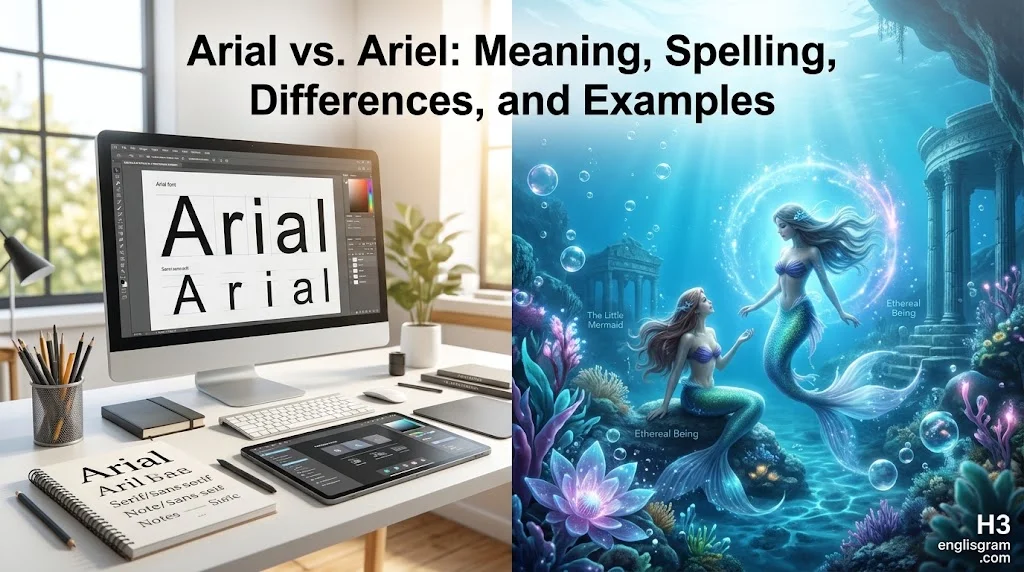
Have you ever typed “Ariel” when you meant the font Arial? You’re not alone. These two words look almost identical, sound similar in many accents, and often cause confusion when people write emails, format documents, or discuss names.
However, Arial and Ariel have different meanings and uses. Arial is a widely recognized sans-serif typeface used in digital documents, presentations, and printed materials. Ariel, on the other hand, is a personal name associated with real people, literary characters, and popular culture.
The difference comes down to a few letters, but using the wrong spelling can change the meaning of your sentence entirely. Imagine asking a colleague to format a report in “Ariel” when you mean Arial. Your colleague might understand the request, but the spelling would still be incorrect.
Arial vs. Ariel: What’s the Difference?
The main difference between Arial vs. Ariel is their meaning. Arial is the name of a typeface, while Ariel is primarily a proper name. Although their spellings are similar, you can’t use them interchangeably.
Arial belongs to typography. You’ll commonly encounter it in word processors, business documents, presentations, websites, and other design projects. Ariel usually refers to a person or character, such as Ariel in Disney’s The Little Mermaid or the spirit in William Shakespeare’s The Tempest.
Here’s a quick comparison:
| Feature | Arial | Ariel |
| Primary meaning | A sans-serif typeface | A personal name |
| Word type | Typeface name | Proper noun |
| Common use | Documents, websites, presentations, and design | People, literature, and entertainment |
| Spelling | A-R-I-A-L | A-R-I-E-L |
| Example | The report uses Arial. | Ariel sent the report. |
| Common confusion | Mistaken for the name Ariel | Mistaken for the font Arial |
The easiest way to remember the distinction is simple: Arial is a font; Ariel is a name.
For example, if someone says, “Please change this document to Arial,” they’re talking about its appearance. If someone says, “Ariel changed the document,” they’re talking about a person.
Context usually makes the intended meaning clear. Nevertheless, correct spelling helps your writing look polished and professional.
What Does Arial Mean?
Arial is a sans-serif typeface designed for clear, practical reading across a wide range of digital and printed applications. It has a straightforward appearance, without the small decorative strokes known as serifs at the ends of letters.
You might recognize Arial from a business report, a school assignment, a presentation, or an online form. Its familiar letter shapes make it a common choice for everyday communication.
Unlike a word that describes an object or action, Arial functions as the proper name of a typeface. You don’t use it to describe a person named Arial unless someone actually has that name.
Arial as a Font and Typeface
To understand Arial, it helps to know the difference between a typeface and a font.
A typeface is a designed family of letterforms. A font refers more specifically to a particular style, weight, or digital implementation of those letterforms. In everyday conversation, however, people often use the two terms interchangeably.
Arial is a typeface family that includes different styles, such as regular, bold, and italic. Each style serves a slightly different purpose while maintaining the same overall design.
For example:
- Arial Regular: Suitable for paragraphs, emails, and everyday documents.
- Arial Bold: Useful for headings, labels, and important statements.
- Arial Italic: Often used for emphasis, titles, or selected phrases.
- Arial Bold Italic: Combines heavier lettering with a slanted style.
Arial belongs to the sans-serif category. The word sans means “without” in French, so sans-serif letters lack the small finishing strokes found in serif typefaces such as Times New Roman.
Compare the two styles in a document. Times New Roman has small strokes at the ends of many letters, while Arial generally looks cleaner and more uniform. Neither style is automatically better for every purpose; the right choice depends on the document, audience, and design.
History and Origin of the Arial Typeface
Arial was designed in 1982 by Robin Nicholas and Patricia Saunders for Monotype. Its development came during a period when digital typography was becoming increasingly important.
The typeface later became especially familiar through its inclusion in Microsoft software. As personal computers, office applications, and digital documents spread, Arial became a regular sight in homes, schools, and workplaces.
Its widespread availability helped establish Arial as one of the best-known sans-serif typefaces. People often encounter it without deliberately choosing it, particularly when opening documents or working with software that offers Arial among its font options.
Arial also shares similarities with Helvetica, another influential sans-serif typeface. Their visual resemblance has contributed to discussions about their design and use. However, they are separate typefaces with differences in letter shapes, spacing, and other details.
Common Uses of Arial
Arial appears in many everyday settings because it offers a practical, familiar design.
Common applications include:
- Business documents: Reports, proposals, letters, and internal memos.
- School assignments: Essays, worksheets, and classroom handouts.
- Presentations: Slides, labels, charts, and supporting text.
- Digital communication: Emails, forms, and interface elements.
- Graphic design: Posters, informational graphics, and simple layouts.
- Printed materials: Notices, instructions, brochures, and other publications.
For example, a company might use Arial for a presentation because its letterforms remain familiar across many devices. A student might choose Arial for an assignment when the instructor permits it.
Still, Arial isn’t the right choice for every situation. A brand may require a custom typeface, while a publication may follow a specific typography guide. Always check the relevant instructions before selecting a font.
Example Sentences Using Arial
The following examples show how to use Arial correctly:
- “Please format the report in Arial.”
- “The presentation uses Arial for its headings.”
- “I changed the document from Times New Roman to Arial.”
- “Arial Bold makes the section titles easier to distinguish.”
- “Choose Arial from the font menu before printing.”
In each sentence, Arial refers to a typeface rather than a person.
Notice that the word remains capitalized because Arial is the name of a specific typeface. Writing “arial” in ordinary prose is not the standard form when referring to the font.
What Does Ariel Mean?
Ariel is primarily a given name. It has Hebrew roots and is traditionally associated with the meaning “lion of God.” The name appears in religious, literary, and cultural contexts, and people use it across different communities.
Unlike Arial, Ariel doesn’t ordinarily refer to a font. When you encounter Ariel in a sentence, the word most often identifies a person, character, or named subject.
For instance, “Ariel works in marketing” refers to someone with that name. Likewise, “Ariel is my favorite character” might refer to a fictional person or character, depending on the conversation.
Ariel as a Personal Name
Ariel comes from Hebrew, where the name is traditionally understood as “lion of God.” Its historical and cultural associations give it meaning beyond its modern use as a first name.
Ariel can be used as a given name for people of different genders. Its gender associations vary by country, language, family tradition, and personal preference.
The name also appears in religious and historical texts. In the Hebrew Bible, Ariel occurs in Isaiah 29, where it is associated with Jerusalem in a passage that uses poetic and symbolic language. The precise interpretation depends on the translation and scholarly context.
In modern life, Ariel may be the name of a classmate, colleague, public figure, fictional character, or family member. Because it is a proper name, capitalization matters.
Consider these examples:
- “Ariel is joining us for dinner.”
- “I received an email from Ariel.”
- “Ariel lives near the university.”
- “The teacher asked Ariel to read the next paragraph.”
In each example, Ariel identifies a person. Replacing it with Arial would normally be a spelling mistake unless the individual intentionally uses that spelling as their name.
Ariel in Literature and Popular Culture
Ariel has become widely recognizable through literature and entertainment. Two especially familiar examples help explain why many people remember the spelling.
Ariel in Shakespeare’s The Tempest
In William Shakespeare’s play The Tempest, Ariel is a spirit who serves Prospero. The character is closely associated with magic, movement, and the events that unfold on the island.
Shakespeare’s Ariel is a literary character, not a reference to typography. The name has remained familiar through stage productions, classroom study, and adaptations of the play.
Ariel in Disney’s The Little Mermaid
Ariel is also the name of the mermaid protagonist in Disney’s The Little Mermaid. The character became widely recognized through Disney’s 1989 animated film and subsequent adaptations.
For many readers and viewers, this character provides an easy memory aid. If you’re thinking of the mermaid, the correct spelling is Ariel, not Arial.
These cultural references also show why context matters. A discussion about Disney characters points toward Ariel, while a conversation about formatting a document points toward Arial.
Example Sentences Using Ariel
Here are several correct examples:
- “Ariel is a character in Disney’s The Little Mermaid.”
- “Ariel appears in Shakespeare’s The Tempest.”
- “Ariel sent the meeting invitation.”
- “My friend Ariel enjoys reading historical novels.”
- “The teacher asked Ariel to explain the character’s role.”
In each sentence, Ariel functions as a proper name. It should begin with a capital letter.
One useful distinction is that names don’t need to describe a person’s occupation or role. Ariel remains Ariel whether the name belongs to a student, an actor, a fictional character, or someone working in graphic design.
Arial vs. Ariel: Key Differences Explained
The spelling difference between Arial and Ariel is small, but their meanings are distinct. Understanding how spelling, grammar, pronunciation, and capitalization work together will help you choose the right word.
Spelling Difference Between Arial and Ariel
The two words contain the same five letters, but the order of the middle vowels differs.
| Word | Letter sequence | Meaning |
| Arial | A-R-I-A-L | A typeface |
| Ariel | A-R-I-E-L | A personal name |
The most useful spelling clue is the fourth letter:
- Arial contains an A after the letter I.
- Ariel contains an E after the letter I.
This small difference changes the word’s identity.
A simple memory trick is to connect the A in Arial with the word appearance. Both refer to the visual presentation of text. For Ariel, remember the mermaid from The Little Mermaid.
These associations aren’t formal linguistic rules. They’re practical reminders that can help you catch a typing mistake.
Pronunciation of Arial and Ariel
Arial and Ariel can sound similar in American English, particularly in casual conversation. However, their pronunciation isn’t necessarily identical for every speaker.
Pronunciation varies with regional accent, speaking speed, and individual habits. Some people pronounce the two words distinctly, while others pronounce them in ways that sound almost the same.
That similarity can create confusion during phone calls, meetings, or verbal instructions. If a colleague says, “Use Arial,” you may need the surrounding context to understand the intended word.
For example, if you’re editing a report and someone asks you to change the font, Arial is the likely choice. If you’re discussing a character from The Little Mermaid, Ariel is the intended spelling.
Don’t rely on pronunciation alone. When spelling matters, confirm the word through context or ask the speaker to clarify.
Capitalization Rules for Arial and Ariel
Both words normally begin with capital letters when used in their standard meanings.
Arial is capitalized because it’s the name of a specific typeface. Ariel is capitalized because personal names and named fictional characters are proper nouns.
Correct examples include:
- “The document uses Arial.”
- “Ariel joined the video call.”
- “I prefer Arial for this presentation.”
- “Ariel is the main character in the story.”
In ordinary prose, lowercase arial is not the standard spelling for the typeface, and lowercase ariel is not the standard form of the personal name.
Capitalization can change in specialized technical contexts, filenames, code, or informal text. Nevertheless, standard written English uses Arial for the typeface and Ariel for the name.
Grammar and Sentence Context
The grammatical role of each word offers another helpful clue.
Arial usually appears in a sentence about formatting, visual design, or text. It may follow verbs such as use, select, change, or format.
Examples:
- “Select Arial from the font list.”
- “The designer uses Arial for body text.”
- “Please change the heading to Arial Bold.”
Ariel commonly appears as the subject or object of a sentence about a person or character.
Examples:
- “Ariel called after the meeting.”
- “We watched Ariel in the film.”
- “The story follows Ariel’s adventures.”
Grammar alone doesn’t guarantee the correct choice, but it provides useful evidence. When combined with meaning and context, it makes the distinction easier to recognize.
Read More: Inside Of vs. Inside: Meaning, Grammar, Differences, and Examples
Is It Arial Font or Ariel Font?
If you’re referring to the familiar typeface used in documents and presentations, Arial font is correct.
“Ariel font” is a common spelling mistake that occurs when someone substitutes the more familiar personal name for the typeface name. Although readers may understand the intended meaning, the wording remains incorrect when Arial is the intended font.
Compare these examples:
| Correct spelling | Incorrect spelling when referring to the typeface |
| Please use Arial font. | Please use Ariel font. |
| The document is written in Arial. | The document is written in Ariel. |
| Select Arial Bold. | Select Ariel Bold. |
| The website uses Arial for body text. | The website uses Ariel for body text. |
How to Choose Arial in a Document
If you’re unsure whether you’ve selected Arial, check the font menu in your word processor or design application.
Follow these steps:
- Open the document.
- Select the text you want to format.
- Locate the font selector in the toolbar.
- Type “Arial” into the font field.
- Select Arial from the available results.
- Review the document to confirm that the intended text uses the correct typeface.
The exact steps depend on your software. In Microsoft Word, for example, the font name appears in the Home tab’s font controls in the standard desktop interface.
This process also helps prevent a practical problem: typing the name incorrectly in written instructions. A font selector identifies the actual typeface, while a sentence requires you to spell its name correctly.
Can Ariel Ever Be a Font Name?
The distinction requires a little care. Arial is the established name of the familiar typeface discussed in this article. However, a separate font, product, or custom design could conceivably use Ariel as its own name.
Therefore, it’s too broad to claim that no font anywhere can ever be called Ariel. The correct rule is more specific: use Arial when referring to the well-known Arial typeface.
If a design application lists a different product named Ariel, check its documentation rather than assuming it refers to Arial.
This distinction keeps the explanation accurate without creating an unnecessary exception to the main rule.
Arial vs. Ariel vs. Aerial
Just when you think you’ve settled the spelling question, another similar word appears: aerial.
Although Arial, Ariel, and aerial look alike, they have different meanings. Learning all three can help you avoid mistakes in writing, editing, and everyday communication.
| Word | Meaning | Example |
| Arial | A sans-serif typeface | The report uses Arial. |
| Ariel | A personal name or named character | Ariel sent a message. |
| Aerial | Related to the air or something viewed from above | We took an aerial photograph. |
What Does Aerial Mean?
Aerial is an adjective that commonly relates to the air, flight, or something positioned or viewed from above. It can also function as a noun in certain contexts.
For example, an aerial photograph shows an area from an elevated viewpoint, often from an aircraft, drone, or another airborne platform. An aerial survey gathers information about land or other features from above.
You’ll also encounter the word in phrases such as:
- Aerial photography
- Aerial view
- Aerial survey
- Aerial transportation
- Aerial roots in botany
Consider this sentence: “The photographer captured an aerial view of the city.” Here, aerial describes the viewpoint. It doesn’t refer to a font or a person.
When to Use Arial
Use Arial when discussing typography or the appearance of written material.
Examples include formatting a resume, selecting a font for a report, changing a website’s typography, or preparing a presentation.
Correct: “Please change the document to Arial.”
Incorrect for the familiar typeface: “Please change the document to Ariel.”
When to Use Ariel
Use Ariel when referring to a person or a character with that name.
For instance, you might write about a friend named Ariel, a character in The Tempest, or Disney’s mermaid protagonist.
Correct: “Ariel is my favorite character in the film.”
Incorrect when referring to the character: “Arial is my favorite character in the film.”
The second sentence would be appropriate only if Arial were genuinely the name of the character being discussed.
When to Use Aerial
Use aerial when discussing air, flight, elevated viewpoints, or related activities.
For example:
- “The company offers aerial photography.”
- “We studied an aerial map of the region.”
- “The drone recorded an aerial view of the coastline.”
The context is usually straightforward. If the sentence concerns a view from above or something in the air, aerial is likely the word you need.
Common Mistakes When Using Arial and Ariel
Even experienced writers make spelling mistakes when two words look nearly identical. Fortunately, most Arial vs. Ariel errors are easy to correct once you understand the context.
Here are the mistakes worth watching for.
Using Ariel Instead of Arial
This is the most common mistake when someone refers to the typeface.
Incorrect: “Please change the report to Ariel.”
Correct: “Please change the report to Arial.”
The correction matters because Arial is the established name of the typeface. If you’re giving instructions to a colleague or preparing a document for a client, using the right spelling keeps your message professional.
Using Arial Instead of Ariel
The reverse mistake happens when someone writes about a person or fictional character.
Incorrect: “Ariel is the mermaid in Disney’s The Little Mermaid.”
Correct: “Ariel is the mermaid in Disney’s The Little Mermaid.”
The two sentences above look identical because the name is already spelled correctly in both. The mistake would occur if you replaced the name with Arial.
Correct: “Ariel is the mermaid in Disney’s The Little Mermaid.”
Incorrect: “Arial is the mermaid in Disney’s The Little Mermaid.”
Always check whether the sentence discusses a typeface or a named character.
Confusing Arial With Aerial
Another common error involves aerial. Unlike Arial, aerial is a regular English word with meanings related to air, flight, or elevated views.
Incorrect: “The photographer captured an Arial view of the coastline.”
Correct: “The photographer captured an aerial view of the coastline.”
This mistake can slip through spell-checking because all three spellings may be valid in other contexts. A spelling checker cannot always determine which word you intended.
Assuming Similar Words Are Interchangeable
Arial, Ariel, and aerial aren’t alternative spellings of one word. Each has its own meaning.
Remember these distinctions:
- Arial: The typeface.
- Ariel: A personal name.
- Aerial: Related to air or a view from above.
When proofreading, look at the meaning of the entire sentence rather than checking the spelling in isolation.
Easy Ways to Remember Arial vs. Ariel
A simple memory trick can prevent repeated spelling mistakes. You don’t need a complicated grammar rule; you just need a clear association for each word.
Use the Font-and-Name Memory Trick
Connect each spelling with something familiar.
- Arial = typeface. Picture a document with a clean, sans-serif design.
- Ariel = name. Think of Ariel from The Little Mermaid.
- Aerial = air. Picture a drone taking photographs from above.
These associations make the three words easier to distinguish, especially when you’re writing quickly.
Check the Context Before Typing
Before choosing Arial or Ariel, ask yourself one simple question: What am I referring to?
If you’re talking about document formatting, the answer is usually Arial. If you’re identifying a person or character, Ariel is likely correct.
For example, consider these sentences:
- “I changed the font to Arial.” The sentence concerns typography.
- “I watched Ariel in the movie.” The sentence identifies a character.
- “I watched an aerial video of the mountains.” The sentence describes a view from above.
The surrounding words provide useful clues. Font, bold, and formatting often appear near Arial, while personal names and character references point toward Ariel.
Use a Proofreading Checklist
If you frequently write about fonts, names, or design, use this quick checklist before publishing.
- Check whether you mean the Arial typeface or a person named Ariel.
- Verify the middle vowel: Arial has A; Ariel has E.
- Confirm that aerial is the intended word when discussing air or elevated views.
- Review the sentence for meaning, not just spelling.
- Check font names against the software’s font menu when necessary.
A few seconds of proofreading can prevent an avoidable error in an email, report, blog post, or presentation.
Real-World Examples: How Context Changes the Meaning
The best way to understand Arial vs. Ariel is to see how the words work in everyday situations.
Example: Formatting a Business Report
Suppose a manager sends you a message asking you to make a report more consistent. The instructions say, “Use Ariel throughout the document.”
You suspect the manager means Arial because the message also mentions font size, headings, and paragraph spacing.
The sensible response is to confirm the intended typeface or select Arial if the surrounding instructions make the meaning clear. The word font provides a strong clue, but confirming an unclear instruction can prevent rework.
Example: Writing About a Movie
Now imagine you’re writing a review of Disney’s The Little Mermaid.
You write, “Arial is one of Disney’s best-known animated characters.”
The sentence contains the wrong spelling because you’re referring to the mermaid named Ariel. Changing the word to Ariel fixes the error.
The difference matters even when readers understand what you mean. Correct names help readers find information and make your writing more trustworthy.
Example: Describing a Photograph
Suppose you’re writing a travel article about a mountain range photographed by a drone.
You write, “The aerial image shows the winding road below.”
Here, aerial is correct because the sentence describes a view from above. Neither Arial nor Ariel would express that meaning.
These examples demonstrate a useful principle: the right spelling depends on the meaning you want to communicate.
Frequently Asked Questions About Arial vs. Ariel
Is Arial or Ariel the correct spelling for the font?
Arial is the correct spelling for the familiar sans-serif typeface used in documents, presentations, and digital design. Ariel is primarily a personal name, so using it when you mean Arial is a spelling mistake.
Is Ariel a real word?
Yes. Ariel is an established personal name with Hebrew roots. It also appears in religious texts, literature, and popular culture. Its traditional interpretation is often given as “lion of God,” although the precise meaning can depend on the historical context.
What is the main difference between Arial and Ariel?
Arial is a typeface, while Ariel is primarily a proper name. You use Arial when discussing typography and Ariel when referring to a person or named character.
Is “Ariel font” ever correct?
Arial is the correct spelling when referring to the well-known Arial typeface. However, another product or custom font could independently use Ariel as its name. Check the specific product if you’re referring to something other than the familiar typeface.
Are Arial and Ariel pronounced the same?
Not necessarily. Their pronunciation can vary by accent and speaker, and some people pronounce them very similarly. When you aren’t sure which word someone means, use the context or ask for clarification.
How do you spell Arial correctly?
Spell it A-R-I-A-L. The fourth letter is A, not E. This is the standard spelling of the typeface name.
What does Ariel mean as a name?
Ariel is a given name with Hebrew origins. It is traditionally associated with “lion of God,” although interpretations can vary with historical and religious context.
What is the difference between Arial and aerial?
Arial is the name of a typeface. Aerial is a word associated with air, flight, or views from above. For example, a document can use Arial font, while a photographer can capture an aerial view of a city.
Should Arial always be capitalized?
When referring to the typeface, use the standard capitalization Arial. Personal names and fictional character names also begin with capital letters, so Ariel is the standard form for the name.
Why do people confuse Arial and Ariel?
The words have similar spellings and can sound alike in conversation. People may also know the name Ariel better than the font name Arial. The best solution is to check the context and remember which spelling belongs to each meaning.
Conclusion: Arial vs. Ariel
The difference between Arial and Ariel is simple once you connect each word with its meaning. Arial is a typeface, Ariel is a personal name, and aerial describes something related to air or a view from above.
Although these words look similar, they aren’t interchangeable. Using the correct spelling helps you communicate clearly in emails, school assignments, business documents, blog posts, and everyday conversations.
Keep this quick reminder in mind:
- Arial: Use it when discussing fonts and typography.
- Ariel: Use it when referring to a person or character with that name.
- Aerial: Use it when discussing air, flight, or elevated views.
When in doubt, read the entire sentence before choosing a spelling. A little attention to context can make all the difference.
FAQs
Is Arial or Ariel the correct spelling for the font?
Arial is the correct spelling for the popular sans-serif typeface used in documents, presentations, and websites.
What does Ariel mean?
Ariel is a personal name of Hebrew origin traditionally associated with the meaning “lion of God.” It is also the name of famous fictional characters.
Are Arial and Ariel pronounced the same?
They can sound very similar, depending on the speaker’s accent and pronunciation. Their meanings and spellings are different.
What is the difference between Arial and aerial?
Arial is a typeface, while aerial describes something related to air, flight, or a view from above.
How can I remember the difference between Arial and Ariel?
Remember this simple rule: Arial = font, Ariel = name, and aerial = air.
Conclusion
Understanding the difference between Arial vs. Ariel is simple once you remember what each word means. Arial is the name of a popular sans-serif font used in documents, presentations, and digital designs. Ariel, on the other hand, is a personal name associated with the meaning “lion of God” and appears in famous works of literature and entertainment.
If you’re choosing a font for your next project, Arial is the correct spelling. Use Ariel when referring to a person or fictional character. Also, don’t confuse either word with aerial, which relates to the air, flight, or views from above.