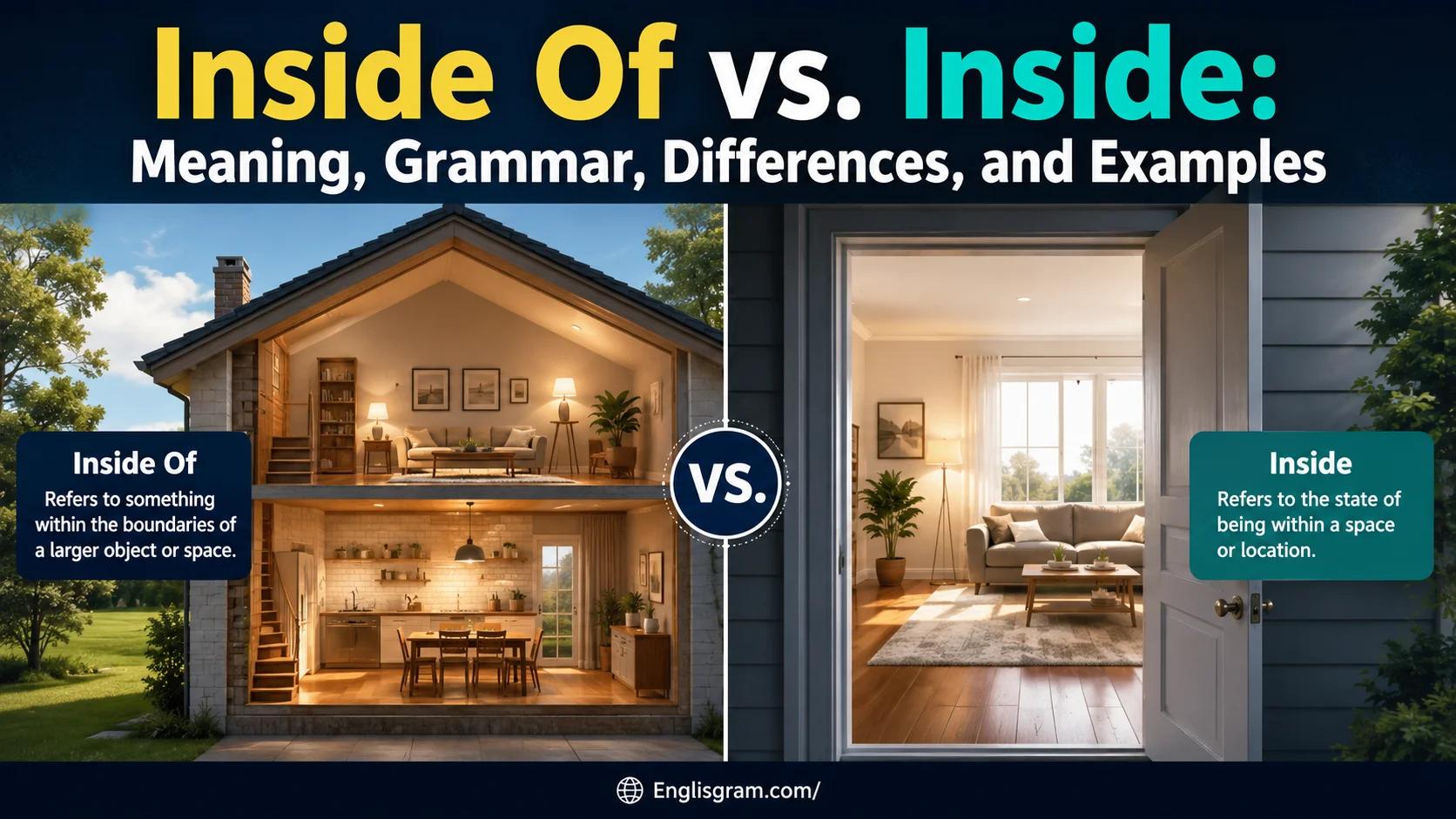
When learners feel confused about Inside Of vs. Inside, they may see the two phrases as similar at first glance. Their usage, tone, and acceptance can vary significantly in modern English, so context matters. In this guide, the basic rules have clear practical applications. Inside usually refers to being within a house, box, location, or place, while Inside of can add emphasis or specify a time frame, such as a period of five minutes.
Inside Of vs. Inside becomes easier when you know the right form for the situation and understand how each expression works in everyday language.Knowing the right form is a useful tool for communicating a feeling clearly. Small details matter because using each form correctly can prevent confusion when a sentence is used in talking, writing, or speaking. Each expression serves a specific purpose, and noticing these subtle differences makes learning easier.
For example, practicing both forms in real conversations can help you become more clear, simple, and direct, especially when trying to communicate naturally like a native speaker.From an English grammar perspective, the meaning of both forms can overlap in many sentences. Choosing the correct phrase often depends on real communication and the writing situations involved.
Inside vs. Inside Of: Quick Difference
The simplest way to understand inside vs. inside of is to look at what each expression does in a sentence.
| Feature | Inside | Inside of |
| Basic meaning | Within or in the interior | Within or in the interior |
| Common in American English | Yes | Yes |
| Works as a preposition | Yes | Yes, as a phrase |
| Works as an adverb | Yes | No |
| Works as a noun | Yes | No |
| Works as an adjective | Yes | No |
| Can stand alone | Yes | Usually no |
| Concise | Usually | Less concise |
| Common in casual speech | Very common | Common in some American speech |
| Formal writing | Usually preferred | Possible, but often unnecessary |
Consider these sentences:
The wallet is inside the bag.
The wallet is inside of the bag.
Both can communicate the same basic location.
Now compare them with:
Come inside.
Here, inside stands alone. You can’t normally say:
Come inside of.
The second sentence feels incomplete because inside of normally needs an object after of, such as the house, the building, or the room.
So the main lesson is simple:
Inside is more versatile. Inside is more restricted.
What Does “Inside” Mean?
Inside refers to a position within the boundaries, limits, or interior of something.
It can describe physical locations:
- inside the house
- inside the car
- inside the box
- inside the room
It can also describe figurative or abstract ideas:
- inside information
- something hidden inside
- feelings deep inside
- the inside story
One reason inside appears so often in English is its grammatical flexibility.
Inside as a Preposition
As a preposition, inside connects an object with the place containing it.
For example:
The documents are inside the folder.
There’s a small compartment inside the cabinet.
We found the missing toy inside the closet.
In each example, inside introduces a noun phrase that identifies the container or location.
The basic pattern is:
inside + noun
Examples:
- inside the house
- inside my backpack
- inside the garage
- inside the envelope
Inside as an Adverb
Inside can also function as an adverb. In this role, it doesn’t need an object immediately after it.
For example:
It’s raining. Let’s stay inside.
The children ran inside.
Please wait inside.
Notice that you don’t need to say what the person entered. The context already makes the meaning clear.
This is one of the biggest differences between inside and inside of.
Inside as a Noun
English can also use inside as a noun to mean the interior part of something.
For example:
The inside of the car was covered in mud.
Clean the inside before using the container.
The first sentence has an especially useful structure:
the inside of + noun
Here, inside itself acts as the noun. The word connects that noun to the thing whose interior you’re describing.
That makes this construction different from the inside of used as a prepositional phrase.
Compare:
The dog is inside of the house.
with:
The inside of the house needs painting.
Although the words look similar, their grammatical structures differ.
Inside as an Adjective
Inside can also modify a noun.
Examples include:
Put the papers in the inside pocket.
The inside lane is moving faster.
Check the inside cover of the book.
Here, inside tells you which part, lane, pocket, or cover you’re talking about.
Read More: In the Morning or On the Morning? The Correct Phrase Explained
What Does “Inside Of” Mean?
Inside of generally means within the interior of something.
For example:
The keys are inside of the drawer.
She left her phone inside of the car.
There was a note inside of the envelope.
In these sentences, inside of functions as a prepositional expression.
The common pattern is:
inside of + noun phrase
For example:
- inside of the house
- inside of the box
- inside of the building
- inside of my office
The phrase occurs regularly in American English, particularly in casual speech.
However, that doesn’t mean you must use it whenever you’re describing an interior location. In many cases, inside works just as well and sounds more concise.
Is “Inside Of” Grammatically Correct?
Yes. Inside of is not automatically grammatically wrong.
This point matters because some grammar discussions treat inside of as though it were always an error. That’s too broad.
Major English dictionaries recognize inside and document its use in constructions involving inside of. For example, Merriam-Webster’s entry for “inside” covers the word’s different grammatical uses.
The Cambridge Dictionary also identifies inside as a preposition, adverb, noun, and adjective.
The real question isn’t simply:
“Is inside of correct?”
A better question is:
“Does inside of fit this particular sentence and style?”
For casual American conversation, it can sound perfectly natural:
“Your shoes are inside of the closet.”
For concise formal writing, many editors would prefer:
“Your shoes are inside the closet.”
Neither sentence needs to change the basic meaning.
Inside Of vs. Inside: Key Differences
The two forms overlap considerably, but their grammatical flexibility creates important differences.
Inside Has More Grammatical Jobs
You can use inside in several ways:
Come inside. — adverb
The cat is inside the house. — preposition
The inside of the box is wet. — noun
Use the inside pocket. — adjective
By contrast, inside of generally works as a prepositional phrase.
That makes inside the more versatile choice.
Inside Can Stand Alone
This is perhaps the easiest practical test.
Come inside.
Go inside.
Stay inside.
What’s inside?
These sentences work naturally because inside can function independently.
You can’t normally replace those examples with inside of:
Come inside of.
Go inside of.
Stay inside of.
The phrase needs an object:
Go inside of the building.
Even then, going inside the building is generally cleaner.
When Should You Use “Inside”?
Use “Inside” as a Standalone Word
When you don’t need to name the location, inside is the natural choice.
Examples:
It’s cold outside. Come inside.
The dog is inside.
I left my umbrella inside.
Everyone went inside when it started raining.
Adding of doesn’t work because there is no noun after it.
Use “Inside” for Concise Writing
When inside and inside of mean the same thing, the shorter form often creates a cleaner sentence.
Compare:
The receipt is inside the envelope.
The receipt is inside of the envelope.
The second version isn’t necessarily ungrammatical. It simply uses an extra word without adding much meaning.
In professional writing, that distinction can matter. Business documents, instructions, academic prose, and technical material often benefit from direct wording.
For example:
Store the device inside the protective case.
is tighter than:
Store the device inside of the protective case.
Good writing doesn’t remove words simply because they’re long. It removes words that don’t earn their place.
Use “Inside” in Different Grammatical Roles
Another reason to favor inside is its versatility.
Consider these examples:
| Grammatical role | Example |
| Preposition | The money is inside the wallet. |
| Adverb | Please come inside. |
| Noun | The inside is damaged. |
| Adjective | Use the inside pocket. |
That flexibility makes the inside useful in almost every type of English writing.
When Should You Use “Inside Of”?
Use “Inside Of” in Natural American Conversation
Inside occurs naturally in some forms of American speech.
For example:
“I left my keys inside of the car.”
“There’s something inside of this box.”
“She was waiting inside of the restaurant.”
A speaker may choose the longer phrase without consciously making a grammatical decision. Speech often contains forms that are more expansive than polished written prose.
That’s normal.
Language isn’t always built like a spreadsheet. People choose expressions based on rhythm, habit, emphasis, and regional speech patterns.
Use “Inside Of” When the Full Phrase Sounds Natural
If you’re writing dialogue, reproducing casual speech, or intentionally using a conversational American voice, inside of may fit the tone.
For example:
“I swear I put the receipt inside of that drawer.”
That can sound more like ordinary conversation than an edited sentence such as:
“I swear I put the receipt inside that drawer.”
Both work. The choice depends partly on voice and context.
Don’t Assume “Inside Of” Is Always Better for Emphasis
It’s tempting to think inside of adds emphasis to inside. Usually, it doesn’t create a major difference in meaning.
Compare:
There was a letter inside the box.
There was a letter inside of the box.
The location remains essentially the same.
If you want emphasis, English has clearer options:
There was a letter deep inside the box.
There was a letter hidden inside the box.
Those changes add information. Simply adding of usually doesn’t.
Inside vs. Inside Of in American English
The expression inside of has a recognizable place in American English.
You may hear it in everyday conversations, regional speech, informal writing, and dialogue. It isn’t unusual for an American speaker to say:
“It’s inside of the garage.”
At the same time, inside the garage is extremely common and often more concise.
This creates an important distinction between usage and style.
A phrase can occur naturally in real speech while still being less desirable in a particular type of edited writing.
Everyday American Examples
“Your jacket is inside the closet.”
“Your jacket is inside of the closet.”
Both may appear in conversation.
However:
“Place the sample inside the container.”
is usually a better choice for an instruction manual than:
“Place the sample inside of the container.”
The second version isn’t suddenly meaningless or universally ungrammatical. It’s simply less economical.
Inside vs. Inside Of in British English
Inside is firmly established in British English.
For example:
“The children are inside the house.”
“Come inside.”
“She left her bag inside.”
Inside of can occur in English outside the United States, but it isn’t as broadly characteristic of standard British usage as inside.
Regional variation matters here.
English isn’t one single fixed system spoken identically everywhere. American English, British English, Canadian English, Australian English, and other varieties can favor different constructions.
For general international writing, inside is usually the safer and more concise choice.
Inside Of vs. Inside in Formal and Informal Writing
The context changes the best choice.
Formal Writing
In formal writing, inside often works better when the two versions communicate the same idea.
Instead of:
Keep the medication inside of the cabinet.
Prefer:
Keep the medication inside the cabinet.
Instead of:
The files are stored inside of the database.
Prefer:
The files are stored inside the database.
The shorter form keeps the sentence moving.
Informal Writing
Casual writing allows more flexibility.
A text message might say:
“It’s inside of my bag lol.”
A polished version could say:
“It’s inside my bag.”
The first isn’t necessarily a grammar disaster. It simply has a more conversational feel.
Writing Dialogue
Dialogue is different because natural speech matters.
If a character normally uses inside of, removing it from every line could make their speech sound artificially polished.
For example:
“I know I put it inside of the drawer.”
That may work well when the goal is realistic dialogue.
Inside Of vs. Inside: Cases Where They Aren’t Interchangeable
This is where many quick grammar guides fall short.
The two expressions overlap when inside acts as a preposition. They don’t overlap in every grammatical role.
“Come Inside” vs. “Come Inside Of”
Consider:
Come inside.
This is complete.
Now:
Come inside of.
This feels unfinished.
Why?
Because inside can operate as an adverb without an object. Inside of normally needs an object after of.
For example:
Come inside the house.
Come inside of the house.
Now both expressions have a noun phrase following them.
“The Inside of the Box”
This is another important construction.
The inside of the box is dirty.
Here, inside functions as a noun.
The structure is:
the inside + of + noun
That differs from:
The toy is inside of the box.
Here, inside of functions as a prepositional phrase.
The wording looks similar, but the grammar isn’t identical.
This distinction helps explain why inside of isn’t simply a two-word replacement for every use of inside.
Fixed Expressions
Some expressions are naturally use inside.
For example:
- inside information
- inside knowledge
- inside story
- inside job
- inside track
- inside lane
- inside pocket
You wouldn’t normally replace these with inside of.
For example:
She had inside information about the deal.
Not:
She had inside information about the deal.
The same principle applies to many established combinations. Grammar isn’t just about individual words. Common word pairings also shape what sounds natural.
FAQs
Is “inside of” grammatically correct?
Yes. Inside is grammatically acceptable, especially in American English and everyday conversation. However, inside is often shorter and more natural in formal writing.
What is the difference between “inside” and “inside of”?
Both can describe something located within a particular space. For example, “The keys are inside the drawer” and “The keys are inside of the drawer” have essentially the same meaning. Inside can sound more conversational or emphatic.
Is “inside” better than “inside of”?
Not always. Inside is usually preferred when you want a concise, direct sentence, especially in formal writing. Inside can still work naturally in casual speech.
Can “inside” be used as different parts of speech?
Yes. Inside can function as a preposition, adverb, noun, or adjective. Its grammatical role depends on how it appears in the sentence.
Is “inside of” common in American English?
Yes. Inside appears regularly in American English, particularly in everyday conversation. Its frequency and naturalness can vary by context and region.
Conclusion
The difference between inside and inside of is usually simple once you understand their grammar, context, and tone. Both can describe something within a particular place, but inside is often shorter and more suitable for formal writing. Inside can sound natural in casual conversation or add emphasis. When choosing between them, focus on the sentence, audience, and communication situation rather than memorizing a complicated rule.