Fiancé vs Fiancée shows confusion in engagement terms today as you learn usage meaning and difference in simple English writing guide.In Fiancé, Fiancée, people, often, face, confusion, today, small, engagement, terms, vs, Difference. I still, remember When a friend, once, asked, about, correct, spelling, my, memory, learning, kicked, in. That moment, of, curiosity, led, me, to, dig, into, words, that, are, borrowed, shaped, from, French, Latin, and, English, blend, studies, carrying, roots, like, fidare, and, a, long, journey, through, language, history.
In Understanding, language, we, notice, how, Language, shapes, communication, storytelling, and, emotional, expression. Whether, you, are, improving, writing, skills, or, exploring, creative, techniques, understanding, word, choice, is, essential. Small, spelling, differences, can, completely, change, meaning, tone, and, accuracy. One, common, example, is, the, confusion, between, Fiancé, and, Fiancée, where, Writers, students, and, learners, often, struggle, with, these, French-origin, words, because, they, look, almost, identical.
What Does Fiancé vs Fiancée Mean? Simple Definition Guide
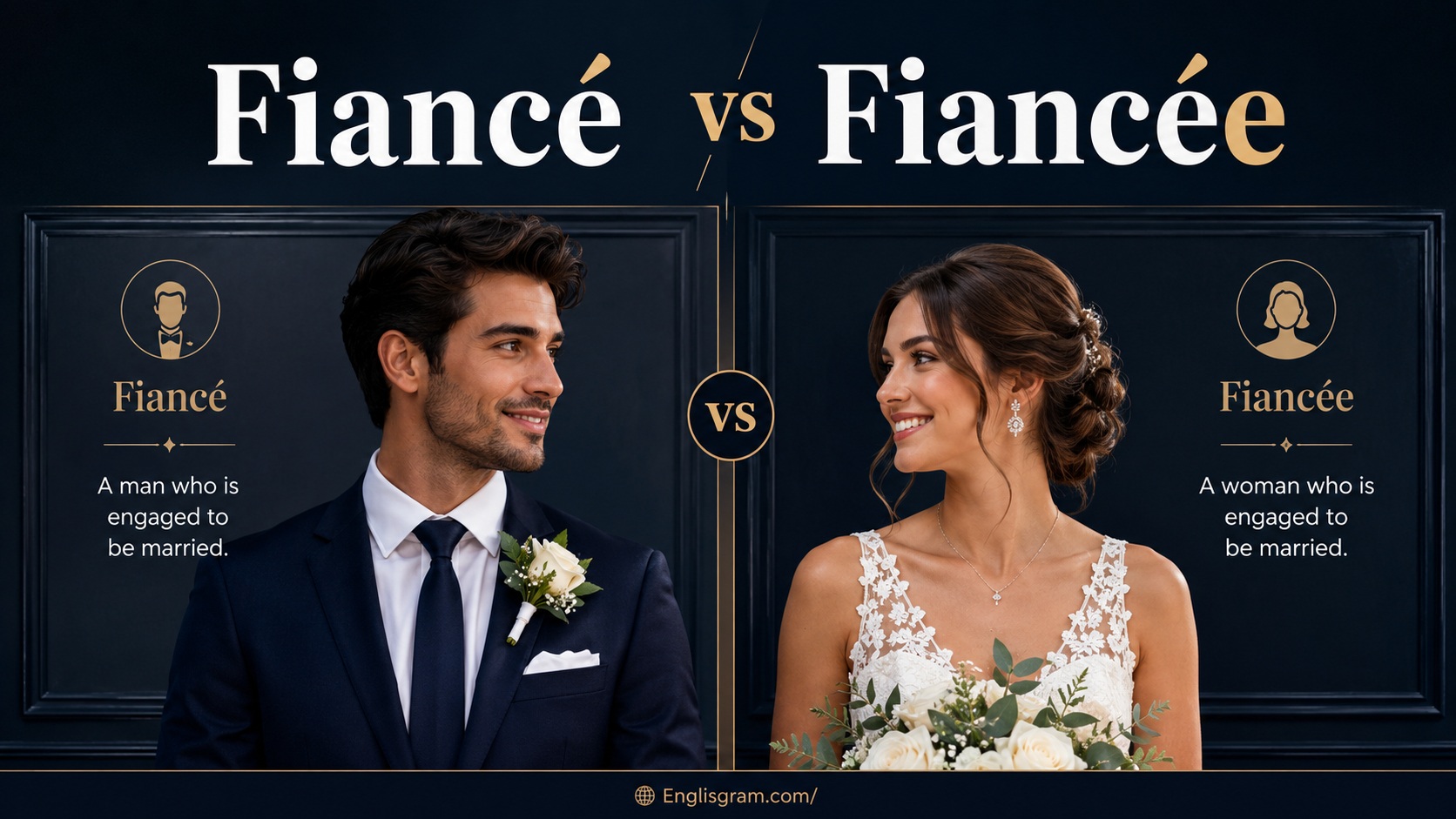
The difference between fiancé vs fiancée comes down to one thing: gender.
- Fiancé → an engaged man
- Fiancée → an engaged woman
That’s it at the core level. Both words refer to someone promised in marriage.
Quick comparison table
| Word | Meaning | Gender | Language Origin |
| Fiancé | Engaged man | Male | French |
| Fiancée | Engaged woman | Female | French |
Even though English uses many gender-neutral terms today, this pair still keeps its original distinction from French.
Fiancé vs Fiancée Origin: The Real Language Story
To understand these words properly, you need to go back to French roots. English didn’t invent them. It borrowed them.
The base verb is “fiancer”, which means to promise in marriage.
From there:
- Fiancé = promised (male form)
- Fiancée = promised (female form)
French is a gendered language. That means most nouns change depending on masculine or feminine form. English borrowed both versions instead of simplifying them into one.
Why English adopted them unchanged
English absorbed thousands of French words after the Norman Conquest in 1066. Words related to law, fashion, and relationships often stayed close to their French spelling.
So instead of rewriting the term, English kept both forms:
- It preserved prestige
- It kept social distinction
- It matched educated writing styles of the time
Why English Still Keeps Fiancé vs Fiancée Gendered
You might wonder why English didn’t simplify it later.
Here’s the truth: tradition won.
Even though English is mostly gender-neutral today, certain borrowed words stayed untouched. “Fiancé vs fiancée” survived because:
- It is widely understood in both forms
- It appears in formal writing
- It carries cultural and romantic tone
- It connects directly to French etiquette traditions
However, modern writing trends are slowly shifting toward simplification.
Timeline: How Fiancé vs Fiancée Entered English
Let’s break down the journey in a simple timeline:
- 12th–15th century: French heavily influences English vocabulary
- 17th century: “Fiancé” begins appearing in English literature
- 18th century: “Fiancée” becomes more common in romantic writing
- 19th century: Both forms stabilize in dictionaries
- 20th century: Usage becomes standard in formal English
- 21st century: Informal writing drops accents more often
Key fact:
Both words have been used in English for over 200 years in documented literature.
Modern Usage of Fiancé vs Fiancée Today
In today’s world, the distinction still exists but people don’t always follow strict rules.
Current real-world trends:
- Many writers drop accents entirely → “fiance”
- Social media uses simplified spelling
- Formal publications still prefer accents
- Gender-neutral terms are growing
Example usage:
- “My fiancé and I are planning a wedding.”
- “Her fiancée moved in last month.”
- “They met their fiance at college.” (informal simplified usage)
Even when accents disappear, context usually makes meaning clear.
Read More:In the Same Day or On the Same Day? A Complete Grammar Guide
Why Many People Drop Accent Marks in Fiancé vs Fiancée
You’ll often see:
- fiancé → fiance
- fiancée → fiancee
Why does this happen?
Main reasons:
- Keyboards don’t include accents easily
- Mobile typing feels faster without them
- Many English speakers ignore French grammar rules
- Social media prioritizes speed over accuracy
Important note:
Dropping accents is acceptable in informal writing. However, formal documents still prefer correct spelling.
Pronunciation Guide: Fiancé vs Fiancée Made Easy
Here’s something surprising:
Both words are pronounced almost the same in English.
Standard pronunciation:
- Fiancé → fee-ahn-SAY
- Fiancée → fee-ahn-SAY
The final sound is identical in most English accents.
Why this happens:
English simplifies pronunciation when borrowing foreign words. Even though French distinguishes endings, English speakers usually don’t.
Common mistake:
Many people try to pronounce fiancée differently. In reality, most native speakers don’t.
Memory Tricks to Remember Fiancé vs Fiancée
You don’t need complex rules. Just use simple memory hooks.
Easy tricks:
- “E = Extra female” → fiancée has an extra “e” for woman
- “Man ends early” → fiancé has a shorter ending
- Think: ‘she gets the extra letter’
- Associate “ee” sound with feminine form
Example shortcut:
If it feels “longer,” it usually refers to female form.
Real Examples of Fiancé vs Fiancée in Sentences
Let’s make this crystal clear with real usage.
Correct examples:
- “My fiancé surprised me with a proposal.”
- “Her fiancée planned a destination wedding.”
- “The couple met their fiancés at university.” (plural informal use)
Incorrect usage:
- ❌ “My fiancée is a man.”
- ❌ “Her fiancé is a woman.”
Context rule:
Even if spelling gets messy, meaning stays clear in conversation.
Gender-Neutral Alternatives to Fiancé vs Fiancée
Modern English often avoids gendered terms. That’s where alternatives come in.
Common alternatives:
- Partner
- Engaged partner
- Future spouse
- Significant other
- Life partner
Comparison table:
| Term | Formality | Gender Neutral | Usage |
| Fiancé/Fiancée | High | No | Traditional writing |
| Partner | Medium | Yes | Everyday speech |
| Future spouse | High | Yes | Formal/legal tone |
Example:
Instead of saying:
“My fiancé is arriving tomorrow.”
You can say:
“My partner is arriving tomorrow.”
Where Gender-Neutral Terms Work Best
Not every situation needs traditional words.
Best places to use neutral terms:
- Workplace communication
- Inclusive writing
- Social media bios
- International audiences
Where traditional terms still dominate:
- Wedding invitations
- Formal announcements
- Legal paperwork
- News articles
Situational Usage: When Fiancé vs Fiancée Matters Most
Let’s break down real-world situations where the distinction actually counts.
Wedding Invitations
This is where tradition still rules.
Example:
“Together with their families, Emma and her fiancé invite you…”
Why it matters:
- Keeps formal tone intact
- Matches wedding etiquette
- Avoids confusion in printed materials
Newspaper Announcements
Public announcements still prefer accuracy.
Example:
“John Smith, fiancé of Laura Jones, announced engagement plans…”
Why:
- Editorial standards require clarity
- Readers expect precision
Legal and Immigration Documents
Here accuracy becomes critical.
- Fiancé/fiancée may appear in visa applications
- Relationship status must be clear
- Mistakes can create confusion in documentation
Example:
A visa form might ask:
“Are you engaged? If yes, provide fiancé/fiancée details.”
Professional Writing
In business or formal writing:
- Neutral terms are preferred
- “Partner” often replaces both words
- Gender clarity is less important
Social Media Posts
This is the most flexible space.
You’ll see:
- fiancé
- fiance
- partner
- emojis replacing words entirely
Example:
“Got engaged 💍 my fiancé said yes!”
Common Mistakes with Fiancé vs Fiancée
Even fluent writers mess this up.
Frequent errors:
- Using fiancé for both genders
- Forgetting accent marks in formal writing
- Mixing spelling styles in one document
- Overthinking pronunciation differences
Quick fix rule:
If unsure, check gender or switch to “partner.”
Decision Chart: Choosing Fiancé vs Fiancée Instantly
Use this simple decision guide:
| Question | If YES | If NO |
| Is it a man? | Use fiancé | Move next step |
| Is it a woman? | Use fiancée | Use neutral term |
| Is it formal writing? | Keep accents | Simplify if informal |
| Do you want neutrality? | Use partner | Stick to traditional form |
FAQs
Q1: What is the main difference between fiancé and fiancée?
The difference is gender. Fiancé refers to a man who is engaged, while fiancée refers to a woman who is engaged.
Q2: Why do these words look so similar?
They come from French, and English borrowed them. That’s why they share the same spelling pattern with a small change.
Q3: Do people still use fiancé and fiancée today?
Yes, but many modern speakers sometimes avoid them because English often prefers simpler or gender-neutral terms.
Q4: What happens if I use the wrong one?
It can cause confusion or look like a small grammatical mistake, especially in formal writing.
Q5: Are they used only in formal writing?
Mostly yes, but you can still see them in books, wedding announcements, and literature.
Conclusion
Understanding fiancé vs fiancée helps you write with more clarity and avoid simple mistakes. These words may look small, but they carry a clear language difference shaped by French origin and English usage over time. Once you remember the gender rule, you can use them correctly in everyday writing without hesitation.