No Thank You or No, Thank You helps you understand comma use in plain English with clear examples for better writing every day.If you have ever paused and wondered which version to choose, you are not alone. This guide breaks down the answer in plain English. The difference is not about right or wrong. It is about tone, rhythm, emphasis, and the small change a comma can make. In many cases, the comma after thank you, or where the comma belongs, depends on the context, sentence, and wording.
This tiny comma creates a natural pause, improves clarity, helps readers understand the message, and reduces confusion. When you read aloud, one version sounds quicker, while another feels more deliberate and polite.From my editing experience, I often see a kid, parents, teachers, adults, and even an adult professional asking the same question in emails, an email, letters, a letter, texts, dialogue, or a speech.
Whether the phrase is used as a response, a polite refusal, or another expression, following writing rules, punctuation, every punctuation mark, punctuation rules, and proper spacing makes the meaning much clearer in both formal writing and informal writing.The best way to learn is to apply these ideas every time you write. Notice the changes in tone, expression, and meaning instead of memorising rules.
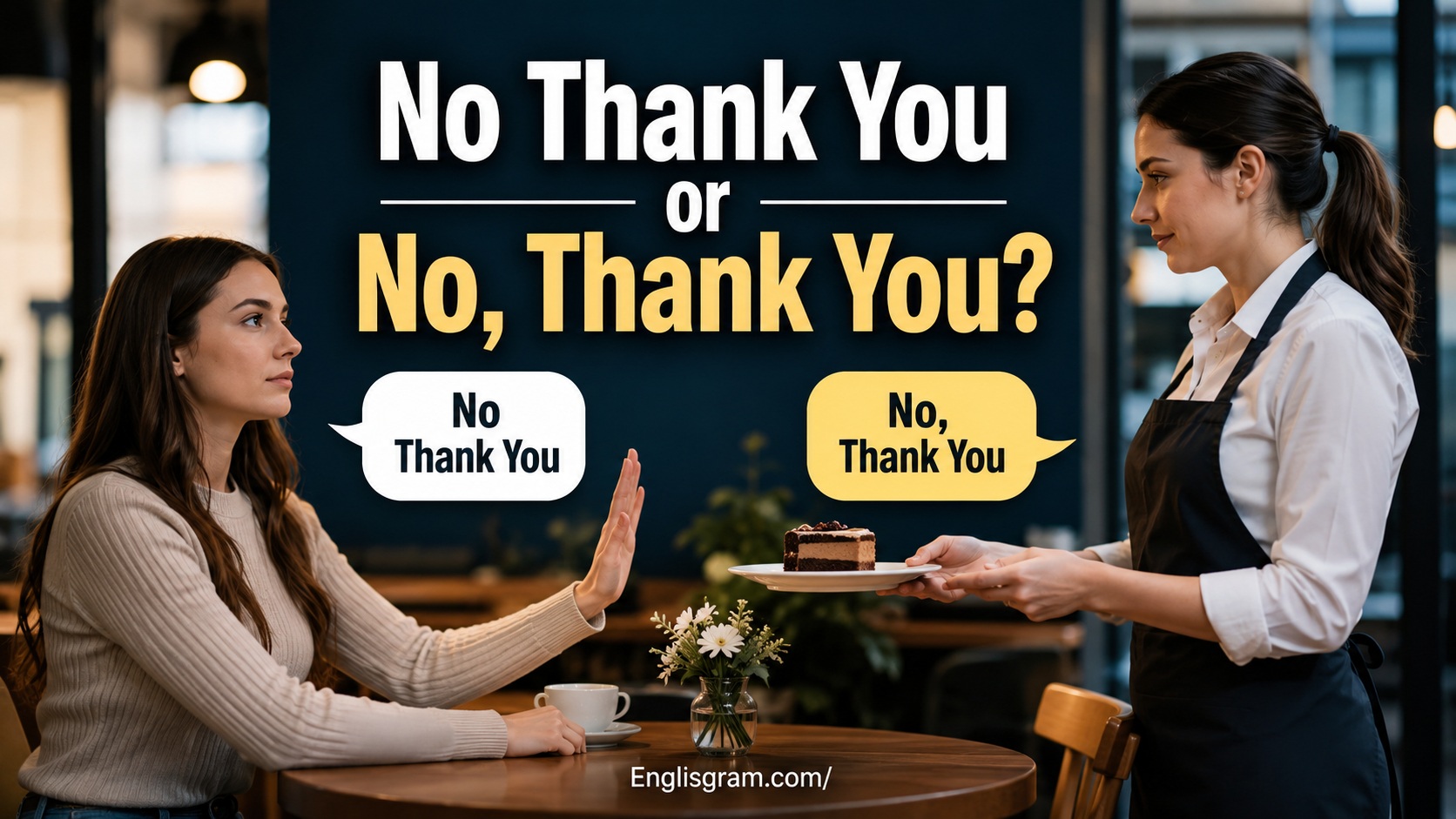
No Thank You or No, Thank You? The Short Answer
The short answer is simple:
- “No thank you” is acceptable in casual writing and everyday conversation.
- “No, thank you” is also correct and often sounds a little more polite or natural in edited writing.
The comma does not change the basic meaning. It changes the pause.
Think of it like speech. When you say “No, thank you,” your voice usually dips after no. That pause makes the refusal feel more courteous or thoughtful. When you say “No thank you,” the phrase can sound a bit more compact and direct.
Both are fine. The best choice depends on the effect you want.
What Does “No Thank You” Mean?
The phrase “No thank you” is a polite refusal. It means you are turning something down while still being courteous.
You might use it when someone offers you:
- food
- a drink
- help
- an invitation
- a product or service
- extra attention you do not want
For example:
- “Would you like dessert?”
“No thank you.” - “Can I carry that for you?”
“No thank you.” - “Do you want to join us?”
“No thank you.”
The phrase is short, clear, and polite. It works well in daily conversation because it avoids sounding rude or cold.
What Does “No, Thank You” Mean?
“No, thank you” means the same thing, but the comma adds a small pause after no.
That pause matters. It makes the phrase sound more like a spoken reply. It also creates a little breathing room between the refusal and the politeness marker.
This version often feels:
- more deliberate
- more courteous
- more natural in formal dialogue
- slightly softer in tone
Example:
- “Would you like more coffee?”
“No, thank you.”
Here, the comma helps the sentence sound like a real person speaking. The refusal comes first. The politeness follows.
Does the Comma Change the Meaning?
Not really. The comma changes the delivery, not the core message.
That is the key point.
The phrase means the same thing in both forms. You are still refusing politely. However, punctuation changes how readers hear it in their heads. That is why English punctuation often feels more like music than math. A small mark can shift the rhythm.
Compare the two
| Form | What it sounds like | Typical tone |
| No thank you | Quick and compact | Casual, neutral |
| No, thank you | Slight pause after “no” | Softer, more polite |
In other words, the comma does not rewrite the meaning. It simply helps the line land differently.
Why the Comma Feels Natural in “No, Thank You”
English often uses commas to show a pause after an introductory word or short phrase. In this case, no can act like a small standalone response. The comma gives it room.
Read these aloud:
- “No thank you.”
- “No, thank you.”
Most speakers naturally pause after no in the second version. That pause makes the phrase sound more conversational. It feels like a human response rather than a clipped phrase on a page.
This is one reason many editors prefer the comma in polished writing. It mirrors spoken English more closely.
When Should You Use “No, Thank You”?
Use the comma when you want the phrase to sound natural, courteous, or formal enough for edited writing.
Good situations for the comma
- Polite refusals
- Business emails
- Customer service replies
- Dialogue in fiction
- Professional communication
- Any sentence where the pause sounds right when spoken aloud
For example:
- “Would you like me to schedule that call?”
“No, thank you.” - “Would you like another copy?”
“No, thank you.” - “Can I interest you in an upgrade?”
“No, thank you.”
The comma helps the sentence feel smooth. It also avoids the slightly abrupt feel that can happen when the phrase is written too tightly.
Read More:The Latter Two: Meaning, Grammar, Usage, and Clear Examples
When Can You Use “No Thank You”?
You can leave out the comma when the phrase appears in casual writing or when brevity matters more than punctuation style.
Good situations without the comma
- text messages
- quick replies
- informal chat
- notes
- marketing copy with a conversational style
Examples:
- “No thank you, I’m fine.”
- “No thank you.”
- “No thank you, I already ate.”
In fast-moving digital writing, people often skip punctuation that they would include in edited prose. That is normal. It is also one reason you will see both forms widely used online.
A Simple Grammar Rule You Can Remember
Here is the easiest rule:
If “no” feels like a separate spoken response, the comma usually makes sense.
That means:
- No, thank you sounds like a spoken, polite refusal.
- No thank you sounds tighter and a little less paused.
This is not a rigid law. It is a style choice. But it is a very useful one.
No Thank You vs No, Thank You in Real Sentences
Let’s look at more examples side by side.
| Situation | Without comma | With comma |
| Offered tea | No thank you. | No, thank you. |
| Declining a favour | No thank you, I can manage. | No, thank you. I can manage. |
| Turning down an invite | No thank you. Maybe next time. | No, thank you. Maybe next time. |
| Responding in dialogue | No thank you, I’m full. | No, thank you. I’m full. |
Notice how the comma version usually sounds a little more balanced. It gives the reader time to process the refusal before the rest of the sentence continues.
The Grammar Behind the Comma
The comma in “No, thank you” is often explained as a punctuation mark that separates a brief introductory word from the rest of the phrase.
In plain terms, no can stand on its own as a response. Then thank you follows as a polite addition. The comma shows that break.
This is similar to how commas work in these kinds of expressions:
- “Yes, please.”
- “Well, I’m not sure.”
- “Actually, no.”
- “No, sir.”
- “Yes, ma’am.”
These are all short spoken responses. In writing, commas help them feel natural and clear.
Is “No, Thank You” More Polite?
Often, yes. At least, it can sound a little softer.
That does not mean “No thank you” is rude. It is not. But the comma version usually feels more like a face-to-face response. It sounds as though someone paused briefly before answering.
Tone comparison
- No thank you — brisk, simple, direct
- No, thank you — warm, measured, polite
This difference is subtle. Still, subtle differences matter in communication.
For example, if someone offers you something in a formal setting, “No, thank you” may feel more suitable. If you are texting a friend while rushing between tasks, “No thank you” may feel perfectly fine.
Examples in Everyday Conversation
The phrase shows up everywhere in spoken English.
At a café
“Would you like sugar?”
“No, thank you.”
At a dinner table
“Would you like another slice?”
“No, thank you. I’m full.”
At work
“Would you like me to print this for you?”
“No, thank you. I have it already.”
At a store
“Would you like a bag?”
“No, thank you.”
At a school event
“Would you like to volunteer?”
“No, thank you.”
These examples show the phrase doing the same job in different settings. It declines politely without creating tension.
Examples in Professional Writing
In professional communication, punctuation often matters a bit more because tone can be harder to read.
Email example
Subject: Meeting materials
Dear Jordan,
Thank you for sending the file. I have reviewed it.
No, thank you. I do not need the printed copy.
Best,
Maya
Here, the comma helps the sentence feel professional and natural.
Customer support example
“Would you like to add premium support to your plan?”
“No, thank you.”
This version sounds polite and clean. It is easy to read and unlikely to feel blunt.
Workplace chat example
“Do you want me to forward the report?”
“No thank you, I already sent it.”
This works too. In a relaxed internal chat, many people would drop the comma.
Examples in Creative Writing
Dialogue is one of the best places to see punctuation at work. Writers use commas to capture the rhythm of real speech.
Dialogue without comma
“No thank you,” she said, stepping back.
Dialogue with comma
“No, thank you,” she said, stepping back.
The second version usually reads more naturally. It reflects the small pause that often happens in speech.
That is why fiction editors often prefer the comma in dialogue when the line sounds like a clear refusal.
Common Mistakes People Make
Even though this phrase is simple, a few mistakes come up often.
Using a hyphen
Some people write “no-thank you” or “no, thank-you.” That is not correct in normal usage.
Treating one version as the only correct one
Both forms can be correct. The choice depends on style and tone.
Overpunctuating
You do not need to add extra marks for drama.
- Wrong: No, thank you!!!
- Better: No, thank you.
Forcing formality in casual writing
If you are texting a friend, you do not need to make every line sound like a formal letter.
No Thank You vs No Thanks
People often compare “No thank you” with “No thanks.” Both are common, but they carry slightly different tones.
| Phrase | Tone | Best use |
| No thanks | casual, quick | texts, informal speech |
| No thank you | polite, neutral | everyday conversation |
| No, thank you | polished, courteous | formal or edited writing |
No thanks
This is shorter and more casual.
- “Want another one?”
“No thanks.”
No thank you
This sounds a bit more courteous.
- “Would you like another one?”
“No thank you.”
No, thank you
This is often the most graceful version on the page.
- “Would you like some help?”
“No, thank you.”
None of these is wrong. They just live in different tone zones.
No Thank You vs Thank You, No
There is another twist: “Thank you, no.”
This form also appears in English, though it is less common in everyday speech than the other two.
It means the same thing, but it flips the order. Instead of starting with the refusal, it starts with gratitude.
Example
“Would you like more wine?”
“Thank you, no.”
This can sound a little formal or stylized. Some speakers like it because it places thanks first. Others prefer “No, thank you” because it feels more natural and direct.
Tone comparison
- No, thank you — common and natural
- Thank you, no — more formal or stylised
- No thank you — compact and casual
If you are unsure which one to use, “No, thank you” is usually the safest choice.
British English and American English
This phrase works the same way in both British and American English. There is no major rule difference here.
That said, style preferences can vary by publication or editor. In one place, the comma may appear more often. In another, the shorter form may be preferred for casual tone.
The bigger issue is not regional grammar. It is context.
A polished magazine article, a novel, a business email, and a text message all operate with slightly different expectations. The best version is the one that fits the situation.
Style Guide Thinking in Plain English
Style guides usually care about clarity, consistency, and natural rhythm. They are less interested in forcing one tiny phrase into a single rigid shape.
That is why many editors treat “No, thank you” as the safer written form when the line is meant to sound like speech.
They tend to like:
- short direct responses when punctuation improves flow
- commas that reflect natural pauses
- consistency across the document
They do not usually insist that one form is always superior in every setting.
The practical rule is simple: write the version that sounds right when read aloud in context.
A Small Case Study: How Tone Changes in Real Life
Imagine two people receive the same invitation.
Version A
“Would you like to join us for lunch?”
“No thank you.”
Version B
“Would you like to join us for lunch?”
“No, thank you.”
Both decline the invitation. But the second version feels a touch warmer. It gives the reader a brief pause. That pause softens the reply.
Now imagine a text message between friends:
“Want fries?”
“No thank you.”
This may feel slightly over-formal in a casual chat. In that setting, “No thanks” might feel more natural. So the best version always depends on audience and setting.
That is the heart of good writing. Not just grammar. Fit.
A Handy Table for Choosing the Right Version
| Situation | Best choice | Why |
| Formal email | No, thank you | Polite and polished |
| Friendly conversation | No thank you | Clear and natural |
| Text message | No thanks or No thank you | Casual and quick |
| Fiction dialogue | No, thank you | Sounds spoken |
| Business reply | No, thank you | Professional and courteous |
How to Decide Which Version You Should Use
Ask yourself three questions:
- How formal is the situation?
- How does it sound when read aloud?
- Do you want the line to feel quick or softened?
If the answer leans toward formal, polished, or spoken dialogue, go with “No, thank you.”
If the answer leans toward casual and brief, “No thank you” is fine.
A simple rule of thumb
If you pause after no when saying it, the comma probably belongs there.
Common Questions Writers Ask Themselves
Is the comma required?
No. It is often preferred, but not strictly required in every context.
Does one version look more professional?
Usually “No, thank you” looks a bit more polished.
Can I use the shorter version in edited writing?
Yes, especially if you want a tighter tone.
Should I be consistent?
Yes. Consistency matters. Pick a style and stick with it in the same document.
Quick Examples You Can Copy
Here are some clean examples you can use as a model.
Polite and formal
- No, thank you. I’m fine.
- No, thank you. That will not be necessary.
- No, thank you. I appreciate the offer.
Casual and simple
- No thank you.
- No thank you, I’m good.
- No thank you, maybe later.
Very casual
- No thanks.
- Nah, thanks.
- I’m good, thanks.
Each version works in a different setting. That is why context matters so much.
FAQS
1. Is “No Thank You” or “No, Thank You” correct?
Both are correct. “No, thank you” is the more common and grammatically preferred form because the comma separates “No” from “thank you.” “No thank you” without a comma is also acceptable in casual writing and conversation.
2. Why is there a comma in “No, thank you”?
The comma creates a short pause and makes the sentence easier to read. It also shows that “No” is the response, while “thank you” adds politeness.
3. Can I write “No thank you” in emails and text messages?
Yes. In informal texts, either version works. In professional emails, letters, or formal writing, “No, thank you” is usually the better choice because it looks more polished and follows standard punctuation rules.
4. Does the comma change the meaning?
Not really. Both versions express a polite refusal. The comma mainly changes the rhythm, tone, and readability rather than the meaning.
5. Which version should I use most of the time?
If you are unsure, use “No, thank you.” It is the standard form in English grammar and is suitable for almost every situation, from everyday conversations to formal communication.
Conclusion
Choosing between “No Thank You” and “No, Thank You” is easier once you understand the purpose of the comma. Both forms are correct, but “No, thank you” is generally the preferred choice because it improves clarity, creates a natural pause, and sounds more polished. Whether you are writing an email, sending a text, or speaking in a formal setting, using the version that best matches the context will help your message sound clear, polite, and natural.