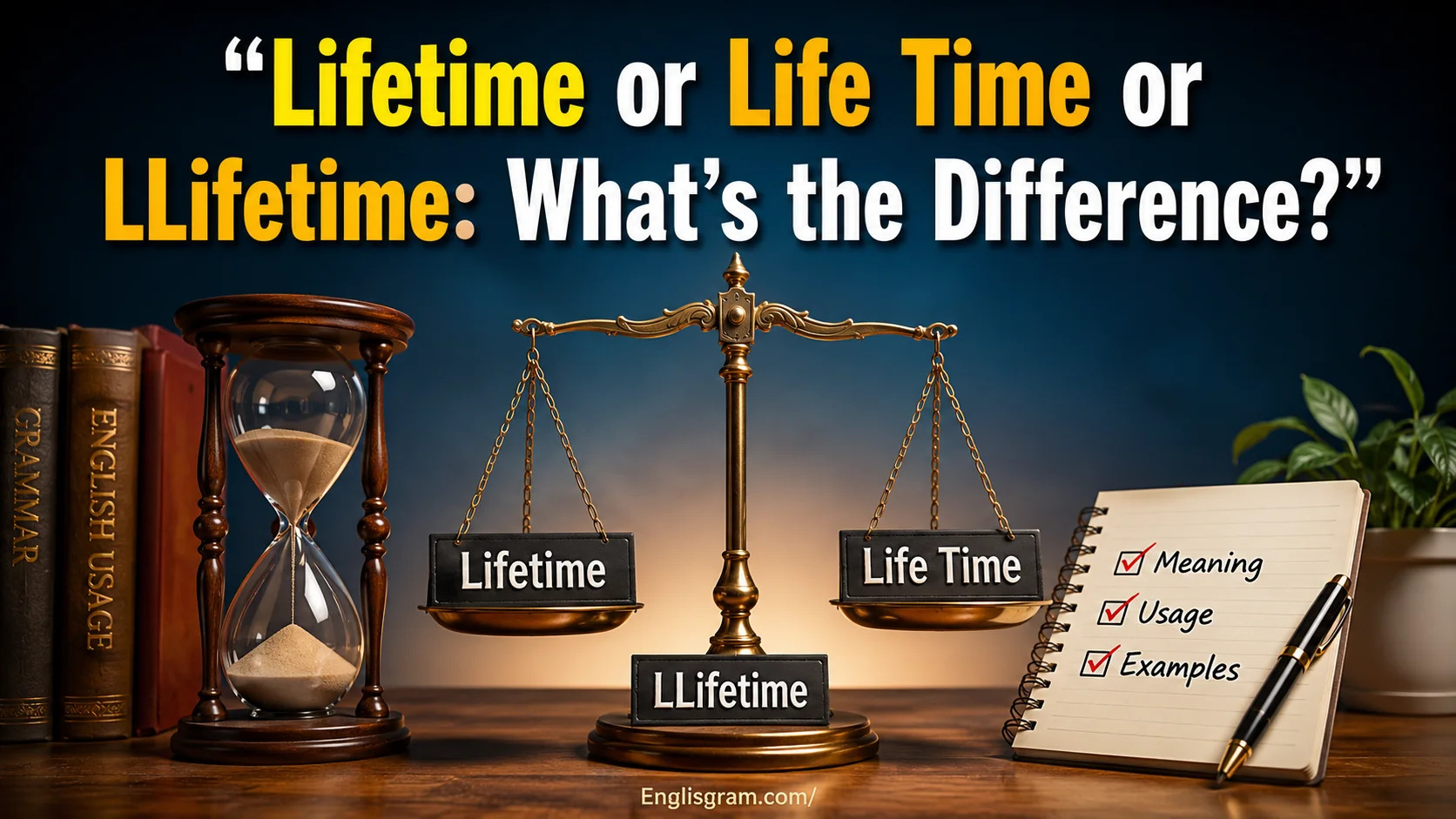
Lifetime or Life Time or LLifetime can confuse writers, yet one small space may change meaning, clarity, precision, and professional writing.For writers, students, editors, marketers, and professionals, the difference between Lifetime and Life Time becomes clearer when you examine context, grammar, usage, and meaning.
At a quick glance, the words look almost the same, but their linguistic nuance, semantics, and sentence-meaning can differ. In everyday English language, people may use them interchangeably in conversation, yet writing correctly requires knowing the distinction. Lifetime is normally one word and works as a noun referring to the total time a living thing spends being alive, from when it is born until it dies.
It can describe a lifespan, duration, or complete existence, and the dictionary lists its plural as lifetimes. In my editing experience, I’ve seen this seemingly harmless mistake cause clarity loss, weaken credibility, and reduce writing accuracy. The adjective use can also describe something connected with a person’s life or a thing’s entire existence. Life Time, by contrast, consists of two separate words and is not normally the correct form in standard English when you mean a person’s full life.
Quick Answer: Lifetime or Life Time?
Lifetime is the correct standard spelling in modern English when you mean a person’s entire life or the period during which something exists or lasts.
| Form | Correct in standard English? | Main use | Example |
| lifetime | Yes | Noun or adjective | “She achieved a lifetime goal.” |
| life time | Usually no for this meaning | Separate words only in unusual grammatical contexts | Usually replace it with “lifetime” |
| LLifetime | No | Not a standard English word | Use “lifetime” instead |
For example:
- Correct: “I’ve never seen anything like this in my lifetime.”
- Correct: “The device has a lifetime of about ten years.”
- Correct: “She received a lifetime achievement award.”
- Incorrect: “I’ve never seen anything like this in my life time.”
- Incorrect: “She received a LLifetime achievement award.”
The simplest rule is this: when “lifetime” means the complete span of a life or existence, write it as one word.
What Does “Lifetime” Mean?
Lifetime refers to the period during which a person lives or something exists.
For a person, it can describe the span from birth until death. For an object, technology, organization, or other thing, it can describe how long that thing exists, functions, or remains useful.
Consider these examples:
“She traveled to more than 40 countries during her lifetime.”
Here, lifetime means the entire period of her life.
Now compare it with:
“The battery has an expected lifetime of eight years.”
In this sentence, lifetime describes the expected period during which the battery can function effectively.
The word also appears in figurative expressions. If someone says, “That concert feels like a lifetime ago,” they aren’t claiming that an entire human life has literally passed. They’re emphasizing that a very long time seems to have passed.
Common meanings include:
- A person’s lifespan: “He accomplished a great deal during his lifetime.”
- The existence of something: “The product has a limited lifetime.”
- A period of usefulness: “The software has a projected lifetime of five years.”
- A very long period, figuratively: “I haven’t seen you in a lifetime.”
- Something lasting throughout a person’s life: “She has a lifetime membership.”
That flexibility explains why lifetime appears so often in everyday English.
Is Lifetime One Word?
Yes. Lifetime is normally written as one word.
It is an established compound word formed from life and time. English frequently combines two words into a single compound when they develop a recognized meaning and common usage.
You can see the same pattern in words such as:
- bedroom
- notebook
- sunshine
- hometown
- workplace
- lifetime
- lifespan
- lunchtime
The original components may remain recognizable, but the resulting compound functions as an established word.
This matters because English doesn’t require every combination of words to remain separate. Some combinations become closed compounds, some remain open phrases, and others use hyphens.
For lifetime, modern standard usage has settled on the closed form.
Why “Life Time” Looks Tempting
The confusion makes sense because life and time are both independent English words.
You might naturally think:
life + time = life time
English doesn’t always work that way, though. Once a compound becomes established, its conventional spelling matters.
For example, you wouldn’t normally write:
- “bed room” instead of bedroom
- “sun shine” instead of sunshine
- “note book” instead of notebook
Likewise, standard modern English normally uses lifetime, not life time.
Lifetime as a Noun
One of the most common uses of lifetime is as a noun.
A noun names a person, place, thing, idea, or period. In this case, lifetime names a period of existence.
You can use it to talk about human lives, animals, products, inventions, organizations, experiences, and more.
Examples of Lifetime as a Noun
- “She learned several languages during her lifetime.”
- “The machine has an expected lifetime of 15 years.”
- “I’ve never experienced anything like that in my lifetime.”
- “He dedicated his lifetime to scientific research.”
- “The company has changed dramatically during its lifetime.”
Several common expressions use the noun naturally.
“In My Lifetime”
This expression means during the period in which I have been alive.
“That was the hottest summer I’ve experienced in my lifetime.”
It doesn’t mean the speaker knows what happened throughout every moment of human history. The reference point is the speaker’s own life.
“During Your Lifetime”
This means while you are alive.
“Technology has changed dramatically during your lifetime.”
The phrase works particularly well when discussing historical developments that someone has personally witnessed.
“For a Lifetime”
This expression can describe something that lasts for someone’s entire life.
“The experience gave her memories that would last a lifetime.”
Notice that lifetime remains one word.
Lifetime as an Adjective
Lifetime can also function as an adjective when it describes another noun.
This use appears constantly in business, entertainment, technology, memberships, awards, and advertising.
Consider these examples:
- lifetime achievement
- lifetime membership
- lifetime warranty
- lifetime access
- lifetime supply
- lifetime earnings
- lifetime ban
- lifetime subscription
- lifetime award
In each case, lifetime modifies another noun.
For example:
“The actor received a lifetime achievement award.”
Here, lifetime doesn’t name the period itself. It helps describe the type of achievement award.
Similarly:
“The software includes lifetime access.”
The exact meaning of lifetime depends on the product or service’s terms. It doesn’t necessarily mean that the company promises access forever.
What Is a Lifetime Warranty?
The phrase lifetime warranty deserves special attention because it often causes confusion.
A lifetime warranty doesn’t automatically mean “the product will be repaired or replaced forever under every circumstance.”
The word lifetime must be interpreted according to the warranty’s terms.
A company might define “lifetime” as:
- the expected useful life of the product
- the period during which the original purchaser owns it
- the period during which the manufacturer supports it
- another period specified in the warranty agreement
For that reason, you should read the actual warranty rather than relying solely on the phrase lifetime warranty.
This is a useful example of how context can affect the practical meaning of a word.
Is “Life Time” Correct?
In most ordinary situations, life time is not the standard form when you mean lifetime.
For example:
- Preferred: “This is a once-in-a-lifetime opportunity.”
- Not standard: “This is a once-in-a-life-time opportunity.”
Likewise:
- Preferred: “The product has a long lifetime.”
- Not standard: “The product has a long life time.”
The separate spelling can appear in unusual contexts where life and time genuinely function as separate words. However, you shouldn’t use that possibility as a reason to split the established compound in normal writing.
The key question is whether you’re using the recognized word lifetime.
If you are, keep it together.
Read More:Which Is Correct: I’m or I Am? Learn the Difference and Use Both Correctly
Why You Might See “Life-Time” in Older Writing
Readers sometimes encounter life-time with a hyphen, particularly in older books, historical documents, or dictionaries.
That doesn’t mean modern writers should normally use the hyphenated form.
English compound words have changed their spelling over centuries. A combination may begin as two words, develop a hyphenated form, and eventually become a closed compound.
Historical sources preserve earlier spelling practices. Modern usage can differ.
This distinction matters when you’re reading older material. A spelling that appears in a nineteenth-century text isn’t automatically the preferred spelling in contemporary American English.
For modern general writing, lifetime is the safest and most natural choice.
What About “LLifetime”?
LLifetime is not a standard English word.
The extra capital L doesn’t create a new grammatical form. In ordinary writing, it is almost certainly a typing, formatting, or capitalization mistake.
For example:
- LLifetime membership → incorrect
- Lifetime membership → correct
- LLifetime achievement → incorrect
- Lifetime achievement → correct
- LLifetime warranty → incorrect
- Lifetime warranty → correct
There is one important capitalization point, though.
Lifetime can begin with a capital letter when grammar or naming conventions require it.
For example:
“Lifetime memberships are available.”
The capital letter appears because the word begins the sentence.
A company, product, program, or title could also use Lifetime as part of a proper name. That’s different from treating LLifetime as a normal English spelling.
Lifetime vs. Life Time: The Main Difference
The central difference isn’t usually meaning. It’s whether the words form the established compound noun or adjective.
| Feature | Lifetime | Life time |
| Standard modern spelling | Yes | Generally no for the compound meaning |
| Written as one word | Yes | No |
| Common noun | Yes | No |
| Common adjective | Yes | No |
| Used in “during my ___” | Yes | No |
| Used in “___ achievement” | Yes | No |
| Used in “___ warranty” | Yes | No |
| Normal modern choice | Yes | No |
So if you’re writing about the period someone lives or something exists, lifetime should normally be your choice.
Common Expressions With Lifetime
Learning common expressions makes the correct spelling easier to remember because you’ll see the word in familiar patterns.
Once-in-a-Lifetime
Once-in-a-lifetime describes something extremely unusual or unlikely to happen again.
“Winning the championship was a once-in-a-lifetime experience.”
The phrase uses hyphens when it functions as a compound adjective before a noun.
Compare:
“It was a once-in-a-lifetime opportunity.”
But:
“An opportunity like that may happen only once in a lifetime.”
The second example doesn’t need the same adjective-style hyphenation because the phrase functions differently.
Lifetime Achievement
A lifetime achievement is an accomplishment recognized as part of someone’s long-term body of work.
“She received a lifetime achievement award for her contributions to film.”
The phrase is especially common in entertainment, sports, business, science, and professional organizations.
Lifetime Membership
A lifetime membership usually gives someone membership rights for an extended period defined by the organization.
“The club offered him a lifetime membership.”
The precise conditions depend on the organization.
Lifetime Supply
A lifetime supply means an amount intended to last for the relevant person’s lifetime.
“The contest winner received a lifetime supply of coffee.”
Of course, “lifetime” doesn’t guarantee an infinite quantity. The practical meaning depends on the terms of the offer.
Lifetime Access
Lifetime access means access intended to continue throughout a defined lifetime or applicable service period.
“The course includes lifetime access to the recorded lessons.”
Again, check the provider’s terms if the phrase appears in a commercial offer.
Lifetime vs. Lifespan
Lifetime and lifespan overlap, but they aren’t interchangeable in every sentence.
A lifespan usually focuses on how long a living organism, object, or system exists.
For example:
“The average lifespan of a domestic cat can be more than a decade.”
Lifetime, meanwhile, has broader everyday and figurative uses.
“She visited every continent during her lifetime.”
You could sometimes replace lifetime with lifespan, but the result may sound unnatural.
Compare:
“I’ve learned a lot during my lifetime.”
That sounds natural.
“I’ve learned a lot during my lifespan.”
The second sentence sounds clinical and unusual because lifespan focuses more strongly on measurable duration.
A Simple Distinction
Think of the words this way:
- Lifetime = the period of existence, often in personal or everyday contexts.
- Lifespan = the length or duration of existence, often in factual, biological, scientific, or technical contexts.
The meanings overlap, but their typical contexts differ.
Lifetime vs. Lifelong
Another common confusion involves lifetime and lifelong.
They look related because both contain the idea of an entire life. Grammatically, however, they do different jobs.
Lifetime usually functions as a noun or adjective.
Lifelong functions as an adjective.
Compare these sentences:
“She has a lifetime of experience.”
“She is a lifelong learner.”
In the first sentence, lifetime refers to a period.
In the second, lifelong describes something that continues throughout a person’s life.
More examples make the distinction clear:
| Lifetime | Lifelong |
| “During his lifetime” | “His lifelong passion” |
| “A lifetime achievement” | “A lifelong friendship” |
| “A lifetime of memories” | “A lifelong commitment” |
| “The product’s lifetime” | “A lifelong habit” |
Don’t use lifelong simply because you mean “for life.” The grammatical role matters.
Common Mistakes With Lifetime
Even though the spelling seems simple, several mistakes appear regularly.
Mistake 1: Writing “Life Time”
“I’ve known her for a life time.”
Use:
“I’ve known her for a lifetime.”
The compound should normally remain closed.
Mistake 2: Writing “LLifetime”
“He received a LLifetime award.”
Use:
“He received a lifetime award.”
The double L is not a legitimate spelling variant.
Mistake 3: Overusing Hyphens
“She earned a life-time achievement award.”
In contemporary standard English, lifetime achievement award is the normal form.
Don’t insert a hyphen merely because two words originally formed the compound.
Mistake 4: Confusing Lifetime and Lifelong
“She has a lifetime friendship with him.”
This may be understandable, but lifelong friendship is generally the more natural phrase when you mean a friendship that lasts throughout life.
Mistake 5: Assuming Lifetime Means Forever
A lifetime is not necessarily infinite.
A person’s lifetime has a beginning and an end. Likewise, a product’s “lifetime” may refer to its expected useful period.
So:
“This battery has a lifetime of 10 years.”
doesn’t mean the battery lasts forever.
Correct and Incorrect Examples
| Incorrect or less suitable | Better version | Explanation |
| “I haven’t seen him in a life time.” | “I haven’t seen him in a lifetime.” | Use the closed compound. |
| “She won a LLifetime award.” | “She won a lifetime award.” | LLifetime isn’t standard English. |
| “This is a once-in-a-life-time chance.” | “This is a once-in-a-lifetime chance.” | Use the established compound. |
| “The product has a five-year life time.” | “The product has a five-year lifetime.” | Lifetime is the standard noun. |
| “He has a lifetime passion for music.” | “He has a lifelong passion for music.” | Lifelong is usually better for something continuing throughout life. |
| “She did this during her life time.” | “She did this during her lifetime.” | Standard compound spelling. |
| “The company offers LLifetime access.” | “The company offers lifetime access.” | Correct the spelling. |
Is “Lifetime” Hyphenated?
Usually, no.
The standard spelling is lifetime, with no space and no hyphen.
However, you’ll often see hyphens in the related expression once-in-a-lifetime.
That’s because the entire phrase works together as a compound modifier.
For example:
“It was a once-in-a-lifetime opportunity.”
Here, once-in-a-lifetime collectively modifies opportunity.
But when you use lifetime by itself, you don’t normally add a hyphen:
“She achieved a lifetime goal.”
Not:
“She achieved a life-time goal.”
This distinction illustrates an important principle in English punctuation: compound-word spelling and compound-adjective hyphenation aren’t the same thing.
Does American English Use “Lifetime” Differently?
American English uses lifetime as the standard spelling.
There isn’t a major US-vs.-UK spelling difference here comparable to words such as color/colour or center/centre.
So whether you’re writing for an American audience, communicating internationally, or learning general English, lifetime is the form you should normally use.
The bigger issue is context rather than dialect.
For formal writing, business communication, websites, academic work, and everyday conversation, the closed form is the natural choice.
A Useful Rule for Choosing Lifetime
When you’re uncertain, ask yourself one question:
Am I referring to the entire period of someone’s life or something’s existence?
If the answer is yes, use lifetime.
For example:
“I’ve never experienced anything like this in my lifetime.”
Yes. Use lifetime.
“The machine’s expected lifetime is 20 years.”
Yes. Use lifetime.
“She received a lifetime achievement award.”
Yes. Use lifetime.
“This is a once-in-a-lifetime opportunity.”
Yes. Use lifetime.
That quick test solves most spelling questions involving this word.
FAQs
Is Lifetime one word or two words?
Lifetime is normally written as one word in standard English. It refers to the full duration, lifespan, or existence of a person or thing.
Is Life Time correct?
Life Time is generally not the standard form when you mean a person’s complete life. In most cases, use lifetime instead.
What does lifetime mean?
Lifetime means the entire period during which a person, animal, or thing exists. For example, “She achieved a lot in her lifetime.”
What is the difference between Lifetime and Life Time?
The main difference is word formation and usage. Lifetime is the standard compound noun, while life time is usually an incorrect spacing of the same word when referring to a full life.
Is LLifetime a correct spelling?
No. LLifetime is not a standard English spelling. The correct form is lifetime.
Conclusion
Lifetime is the standard and correct one-word form when you mean the full duration, lifespan, or existence of a person or thing. Life Time is generally not used as a two-word phrase for this meaning, while LLifetime is simply an incorrect spelling. Understanding this small difference can improve your writing accuracy, language precision, and overall clarity. When you’re unsure, remember the simple rule: use lifetime as one word in standard English.