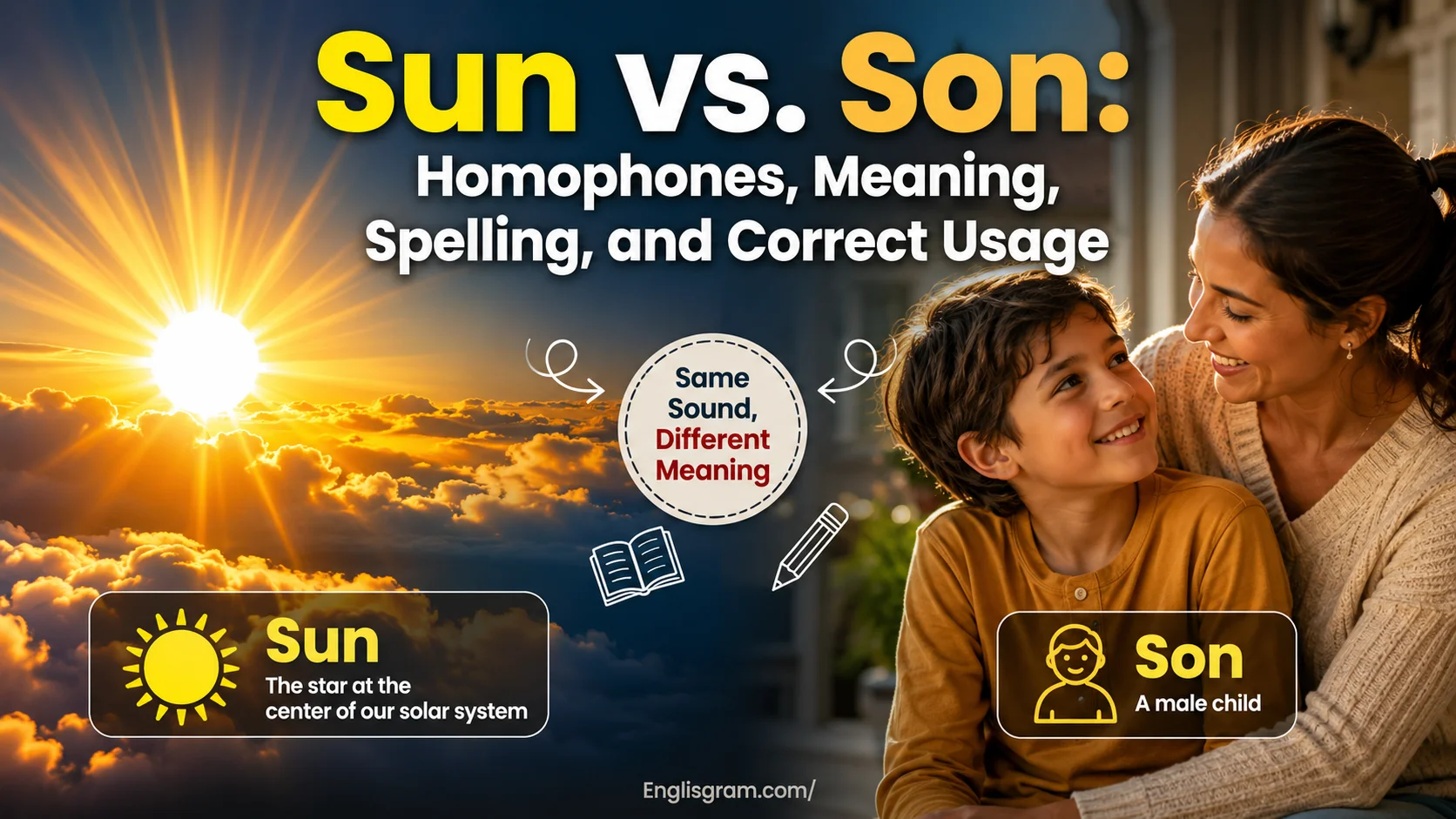
Sun vs. Son explains why these homophones sound alike but have different meanings, spellings, and uses in everyday English communication. On a quiet morning, the sun may be shining beautifully today, while a son may be coming home from school. When spoken aloud, these words sound identical, yet they represent completely different worlds of meaning.
This simple confusion can leave learners of English puzzled, especially because sun and son are homophones with the same sound but different spelling and meaning. The difference might seem minor, but in real life it can cause misunderstandings in writing, communication, and exams. It can even affect emotional expressions.
A heartfelt sentence about a child might accidentally use sun instead of son, replacing one word and causing the meaning to shift dramatically, sometimes humorously or confusingly. The basic definitions become easier to understand when viewed through linguistic, cultural, and practical perspectives.
Quick Answer: Sun vs. Son
Sun means the star that provides Earth with light and heat. Son means a male child or male descendant. They are homophones, which means they have the same pronunciation but different meanings and spellings.
| Word | Meaning | Pronunciation | Typical Use | Example |
| Sun | The star at the center of our solar system | /sʌn/ | Astronomy, daylight, sunlight | The sun is rising. |
| Son | A male child or descendant | /sʌn/ | Family and relationships | Their son is five years old. |
A quick memory trick makes the distinction easier:
- Sun = sky
- Son = family
- Sun = sunlight
- Son = child
If you’re talking about something shining above Earth, choose sun. If you’re talking about someone’s male child, choose son.
What Does Sun Mean?
Sun is primarily a noun referring to the star at the center of our solar system. Earth and the other planets orbit it because of its enormous gravitational influence. The sun supplies most of the energy that drives Earth’s climate, weather, and biological systems.
In everyday English, however, people often use sun more simply. You might say, “The sun is bright,” “We sat in the sun,” or “The sun disappeared behind the clouds.”
In these sentences, sun refers either to the celestial object itself or to the light and warmth associated with it.
The scientific and everyday meanings connect naturally. When you say, “The sun feels warm today,” you’re talking about the solar radiation reaching you, even though you aren’t describing the star in technical astronomical terms.
Sun as a Noun
The noun sun appears in many ordinary expressions:
- The sun is setting.
- The sun came out after the storm.
- We sat in the sun for an hour.
- The morning sun filled the room with light.
- The plants need sun to grow.
- The sun’s rays were unusually strong.
- The sun rises in the east and sets in the west.
Notice how each sentence involves light, heat, the sky, or the celestial object.
The word can also appear in compounds such as sunlight, sunshine, sunrise, sunset, and sunbeam. These related words provide useful clues when you’re trying to remember the spelling.
Sun as a Verb
Here’s a detail that English learners sometimes overlook: sun can also function as a verb.
To sun means to expose something or yourself to sunlight. For example:
- She sunned herself beside the pool.
- The cat was sunning itself on the windowsill.
- The towels were left outside to sun.
- He spent the afternoon sunning on the beach.
The verb isn’t as common as the noun, but it appears in both everyday and literary English.
The word son, on the other hand, doesn’t have this meaning. You can’t replace sun with son in these sentences without changing them into nonsense.
What Does Son Mean?
Son is a noun that normally means a male child in relation to one or more parents.
For example:
- They have one son and two daughters.
- Her son starts college this fall.
- My son loves baseball.
- Their youngest son lives in Chicago.
The relationship doesn’t have to involve a young child. An adult male can remain someone’s son throughout his life.
A 45-year-old man can still be his mother’s son. Age doesn’t remove the family relationship.
Son and Family Relationships
The word frequently appears when describing family structure or ancestry.
Common expressions include:
- only son
- eldest son
- youngest son
- middle son
- father and son
- mother and son
- son and daughter
- son-in-law
The meaning stays connected to family or descent.
For example, “Michael is their only son” tells you that Michael is their only male child. It doesn’t tell you that he’s necessarily their only child because they might also have daughters.
Son Beyond Immediate Parenthood
Son can sometimes have a broader meaning than biological parenthood. Adoption, stepfamilies, and figurative relationships can all affect how people use the term.
For instance, an adopted male child can be someone’s son. A person may also use son affectionately or figuratively when addressing a younger male, especially in certain cultural, historical, or literary contexts.
The central idea remains the same: son describes a male child or a male descendant in a relationship of parentage or family connection.
Why Are Sun and Son Homophones?
Sun and son are homophones because they share the same pronunciation while having different meanings and spellings.
The term homophone comes from Greek roots associated with “same” and “voice.” In practical terms, homophones are words that sound alike but don’t necessarily look alike or mean the same thing.
English contains hundreds of familiar homophone pairs:
| Homophones | Meanings |
| sun / son | star / male child |
| sea / see | body of water / perceive with your eyes |
| right / write | correct / form words |
| flower / flour | plant bloom / baking ingredient |
| pair / pear | two things / fruit |
| there / their / they’re | location / possession / they are |
The sun vs. son pair is especially interesting because the pronunciation gives you no clue about spelling. You hear /sʌn/, but you must use the surrounding meaning to decide whether to write sun or son.
Sun vs. Son Pronunciation
In standard English, sun and son are pronounced the same way: /sʌn/.
The vowel sound is the same sound you hear in words such as:
- fun
- run
- done
- one
- none
The initial s produces the /s/ sound, while the final n produces /n/.
The spelling differs because English pronunciation and English spelling don’t always line up neatly. English developed from several languages and went through centuries of sound and spelling changes. As a result, identical sounds can have completely different written forms.
This is why pronunciation alone can’t tell you whether to write sun or son.
Sun vs. Son Spelling Difference
The most obvious difference is one vowel:
- Sun → U
- Son → O
That tiny spelling difference carries the entire meaning.
You might think, “They’re pronounced the same, so why not spell them the same way?” English doesn’t work that way. Homophones preserve different spellings because their histories and meanings developed separately.
A useful visual association can help:
SUN → U → UP in the sky
SON → O → OFFSPRING
The second mnemonic isn’t a linguistic rule. It’s simply a memory device. That’s enough. A good mnemonic doesn’t need to explain the history of a word; it only needs to help you remember the spelling when you need it.
Sun vs. Son Meaning Difference
The sun vs. son meaning becomes straightforward when you focus on the category each word belongs to.
Sun belongs to the natural world. It relates to astronomy, daylight, heat, sunlight, and Earth’s environment.
Son belongs to family relationships. It identifies a male child or descendant.
Consider these two sentences:
The sun is shining through the window.
Their son is studying by the window.
The pronunciation of the bolded words is identical. Their meanings aren’t remotely similar.
Here’s another pair:
We spent the afternoon in the sun.
We spent the afternoon with our son.
Changing one letter transforms the meaning completely. That’s the defining challenge of homophones.
Read More:Lifetime or Life Time or LLifetime: What’s the Difference?
Sun vs. Son in Sentences
The fastest way to master the difference is to see each word operating naturally in context.
Examples With Sun
Here are several common uses of sun:
- The sun was already above the horizon when we left.
- Clouds covered the sun during the afternoon.
- Plants need sunlight to carry out photosynthesis.
- We sat outside in the sun after lunch.
- The sunset painted the western sky with warm colors.
- Don’t stare directly at the sun.
- The morning sun warmed the kitchen.
- The cat stretched out in a patch of sun.
- The sunrise began just before six.
- She spent the afternoon sunning herself beside the pool.
Every example points toward sunlight, warmth, the sky, or the celestial object.
Examples With Son
Now compare them with son:
- Their son starts kindergarten this year.
- My son called me after work.
- She has two daughters and one son.
- His son inherited his love of music.
- Their youngest son lives nearby.
- The father and son worked on the car together.
- Her son graduated from college last spring.
- They welcomed a son into their family.
- His only son became a doctor.
- The proud parent watched her son walk across the stage.
These examples revolve around children, parents, descendants, and family relationships.
Sun vs. Son: Side-by-Side Examples
Seeing the words next to each other makes the distinction even clearer.
| With Sun | With Son |
| The sun is bright. | Their son is bright. |
| We sat in the sun. | We visited our son. |
| The sun is setting. | Their son is studying. |
| The sun warmed the room. | Their son warmed their hearts. |
| I watched the sunrise. | I called my son. |
| The sun came out. | Their son came home. |
The grammar around each word often provides a strong contextual clue.
If you see words such as rise, set, light, rays, bright, warm, or sky, sun is probably the correct choice.
If you see words such as father, mother, child, daughter, family, parent, or brother, son is probably the right answer.
Common Mistakes With Sun and Son
Because both words are legitimate spellings, people can accidentally use the wrong one without triggering a spelling warning.
For example, a word processor may recognize this sentence as correctly spelled:
My sun is coming home tonight.
Every individual word is spelled correctly. The problem is semantic. If the writer means a male child, son is required.
The same issue appears in reverse:
The son is shining brightly today.
Again, son is a correctly spelled English word. It simply doesn’t express the intended meaning.
Incorrect and Correct Examples
| Incorrect | Correct | Why |
| My sun is seven years old. | My son is seven years old. | A male child is a son. |
| The son is setting. | The sun is setting. | The star is the sun. |
| We sat under the son. | We sat under the sun. | Sunlight comes from the sun. |
| Her sun plays soccer. | Her son plays soccer. | A parent’s male child is a son. |
| The son came through the clouds. | The sun came through the clouds. | The celestial object is the sun. |
This is why grammar software can’t always solve homophone errors. The software may know that every word is spelled correctly. It may not know what you intended to say.
How to Remember Sun vs. Son
A reliable memory trick is to connect each word to a larger idea.
Remember Sun With the Sky
Think:
SUN → SKY
Both begin with S, and the sun belongs in the sky.
You can extend the association:
Sun → sky → sunlight → summer
If you’re describing any of those ideas, sun is probably the spelling you need.
Remember Son With Family
Think:
SON → FAMILY
Then connect it to:
Son → child → parent → family
If you could replace the word with male child, you almost certainly need son.
For example:
Her son is visiting.
You could rewrite that as:
Her male child is visiting.
The meaning remains essentially intact.
Try the same test with sun:
The sun is setting.
Replacing sun with male child obviously destroys the meaning. Instead, star or sunlight gives you the right semantic direction.
A Simple Sun or Son Decision Test
When you’re unsure, don’t focus on pronunciation. Ask what the word means.
Step one: Are you talking about the star in the sky?
Use sun.
Step two: Are you talking about sunlight, warmth from the star, sunrise, sunset, or related ideas?
Use sun.
Step three: Are you talking about a male child or descendant?
Use son.
Here’s the shortcut:
| If you mean… | Write… |
| Star | sun |
| Sunlight | sun |
| Daylight | sun |
| Sunrise | sun |
| Sunset | sun |
| A male child | son |
| A parent’s male child | son |
| A male descendant | son |
| Family relationship | son |
Common Phrases With Sun
The word sun appears in many familiar expressions.
In the Sun
“She likes reading in the sun.”
This means she reads while exposed to sunlight.
Under the Sun
The phrase under the sun can mean “on Earth” or “in existence,” depending on context.
For example:
There isn’t much under the sun that he hasn’t tried.
It’s often used to emphasize an extremely broad range of things.
Sunlight and Sunshine
These compounds refer to light associated with the sun.
- sunlight = light from the sun
- sunshine = direct sunlight or figuratively cheerfulness
- sunrise = the apparent rising of the sun
- sunset = the apparent setting of the sun
- sunbeam = a beam or shaft of sunlight
These words all retain the sun spelling.
Common Phrases With Son
Son most often appears in family-related phrases.
Examples include:
- my son
- your son
- their son
- our son
- only son
- eldest son
- youngest son
- father and son
- mother and son
- son and daughter
- son-in-law
The compound son-in-law deserves special attention. It refers to the husband of someone’s daughter. It doesn’t mean the biological son of the family.
For example:
My daughter and her son-in-law are visiting.
Here, son forms part of a compound family term.
Sun vs. Son in Formal and Informal Writing
Confusing these words can create embarrassing mistakes in professional or personal writing.
Imagine a family announcement saying:
We’re thrilled to welcome our new sun.
Readers can usually infer the intended meaning, but the spelling still looks wrong. The correct sentence is:
We’re thrilled to welcome our new son.
Likewise, a weather report saying:
Expect bright son tomorrow.
would immediately look like a typo. The intended word is sun.
The problem becomes particularly important in contexts where accuracy matters:
- school assignments
- business emails
- family announcements
- social media posts
- greeting cards
- journalism
- marketing copy
- educational materials
- professional documents
Homophones deserve extra attention because automatic spell-checkers often can’t distinguish them from correctly spelled words.
A Practical Case Study: Why Context Matters
Imagine someone writing this sentence:
I hope the sun has a wonderful birthday.
At first glance, the sentence is grammatically fine. Every word is spelled correctly. Yet the meaning is probably wrong if the writer is talking about a child.
The intended sentence might be:
I hope my son has a wonderful birthday.
Now consider the opposite:
The son finally appeared after several cloudy days.
If the writer means the star, the sentence needs sun.
This illustrates an important lesson about English spelling: correct spelling isn’t always enough. A word can be spelled perfectly and still be the wrong word for the sentence.
Etymology of Sun and Son
The similarity between sun and son doesn’t mean they developed from the same word.
Origin of Sun
The modern English sun traces back to Old English sunne. It belongs to a broad Germanic family of words referring to the sun.
Related forms appear in several Germanic languages. For example, German has Sonne, while Dutch uses zon.
Over centuries, English pronunciation and spelling changed, eventually producing the modern form sun.
Origin of Son
The modern English son comes from Old English sunu. It also belongs to an old Germanic word family.
Related forms can be found in languages such as German Sohn and Dutch zoon.
The historical development of the two words was separate even though their modern pronunciations eventually became identical in English.
That’s a useful reminder that English spelling often preserves pieces of history that pronunciation no longer makes obvious.
Why Do Sun and Son Have Different Spellings?
The different spellings reflect their separate histories and meanings.
English spelling didn’t develop as one perfectly planned system. Instead, it evolved through layers of Old English, Norman French influence, Latin, Scandinavian contact, printing conventions, regional pronunciation changes, and later standardization.
As sounds changed, some previously distinct words moved closer together in pronunciation. Their written forms could remain different because the spellings helped preserve distinctions between words.
That’s essentially what happened with many English homophones.
The spelling tells you something that pronunciation no longer does.
With sun and son, the letters provide the semantic distinction that your ears can’t provide.
Sun vs. Son in English Learning
For English learners, sun and son demonstrate an important principle: English spelling isn’t always phonetic.
You may hear:
/sʌn/
But you can’t determine the spelling from that sound alone.
Instead, look at context.
If someone says:
“My ___ is starting school.”
The family context tells you the answer is son.
If someone says:
“The ___ is setting.”
The astronomical context tells you the answer is sun.
This approach works better than memorizing pronunciation alone because it links spelling with meaning.
FAQs
What is the difference between sun and son?
The sun is the star at the center of our solar system, while a son is a male child or offspring of a parent.
Are sun and son homophones?
Yes. Sun and son are homophones because they have the same pronunciation but different spellings and meanings.
How can I remember the difference between sun and son?
Think of the sun in the sky and a son in a family. This simple connection can help you remember which word to use.
Why do people confuse sun and son?
People often confuse them because they sound identical when spoken aloud. However, their spelling, meaning, and context are different.
Which word should I use for a male child?
Use son when you mean a male child. For example, “Her son is coming home from school.”
Conclusion
Understanding Sun vs. Son becomes easier once you focus on their meanings and context. Sun refers to the star in our solar system, while son means a male child. Although they sound the same, their spelling and usage are completely different. With regular practice, you can confidently use both words correctly in everyday English.