Role Call or Roll Call – Which Is Correct This simple guide explains the difference with clear examples to help you avoid common mistakes.Many people pause when they see Role Call and Roll Call because both are homophones with identical pronunciation, an identical sound, and they sound alike. However, their different meanings create a clear distinction. From my classroom experience and years of reviewing published articles, emails, and documents, I have noticed this common confusion more often than almost any other confusing English terms.
This article will break down the difference with a clear explanation, practical guide, simple examples, real examples, and useful breakdowns. Learning the correct usage, choosing the right word, and improving meaning, meanings, semantics, context, contexts, usage, word choice, vocabulary, grammar, English grammar, grammar rules, English language, English terms, language, language learning, and language skills help learners, native speakers, writers, students, and teachers avoid a grammar mistake, common grammar mistake, common mistake, common mistakes, common mix-ups, mistakes, errors, and misunderstood words, phrases, or similar words.
The truth is that better communication leads to more efficient, professional, and accurate communication skills in both oral and written speech.A Roll Call is a noun that describes the process of checking attendance by calling, calling out, or saying names from a name list, attendance list, attendance sheet, register, roster, or roster of people.
Is It Role Call or Roll Call?
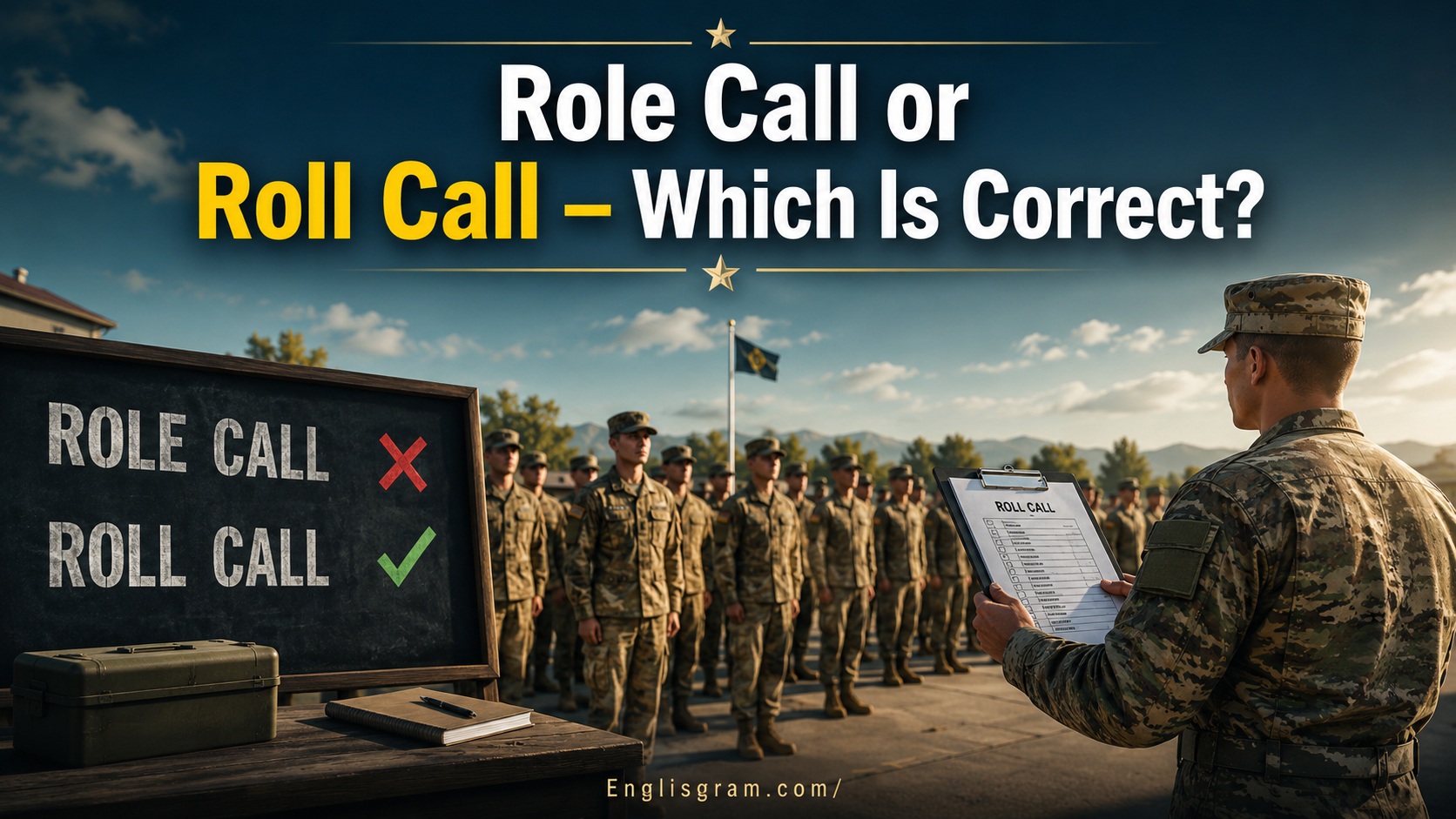
The correct phrase is roll call.
Role call is usually wrong when you mean attendance, name-checking, or a formal count of people present. The confusion happens because role and roll sound the same, but they do not mean the same thing.
Here is the easy way to think about it:
- Roll call = calling names from a list
- Role = a job, function, part, or responsibility
So if a teacher reads names at the start of class, that is roll call. If an actor plays a character in a movie, that is a role.
Quick comparison
| Word | Meaning | Common Use |
| Roll | A list, register, or something that moves | Attendance roll, payroll, roll call |
| Role | A duty, position, or part | Job role, acting role, leadership role |
A lot of people write role call because the word role looks more familiar. It also feels more logical at first glance. But English does not always reward what feels logical. It rewards what is standard and established.
What Does Roll Call Mean?
Roll call means calling out names from a list to check who is present.
The word roll here refers to a list or register, not a movement. Historically, a “roll” was a written record of names. When someone “called the roll,” they read through that list and asked people to respond.
Today, roll call still carries that meaning. It is used in schools, military settings, meetings, courts, and formal organizations.
Common places where roll call appears
- Schools
- Military units
- Government meetings
- Board meetings
- Courts
- Clubs and organizations
- Training sessions
- Attendance systems
Examples of roll call in real sentences
- The teacher took roll call before starting the lesson.
- The captain began roll call at dawn.
- The chairperson asked for roll call before the vote.
- Everyone answered during morning roll call.
The meaning is always tied to checking who is there.
A simple rule
If names are being called from a list, use roll call.
What Does Role Mean?
The word role means a position, duty, function, or part someone plays.
That part can be literal or figurative.
Common meanings of role
- A part in a play, film, or show
- A function in a team or organization
- A responsibility at work or home
- A social position or task
Examples of role in sentences
- She played the role of the queen in the drama.
- He has an important role in the project.
- Parents often play a guiding role in a child’s life.
- Her role in the company is to manage operations.
This is why role call sounds natural to some people. They know the word role well. But natural does not mean correct.
If you are talking about attendance, role is the wrong word.
Why Do People Confuse Roll Call and Role Call?
The mistake is common for three main reasons.
They are homophones
Roll and role are homophones. That means they sound the same but are spelled differently and mean different things.
English has many homophone pairs that cause trouble:
- there / their / they’re
- to / too / two
- your / you’re
- write / right
When words sound alike, the brain often chooses the spelling it sees more often in daily life. That is why role call slips into writing so easily.
The word role feels more familiar
People use role all the time in sentences like:
- job role
- leadership role
- acting role
- family role
Because role is so common, some writers assume it should be part of the phrase for attendance too. But the phrase has a different history.
Fast typing and autocorrect do not always help
In casual texting, people often type by sound, not by spelling. Autocorrect can also reinforce mistakes if the wrong form gets used often enough.
That is how a small error gets repeated across messages, social posts, and even work documents.
Roll vs Role: The Real Difference
Understanding the difference between roll and role makes the correct phrase easy to remember.
Roll
Roll can mean several things:
- A list or register
- To move by turning over
- A small bread item
- A rolling motion
In roll call, the meaning is the first one: a list or register.
Role
Role means:
- A duty
- A function
- A position
- A character part
In writing, role almost always refers to what someone does or who they are in a situation.
Side-by-side comparison
| Word | Main Idea | Example |
| Roll | List, motion, or bread item | The teacher checked the attendance roll. |
| Role | Duty, function, or position | His role was to guide the team. |
If you remember that roll connects to a list, then roll call becomes easy to spot.
What Does Roll Call Look Like in Daily Life?
Most people first meet the phrase in school. But it appears in many places.
In school
A teacher reads out the names of students and waits for answers like “present.”
Example:
- The teacher started roll call at 8:00 a.m.
In the military
A leader checks which soldiers are present and ready.
Example:
- The sergeant completed roll call before the drill.
In meetings
A group may call roll to confirm attendance or voting status.
Example:
- The committee began with roll call and then moved to the agenda.
In formal records
Some organizations keep attendance logs and use roll call to verify names.
Example:
- The training coordinator used roll call to confirm every participant.
This phrase has stayed alive because it is practical. It names a process that still happens in modern life.
Read More:Portmanteau Words in American English: Meaning, History, Examples, and Real-World Use
Can Role Call Ever Be Correct?
In standard English, role call is not the correct phrase for attendance.
That said, there is one narrow situation where the words may be used literally, not as the established phrase. If someone is talking about calling out different roles in a play, a game, or a planning session, they might use the phrase role call in a playful or very literal sense.
Example:
- The director did a quick role call to assign characters.
Even then, this is not the usual fixed expression. It sounds more like a creative or informal use than a standard one.
So here is the practical rule:
- For attendance, use roll call
- For duties or parts, use role
- For a playful literal twist, role call may appear, but it is rare
If you are writing for school, work, publishing, or the web, roll call is almost always the right choice.
Why Roll Call Became the Standard Phrase
The phrase goes back to the older meaning of roll as a list or register.
Before digital systems, attendance was recorded on written rolls. Leaders would read names from that list and ask for responses. Over time, the act became known as calling the roll, and the phrase settled into the language as roll call.
That history matters because English often keeps old expressions even after the original tools or methods change. We still say things like:
- dial a number
- hang up the phone
- carbon copy
- film a video
Even when the original object or process is outdated, the phrase survives.
Roll call is one of those language fossils. It carries the memory of paper lists and official records, even though attendance may now be tracked on tablets, apps, or online systems.
How to Remember the Correct Spelling
This is where memory tricks help.
Memory trick for roll call
Think of a teacher rolling through a list of names.
- Roll = list
- Call = say the names out loud
That gives you roll call.
Memory trick for role
Think of a person’s role in life or work.
- a job role
- a family role
- a role in a film
That word belongs to responsibility and function, not attendance.
Fast memory test
Ask yourself:
- Am I talking about a list of names? Use roll
- Am I talking about a position or responsibility? Use role
If the answer is names and attendance, the phrase is roll call.
Common Mistakes People Make
Even strong writers mix these up from time to time. Here are the most common errors.
Mistake using role call for attendance
Incorrect:
- The professor took role call before class.
Correct:
- The professor took roll call before class.
Mistake using roll for responsibility
Incorrect:
- She has a leadership roll in the team.
Correct:
- She has a leadership role in the team.
Mistake assuming sound equals spelling
Incorrect reasoning:
- It sounds like “role,” so it must be role call.
That logic fails because English spelling often preserves older word history. Sound alone does not tell the full story.
Mistake mixing up list words
Some people also confuse roll, register, attendance, and role. They are related in context but not in meaning.
Roll Call in Different Contexts
The phrase appears in different settings, but the core idea stays the same.
School roll call
Teachers use it to mark students present or absent.
Example:
- During roll call, the teacher marked four students absent.
Military roll call
Used for discipline, readiness, and accountability.
Example:
- After training, the unit lined up for roll call.
Court roll call
In some legal or formal settings, roll call confirms who is present.
Example:
- The clerk began roll call before the session opened.
Meeting roll call
Used in formal groups, boards, and committees.
Example:
- The secretary completed roll call before the vote.
Event roll call
Sometimes used loosely for any attendance check at a large event.
Example:
- Staff performed roll call before the conference started.
The setting may change, but the meaning stays stable.
Roll Call vs Role Call: Clean Comparison Table
Here is a simple table that captures the difference clearly.
| Feature | Roll Call | Role Call |
| Standard phrase for attendance | Yes | No |
| Used in schools | Yes | No |
| Used in military settings | Yes | No |
| Refers to a list of names | Yes | Usually no |
| Refers to a responsibility or position | No | Yes, if literally about roles |
| Common in formal writing | Yes | Rare |
| Best choice for everyday use | Yes | No |
This table is the easiest way to keep the two separate in your head.
Real-World Case Study: A Classroom Mistake
Imagine a student writes this in an essay:
The teacher did role call before the lesson started.
At first glance, a casual reader may not blink. But a sharp editor will notice the mistake right away.
Why?
Because the sentence is about attendance, not duties or acting parts. The writer wanted to say the teacher checked names. The correct phrase is:
The teacher did roll call before the lesson started.
Now the sentence fits standard English.
This tiny fix improves the writing in three ways:
- It makes the meaning clear
- It sounds more natural
- It looks more polished and trustworthy
That is why spelling choices matter even when the mistake seems small.
Real-World Case Study: Workplace Communication
Now picture an office team using a scheduling app.
One employee writes in a group chat:
Please do role call before the meeting.
That message creates confusion. A teammate may wonder whether the sender means attendance or work responsibilities.
A better version is:
Please do roll call before the meeting.
This removes the doubt immediately.
When you write clearly, people waste less time guessing.
A Helpful Quote to Keep in Mind
Use role for responsibility. Use roll for lists.
That simple line captures the difference in one glance. It is short, memorable, and practical.
How Teachers, Editors, and Managers Use Roll Call
People in different jobs may use the phrase slightly differently, but the core idea stays the same.
Teachers
They use roll call to check who is in class.
Editors
They correct role call to roll call when the phrase is about attendance.
Managers
They may use it when checking staff presence before a meeting or shift.
Event coordinators
They may use it to confirm volunteers or staff are ready.
Military leaders
They use it for accountability and readiness.
In each case, roll call signals a structured attendance check.
Other Words Related to Roll Call
A strong vocabulary makes the term easier to understand.
Words connected to roll call
- attendance
- register
- roster
- list
- presence
- check-in
- count
- names
Words connected to role
- position
- function
- duty
- responsibility
- part
- task
- assignment
These word groups do not mean the same thing, but they often appear near each other in formal writing.
FAQs
1. Is it Role Call or Roll Call?
The correct term is Roll Call when you mean checking attendance by reading a list of names. Role Call is incorrect in this context because role refers to a person’s function or character.
2. Why do people confuse Role Call and Roll Call?
People confuse these words because they are homophones. They sound the same when spoken but have different spellings and meanings. This makes them a common English grammar mistake.
3. What does Roll Call mean?
Roll Call is the process of calling people’s names from a register, roster, or attendance list to confirm who is present or absent. It is commonly used in schools, meetings, workplaces, and other organisations.
4. What does Role mean?
A role is a person’s job, function, duty, or character in a specific situation. For example, an actor plays a role in a film, and a manager has a leadership role in a company.
5. How can I remember the difference between Role Call and Roll Call?
A simple trick is to connect Roll Call with a roll book, roster, or register used for attendance. Connect role with the part or function a person performs. This memory tip makes it much easier to choose the correct word.
Conclusion
Although Role Call and Roll Call sound identical, they have completely different meanings. Roll Call is the correct expression for checking attendance, while role refers to a person’s function or character. Understanding this small spelling difference improves your writing, strengthens your grammar, and helps you communicate more clearly in school, the workplace, and everyday conversations. Once you remember the distinction, you’ll avoid this common mistake with confidence.