Portmanteau Words in American English explains how portmanteau words blend ideas into everyday speech, making American English more creative, natural, and easy to understand.A portmanteau word is a great example of how portmanteaus enrich English through linguistic shortcuts and a unique linguistic phenomenon. They are created by combining existing words or two words to produce a new word with a new meaning.
This process includes blend, blends, blend words, blended words, blending, word blending, lexical blend, semantic blending, compound formation, word formation, word creation, and phrase construction.
In my experience editing educational articles, understanding morphology, semantics, linguistics, lexical patterns, language structure, syllables, syllable levels, initial segment, final segment, segments, forms, form, formation, formed, fused, fused words, compounds, compound concepts, combination, combine, combining sounds, combining meanings, sound, sounds, unique sound, meaning, meanings, and unique meaning helps explain why these expressions fit naturally into language.
What Are Portmanteau Words in American English?
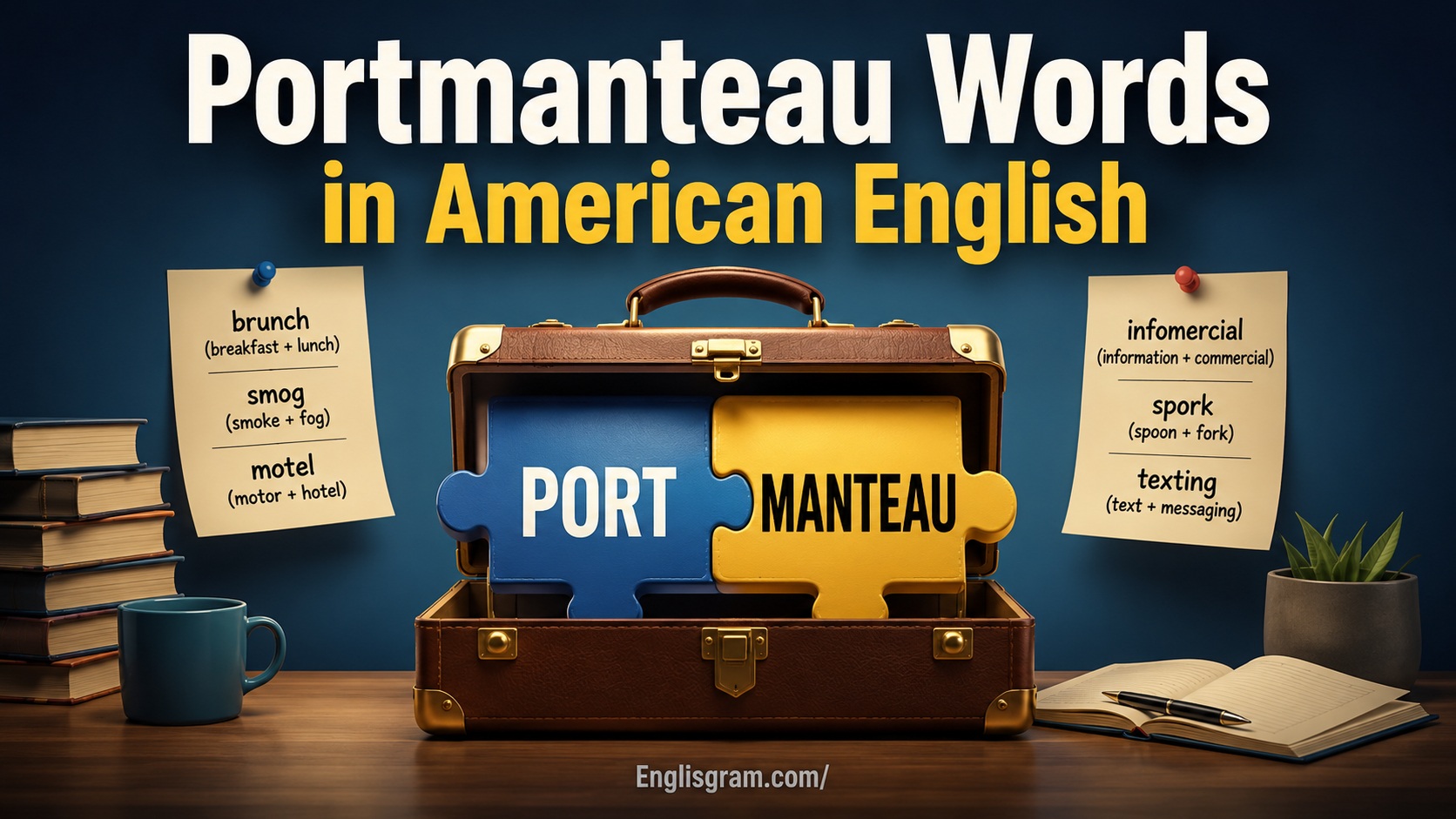
A portmanteau word is a new word created by blending parts of two existing words into one. The new word keeps meaning from both source words. That is the heart of it.
Think of it like language making a shortcut. Instead of saying two full words every time, speakers fuse them into one neat unit.
Here are a few familiar examples:
- brunch = breakfast + lunch
- smog = smoke + fog
- motel = motor + hotel
- infomercial = information + commercial
- spork = spoon + fork
These are not random word mashups. They usually appear because the new term names something useful, funny, or culturally relevant. That makes them easier to remember.
Why the term “portmanteau” matters
The word portmanteau originally referred to a suitcase or carrying case. Lewis Carroll popularized the term in a linguistic sense in Through the Looking-Glass when he used it to describe a word that “packs” two meanings together. That image still works well today. A portmanteau word is basically a suitcase word. It carries more than one idea at once.
Why Portmanteau Words Became So Common in American English
American English has always been open to new expressions. It moves fast. It borrows, trims, fuses, and reshapes words with ease. Portmanteau words fit that habit perfectly.
Speed and convenience
People prefer words that do a lot with a little. A long phrase can be useful, but a blend often sounds cleaner.
For example:
- breakfast and lunch becomes brunch
- motor hotel becomes motel
- smoke and fog becomes smog
Each one saves time. More importantly, each one sounds natural after a while. That matters because language only survives when people actually use it.
Media and marketing
Advertising loves catchy words. A blended word can feel modern, witty, and memorable. That is why companies, campaigns, and product names often lean into portmanteaus. They grab attention without needing a full explanation.
A good blend can also make a brand feel friendly or playful. That is no small advantage in a crowded market.
Creativity and culture
American English thrives on invention. New social habits, new tech, and new lifestyles create naming problems all the time. Portmanteaus solve those problems quickly.
When a new experience needs a name, people often blend two familiar words. That keeps the meaning easy to guess. It also gives the word a sense of freshness.
A Brief History of Portmanteau Words
Portmanteau words did not start with the internet or modern slang. They go back much farther.
The literary roots
Lewis Carroll is often credited with making the term famous. He used it to explain words that combine two meanings into one. His example helped readers think about language in a new way. Since then, the term has stuck.
But the idea itself is older than the label. English speakers had already been blending words for a long time. Carroll simply gave the pattern a memorable name.
Growth in American English
As American life changed, language changed with it. Industrial growth, mass media, advertising, and then the digital age all pushed word creation forward. New inventions and new social habits demanded new vocabulary.
That is one reason portmanteau words spread so well in the United States. They fit a culture that values speed, clarity, and style.
From print to radio to social media
Each major communication era helped blended words travel faster.
- Newspapers spread new terms through headlines.
- Radio made them sound familiar.
- Television gave them national reach.
- The internet and social media supercharged them.
Now a new blend can go from niche joke to mainstream usage in a short time. That is especially true online, where people reward short, witty language.
How Portmanteau Words Are Formed
Not every blended word is made the same way. There are a few common patterns.
First word + second word
This is the most familiar method. A portion of one word joins a portion of another.
Examples:
- brunch = breakfast + lunch
- motel = motor + hotel
- smog = smoke + fog
Overlapping sounds or letters
Sometimes the words share sounds, so the blend feels smooth.
Examples:
- spork = spoon + fork
- sitcom = situation + comedy
Clipped beginnings and endings
One word may keep its opening while the other keeps its ending.
Examples:
- emoticon = emotion + icon
- infomercial = information + commercial
What makes a blend work
A strong portmanteau usually has three things:
- Clarity: People can guess the meaning.
- Sound: It rolls off the tongue easily.
- Usefulness: It names something people actually need to say.
Without those three things, the word may sound clever but never catch on.
Portmanteau Words vs. Other Word Types
People often mix up portmanteaus with other word forms. They are related, but not the same.
Portmanteau words vs. compound words
A compound word joins two whole words.
Examples:
- toothbrush
- laptop
- bookshelf
A portmanteau blends parts of words into a new form.
Examples:
- brunch
- smog
- motel
The difference is important. A compound preserves both full words. A portmanteau trims and fuses.
Portmanteau words vs. acronyms
An acronym uses initials or first letters.
Examples:
- NASA
- FBI
- LOL
A portmanteau uses pieces of sound and spelling from source words. It is built from word parts, not just letters.
Portmanteau words vs. contractions
A contraction shortens a phrase by removing letters.
Examples:
- don’t = do not
- I’m = I am
- they’re = they are
A portmanteau creates a new lexical item. It is not just shortened grammar. It is a new word with its own identity.
Read More:Feel or Felt: What’s the Difference? A Clear Guide to Meaning, Grammar, and Correct Usage
Common Portmanteau Words in American English
Some portmanteaus are so common that people forget they are blends at all. They feel like ordinary English now.
Everyday life blends
- brunch — breakfast + lunch
- hangry — hungry + angry
- staycation — stay + vacation
- glamping — glamorous + camping
- chillax — chill + relax
These words are useful because they describe real situations people talk about often.
Technology and media blends
- podcast — iPod + broadcast
- webinar — web + seminar
- infotainment — information + entertainment
- netizen — internet + citizen
These are excellent examples of language adapting to new technology and culture.
Business and social language
- bromance — brother + romance
- frenemy — friend + enemy
- workaholic — work + alcoholic
- mancation — man + vacation
Some of these are playful. Others are slightly ironic. All of them show how English can compress a complicated idea into one vivid word.
A Useful Table of Portmanteau Words
| Portmanteau Word | Source Words | Meaning |
| brunch | breakfast + lunch | A late morning meal that combines breakfast and lunch |
| smog | smoke + fog | Air pollution that looks like fog mixed with smoke |
| motel | motor + hotel | A hotel designed for motorists |
| podcast | iPod + broadcast | An audio program distributed online |
| webinar | web + seminar | An online seminar or presentation |
| staycation | stay + vacation | A vacation spent at home or near home |
| hangry | hungry + angry | Irritable because of hunger |
| glamping | glamorous + camping | Camping with extra comfort and style |
| bromance | brother + romance | A close but non-romantic friendship between men |
| frenemy | friend + enemy | Someone who acts like a friend but also behaves like a rival |
This kind of table makes one thing clear: portmanteaus are not random. They are practical. They fill real language gaps.
Why Some Portmanteau Words Stick and Others Fail
Not every blend becomes part of everyday speech. In fact, most do not.
The ones that survive solve a real problem
A successful portmanteau usually names something people already understand or need. Brunch worked because people really did eat a late meal between breakfast and lunch. The word gave that habit a neat label.
The ones that sound forced usually fade
Some blends feel too cute, too awkward, or too niche. If people have to work hard to understand the meaning, the word loses power.
Familiar sound helps
If a blend sounds smooth, it has a better chance of lasting. English speakers like words that are quick to say and easy to remember.
Community spread matters
A term might start in one small group, but it spreads only if other people find it useful. That is why online language can move so quickly. When a word clicks, it can travel far.
Portmanteau Words in Modern American Culture
Portmanteaus are everywhere in modern American life. You hear them in casual talk, see them in headlines, and run into them in social media posts.
Social media makes them spread faster
Online spaces reward short language. That creates the perfect setting for portmanteau words. A quick blend can save space and still sound clever.
For example, hangry works because it is instantly understood. FOMO is an acronym rather than a portmanteau, but it shows the same principle: short forms spread fast when they capture a feeling people already know.
Advertising loves them
Brands use blends because they sound memorable. A blended word can feel modern without sounding too technical. It can also make a product sound more fun or more human.
Think of product names, campaign slogans, and service labels. Many of them lean toward hybrid forms because they stick in the mind.
News and commentary use them too
Journalists and commentators often use blends for punch. A portmanteau can make a headline feel sharper. It can also condense a complex social trend into one term.
That said, writers should be careful. A clever blend can become vague or manipulative if it hides more than it explains.
Portmanteau Words in Formal and Informal Writing
Not every word belongs in every setting. That is true for portmanteaus too.
Informal writing
Blended words fit naturally in:
- blogs
- text messages
- social posts
- ads
- casual conversation
In those spaces, a portmanteau can make writing feel lively and modern.
Formal writing
In formal settings, clarity should come first. A portmanteau is fine if it is widely recognized. But if the word is new, trendy, or unclear, a simpler term may work better.
For example, staycation is now common enough that many readers understand it. But a brand-new blend that nobody knows may confuse the audience.
Best practice
Ask one question: does the word improve communication?
If the answer is yes, use it. If the answer is no, leave it out.
Real-World Case Study: “Brunch”
Few portmanteau words have done as much work as brunch. It is a perfect example of a blend that survived because it named something people genuinely do.
Why it worked
People already ate late breakfasts on weekends. They also ate early lunches. The new word gave that social habit a single label.
Why it spread
It sounded friendly. It sounded useful. It was short. And it fit a growing cultural trend around relaxed weekend meals.
What it changed
Today, brunch is not just a meal. It is also a social event. People go out for it with friends, treat it as a lifestyle moment, and even build restaurant menus around it. The word carried more than food. It carried a whole social mood.
That is a powerful sign of a successful portmanteau. It does not just name a thing. It helps shape how people think about that thing.
Real-World Case Study: “Podcast”
The word podcast shows how a portmanteau can rise with technology.
Why it mattered
As audio shows moved onto digital platforms, creators needed a quick, recognizable label. Podcast filled that role.
Why it caught on
The word was short and easy to say. It also felt new without sounding strange. Even people who had never used an iPod could still understand it once the term spread.
What it tells us
A good portmanteau does not need everyone to know its exact origin. It only needs to feel clear in use. That is what happened with podcast. The term became bigger than its original parts.
How to Spot a Portmanteau Word
Sometimes it is easy to tell. Sometimes it is not. Here is a simple way to test it.
Ask these questions
- Does the word combine two different ideas?
- Can you hear or see pieces of both source words?
- Does the blend create a new meaning?
- Does it sound shorter than the full phrase would?
If the answer is yes to most of these, you are probably looking at a portmanteau.
A simple breakdown method
Take the word apart and look for the source words. For example:
- glamping = glamorous + camping
- frenemy = friend + enemy
- webinar = web + seminar
This method works well because portmanteaus often keep the most useful or recognizable parts of each source word.
Common Confusions About Portmanteau Words
A lot of people understand the idea loosely but do not know the details. That leads to a few common mistakes.
“Are blended words always portmanteaus?”
Usually yes, but context matters. Some people use “blend” and “portmanteau” almost the same way. In language study, portmanteau is the more precise term for a word built from two word parts.
“Are all short words portmanteaus?”
No. A short word might be a clipping, an acronym, a contraction, or simply an old word that happened to be brief.
“Are portmanteaus informal?”
Not always. Many start informally, but some become standard English. Brunch and motel are good examples of blends that became mainstream.
Why Portmanteau Words Matter in American English Today
Portmanteau words are not just wordplay. They are a sign of how English works.
They show how language adapts
When culture changes, language changes too. New products, habits, and social patterns need names. Portmanteaus help fill those gaps.
They reflect human creativity
People like naming things in clever ways. A good blend can be funny, sharp, or elegant. That creative spark keeps language alive.
They make communication more efficient
A single well-made portmanteau can replace a clunky phrase. That saves time and makes speech easier to follow.
They reveal cultural trends
Words like staycation, glamping, and hangry tell you a lot about modern life. They show what people value, joke about, and talk about most.
FAQS
1. What are portmanteau words in American English?
Portmanteau words in American English are words formed by blending parts of two existing words into one new word with a new meaning. Popular examples include brunch (breakfast + lunch), smog (smoke + fog), and hangry (hungry + angry).
2. Why are portmanteau words so common in everyday English?
They make communication shorter, clearer, and more engaging. As society, technology, and culture change, people naturally create new blended words to describe modern ideas and experiences more efficiently.
3. Who introduced the term “portmanteau word”?
The term “portmanteau word” was introduced by Lewis Carroll in his 1871 book Through the Looking-Glass. He described words that combine the sounds and meanings of two separate words into one.
4. How are portmanteau words different from compound words?
A compound word joins two complete words together, such as toothbrush or football. A portmanteau word blends only parts of two words, creating a completely new form, such as motel (motor + hotel) or Spanglish (Spanish + English).
5. Are new portmanteau words still being created today?
Yes. Social media, technology, marketing, and popular culture constantly introduce new portmanteau words. Some become part of everyday language and dictionaries, while others disappear if people stop using them.
Conclusion
Portmanteau Words in American English show how creative and adaptable language can be. By blending existing words into fresh expressions, these terms make communication more natural, memorable, and efficient. From classics like brunch, smog, and motel to newer creations shaped by technology and social media, portmanteau words continue to reflect the way people think, speak, and connect. Understanding how they are formed not only improves your vocabulary but also gives you a deeper appreciation of how American English continues to evolve with every generation.