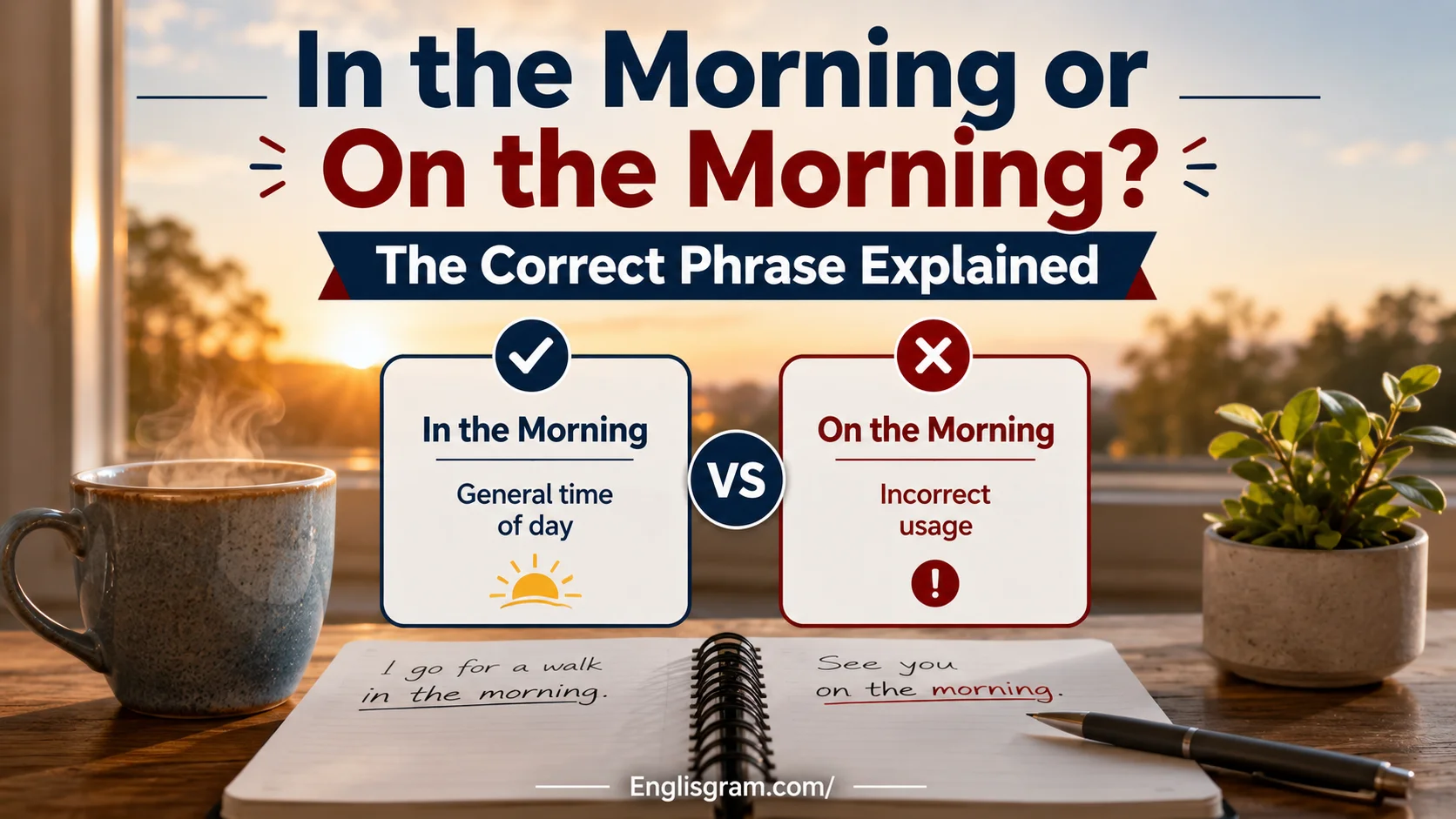
For learners, writers, and speakers, the main confusion comes from choosing between in and on in everyday English. In the Morning or On the Morning depends on context: “in” fits general time, while “on” usually points to a specific morning, date, or event. In the morning is the standard, everyday, and commonly used expression for a general time of day, including parts of the day and broad periods such as months, seasons, and years.
In the morning is less common and usually connects a specific morning with a particular event, date, or occasion. For example, on the morning of a Monday morning, someone might describe the start of a new job. These rules become easier through practical examples instead of fluffy or vague explanations. In my experience, this kind of practice helps people move through the world of language with greater confidence.
You can treat these examples like navigating stepping stones until the correct phrases feel natural, clear, and meaningful in an English sentence.The power of context becomes clearer in emails, WhatsApp messages, conversations, and social media posts, where even seasoned speakers can slip during quick communication.
In the Morning: The Standard Expression
What Does “In the Morning” Mean?
“In the morning” refers to the morning as a general period of the day. You use it when you aren’t pointing to one particular morning as a specific calendar event.
For example:
I usually read in the morning.
This sentence doesn’t tell us which morning. It describes a habit that happens during morning hours in general.
You can use the phrase when talking about:
- Daily routines
- Habits
- General plans
- Regular activities
- Past experiences without a specific date
- Future activities without a specific day
- The general morning period
Consider these examples:
- I drink coffee in the morning.
- She goes for a walk in the morning.
- We usually start work in the morning.
- He studies better in the morning.
- They called me in the morning.
- I’ll finish the report in the morning.
In each sentence, morning functions as a general time period rather than a particular date.
Why Do We Say “In the Morning”?
English commonly uses in with larger or less precise periods of time.
Compare these familiar expressions:
| Time expression | Example |
| in the morning | I exercise in the morning. |
| in the afternoon | We met in the afternoon. |
| in the evening | She studies in the evening. |
| at night | He works at night. |
The preposition in treats the morning as a period that contains a range of possible times.
Think of it like being inside a time window. You aren’t identifying one exact point. You’re placing an activity somewhere within that broader morning period.
That’s why this sounds natural:
I usually check my messages in the morning.
You’re describing when the activity normally happens, not identifying a particular morning on a calendar.
When Should You Use “In the Morning”?
Use “in the morning” when the exact day isn’t important.
For example, imagine someone asks:
“When do you usually go running?”
A natural answer would be:
“I go running in the morning.”
You could also say:
“I prefer studying in the morning because I’m more focused.”
The sentence describes a general preference. It doesn’t matter whether you mean Monday, Tuesday, or Saturday.
Other natural examples include:
- My alarm goes off early in the morning.
- Birds are especially active in the morning.
- I like to plan my day in the morning.
- She often feels tired in the morning.
- The store gets busy in the morning.
- We can talk about it in the morning.
On the Morning: When Is It Correct?
What Does “On the Morning” Mean?
“On the morning” is usually used when you’re referring to a particular morning. In most cases, the phrase needs additional information to identify which morning you’re talking about.
For example:
On the morning of the wedding, everyone woke up early.
Here, the wedding identifies the particular morning.
Likewise:
On the morning of July 4, the streets were unusually quiet.
The date identifies the morning.
This is the major difference between the two expressions:
in the morning = a general morning period
on the morning of… = a specific morning
“On the Morning of” a Specific Day or Event
One of the most useful structures is:
on + the morning + of + specific date/event
Examples include:
- on the morning of the exam
- on the morning of the wedding
- on the morning of July 4
- on the morning of his departure
- on the morning of the accident
- on the morning of the election
- on the morning of the meeting
Each expression points toward one identifiable morning.
For example:
On the morning of the interview, I woke up at 6 a.m.
The sentence doesn’t describe interviews in general. It identifies the particular morning when that interview happened.
That’s why on works naturally.
Examples of Correct “On the Morning” Usage
Consider these sentences:
On the morning of the exam, Maria reviewed her notes.
On the morning of the wedding, the bride received a phone call.
On the morning of June 12, the company released its statement.
On the morning of his departure, his family gathered at the airport.
On the morning of the storm, strong winds damaged several buildings.
Every example identifies a particular morning.
Notice something important: “on the morning” usually doesn’t carry the full meaning by itself. The words that follow it tell you which morning you mean.
In the Morning vs. On the Morning: The Key Difference
The simplest comparison looks like this:
| Phrase | Meaning | Example |
| in the morning | Morning in general | I exercise in the morning. |
| on the morning of + event | A specific morning | I exercised on the morning of the race. |
| on + day + morning | A specific morning | I exercised on Sunday morning. |
The distinction is really about generality versus specificity.
General Time vs. Specific Time
Compare these two sentences:
I saw John in the morning.
I saw John on the morning of the accident.
The first sentence gives us a broad time reference. We know it happened during the morning.
The second sentence gives us a particular reference point. The accident identifies exactly which morning the speaker means.
Here’s another comparison:
We left in the morning.
We left on the morning of our flight.
The first could describe almost any morning. The second refers to one particular morning associated with the flight.
The Simple Rule to Remember
A useful shortcut is:
General morning → in
Specific day or event → on
For example:
- in the morning
- on Monday morning
- on the morning of the meeting
- on the morning of July 10
However, don’t turn this into an absolute rule that every sentence containing a specific morning must be used. English has other natural expressions such as tomorrow morning, this morning, and yesterday morning.
The important point is to recognize the standard patterns rather than force one preposition into every situation.
In the Morning vs. On the Morning of
General Time vs. a Particular Morning
The difference becomes obvious when you place similar sentences side by side.
| General | Specific |
| I felt nervous in the morning. | I felt nervous on the morning of the exam. |
| We went outside in the morning. | We went outside on the morning of the festival. |
| She called me in the morning. | She called me on the morning of the wedding. |
| They arrived in the morning. | They arrived on the morning of June 5. |
The first column doesn’t identify one particular morning.
The second column does.
Everyday Routine Examples
When you’re talking about routines, in the morning is almost always the natural choice.
For example:
I brush my teeth in the morning.
She checks her calendar in the morning.
We usually eat breakfast in the morning.
He listens to podcasts in the morning.
These sentences describe repeated behavior. You’re not discussing one special morning.
Even when the activity happened in the past, in the morning can describe a general or nonspecific time:
When I was younger, I played outside in the morning.
The sentence doesn’t identify one specific morning.
Specific Event Examples
When a morning becomes important because something particular happened on it, on often appears.
On the morning of the interview, I arrived 20 minutes early.
On the morning of the race, the weather suddenly changed.
On the morning of the announcement, reporters gathered outside the building.
The event acts like a label attached to that morning.
It’s similar to saying, “that particular morning when the interview happened.”
“On Monday Morning” vs. “In the Morning”
Why “On Monday Morning” Is Correct
Monday makes the morning specific.
Compare:
I’ll call you in the morning.
This means the call will happen sometime during the morning. The exact day may already be obvious from context or may not matter.
Now consider:
I’ll call you on Monday morning.
This identifies a particular morning: Monday morning.
The preposition on commonly introduces specific days and dates:
- on Monday
- on Tuesday
- on July 4
- on Christmas Day
- on Sunday morning
- on Friday evening
When morning follows a specific day, on remains natural:
We have a meeting on Monday morning.
The train leaves on Tuesday morning.
I’ll send the document on Friday morning.
Other Specific-Day Examples
These all sound natural:
- on Monday morning
- on Tuesday morning
- on Wednesday morning
- on Thursday morning
- on Friday morning
- on Saturday morning
- on Sunday morning
You can also use expressions such as:
- on Christmas morning
- on Easter morning
- on New Year’s morning
These refer to a morning associated with a particular day or occasion.
Read More: Tomatoes or Tomatoes – Which Is Correct? Understanding the Right Spelling
Is “On the Morning” Correct by Itself?
Why It Usually Sounds Incomplete
The phrase “on the morning” isn’t normally the best choice when it stands alone.
For example:
I arrived on the morning.
A reader will probably wonder:
Which morning?
A more natural sentence would be:
I arrived in the morning.
Or, if you’re talking about a particular occasion:
I arrived on the morning of the meeting.
Similarly:
We spoke on the morning.
Better:
We spoke in the morning.
Or:
We spoke on the morning of the conference.
The issue isn’t that on can never appear before “the morning.” It absolutely can. The problem is that the generally points toward something identifiable, while on the morning often doesn’t tell the reader what identifies it.
When Context Makes It Understandable
Context can sometimes make the reference clear.
Suppose two people are discussing a particular event:
“What happened before the ceremony?”
“On the morning, everyone arrived early.”
Here, the surrounding conversation might make the meaning understandable.
Even then, many speakers would choose a more explicit expression if clarity matters:
“On the morning of the ceremony, everyone arrived early.”
Good writing usually makes the reference clear instead of making the reader reconstruct it.
Common Mistakes With “In the Morning” and “On the Morning”
Using “On the Morning” for General Habits
One common mistake is using on when describing a regular routine.
I usually go jogging on the morning.
Better:
I usually go jogging in the morning.
Why?
Because you’re talking about morning generally. You’re not identifying one particular morning.
Another example:
She drinks tea on the morning.
She drinks tea in the morning.
The second sentence sounds natural because it describes a habitual action.
Omitting Information After “On the Morning”
Another common problem appears when writers use on the morning without identifying the morning.
We met on the morning.
Better:
We met in the morning.
Or:
We met on the morning of the conference.
The correct version depends on your intended meaning.
Confusing “At Morning” With “In the Morning”
Learners sometimes write at morning because English uses at for some specific time expressions.
In standard modern English, however:
I wake up at morning.
The normal expression is:
I wake up in the morning.
English doesn’t always let you predict the preposition from logic alone. Time expressions often follow established usage patterns.
Compare:
- at 7 a.m.
- in the morning
- on Monday morning
- at night
These patterns need to become familiar through use.
Confusing “In the Morning” With “On a Morning”
These expressions aren’t identical.
In the morning refers to the morning period generally.
On a morning can refer to one unspecified morning.
Compare:
I like walking in the morning.
This describes a general habit.
Now:
On a cold morning, the lake can look completely different.
Here, a cold morning refers to one type of morning rather than the general period.
Another example:
On a summer morning, the streets can become busy early.
This describes a particular kind of morning without necessarily identifying a specific date.
Related Morning Time Expressions
English has several natural ways to describe morning. Learning them together makes the preposition rules much easier.
In the Morning
Use this for the general morning period.
I work best in the morning.
On Monday Morning
Use this when a particular day identifies the morning.
The meeting starts on Monday morning.
On the Morning of the Event
Use this when a particular event identifies the morning.
She received the news on the morning of the ceremony.
Early in the Morning
Early in the morning means near the beginning of the morning.
We left early in the morning.
Notice that in remains part of the expression.
You wouldn’t normally replace it with on:
early on the morning
unless you’re using a longer specific construction such as:
Early on the morning of the race, the roads were closed.
Here, on belongs to the specific construction on the morning of the race.
Tomorrow Morning
English normally says:
I’ll call you tomorrow morning.
You don’t need in or on.
Not:
I’ll call you tomorrow morning.
Not:
I’ll call you tomorrow morning.
Simply use:
I’ll call you tomorrow morning.
This Morning
Likewise:
I saw her this morning.
Yesterday Morning
You can say:
We left yesterday morning.
These expressions are worth learning as complete phrases because English doesn’t always use a preposition before every time expression.
At 8 in the Morning
You can combine a precise clock time with a general part-of-day expression:
The train leaves at 8 in the morning.
Here, at identifies the precise time while it identifies the part of the day.
You could also say:
The train leaves at 8 a.m.
The first version sounds especially natural in everyday conversation.
A Practical Comparison Table
| Expression | Correct? | Typical meaning |
| in the morning | General morning period | |
| on the morning | Usually needs context or additional information | |
| on the morning of the exam | Specific morning | |
| on Monday morning | Specific day | |
| at morning | Not standard everyday English | |
| early in the morning | Early part of morning | |
| tomorrow morning | The next day’s morning | |
| this morning | The current/recent morning | |
| yesterday morning | The previous day’s morning | |
| at 8 in the morning | Specific clock time during morning |
British English and American English
The central distinction between “in the morning” and “on the morning of” works in both American and British English.
For example, American English commonly uses:
I usually leave in the morning.
British English uses the same structure:
I usually leave in the morning.
Likewise:
On the morning of the election, voters arrived early.
The preposition rule doesn’t change simply because the variety of English changes.
There can be differences in other time expressions, vocabulary, punctuation, or regional habits. However, in the morning remains the standard general expression in both major varieties.
FAQs
Is “in the morning” or “on the morning” correct?
In the morning is the standard choice when you mean a general time of day. On the morning is less common and usually refers to a specific morning connected to a particular event or date.
When should I use “in the morning”?
Use in the morning for general routines or activities. For example, “I drink coffee in the morning” refers to a regular part of the day.
When is “on the morning” used?
Use in the morning when you identify a particular occasion, date, or event. For example, “On the morning of the meeting, I arrived early.”
Is “on Monday morning” correct?
Yes. Monday morning is natural because Monday identifies a specific day. You can also say, “I usually exercise in the morning.”
Why do learners confuse “in” and “on”?
The confusion comes from preposition choice. English uses in for broader periods and on for particular days or dates, although context can affect the final wording.
Conclusion
Understanding in the morning vs. in the morning becomes easier when you focus on whether you’re talking about a general time or a specific occasion. Use in the morning for everyday routines and broad time references. Use in the morning when a particular event, date, or day gives the morning a specific context. With regular practice, this small grammar difference becomes much more natural in both spoken English and written communication.