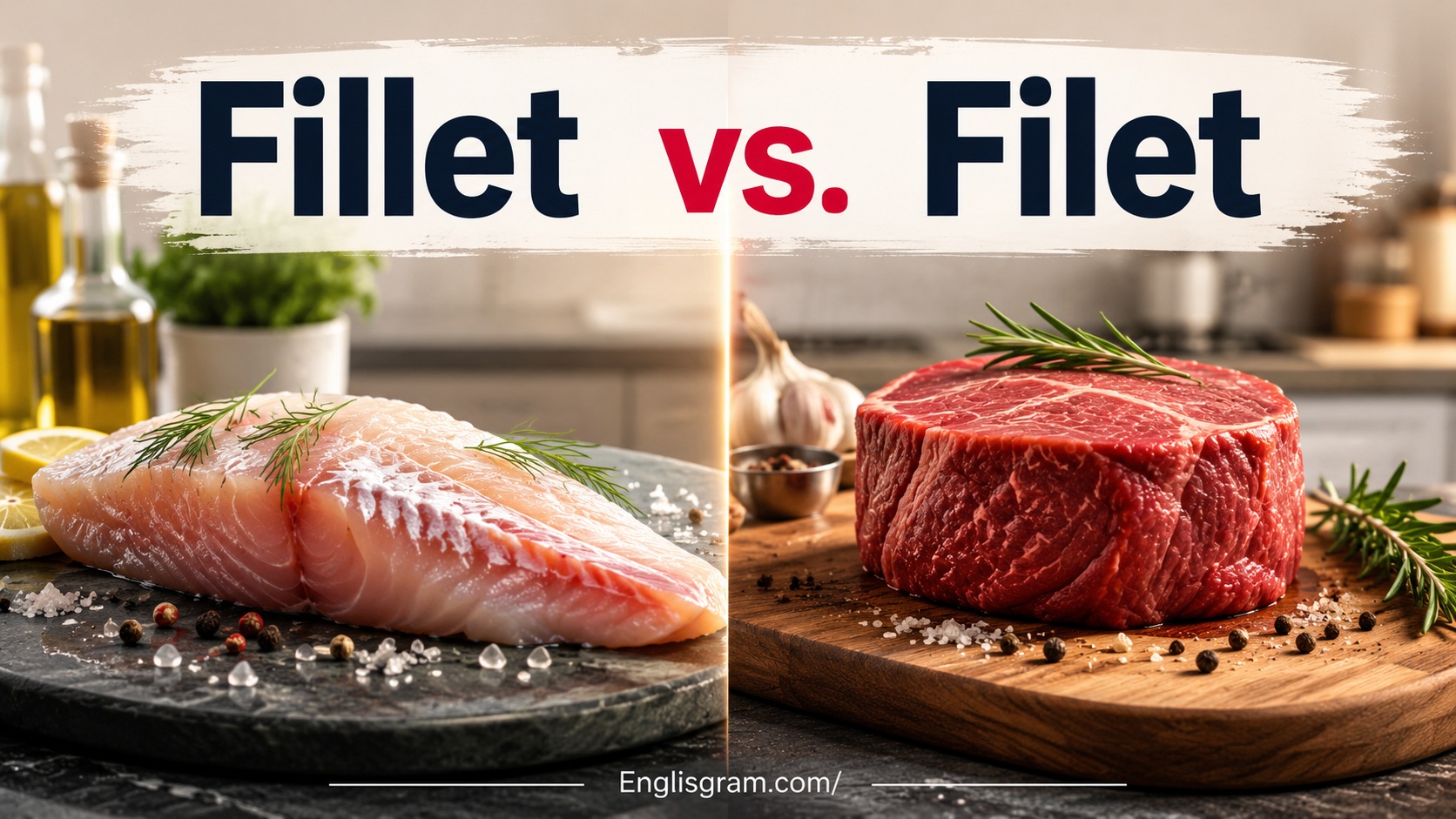
Fillet vs. Filet helps you choose the right spelling with confidence, making your writing clear, natural, polished, and easy to understand.Many people confuse Fillet and Filet because they have identical meanings in most contexts. Both describe a boneless meat or fish cut, boneless piece, meat cut, strip, or strips that are carefully cut by carefully separating the bone. The general term Fillet is more common in general English, while Filet is the American variant often connected with French cuisine, French-derived dishes, French terminology, specific culinary terms, and filet mignon.
Most American and Canadian writers, dictionaries, and every major dictionary accept both spellings, but usage, preference, setting, context, writing style, and regional differences still matter. In North America and outside North America, one spelling may be heavily favored, simply favored, or reserved for cuisine and restaurant language.
These different words share the same idea, although English, American English, Canadian English, and the wider English language have been influenced by Latin, Germanic languages, and loanwords, creating various ways of spelling. Knowing the difference, spelling difference, correct usage, common usage, word choice, expression, and terminology helps your text sound natural, polished, and knowledgeable instead of awkward because of the wrong spelling in the wrong place.
What this guide covers
This guide breaks down:
- the meaning of fillet and filet
- how they compare in British English and American English
- why restaurants often prefer filet
- how to pronounce each word
- when to use one form over the other
- common mistakes people make
- related food terms that get mixed up all the time
By the end, you will know exactly when to use fillet and when filet makes more sense.
Fillet vs. Filet meaning: are they the same?
In most cases, yes. The two words overlap heavily.
Both words can refer to:
- a boneless cut of fish
- a boneless cut of meat
- in some contexts, a strip or narrow slice
- in technical fields, a rounded edge or decorative band
So why do people treat them like different words?
Because English borrowed the term from French, and the spelling changed depending on place, industry, and habit. That is why you will see fillet in a recipe book, filet on a steakhouse menu, and filet mignon as a standard culinary term.
Quick comparison table
| Feature | Fillet | Filet |
| Basic meaning | Boneless cut of meat or fish | Same basic meaning |
| Language root | From French | French spelling |
| Common in general English | Very common | Less common outside culinary branding |
| Common on menus | Yes | Very common |
| Common with steak | Sometimes | Very common, especially in filet mignon |
| Common with fish | Very common | Less common |
| Formal correctness | Correct | Correct |
The key point is simple: they are not enemies. They are close cousins.
Fillet meaning in English
The word fillet is the spelling most people expect in general English, especially when talking about fish.
Fish fillet
A fish fillet is a boneless piece of fish cut lengthwise from the body. It usually has little to no bone left in it, which makes it easier to cook and eat.
Examples:
- cod fillet
- salmon fillet
- tilapia fillet
- haddock fillet
When someone says, “I ordered a fish fillet,” they usually mean a boneless cut that can be grilled, baked, fried, or pan-seared.
Meat fillet
A fillet can also refer to a cut of meat, especially in British English. In that sense, it often means a tender, boneless section of beef, pork, or other meat.
For example:
- fillet steak
- fillet of beef
- fillet of pork
This usage is common in restaurants, recipes, and butcher shops.
Other meanings of fillet
The word does not only belong to food. It can also describe:
- a thin decorative band
- a narrow strip
- a rounded inner edge in design, engineering, and manufacturing
That wider meaning explains why the word has lasted so long in English. It has useful applications beyond the kitchen.
Filet meaning and why it appears so often in food writing
Filet is the French spelling. English still uses it, especially in culinary settings.
In practice, filet often appears when the writer or restaurant wants to evoke:
- French cuisine
- elegance
- premium quality
- classic fine dining
That is why you will see the word on upscale menus far more often than in everyday conversation.
Filet in modern usage
In modern English, filet usually appears in phrases like:
- filet mignon
- filet of sole
- beef filet
- grilled filet
Sometimes the spelling is a stylistic choice. Sometimes it follows culinary tradition. Either way, the form signals a more restaurant-focused tone.
Why the spelling feels more premium
Language is never just language. It also carries feeling.
The word filet often sounds more refined because it looks French. Restaurants know that. Menus use that effect on purpose. A customer may not consciously think, “This word is sophisticated,” but the spelling quietly shapes perception.
That is one reason filet survives even where fillet would also be correct.
Language sells the meal before the first bite.
That is especially true in fine dining.
Fillet vs. Filet pronunciation
The pronunciation is part of the confusion. In English, the two spellings are often pronounced almost the same way.
Common pronunciations
- fillet: often pronounced like “FILL-it” in English
- filet: often pronounced like “fill-AY” or “fil-LAY” in culinary settings
The pronunciation can vary by region and context. In some places, people say fillet with the French-style ending. In others, they use an anglicized version.
What matters most
The important thing is this: pronunciation depends on usage more than spelling alone.
A person discussing fish in everyday English may say “fillet” in a straightforward way. A chef speaking about a steakhouse special may say “filet” with a French-influenced sound.
So if you hear two people say the word differently, that does not automatically mean one of them is wrong. Context often drives the difference.
Fillet vs. Filet in British English and American English
The spelling choice often depends on region.
British English
In British English, fillet is usually the standard spelling for fish and meat. You will see it in cookbooks, grocery stores, restaurants, and general writing.
Examples:
- fish fillet
- fillet steak
- fillet of beef
American English
In American English, fillet is also common, especially for fish. However, filet appears more often in restaurant branding and specific French-derived food terms.
Examples:
- fish fillet
- filet mignon
- filet of sole
- grilled filet
So the difference is not about one country always using one spelling and the other country using the opposite. It is more layered than that.
Simple usage chart
| Context | Common in British English | Common in American English |
| Fish | Fillet | Fillet |
| General food writing | Fillet | Fillet |
| Steak menus | Fillet | Filet often |
| Filet mignon | Less common as spelling choice | Very common |
| French-style menu language | Sometimes | Very common |
The safest rule is to match the tone and audience of your writing.
Read More:A Big Ask – Idiom & Meaning: What It Means, How to Use It, and When It Fits
Why restaurants often use filet instead of fillet
This is one of the biggest reasons people keep asking about the spelling.
Restaurants do not always choose filet because they must. They choose it because it sounds more special.
Why the spelling works in marketing
The word filet can make a dish seem:
- more refined
- more authentic in a French-inspired setting
- more premium
- more expensive
- more elegant
That makes it useful on menus, where language helps frame the customer’s experience.
For example, compare:
- beef fillet
- beef filet
Both can refer to a tender cut. Still, the second one often feels more upscale because of the French spelling.
Menus are about tone
A menu is not just a list of food. It is a sales tool. The wording has to do more than identify the dish. It has to shape the mood.
That is why restaurants often lean into forms like:
- filet
- à la carte
- consommé
- soufflé
- mousse
The spelling filet belongs in that same family of food language.
What is filet mignon?
Filet mignon is one of the most famous culinary terms involving this word.
It refers to a tender cut of beef taken from the smaller end of the tenderloin. It is known for being very soft, lean, and delicate in texture.
Why the French spelling stayed
The phrase comes from French culinary tradition, so the spelling remained French. English speakers did not replace it with fillet mignon. The French form stayed standard in cooking and restaurant language.
That is why people almost always say and write:
- filet mignon
not:
- fillet mignon
What makes it different from other steak cuts
Filet mignon is prized for tenderness. It is not usually chosen for intense beefy flavor the way some other cuts are. Instead, people love it because it is soft, elegant, and easy to eat.
Common misunderstanding
Some people think filet mignon means the same thing as any steak with a fancy name. It does not. It refers to a specific part of the tenderloin and carries a long culinary tradition.
Why fish fillet is more common than fish filet
When people talk about fish, fillet is usually the standard word in English.
Reasons fish fillet won out
- It fits everyday English better.
- It appears in grocery packaging and recipes.
- It is easy to understand.
- It has become the default form in many markets.
That is why you are more likely to see:
- fish fillet
- salmon fillet
- cod fillet
than:
- fish filet
That said, filet of sole and similar phrases still appear in restaurant language, especially in French-influenced dishes.
Practical rule
If you are writing about fish in general, fillet is usually the safer choice.
If you are writing about a specific dish with French styling, filet may fit better.
Fillet vs. Filet: side-by-side usage guide
Here is a practical comparison that shows where each form tends to work best.
| Situation | Best choice | Why |
| Everyday writing about fish | Fillet | Standard English form |
| Grocery shopping list | Fillet | Clear and familiar |
| Recipe writing | Fillet | Most readers expect it |
| Steakhouse menu | Filet | Traditional and polished |
| Filet mignon | Filet | Fixed culinary term |
| British English food writing | Fillet | Common standard |
| French cuisine references | Filet | Matches source language |
| Technical design or engineering | Fillet | Common technical term |
| Decorative or architectural use | Fillet | Established term |
This table is a good reminder that the “right” spelling depends on the context, not just the dictionary entry.
Origin and etymology of fillet and filet
Both words trace back to French roots.
The French connection
English borrowed the word from French, where filet has long referred to a strip, thread, or narrow band. Over time, English adapted the word into fillet as one common spelling.
Language borrowing like this is normal. English does it all the time. It takes words from Latin, French, German, Italian, and many other languages. Then it reshapes them for local use.
Why both spellings survived
Some borrowed words settle into one form and one form only. This one did not.
Instead, English kept both:
- fillet as the more anglicized, general spelling
- filet as the French spelling used in food language and branding
That is why this pair still causes questions today. They are both alive in modern English, just in slightly different lanes.
Common mistakes people make with fillet and filet
People usually make one of these mistakes:
Thinking the words have totally different meanings
They usually do not. In most food contexts, they are extremely close in meaning.
Using filet everywhere
That can sound too French or too branded if the setting is simple or everyday. A recipe about baked cod usually sounds more natural with fillet.
Using fillet where a French culinary phrase is expected
If you write fillet mignon, you will likely look unfamiliar with standard culinary spelling. Filet mignon is the recognized form.
Ignoring audience and region
A British recipe, an American menu, and a French-inspired restaurant review may each prefer different wording. Good writing respects that.
Mixing up food use with technical use
In engineering or design, fillet can mean something completely different from a food cut. Context matters a lot.
Examples of fillet in sentences
Here are natural examples that show how fillet works in real writing.
- I ordered a salmon fillet with vegetables.
- The recipe calls for a fish fillet without skin.
- She bought a fillet steak for dinner.
- The butcher trimmed the fillet carefully.
- The chef prepared a pan-seared cod fillet.
These sentences sound plain and natural. That is usually what you want in everyday English.
Examples of filet in sentences
Now look at filet in a more culinary or branded setting.
- The restaurant served a filet mignon with sauce.
- He ordered a grilled filet with roasted potatoes.
- The menu listed a filet of sole with lemon butter.
- She wanted the most tender filet on the plate.
- The chef recommended the beef filet for a special dinner.
Notice how filet often appears in settings where the food sounds more refined or traditionally French.
When should you use fillet?
Use fillet when you want the most standard, clear, and natural spelling in English.
Best situations for fillet
- fish recipes
- grocery labels
- general food writing
- British English writing
- technical or mechanical use
- straightforward everyday communication
Why fillet is usually the safer choice
It feels familiar. It reads cleanly. It does not make the sentence seem overly styled.
If you are unsure which spelling to use, fillet is often the better default.
When should you use filet?
Use filet when the setting clearly fits French culinary tradition or restaurant branding.
Best situations for filet
- filet mignon
- French-influenced menus
- upscale steakhouse language
- culinary writing that mirrors restaurant style
- dishes where the term is already established by convention
Why filet works well here
It carries a specific tone. It signals a certain style of dining and a certain level of polish.
That is useful when you want the language to match the experience.
Related food terms people confuse with fillet and filet
These words often show up near the same conversations, so it helps to separate them.
Tenderloin vs. filet mignon
The tenderloin is the larger muscle. Filet mignon comes from part of that tenderloin. The terms are related but not identical.
Steak vs. fillet
A steak is a general term for a slice of meat. A fillet is a specific tender cut. Not every steak is a fillet.
Fish steak vs. fish fillet
A fish steak is usually cut crosswise and may include bone. A fish fillet is boneless and cut lengthwise.
Cutlet vs. fillet
A cutlet can refer to a thin slice of meat, often breaded or prepared in a particular style. A fillet refers more specifically to a boneless cut.
These differences matter because they affect both cooking and description.
A closer look at fillet in technical and non-food use
Many people only know fillet as a food word. That is not the whole story.
In engineering and design
A fillet can mean a rounded interior edge where two surfaces meet. Designers and engineers use this term often because rounded corners reduce stress and improve durability.
In architecture and decoration
The word can also describe a narrow band or molding. That gives it a place in older design language too.
Why this matters
Understanding these meanings helps you avoid thinking of fillet as just a menu word. It is a broader English term with a long working life.
FAQS
1. Is fillet the same as filet?
Yes. In most cases, fillet and filet mean the same thing: a boneless piece of meat or fish. The main difference is spelling and where each form is commonly used.
2. Which spelling is more common: fillet or filet?
Fillet is the more common spelling in general English, especially outside North America. Filet is often used in American menus and French-inspired dishes, such as filet mignon.
3. Can I use filet when writing in English?
Yes. Filet is a correct spelling, particularly in American English and culinary writing. However, if you are writing for a general audience, fillet is usually the safer and more widely recognised choice.
4. What does filleting mean?
Filleting is the process of carefully cutting meat or fish away from the bone to create a clean, boneless piece. It is a common cooking technique used by both home cooks and professional chefs.
5. Why does the spelling matter?
Using the right spelling makes your writing look more natural and professional. Choosing fillet or filet based on your audience, context, and writing style helps avoid confusion and improves clarity.
conclusion day
Conclusion
The choice between fillet and filet is mostly about spelling, context, and style, not meaning. Both words describe a boneless cut of meat or fish, but fillet is more common in general English, while filet often appears in American and French-inspired culinary writing. Understanding when to use each spelling helps your writing sound clear, natural, and professional. Whether you are writing a recipe, reading a restaurant menu, or discussing cooking techniques, choosing the correct form ensures your message fits the audience and the situation.