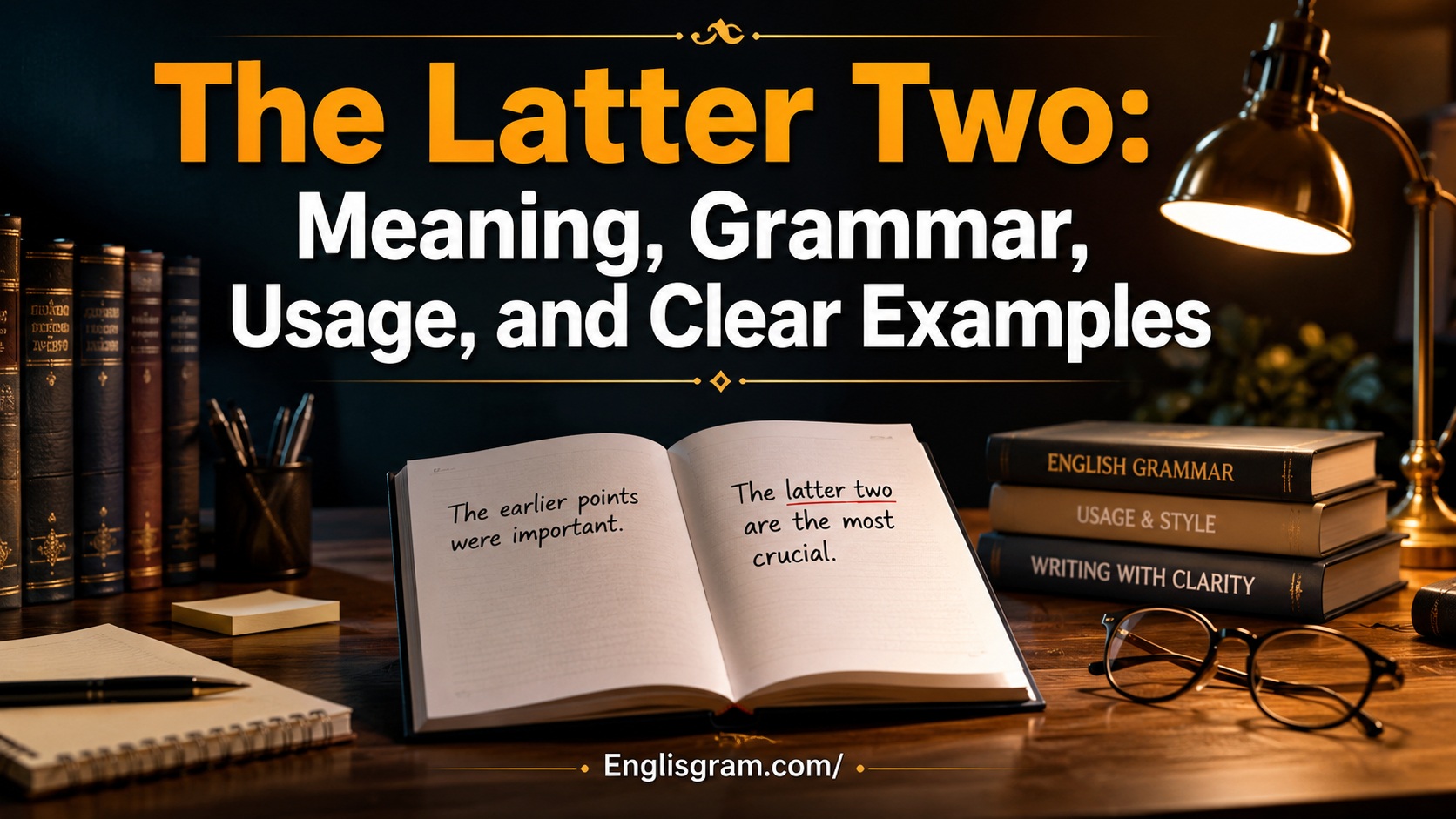
The Latter Two: Mastering the Art of Referring to the Last Two Items is a simple concept that improves spoken English, written English, and everyday communication. When referring to a pair, group, or group of items, knowing the difference between former, latter, former and latter, former versus latter, and the latter helps you refer to the first, second, second item, third, third item, last, Last, last two items, and final items in a list, lists, shorter lists, or more than two things mentioned.
From my experience, many people learning English find these subtle distinctions seemingly simple, yet they still cause confusion. In real conversation, speaking, writing, or a longer article, the riht method, approach, and phrase usage depend on the sequence and order. For example, if a list includes apples, bananas, and oranges, the latter two identify the second item and third item instead of repeating the items. This works best because it helps avoid repetition, mix-up, mix-ups, awkward wording, and unclear structure while creating effective communication with a more natural style.
With regular practice, practice, using the rules as they are normally applied, while allowing flexibility to use them flexibly, you gain a deeper understanding of the total context. Helpful examples, another example, detailed explanation, and Language Resources shed light on the common quandary, common mistakes, and exceptions that often confuse learners or are used incorrectly.
What Does the Latter Two Mean?
The latter two refers to the last two items in a list of three or more items.
That is the core idea.
If you mention four things, the latter two are the final two. If you mention six things, the latter two are still the final two. The phrase does not mean “the two that came earlier.” It points to the items near the end of the list.
Simple example
I bought apples, oranges, pears, and grapes.
The latter two were the sweetest.
In this sentence, the latter two means pears and grapes because they are the last two items named.
That is the main rule. Once you understand that, the rest becomes much easier.
Why people use it
People use the latter two when they want to avoid repeating nouns. It is handy in essays, reports, emails, and discussions where you do not want to sound clunky.
For example:
- “The report covers sales, costs, margins, and growth. The latter two matter most for this quarter.”
- “We discussed design, budget, timeline, and staffing. The latter two need approval.”
That said, the phrase only works well when the reader can still clearly see the original list in mind.
How the Latter Two Works in English Grammar
The phrase comes from the older pair former and latter.
- Former = the first of two items
- Latter = the second of two items
When you add two, you are simply narrowing the reference to the final two items in a longer list.
What is happening grammatically
At a basic level, the latter two works like a shorthand noun phrase. It stands in for two previously mentioned nouns. In grammar terms, it is a reference expression. It points backward in the text instead of repeating the full nouns.
That makes it useful, but also risky.
Why risky? Because the reader has to remember the original list. If the list is long or the sentence is crowded, the reference may become fuzzy.
A clear pattern
Here is the pattern:
- Name a list.
- Mention the last two items.
- Use the latter two to refer back to them.
Example:
The team reviewed research, planning, execution, and follow-up. The latter two were delayed.
Here, the reader can reasonably track that execution and follow-up are the latter two.
A practical note
The phrase sounds a little formal. It is not old-fashioned in a bad way, but it does belong to more polished writing. In casual speech, many people prefer:
- the last two
- those two
- the final two
- the actual item names
That is often the smarter choice if clarity matters more than style.
When Should You Use the Latter Two?
Use the latter two when all of these are true:
- You have already introduced a list.
- The list contains three or more items.
- The last two items are easy to identify.
- You want to avoid repeating the item names.
Good situations for the phrase
Academic writing
Writers often use it in essays and analytical papers because it keeps sentences shorter.
Example:
The study compares speed, accuracy, reliability, and cost. The latter two are the most important measures in this case.
Business writing
It works well in reports and meeting notes.
Example:
We discussed pricing, delivery, support, and training. The latter two require leadership approval.
Professional communication
If the list is already established, the phrase can help you stay concise.
Example:
The proposal includes scope, budget, timeline, and risks. The latter two need to be revised.
Everyday explanations
It can also work in plain conversation if the list is short and fresh.
Example:
I need bread, milk, eggs, and butter. The latter two are on sale.
That said, in everyday speech, many people would still say the last two because it sounds more natural.
When You Should Not Use the Latter Two
There are moments when the latter two is a bad choice, even if it is technically correct.
Do not use it when the list has only two items
This is the first hard rule.
If there are only two items, the latter two makes no sense because there are not two “latter” items. There is only one latter item in a pair.
Correct:
Between coffee and tea, the latter is stronger.
Incorrect:
Between coffee and tea, the latter two are stronger.
Do not use it when the list is unclear
If the reader cannot easily identify the original items, the phrase becomes muddy.
Example:
The company reviewed product quality, shipping delays, customer retention, pricing strategy, and marketing. The latter two need attention.
This may sound okay, but it is not perfectly clear. Does it mean pricing strategy and marketing? Probably. Still, the sentence asks the reader to do too much work.
A clearer version:
The company reviewed product quality, shipping delays, customer retention, pricing strategy, and marketing. Pricing strategy and marketing need attention.
That is cleaner. And it avoids a small mental hiccup.
Do not use it when repetition improves clarity
Sometimes repeating the nouns is not lazy. It is smart.
Example:
The presentation covered hiring, onboarding, retention, and performance reviews. The latter two were discussed in detail.
This works, but it can be even clearer as:
The presentation covered hiring, onboarding, retention, and performance reviews. Retention and performance reviews were discussed in detail.
Good writing does not always choose the shortest path. It chooses the clearest one.
Do not use it too often
Like any formal shorthand, the latter two loses force if you overuse it. If every other sentence says the latter two, the writing starts to feel mechanical.
Use it when it helps. Skip it when plain nouns would sound better.
The Latter Two vs. The Former Two
This is where many writers mix things up.
Simple difference
- The former two = the first two items in a list
- The latter two = the last two items in a list
Comparison table
| Phrase | Refers to | Best use | Example |
| The former two | The first two items | When you want to point to the start of a list | “Apples, oranges, pears, and grapes. The former two are common breakfast fruit.” |
| The latter two | The last two items | When you want to point to the end of a list | “Apples, oranges, pears, and grapes. The latter two are the juiciest.” |
Easy memory trick
Think of former as first and latter as last.
That is not a perfect mnemonic in a literal sense, but it helps many people remember the basic contrast.
Example in one sentence
The project includes research, planning, testing, and launch. The former two set the foundation, while the latter two affect delivery.
That sentence works because the reader can track the sequence clearly.
The Latter Two vs. The Last Two
These phrases overlap, but they are not always identical in tone.
The last two
This is more direct and more common in everyday English. It is usually the safer choice if you want broad readability.
The latter two
This sounds slightly more formal and compact. It is useful in edited writing where tone matters.
Which one should you choose?
Use the last two when:
- you want plain, natural language
- the audience is general
- clarity matters more than style
Use the latter two when:
- the writing is polished or formal
- the list is already clear
- you want to avoid repeating nouns
Example
The report discusses revenue, expenses, debt, and cash flow. The latter two changed most sharply.
This is fine.
But in many cases, this is even better:
The report discusses revenue, expenses, debt, and cash flow. Debt and cash flow changed most sharply.
Plain language wins more often than people think.
A useful rule
If the phrase sounds stiff in your mouth when you read it out loud, use the last two or name the items directly.
That simple test catches a lot of awkward writing.
The Latter vs. The Latter Two
These are related, but they are not the same.
The latter
This points to the second of two items.
Example:
You can choose tea or coffee. I’ll take the latter.
Here, the latter means coffee.
The latter two
This points to the last two items in a longer list.
Example:
You can choose tea, coffee, juice, or water. The latter two are best for the table.
Here, the latter two means juice and water.
Quick difference
- The latter = one item from a pair
- The latter two = two final items from a longer list
That distinction matters. People often use the latter when they really mean the last two, or they use the latter two when the list has only two items. Both mistakes weaken the sentence.
Can You Use the Latter Two With More Than Four Items?
Yes. That is actually one of the main reasons the phrase exists.
It works with any list of three or more items.
Examples with different list lengths
Three items
The menu includes soup, salad, and pasta. The latter two are vegetarian.
Four items
The plan covers research, design, testing, and launch. The latter two are still in progress.
Five items
The package includes transport, lodging, food, entry, and extras. The latter two are not included.
Six items
The report reviews sales, margins, staffing, retention, delivery, and service. The latter two need improvement.
The catch
The longer the list, the more fragile the phrase becomes. If the reader has to scroll back or mentally count too much, the sentence loses smoothness.
So yes, you can use it in long lists. But ask yourself whether the reader will thank you for it.
Often, they will not.
Read More:Delicious or Dilicious – Which Is Correct? The Complete Guide to the Right Spelling
Examples of the Latter Two in Different Contexts
A phrase is easier to understand when you see it used in real settings.
Academic writing
The article examines memory, attention, speed, and accuracy. The latter two are the strongest predictors of performance.
This sounds normal in an essay because academic writing often accepts compact reference phrases.
Business writing
The board reviewed revenue, cost control, hiring, and product quality. The latter two will shape next quarter’s strategy.
This is efficient and professional.
Technical writing
The system tracks input, processing, storage, and output. The latter two are handled by the backend.
In technical writing, compact references can be useful, but clarity still matters most.
News writing
The proposal affects taxes, wages, housing, and transport. The latter two sparked the strongest public response.
This works, though many editors would still prefer direct nouns for speed.
Everyday conversation
We need napkins, plates, cups, and forks. The latter two are missing.
This is natural enough in speech, though some speakers would still say the last two.
Legal or formal documents
The phrase appears less often here. Legal and policy writing often prefers exact nouns because precision matters more than elegance.
That is a useful pattern to remember: the more exact the field, the less tolerance there is for vague shorthand.
Sentence Examples: Correct and Incorrect Uses
Correct examples
The coach discussed offence, defence, stamina, and discipline. The latter two were the focus of training.
The plan includes pricing, packaging, marketing, and support. The latter two need approval.
You can choose between blue, green, red, and black. The latter two are my favorites.
The course covers reading, writing, speaking, and listening. The latter two are tested most heavily.
Incorrect examples
The latter two are strong.
This is too vague because there is no clear list before it.
Between coffee and tea, the latter two are better.
Wrong, because there are only two items.
The latter two of the book are exciting.
Awkward and unclear. It sounds as if a book is being split into item-like pieces.
We bought apples, bananas, and oranges. The latter two of them were ripe.
Grammatically possible, but clumsy. “The latter two were ripe” is cleaner.
Why the wrong ones fail
Most of the time, the problem is not grammar in the narrow sense. The problem is reference clarity. If the reader cannot tell exactly what the phrase points to, the sentence stumbles.
That is why careful writers focus on the reader’s experience, not just the rulebook.
Common Mistakes Writers Make With the Latter Two
Here are the most common mistakes, and they are worth watching for.
Mistake using it with only two items
As already noted, this is the easiest error to spot and the easiest to fix.
Mistake using it after a long or noisy list
If the list is too long, the phrase forces the reader to count backward and guess. That is not elegant. It is work.
Mistake mixing up former and latter
This is a classic slip.
- former = first
- latter = second
If you swap them, the meaning flips.
Mistake using it without enough context
If the reader has to hunt for the original list, the phrase fails.
Mistake overusing formal shorthand
Writers sometimes use the latter two because it sounds smart. That is the wrong reason.
Good writing is not a costume. It does not need to dress itself up to be respected.
How to Make Your Writing Clearer
The goal is not to ban the latter two. The goal is to use it well.
Use short lists when possible
Shorter lists are easier to reference.
Repeat the nouns when clarity matters
If you suspect confusion, say the names again.
Keep sentence structure simple around the reference
The cleaner the sentence, the easier the reference is to follow.
Prefer the direct option in high-stakes writing
If you are writing instructions, policies, or technical guidance, direct nouns often beat shorthand.
Read it out loud
This is a powerful test. If your sentence sounds awkward or stiff when spoken, it probably needs revision.
A useful writing quote says it well:
“Clarity is kindness.”
That fits this topic perfectly. A reader should not have to decode your sentence like a locked box.
A Real-World Case Study
Case study: a team update email
A project manager writes:
We reviewed scope, budget, timeline, and staffing. The latter two are under pressure.
This is grammatically fine. It is also compact.
But imagine the audience is a mixed group: designers, marketers, and executives. Some readers may have to pause and count the list to confirm what the latter two means. That tiny pause breaks flow.
A clearer version would be:
We reviewed scope, budget, timeline, and staffing. Timeline and staffing are under pressure.
Now compare both versions:
- The first is shorter.
- The second is clearer.
In a fast-moving workplace, clarity usually wins.
What this shows
This phrase is not wrong. It is just not always the best tool. Skilled writers choose the tool that fits the moment, not the one that merely sounds formal.
Alternatives to the Latter Two
Sometimes you need a simpler or sharper option.
The last two
Best when you want natural, everyday English.
Those two
Best when the context already makes the reference clear.
The final two
Best when the sequence matters and you want a polished tone.
The second and third items
Best when precision matters more than style.
Naming the items directly
Best when clarity matters most.
Example comparison
Instead of:
The latter two require approval.
You could say:
The budget and timeline require approval.
That version is often stronger because it leaves no room for guesswork.
FAQS
1. What does “the latter two” mean?
The latter two refers to the last two items in a list of three or more items. It helps you avoid repeating the item names and makes your writing easier to read.
2. What is the difference between former and latter?
Former refers to the first of two previously mentioned items, while latter refers to the second. If there are three or more items, phrases like the latter two can refer to the final two items in the list.
3. Can I use the latter two in formal writing?
Yes. The latter two is suitable for essays, reports, academic writing, and professional communication. It creates a clear reference and helps keep sentences concise.
4. Is the latter two used in everyday conversation?
Yes. Although it appears more often in formal writing, native English speakers also use the latter two in conversations when they want to refer to the final two items without repeating them.
5. How can I avoid mistakes when using the latter two?
Always check the order of the items you mentioned. The latter two should only refer to the final two items in the sequence. If the reference is unclear, repeat the item names instead.
Conclusion
Understanding the latter two is a simple way to make your English more precise and natural. Whether you are writing an article, giving a presentation, or having a conversation, this expression helps you refer to the final two items without unnecessary repetition. With regular practice and attention to the order of items, you can use former, latter, and the latter two confidently in both spoken and written English.