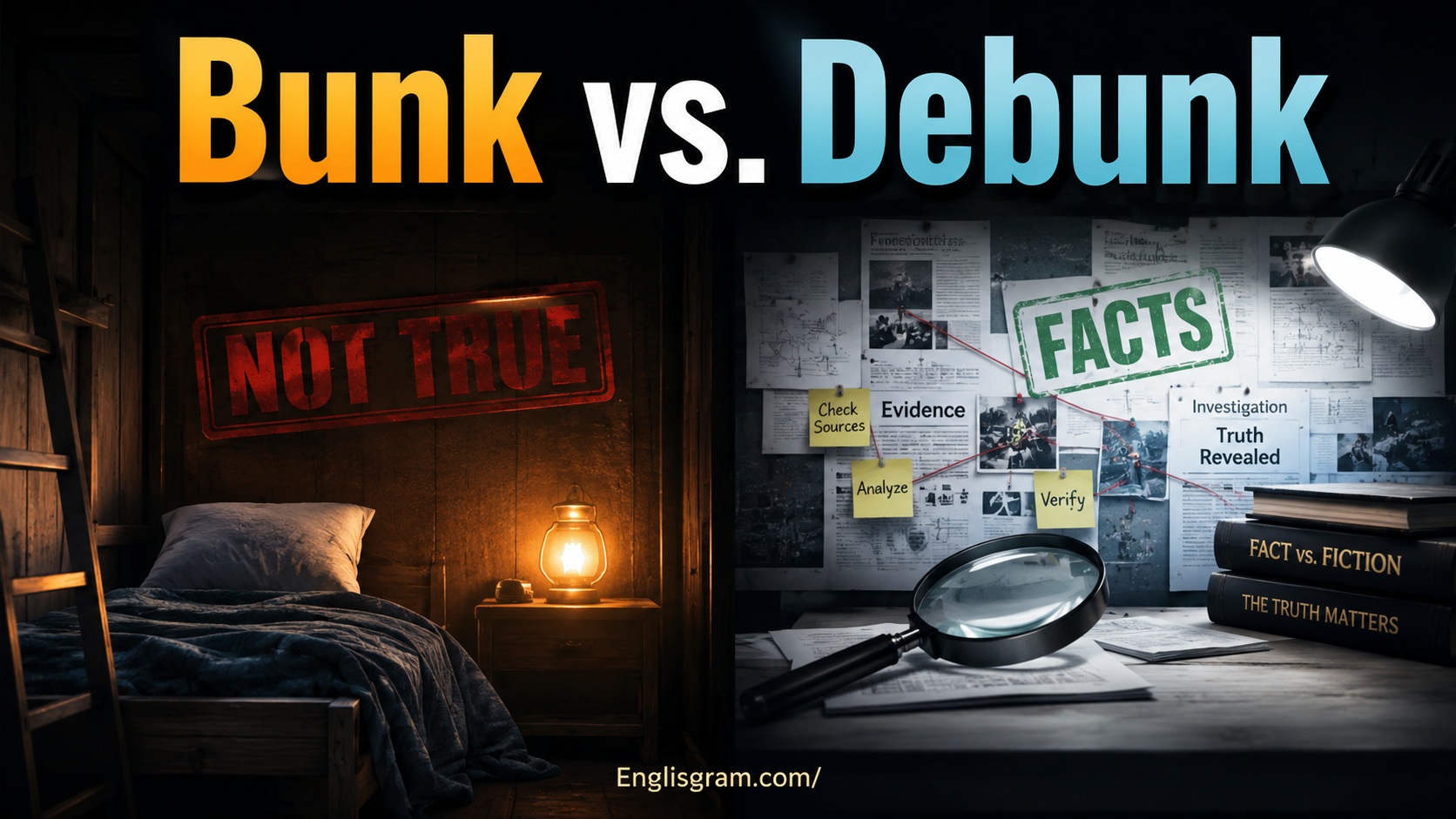
Bunk vs. Debunk explains the difference between two words with similar sounds but different meanings, helping you choose the correct word with confidence every time.When I began editing articles, I realised many readers mixed up Bunk and Debunk because they sound similar and share a common root. This guide offers a clear explanation in plain English, using comparison, contrast, definitions, and context to help you distinguish their distinct meanings.
Better vocabulary, grammar, word choice, and language learning improve communication, writing, speech, editing, and everyday conversations, whether on social media, in the news, or while learning. As your understanding grows, confusion, misunderstanding, and being misunderstood become less common, making it easier to remember the difference, respond correctly, clearly, and faster, without second-guessing yourself every time.
The term Bunk usually means nonsense, nonsensical talk, empty talk, foolishness, or even a bed, narrow bed, or shared room with room with another person. It also appears in the phrase do a bunk, meaning to leave, escape, or go hastily. As a noun, noun form, mass noun, or verb, it has several forms of usage. Debunk, by contrast, refers to expose, exposed, exposing, or expose as false by proving a false claim, nonsense claim, claim, or claims with proof, verification, evidence, evidence-based methods, evidence-based research, logic, and logical reasoning.
Bunk vs. Debunk in Simple Words
Before going deeper, here is the shortest way to remember it:
- Bunk = nonsense, rubbish, or a type of bed
- Debunk = to prove a claim is false or misleading
That is the core difference. The rest of the article fills in the details.
What Does Bunk Mean?
The word bunk has more than one meaning, which is one reason people get confused. In modern English, it usually shows up in one of these ways:
- as nonsense
- as a bed
- as a sleeping place
- as part of phrases like bunk off
Bunk as Nonsense
In informal English, bunk often means something like “rubbish,” “nonsense,” or “an empty claim.”
For example:
- “That story is pure bunk.”
- “Don’t give me bunk.”
- “Most of what he said was bunk.”
In these sentences, bunk means the idea is not believable or is not worth taking seriously.
This meaning is casual and a little blunt. You would use it when speaking naturally, when writing an opinion piece, or when you want a sharper tone.
Bunk as a Bed
The other common meaning of bunk is a bed, especially one in a shared space.
You will hear this in phrases like:
- bunk bed
- top bunk
- bottom bunk
A bunk bed is a set of two beds stacked on top of each other. Children often use them, but you also see them in hostels, trains, military barracks, and ship cabins.
Examples:
- “He slept on the top bunk.”
- “We bought bunk beds for the kids’ room.”
- “The cabin had narrow bunks along the wall.”
This meaning is very different from “nonsense,” even though the same word carries both ideas.
Bunk as a Verb
In British English, to bunk off means to skip school, work, or another responsibility.
Examples:
- “He bunked off school.”
- “She bunked off work early.”
This use is informal and often playful, though it can still sound negative if the skipping is serious.
Bunk in Everyday Speech
Here is the key point: bunk is a flexible word, but its meanings stay fairly informal. It does not usually appear in serious academic writing unless someone is talking about a bed or quoting a casual remark.
That is why context matters so much. The same word can mean a sleeping space in one sentence and nonsense in another.
What Does Debunk Mean?
Unlike bunk, debunk has one main job in English. It means to show that something is false, exaggerated, or misleading.
It is a verb, and it often appears in writing about:
- myths
- rumors
- hoaxes
- conspiracy theories
- fake health claims
- misinformation
- false beliefs
Debunk Meaning in Plain English
If you debunk something, you do not just disagree with it. You show, usually with evidence, that it is wrong.
Examples:
- “Scientists debunked the myth.”
- “The article debunks the rumor.”
- “Fact-checkers debunked the false claim.”
- “She debunked the idea that the trend was real.”
That makes debunk stronger than simply saying “I do not believe it.” It suggests evidence, not just opinion.
Debunk in Journalism, Science, and Fact-Checking
This word shows up a lot in places where accuracy matters.
Journalists debunk false stories by checking sources, documents, and statements.
Scientists debunk claims by testing them against data.
Teachers debunk myths by explaining facts in a clear way.
A good debunking usually does three things:
- names the claim
- shows why it is wrong
- replaces it with the correct information
That is why the word feels so useful in modern writing. It fits both everyday fact-checking and formal evidence-based work.
Debunk in Sentences
Here are a few natural examples:
- “Experts debunked the viral health rumor.”
- “The report debunks several myths about the topic.”
- “He spent the whole interview debunking the claim.”
- “The article debunks the theory with evidence.”
Notice how each sentence implies some sort of proof or careful correction.
Bunk vs. Debunk: The Main Difference
These words are easy to mix up because they sit close together in meaning. Still, they do different jobs.
| Feature | Bunk | Debunk |
| Part of speech | Noun, sometimes verb | Verb |
| Main meaning | Nonsense, bed, sleeping space | To expose something as false |
| Tone | Informal | Neutral to formal |
| Common use | Everyday speech, bedding, casual criticism | Journalism, science, research, fact-checking |
| Example | “That is bunk.” | “They debunked the myth.” |
Here is the simplest way to think about it:
- Bunk judges a claim as nonsense
- Debunk proves a claim is false
That difference sounds small, but it changes the whole sentence.
Bunk vs. Debunk Meaning in Simple Terms
A good shortcut helps here.
Imagine someone says, “That idea is bunk.”
They are basically saying, “That idea is rubbish.”
Now imagine someone says, “The article debunks that idea.”
They are saying, “The article proves that idea is wrong.”
One is a reaction. The other is an action.
That is why bunk feels like a label, while debunk feels like a process. One dismisses. The other demonstrates.
Read More:Ardor or Ardour – Which Is Correct? A Clear Guide to Meaning, Spelling, and Usage
Why People Confuse Bunk and Debunk
People confuse these words for a few clear reasons.
They Look Similar
Both words end with -bunk. That visual similarity is enough to trip people up, especially in quick reading.
They Sound Related
Because debunk contains bunk, some people assume they mean nearly the same thing. They do not.
Bunk Has Multiple Meanings
If a word already means both “nonsense” and “bed,” it becomes harder to keep straight. English loves these little traps.
Debunk Is More Specific
Since debunk is tied to proof and correction, some people use it loosely as a fancy way to say “disagree.” That waters down its meaning.
A claim can be wrong without being formally debunked.
Debunking usually involves evidence.
The Origin of Bunk and Debunk
Word history can make the difference even clearer.
Where Bunk Came From
Bunk has been used in English for a long time. Over time, it picked up different meanings, including the bed meaning and the “nonsense” meaning.
The “nonsense” use is the one most people mean in modern speech when they say something is bunk. It carries a dismissive tone, almost like saying, “That’s a load of rubbish.”
Where Debunk Came From
Debunk came later and was formed from de- plus bunk in the “nonsense” sense.
That prefix de- often means removing, reversing, or undoing something.
So in a very neat sense:
- bunk = nonsense
- de-bunk = remove the nonsense
That logic is one reason the word feels so satisfying. It says exactly what it does.
Bunk vs. Debunk Examples You Can Use
Examples make the difference easier to see than rules alone. Here are some clear ones.
When Bunk Is the Right Word
Use bunk when you mean nonsense, rubbish, or a bed.
- “The rumor turned out to be bunk.”
- “That argument is complete bunk.”
- “She climbed into the top bunk.”
- “We stayed in a room with four bunks.”
When Debunk Is the Right Word
Use debunk when you want to show a claim is false.
- “The scientist debunked the myth.”
- “The report debunks the false story.”
- “Fact-checkers debunked the rumor.”
- “He debunked the claim with hard evidence.”
Side-by-Side Comparison
| Sentence | Correct Word | Why |
| “That conspiracy theory is ___.” | bunk | You mean it is nonsense |
| “Researchers ___ the conspiracy theory.” | debunked | They proved it false |
| “The kids slept in the top ___.” | bunk | You mean a bed |
| “The article ___ the rumor.” | debunked | It exposed the rumor as false |
Real-Life Uses of Bunk vs. Debunk
These words show up in different situations, and each setting changes the tone a bit.
In Casual Conversation
If someone tells you a wild story that sounds fake, you might say:
- “That sounds like bunk.”
- “Don’t feed me bunk.”
- “That is total bunk.”
This sounds direct and informal. It is not the right choice for formal research writing, but it works in everyday speech.
In News and Media
A journalist would more likely write:
- “The report debunks the claim.”
- “Experts debunked the rumor.”
- “The article debunks several false assumptions.”
That sounds precise and professional. It tells the reader there is evidence behind the correction.
In School and Academic Writing
A teacher or researcher would usually use debunk rather than bunk.
For example:
- “The study debunks a common myth.”
- “This evidence debunks the earlier assumption.”
The word bunk is too informal for most academic settings unless you are quoting someone or writing in a lighter style.
In Travel or Housing Contexts
If someone says:
- “I got the top bunk.”
They mean the upper bed.
That has nothing to do with debunking. It is one of those English moments where a word takes a completely different route.
Case Studies That Show the Difference Clearly
A few short case studies can make the distinction stick.
Case Study: A Viral Health Rumor
A rumor spreads online saying a certain food can instantly cure a serious illness.
At first, people share it because it sounds hopeful. Then doctors and researchers review the claim. They find no real evidence.
In that case, a writer might say:
- “Experts debunked the claim.”
Why not say “bunk”? Because the writers are not just calling it nonsense. They are showing, with evidence, that the claim is false.
Case Study: A Casual Argument
A coworker says a strange office rumor is true. Another person hears it and laughs.
They might respond:
- “That is bunk.”
This works because the speaker is not presenting a formal proof. They are just dismissing the idea as nonsense.
Case Study: Shared Sleeping Quarters
A group of students stays overnight at a camp. Two of them sleep in bunk beds.
Someone says:
- “He took the top bunk.”
Here, bunk has nothing to do with truth or falsehood. It is simply the bed.
That is why context saves the day.
Common Mistakes to Avoid
Even confident writers slip here. These are the most common errors.
Using Debunk When You Mean Nonsense
This is the biggest mistake.
Wrong: “That idea is debunk.”
Correct: “That idea is bunk.”
Why? Because debunk is a verb. It needs an object or context.
Using Bunk When You Mean Expose as False
Wrong: “The scientist bunked the myth.”
Correct: “The scientist debunked the myth.”
Here, you need the verb debunked because you are describing an action.
Confusing Bed Meaning with Nonsense Meaning
Sometimes the problem is not grammar. It is meaning. A bunk bed has nothing to do with bunk as nonsense.
So always stop and ask:
- Am I talking about a bed?
- Am I talking about nonsense?
- Am I talking about exposing falsehood?
That one question will save you a lot of trouble.
Bunk vs. Debunk vs. Similar Words
English has a few close cousins here. They are related, but each one has a different shade of meaning.
| Word | Meaning | Best Use |
| bunk | nonsense or bed | casual speech, bedding |
| debunk | expose as false | fact-checking, research |
| refute | prove a statement wrong | formal argument, debate |
| disprove | show something is false | science, logic, evidence |
| expose | reveal something hidden | journalism, criticism |
| myth | a common belief that may be false | cultural or popular ideas |
| hoax | a deliberate trick or fake story | fraud, deception |
FAQS
1. What is the main difference between Bunk and Debunk?
The main difference is their meaning. Bunk refers to nonsense, foolish talk, or something that is not true. It can also mean a bed in some contexts. Debunk means to prove that a claim, belief, or myth is false by using evidence, facts, or logical reasoning.
2. Can Bunk and Debunk be used interchangeably?
No. Although the words sound similar, they have different meanings. Saying an idea is bunk means you think it is nonsense. Saying you debunk an idea means you have shown it is false with evidence.
3. Where did the word Debunk come from?
The word Debunk was popularised by American writer William Woodward in 1923. It comes from the older word bunk, which itself developed from bunkum, meaning empty or meaningless talk.
4. What are some examples of things people often debunk?
People often debunk myths, misinformation, false claims, conspiracy theories, and popular misconceptions. For example, scientists have debunked the idea that the Earth is flat and many common health myths by using research and evidence.
5. How can I remember the difference between Bunk and Debunk?
A simple trick is to remember that bunk means nonsense, while the prefix de- in debunk suggests removing or undoing something. So, debunk means to remove false beliefs by proving them wrong with facts.
Conclusion
Understanding Bunk vs. Debunk helps you choose the right word in both speaking and writing. While bunk describes nonsense, false ideas, or even a type of bed, debunk is the act of exposing false claims with evidence and logic. Knowing this distinction makes your communication clearer, improves your writing, and helps you avoid common mistakes. The next time you come across a doubtful claim, you’ll know whether it is simply bunk or whether someone has successfully debunked it.