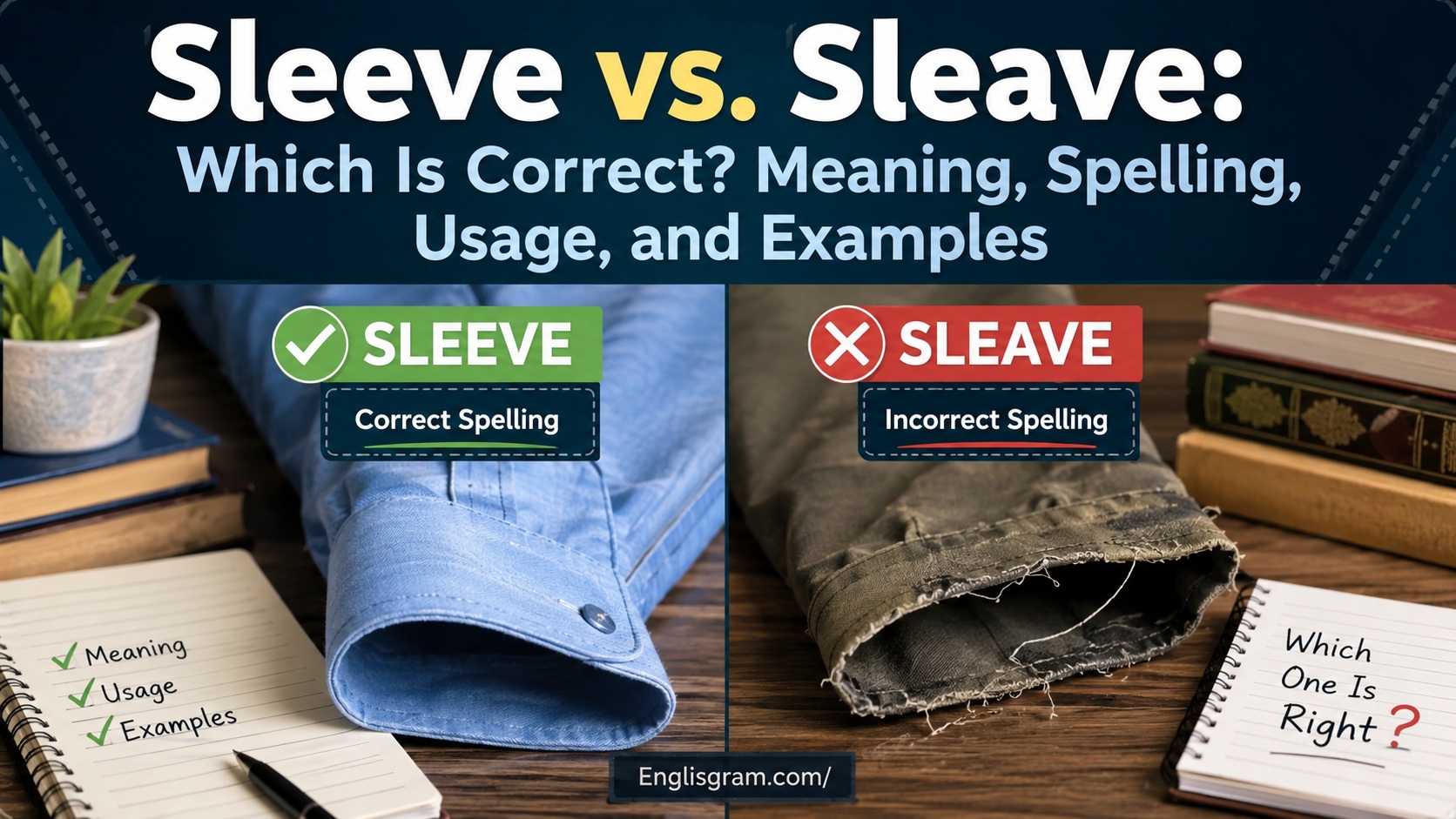
Sleeve vs. Sleave can confuse English learners because the words look similar, yet their meanings, spelling, and modern usage are different. If you have ever heard or wondered why sleave and sleeve seem so close, you are not alone. These words look and sound similar, but their meanings are different. To clarify, sleave is rarely used in modern English, while sleeve is the correct, familiar choice in most contexts.
Historically, sleave originally referred to untwisted silk fibers, while sleeve refers to the part of a garment that covers the arms. When talking about clothing, use sleeve. For example, “She pulled her sleeve up to check her watch” is perfectly correct and easily understood.The same distinction matters in retailers, best brands, product descriptions, and everyday writing. English learners and native speakers can experience confusion because the spelling, pronunciation, meanings, and histories are not identical.
To break down the difference, see what each term means, when it is used, and how it fits the context. This helps you get the right word every time and avoid incorrect usage. From my experience with English vocabulary, a clear example often makes a difficult distinction easier to remember. A well-crafted explanation also makes an article easier to understand while supporting better communication, confidence, and writing.
Sleeve vs. Sleave: The Short Answer
Here is the clean answer:
- Sleeve is the standard modern English spelling.
- Sleave is an old, rare word with a different historical meaning.
- In everyday writing, use sleeve.
- In most cases, sleave is either a typo or an outdated literary word.
That simple rule solves most problems.
Still, the reason people confuse them matters. The words look alike, sound similar, and both appear in English dictionaries. That mix creates doubt. Once you understand what each one means, the confusion disappears fast.
What Does “Sleeve” Mean?
The word sleeve has several real uses in modern English. Most people first learn it as part of clothing, but the word has grown far beyond shirts and jackets.
At its core, sleeve means a part of something that covers, surrounds, or protects another part. That basic idea shows up in many places.
Sleeve in Clothing
The most common meaning is the fabric part of a shirt, jacket, dress, or coat that covers the arm.
You hear it in phrases like:
- short sleeve
- long sleeve
- rolled-up sleeve
- fitted sleeve
- puffed sleeve
Examples:
- My shirt has short sleeves.
- She rolled up her sleeves before washing the dishes.
- His jacket sleeve got caught in the door.
This use is so common that most people never stop to think about it. The word feels ordinary because it is. It belongs to daily English.
Sleeve in Technology and Packaging
The word also appears in product and packaging language. A sleeve can mean a protective cover or outer layer that wraps around something.
Common examples include:
- Laptop sleeve — a soft cover that protects a laptop
- Phone sleeve — a case or pouch for a phone
- Card sleeve — a plastic cover for trading cards
- Document sleeve — a paper or plastic holder
- Bottle sleeve — a wrap around a bottle or cup
This meaning keeps the same core idea: the sleeve surrounds and protects.
Think of it like a jacket for an object. That image makes the word easy to remember.
Sleeve in Mechanical and Engineering Terms
In technical language, sleeve can mean a cylindrical cover or lining. Engineers use it in many ways.
Examples:
- Bearing sleeve
- Shaft sleeve
- Pipe sleeve
- Cable sleeve
In these cases, the sleeve supports, guides, covers, or protects another part. The meaning is more specialized, but it still follows the same pattern.
That is one reason the word is so useful. It works in both everyday speech and technical writing.
Common Idioms Using “Sleeve”
English has a few well-known phrases built around sleeve. These are worth knowing because they show how deeply the word lives in the language.
Ace up your sleeve
This means a hidden advantage or secret plan.
Example:
- The candidate had an ace up his sleeve during the debate.
Wear your heart on your sleeve
This means to show your emotions openly.
Example:
- She wears her heart on her sleeve, so everyone knows when she feels hurt.
Roll up your sleeves
This means to prepare for hard work.
Example:
- We need to roll up our sleeves and fix this problem.
Laugh up your sleeve
This means to laugh secretly or quietly, often at someone else’s expense.
Example:
- He laughed up his sleeve when the teacher made a mistake.
Have something up your sleeve
This means to have a hidden idea, trick, or surprise.
Example:
- I think the coach has something up his sleeve for the final match.
These phrases matter because they make sleeve feel even more familiar. When you hear them, you are hearing the modern word, not the old one.
What Does “Sleave” Mean?
Now let’s look at sleave.
Yes, it is a real word. No, it is not the normal word you want in modern English.
Historically, sleave referred to:
- loose silk thread
- untwisted yarn
- something tangled or unraveling in thread form
It also appears in older literary usage, especially in Shakespeare.
So while sleave is not fake, it is definitely niche. You are unlikely to need it unless you are reading older literature, studying historical English, or analyzing a specific text.
That is the key point. Sleave is not a replacement for sleeve. It is a separate, old word with a different meaning.
Pronunciation of Sleave
In modern speech, people usually pronounce sleave the same way they pronounce sleeve. That is one reason the two words cause so much confusion.
When spelling and sound both look close, mistakes happen easily. A writer may type the wrong form without noticing. A reader may also assume the rare word is just an alternate spelling. It is not.
Read More:Is It Correct to Say “Very Helpful”? Meaning, Usage, and Better Alternatives
The Shakespeare Connection
The most famous appearance of sleave comes from Shakespeare’s Macbeth:
“Sleep that knits up the ravell’d sleave of care”
This line often appears in discussions about the word. In that context, sleave relates to thread or yarn, not a shirt sleeve.
The image is beautiful. Sleep is described as something that untangles the messy thread of worry. It is a powerful metaphor.
That does not mean modern writers should start using sleave casually. It means the word survived in a literary moment. Outside that moment, it is rare.
Why Shakespeare Matters Here
Shakespeare keeps old words alive in memory long after everyday English moves on. Many people first meet sleave because of that line and then assume it may be a spelling variant of sleeve.
That is understandable. However, the two words have different histories.
If you are quoting Shakespeare, sleave may be correct because the original text uses it. If you are writing a modern sentence, sleeve is the right choice.
Sleeve vs. Sleave: Key Differences
Here is the simplest way to separate them.
| Feature | Sleeve | Sleave |
| Modern usage | Common | Rare |
| Main meaning | Clothing part, cover, protective wrap | Loose silk thread or old literary meaning |
| Everyday writing | Yes | No |
| Found in idioms | Yes | No |
| Technical writing | Yes | Rare |
| Shakespeare connection | Not the famous one | Yes |
| Should you use it today? | Yes | Usually no |
This table makes the decision easy. In modern writing, sleeve is the safe and correct choice.
Why People Confuse Sleeve and Sleave
People confuse these words for several reasons. None of them are surprising.
Similar spelling
The words differ by just one letter.
Similar sound
They often sound the same when spoken aloud.
Old literature
Readers see sleave in Shakespeare and assume it may be an alternate form of sleeve.
Typing errors
Auto-correct and fast typing can easily turn one into the other.
Word memory
When two words look and sound alike, the brain sometimes stores them as the same thing.
That is why this mistake shows up in schoolwork, blog drafts, captions, and casual writing. It is a small error, but it can still make writing look careless.
Is “Sleave” Ever Correct?
Yes, but only in narrow situations.
You might use sleave when:
- quoting Shakespeare
- discussing old English
- studying literary history
- analyzing archaic word forms
- explaining the difference between old and modern usage
In those cases, sleave is correct because the context demands the historical word.
Outside those situations, it usually looks odd. In a modern article, resume, email, or school paper, it will probably distract the reader.
That is why style guides and editors usually prefer sleeve unless the older form is required for accuracy.
Examples of “Sleeve” in Sentences
Nothing teaches a word faster than examples. Here are some clear uses of sleeve in modern English.
Everyday examples
- My sleeve got wet in the rain.
- She pushed up her sleeves before cooking.
- He tore the sleeve of his shirt.
Clothing examples
- This dress has wide sleeves.
- The jacket sleeve is too long.
- I like the cut of that sleeve.
Product examples
- I bought a padded laptop sleeve.
- The phone sleeve protects the screen.
- Each trading card goes into a clear sleeve.
Technical examples
- The mechanic replaced the shaft sleeve.
- A metal sleeve was added to protect the pipe.
- The cable sleeve keeps the wires together.
Idiomatic examples
- She has an ace up her sleeve.
- They rolled up their sleeves and got to work.
- He wears his heart on his sleeve.
Notice how flexible the word is. That is a big reason sleeve survives in so many contexts.
Examples of “Sleave” in Sentences
This part is much shorter because the word is much rarer.
Historical or literary examples
- Shakespeare used the word sleave in Macbeth.
- The passage refers to the tangled sleave of care.
- The old text uses sleave to describe thread.
Modern use with explanation
- In this historical quote, sleave means loose thread.
- Scholars sometimes discuss the old meaning of sleave.
That is about it for general use. If you are not quoting or discussing older literature, you probably do not need this word.
Common Mistakes to Avoid
A small spelling issue can change how your writing feels. Here are the most common traps.
Using sleave when you mean sleeve
This is the biggest mistake. It happens often because the words look similar. But in modern English, sleeve is the right form almost all the time.
Thinking both words are interchangeable
They are not interchangeable. Sleeve is the modern word. Sleave has a historical meaning.
Overusing rare words
Some writers try to sound smart by using unusual words. That often backfires. Clear writing beats showy writing every time.
Ignoring audience
If your audience is not studying Shakespeare, they will probably expect sleeve. Using sleave may confuse them.
Trusting memory over spelling
If you are unsure, check a dictionary or search the word in a reliable source. That habit saves time and embarrassment.
How to Remember the Difference
A memory trick helps.
Think of it this way:
- Sleeve is what you wear.
- Sleave is what you might see in a Shakespeare class.
Or use this simple clue:
- Sleeve has the word “leeve”, which feels like modern usage.
- Sleave starts with “slea”, which feels older and stranger.
Another easy trick:
If you are writing about shirts, jackets, covers, or idioms, choose sleeve.
If you are talking about old English or a literary quotation, check whether sleave is the original spelling.
That is enough to keep you safe in most situations.
Related Words Often Confused with Sleeve
People also mix up sleeve with a few other words. These are not the same, but they can appear close in meaning.
Sleeve vs. Sheath
A sheath is a covering or protective case, often for a blade or tool. A sleeve can be a kind of cover too, but the words are not identical.
Sleeve vs. Cuff
A cuff is the end part of a sleeve, not the sleeve itself.
Sleeve vs. Cover
A cover is broader. A sleeve is one type of cover, but not every cover is a sleeve.
Sleeve vs. Case
A case usually encloses something more fully. A sleeve may be open at one end or designed as a slip-on layer.
These distinctions matter in product descriptions and technical writing. Precision helps readers trust you.
When Should You Use “Sleeve”?
Use sleeve in almost every modern situation.
That includes:
- school essays
- blog posts
- product descriptions
- work emails
- fashion writing
- technical writing
- everyday conversation
- idioms and expressions
If you are unsure, sleeve is the safe choice.
It is the word people know. It is the word people expect. And it is the word that sounds natural in modern English.
When Might You Use “Sleave”?
Use sleave only when the context clearly calls for it.
That includes:
- quoting Shakespeare
- studying literary history
- analyzing archaic vocabulary
- explaining the old meaning in a language lesson
- discussing thread, yarn, or older textile references
Even then, use it carefully and explain it if needed. Most readers will not know the word right away.
A brief note can help:
- “In Shakespeare, sleave refers to thread or yarn.”
That kind of explanation keeps your writing clear.
FAQs
Is “sleeve” the correct word?
Yes. Sleeve is the standard modern English word for the part of clothing that covers your arm.
What does “sleave” mean?
Sleave is a rare, archaic word historically associated with untwisted silk fibers. You may find it in older literary texts.
Is “sleave” still used in modern English?
Very rarely. Sleave is mostly found in historical or literary contexts, so it is not normally used in everyday writing.
Why do “sleeve” and “sleave” cause confusion?
They have similar spellings and sounds. However, their meanings, origins, and usage are different.
Should I use “sleeve” in formal writing?
Yes. Use sleeve when referring to clothing, protective covers, machine parts, or common expressions. It is the correct choice for modern and professional writing.
conclusion day
Conclusion
The difference between sleeve vs. sleave is simple once you know their meanings. Sleeve is the correct and widely used modern English word for clothing, protective covers, and machine parts. Sleave is an old and rare term mainly connected with historical or literary language. For everyday, academic, professional, and contemporary writing, choose sleeve. This small spelling difference can prevent confusion and help you use the right word with confidence.