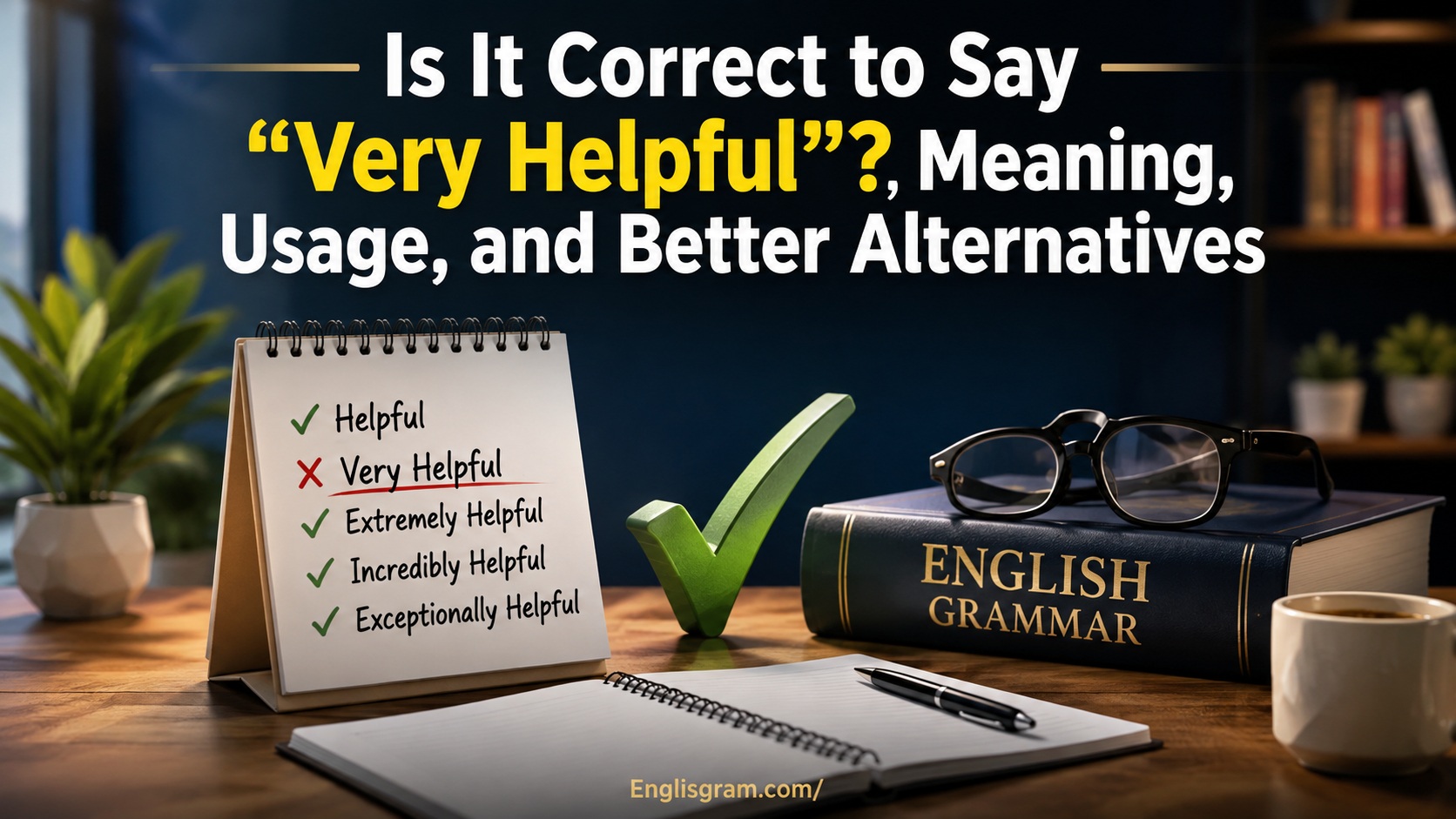
Is It Correct to Say “Very Helpful”? Yes, the phrase is grammatical, natural, and widely accepted in everyday English. Writers should avoid using it only when very creates unnecessary padding, filler, or wordiness. A useful example is a sentence such as “Your advice was very helpful,” where the intensifier very modifies the adjective helpful. The phrase can fit the whole picture when you want to add emphasis without making the sentence complicated.
Collins Dictionary and other dictionary resources can help learners, linguists, and experienced writers understand such phrases, rules, exceptions, and nuance. In my experience, the best first step is to step back, dig deeper, and pay attention to the context, meaning, and tone before changing a familiar expression. A phrase does not become weak simply because it contains an adverb or modifier. Good writing depends on word choice, clarity, precision, and the ability to make a sentence sound appropriate and natural.
The phrase also works across formal, informal, conversational, and academic settings. Its usage is easy to understand because very comes before helpful and strengthens its meaning. This is a normal modifier usage, adverb usage, and adjective usage pattern. However, careful writing should consider writing quality, writing clarity, sentence structure, syntax, vocabulary, style, and contextual meaning. If very helpful feels repetitive, a different phrase may offer more precise, polished, or persuasive wording.
Is It Correct to Say “Very Helpful”?
Yes, it is correct.
The phrase follows standard English grammar:
- Helpful is an adjective.
- Very is an intensifier.
- Together, they form a common adjective phrase.
That structure is completely normal in English. You can say very kind, very useful, very clear, very important, and very helpful. Nothing about it is wrong.
Why it sounds natural
English often uses intensifiers like very, really, quite, and extremely to add emphasis. These words help show degree. When you say something is helpful, you describe a quality. When you say it is very helpful, you strengthen that quality.
For example:
- The guide was helpful.
- The guide was very helpful.
- The guide was extremely helpful.
Each sentence is grammatical. The difference is force. The more emphasis you add, the stronger the praise sounds.
When people ask this question
People usually ask whether very helpful is correct for one of these reasons:
- They want to make sure it sounds professional.
- They are worried it may be too casual.
- They think the phrase might be awkward or weak.
- They want a better way to express gratitude or approval.
That concern makes sense. Writers often worry that common phrases sound flat. Still, common does not mean wrong. Sometimes a simple phrase is the best choice because it is clear and direct.
What Does “Very Helpful” Mean?
The meaning is simple: something or someone provides strong assistance, support, or usefulness.
A person can be very helpful when they give useful advice, solve a problem, or make a difficult task easier. A tool can be very helpful when it saves time or removes confusion. A guide can be very helpful when it explains a process in a way that makes sense fast.
Basic meaning in everyday English
In everyday speech, very helpful usually means:
- useful
- supportive
- practical
- easy to rely on
- good at solving a problem
In professional settings
In work settings, the phrase often means someone was efficient, responsive, and made a task easier. That could apply to:
- a coworker who helped with a deadline
- a manager who clarified expectations
- a support agent who solved an issue
- a consultant who gave useful feedback
In personal settings
In personal life, very helpful often carries a warm tone. You might say it about:
- a friend who gave advice
- a family member who helped with chores
- a neighbor who offered assistance
- a teacher who explained something clearly
In all of these cases, the phrase points to real value. It does not sound dramatic. It sounds honest.
Why “Very Helpful” Works So Well
The phrase works because it is short, clear, and flexible. It fits many situations without sounding forced.
It is easy to understand
No one has to decode it. There is no hidden meaning. That makes it useful in:
- emails
- reviews
- conversations
- letters
- comments
- feedback forms
It sounds polite
“Very helpful” usually sounds positive without sounding exaggerated. That balance matters. You can praise someone without sounding over-the-top.
It avoids awkward complexity
Sometimes people try to sound more formal than they need to and end up sounding stiff. For example:
- “Your assistance was highly instrumental in facilitating resolution of the matter.”
That sentence is grammatical, but it sounds wooden. By contrast:
- “Your help was very helpful.”
That sentence is simple and human. It gets the job done.
Is “Very Helpful” Formal or Informal?
It is both, depending on how you use it.
In casual conversation
It sounds natural and friendly.
Examples:
- Thanks, that was very helpful.
- Your tip was very helpful.
- This video was very helpful.
In professional communication
It is still fine in most workplace settings.
Examples:
- Your explanation was very helpful.
- The training session was very helpful for our team.
- Her feedback was very helpful during the review.
In academic writing
It is usually acceptable in lighter academic contexts, but formal research writing often prefers more precise wording.
Instead of:
- The source was very helpful.
A more academic version might be:
- The source provided useful background information.
- The article offered valuable context.
- The interview clarified the central issue.
So the phrase is not too informal for professional use. It is just not always the most exact choice for scholarly prose.
Read More:Wasn’t vs. Weren’t: The Complete Grammar Guide With Examples
When to Use “Very Helpful”
The phrase works best when you want to express sincere appreciation in a simple way.
Good moments to use it
Use very helpful when:
- someone gave you useful advice
- a resource saved you time
- a guide made something easier
- a person clarified confusion
- support resolved a problem
- feedback improved your work
Strong examples
- Your step-by-step guide was very helpful.
- The customer support agent was very helpful and patient.
- Her comments were very helpful during the revision process.
- This tutorial was very helpful for beginners.
- Your explanation was very helpful and easy to follow.
Each example feels natural because the phrase matches the situation.
Examples of “Very Helpful” in Sentences
Seeing the phrase in context makes it easier to use well.
Everyday examples
- Your directions were very helpful.
- That tip was very helpful.
- The map was very helpful when I got lost.
- His advice was very helpful during a stressful week.
Workplace examples
- Your feedback was very helpful.
- The report was very helpful for the meeting.
- Her notes were very helpful in preparing the presentation.
- The software demo was very helpful for the sales team.
Email examples
- Thank you for your very helpful response.
- I appreciate your very helpful explanation.
- Your very helpful support made this much easier.
- The document you sent was very helpful.
School and study examples
- The teacher’s examples were very helpful.
- This study guide is very helpful for exam prep.
- Her comments were very helpful in understanding the topic.
- The chart was very helpful for memorizing the material.
Customer service examples
- The representative was very helpful and kind.
- Your very helpful response solved my issue quickly.
- The instructions were very helpful.
- The support team was very helpful throughout the process.
Is “Very Helpful” Overused?
Sometimes, yes.
That does not make it wrong. It just means the phrase can become plain if you use it too often. In writing, repetition weakens impact. A phrase that sounds warm once may feel dull if repeated in every paragraph.
When it feels repetitive
It may feel overused when:
- the same phrase appears again and again in one piece
- you use it when a stronger word would fit better
- you want to sound more polished or specific
- your writing already uses many intensifiers
Example of weak repetition
- The guide was very helpful.
- The instructions were very helpful.
- The tips were very helpful.
- The article was very helpful.
That reads fine, but it lacks variety. Better writing changes the rhythm and chooses words more carefully.
A better approach
Mix in alternatives like:
- useful
- valuable
- insightful
- practical
- clear
- supportive
- effective
- informative
That keeps the writing fresh and more precise.
Better Ways to Say “Very Helpful”
The best alternative depends on what you mean.
A tool can be useful. A person can be supportive. A suggestion can be valuable. A lecture can be informative. A plan can be practical.
Strong alternatives and what they mean
| Alternative | Best Use | Tone |
| useful | General value | Neutral |
| valuable | High worth or importance | Positive |
| helpful | Simple and direct | Neutral to positive |
| highly helpful | Strong emphasis | Polite and formal |
| extremely helpful | Strong emphasis | More intense |
| insightful | Deep understanding | Smart and reflective |
| informative | Gives knowledge | Clear and factual |
| practical | Works well in real life | Grounded |
| supportive | Gives encouragement or assistance | Warm |
| beneficial | Produces a good result | Formal |
| effective | Produces the desired result | Professional |
| resourceful | Good at solving problems | Positive |
| constructive | Helps improve something | Formal and useful |
| indispensable | Very important or hard to replace | Strong and formal |
Examples in context
- Your explanation was useful.
- The meeting notes were valuable.
- The training session was informative.
- Her suggestion was practical.
- His support was constructive.
- The guide was insightful.
Each one carries a slightly different flavor. That is the key. Good word choice is not about using the fanciest term. It is about using the right one.
“Very Helpful” vs. “Helpful”
This is one of the most useful comparisons.
Helpful
This says the thing or person provides assistance.
- The app is helpful.
- Your advice was helpful.
Very helpful
This adds stronger praise.
- The app is very helpful.
- Your advice was very helpful.
Which one should you use?
Use helpful when you want to stay simple and balanced. Use very helpful when you want to show stronger appreciation.
A small example makes the difference clear:
- “The checklist was helpful.”
This means it assisted you. - “The checklist was very helpful.”
This means it did a particularly good job of assisting you.
The second version feels warmer and more enthusiastic.
“Very Helpful” vs. Stronger Alternatives
Sometimes a stronger alternative fits better.
Use “very helpful” when:
- you want to sound natural
- you do not need heavy emphasis
- you are speaking casually
- you want simple praise
Use a stronger phrase when:
- you need more polish
- you want more specific praise
- you are writing a review or recommendation
- you want your wording to stand out
For example:
- “Your feedback was very helpful.”
- “Your feedback was invaluable.”
- “Your feedback was incredibly insightful.”
All three work. The best one depends on how much force you want.
Common Grammar Questions About “Very Helpful”
People often worry about related phrases too. Here are the most common concerns.
Is “very much helpful” correct?
No, that sounds unnatural in standard English. Native speakers normally do not say it.
Use:
- very helpful
- much help
- extremely helpful
Is “so helpful” correct?
Yes. It is also natural.
- Your explanation was so helpful.
- That video was so helpful.
This version often sounds a bit more emotional or conversational than very helpful.
Is “really helpful” correct?
Yes. It is also common.
- Your advice was really helpful.
- The guide was really helpful.
This often sounds a little more casual than very helpful.
Is “highly helpful” correct?
Yes. It is correct and a bit more formal.
- The manual was highly helpful.
- Her explanation was highly helpful.
It sounds polished, though some writers prefer useful or beneficial instead.
Is “extremely helpful” too strong?
Not necessarily. It depends on the situation.
- A quick tip may be very helpful.
- A major solution may be extremely helpful.
The stronger phrase works when the praise is genuinely bigger.
Can You Say “Very Helpful” in Professional Emails?
Yes. In most professional emails, it is perfectly fine.
Good examples
- Thank you for your very helpful response.
- Your very helpful explanation cleared up my confusion.
- I appreciate your very helpful support.
- The attached guide was very helpful.
When to be more formal
If you are writing to executives, clients, or people you do not know well, you may want slightly sharper wording.
Instead of:
- Your response was very helpful.
Try:
- Your response was extremely helpful.
- Your explanation was valuable.
- Your guidance was much appreciated.
- Your support helped resolve the issue quickly.
These sound a bit more polished, but very helpful still works if the tone is warm and sincere.
How Native Speakers Use “Very Helpful”
Native speakers use the phrase in a wide range of settings because it is easy and effective.
In speech
People say it naturally after receiving help:
- That was very helpful.
- You were very helpful.
- Thanks, that was very helpful.
In writing
It appears in:
- thank-you notes
- email replies
- product reviews
- feedback forms
- study notes
- comments on articles and videos
In reviews
A review might say:
- The staff was very helpful.
- The guide was very helpful for first-time users.
- The article was very helpful and clear.
That kind of language tells readers the resource actually made a difference.
FAQs
Is “very helpful” grammatically correct?
Yes. “Very helpful” is grammatically correct and natural. The adverb very modifies the adjective helpful to show a stronger degree of usefulness.
Can I use “very helpful” in formal writing?
Yes. Very helpful works in formal, professional, academic, and everyday writing. However, choose a more precise expression when the context requires stronger or more specific wording.
Is “very helpful” better than “helpful”?
Not always. Helpful is enough when you want a simple statement. Very helpful adds emphasis when something provided a high level of assistance or support.
What are other ways to say “very helpful”?
Depending on the context, you can use extremely helpful, highly useful, valuable, beneficial, greatly appreciated, or invaluable. Choose the phrase that best matches your intended meaning.
Does “very helpful” sound repetitive?
It can if you use it too often. The phrase itself isn’t repetitive or incorrect. Repetition becomes a problem when the same wording appears frequently throughout your writing.
Conclusion
“Very helpful” is a correct, natural, and widely accepted English phrase. The word very works as an adverb that modifies helpful, adding emphasis to the level of assistance someone provides. You can use it confidently in formal, informal, professional, academic, and everyday communication.However, good writing depends on context and word choice. If very helpful clearly expresses your meaning, there is no reason to avoid it. When you need stronger, more precise, or more persuasive wording, you can choose an alternative. The key is to focus on clarity, natural usage, and effective communication rather than avoiding simple phrases just because they seem ordinary.