Informational or Informative can seem confusing, but knowing their difference helps you choose the right word for clear and effective writing. When I started writing in English, I noticed that these confusing terms can look nearly identical and are often used interchangeably. However, their meaning, usage, context, and purpose are not always the same. The inform root, spelling, and difference between the words can help explain their roles.
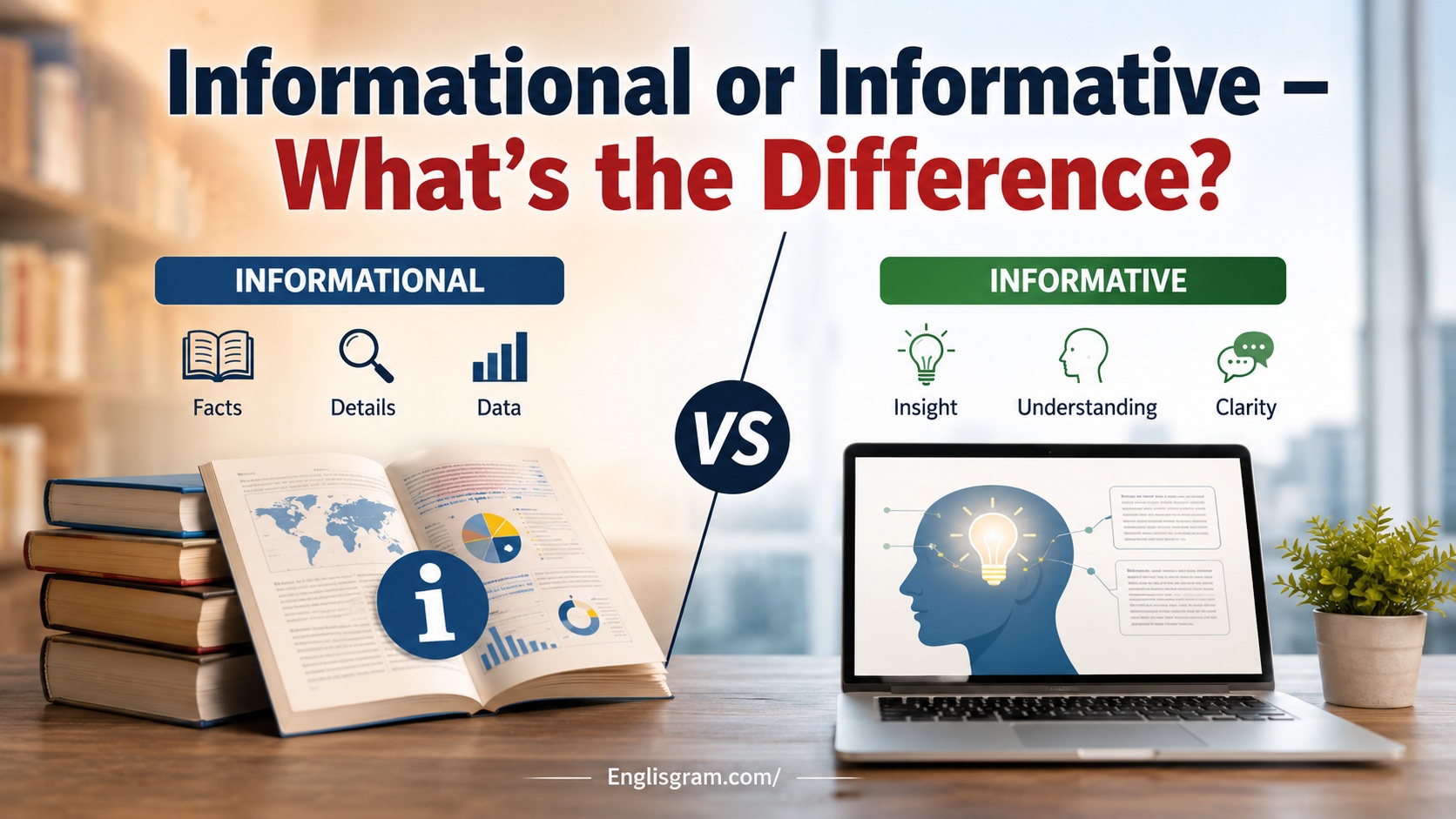
Informational content usually presents useful information, facts, knowledge, and data, while informative writing focuses more on helping readers learn, understand, explain, and explore a subject. Both forms can support better learning, stronger communication, confident English use, and better writing, but they may serve distinct purposes for different audiences.
An informational text generally presents facts or data objectively, while an informative text can add deeper explanations, actionable insights, and clearer understanding. This difference also supports reader understanding, reader comprehension, and clarity.The distinction becomes easier when you look at how writers create content for readers.
Informational vs. Informative: Quick Answer
The simplest way to remember the difference is this:
Informational focuses on the role or purpose of something. Informative focuses on the useful knowledge it provides.
Informational
Informational means related to information or intended to give information.
- The museum has several informational brochures.
- Visit the website for informational resources.
- The city installed an informational sign near the trail.
- The company created an informational video for new customers.
The word often identifies a type of material, resource, service, or content.
Informative
Informative means providing useful knowledge or information.
- The museum tour was highly informative.
- Her presentation was clear and informative.
- I found the article extremely informative.
- The interview was surprisingly informative.
Here, the speaker is usually evaluating the value of the information.
The difference in one table
| Word | Main idea | Typical emphasis | Example |
| Informational | Related to or intended to provide information | Purpose, function, or category | an informational brochure |
| Informative | Provides useful knowledge | Value, quality, or usefulness | an informative presentation |
The distinction isn’t absolute. Dictionaries list the words as related synonyms, and their meanings overlap Still, this difference gives you a reliable way to choose between them in everyday American English.
What Does “Informational” Mean?
Informational is an adjective formed from information. It describes something that relates to information or provides information.
Merriam-Webster gives the definition “relating to or giving information.” Its examples include phrases such as informational brochure and informational books.
The important point is that informational doesn’t necessarily praise the quality of the information.
An informational brochure might contain excellent facts. It might also contain only basic details. The adjective itself doesn’t guarantee that the material will be especially useful, detailed, or enlightening.
Think of informational as a label.
It tells you what something is for or what it relates to.
How “Informational” Is Used
You’ll often find informational before a noun. Common combinations include:
- informational article
- informational brochure
- informational book
- informational campaign
- informational content
- informational guide
- informational material
- informational resource
- informational sign
- informational video
- informational website
These expressions identify something as having an information-related purpose.
For example:
The library offers informational resources for new students.
The sentence doesn’t necessarily tell you whether those resources are fascinating or exceptionally helpful. It tells you what kind of resources they are: resources intended to provide information.
Examples of “Informational” in Sentences
The park has informational signs along the walking trail.
Here, the signs provide visitors with facts about the park, wildlife, history, or safety.
The university created an informational guide for first-year students.
The guide exists to give students useful details about university life.
The company published an informational video about its new software.
The video’s primary function is to explain or provide information about the software.
The website contains informational material about local regulations.
The material exists to communicate facts and guidance about those regulations.
In each example, informational works as a description of the resource’s function.
What Does “Informative” Mean?
Informative describes something that gives knowledge or useful information.
Merriam-Webster defines it as “imparting knowledge” and lists instructive among its synonyms. Its thesaurus also connects informative with words such as educational, illuminating, enlightening, and useful.
That makes informative particularly useful when you’re judging the quality or usefulness of information.
For example:
The lecture was informative.
The speaker isn’t merely saying that the lecture contained information. The sentence suggests that the lecture gave the audience worthwhile knowledge.
That’s why informative frequently appears in reviews and evaluations.
How “Informative” Is Used
You can use informative to describe:
- articles
- books
- lectures
- presentations
- speeches
- interviews
- documentaries
- conversations
- discussions
- websites
- videos
- tours
- classes
It can also describe a response or experience.
For example:
The doctor gave us an informative explanation of the procedure.
The explanation contained useful knowledge.
Or:
The documentary was both entertaining and informative.
This sentence evaluates the documentary positively. It says the program entertained viewers while also teaching them something.
Examples of “Informative” in Sentences
The article was informative and easy to understand.
The writer gave the reader useful knowledge.
Her presentation was informative without becoming boring.
The presentation taught the audience something valuable.
The museum tour was surprisingly informative.
The tour provided useful historical or cultural knowledge.
That interview was more informative than I expected.
The speaker learned something useful from the interview.
Notice the pattern. Informative often answers the question:
Did this actually teach me something useful?
Informational vs. Informative: The Key Difference
The difference becomes much easier once you separate purpose from result.
Informational = purpose or function
Something is informational when it is designed to provide information or belongs to the category of information-related material.
Informative = useful knowledge
Something is informative when it successfully provides useful or meaningful information.
Consider this example:
The company created an informational video.
The adjective describes the video’s purpose.
Now change it:
The company created an informative video.
The adjective can suggest that the video does a good job of teaching viewers something.
That doesn’t mean the first video is bad or the second is automatically excellent. Context matters. The distinction is about what the adjective foregrounds.
A simple analogy
Think about a map.
A map can be called informational because its purpose is to give information about a location.
If the map clearly explains every major road, landmark, entrance, and important feature, you might call it informative because it gives you useful knowledge.
One word tells you more about its function. The other tells you more about its value as a source of knowledge.
Informational vs. Informative Examples
The overlap between these adjectives becomes especially interesting when they modify the same noun.
Informational article vs. informative article
An informational article is an article intended to provide information about a topic.
An informative article is an article that gives readers useful or meaningful information about that topic.
Compare:
The website published an informational article about recycling.
This identifies the article’s purpose.
The website published an informative article about recycling.
This emphasizes the article’s usefulness or educational value.
Both sentences are grammatical. The second carries a stronger evaluative flavor.
Informational website vs. informative website
An informational website generally means a website whose purpose is to provide information rather than perform some other primary function.
For example:
The city maintains an informational website for visitors.
An informative website emphasizes how useful the site’s content is:
The travel website is informative and easy to navigate.
The first describes the website’s role. The second praises its content.
Informational video vs. informative video
An informational video is created to communicate information.
An informative video provides information in a useful or instructive way.
For example:
The hospital produced an informational video for new patients.
The hospital created it as a resource.
The training video was informative and answered all my questions.
Now the speaker is evaluating the video’s effectiveness.
Informational presentation vs. informative presentation
Both expressions can work.
The company prepared an informational presentation about its new benefits package.
The presentation’s purpose is to provide information.
The employee orientation was informative and answered several important questions.
The second sentence evaluates what participants learned.
Read More:Deactivate or Inactivate: Meaning, Differences, and Correct Usage
Informational vs. Informative: Part of Speech and Word Formation
Both informational and informative are adjectives.
They belong to the same word family:
inform → information → informative / informational
The base verb inform means to give someone knowledge or tell someone something.
The noun information refers to knowledge, facts, data, or details. Merriam-Webster defines information in several related senses, including knowledge gained through investigation, study, or instruction and facts or data.
From that family, English has developed several useful adjectives.
| Word | Part of speech | Meaning |
| inform | Verb | Give someone information |
| information | Noun | Facts, knowledge, or details |
| informative | Adjective | Providing useful knowledge |
| informational | Adjective | Related to or providing information |
The suffixes help create different shades of meaning, but you shouldn’t treat them as mechanical substitutes.
English doesn’t work like a mathematical formula where changing one suffix always produces an identical meaning.
When to Use “Informational”
Choose informational when you want to emphasize that something is related to information or designed to provide it.
This makes the word particularly natural for resources and materials.
Common examples
Informational resources
Students can access informational resources through the library.
Informational brochure
Visitors received an informational brochure at the entrance.
Informational guide
The government published an informational guide for residents.
Informational sign
An informational sign explains the area’s history.
Informational website
The museum maintains an informational website for visitors.
Informational content
The platform provides informational content about financial literacy.
In each case, the adjective helps classify the material.
“For informational purposes”
One especially common expression is:
for informational purposes
This phrase means that something is being provided to give information rather than necessarily serving as professional advice, a formal determination, or another specific function.
For example:
The figures are provided for informational purposes only.
Here, informational is the natural choice.
Informative purposes would not normally replace this established expression.
That’s an important usage point because it shows that even closely related adjectives don’t always occupy exactly the same grammatical territory.
When to Use “Informative”
Choose informative when you want to emphasize that something teaches, explains, or gives useful knowledge.
It’s especially natural when you evaluate a person’s explanation or a piece of content.
Natural examples
The book is informative but still easy to read.
Her speech was informative and engaging.
We had an informative conversation about the issue.
The documentary provides an informative look at the region.
The tour guide gave us an informative explanation of the building.
The adjective works because each example focuses on what the reader, listener, or viewer learns.
A useful test
Ask yourself:
“Am I describing what this thing is designed to do, or am I describing how useful the information is?”
If you’re describing its function, informational may be the better choice.
If you’re describing its educational or knowledge-giving value, informative is often better.
Can “Informational” and “Informative” Be Used Interchangeably?
Sometimes. Not always.
The dictionaries themselves show substantial overlap. Merriam-Webster’s thesaurus lists informative among the synonyms of informational and informational among the synonyms of informative.
That doesn’t mean you should swap them mechanically.
Words can be synonyms while still differing in collocation, emphasis, tone, and typical context.
For instance:
The brochure is informational.
This sounds like you’re classifying the brochure.
The brochure is informative.
This sounds more like you’re saying the brochure actually taught you something useful.
The difference is subtle, but native speakers routinely use context to interpret these shades.
Where the distinction matters most
The distinction is especially noticeable when:
- you’re describing the purpose of a resource;
- you’re evaluating whether something was useful;
- you’re describing a person’s explanation;
- you’re discussing educational content;
- you’re using a fixed phrase such as for informational purposes.
Informational vs. Informative in American English
In American English, both words are standard adjectives.
Neither one is inherently incorrect or ungrammatical.
The more natural choice depends heavily on the noun and the intended meaning.
For example, informational materials is a natural phrase because materials are resources designed to convey information.
On the other hand, informative presentation is particularly natural when someone is praising the presentation for teaching the audience something.
In education
You might see:
The school distributed informational materials to parents.
The materials communicate school policies and details.
But:
The teacher gave an informative presentation about climate science.
The presentation gave students useful knowledge.
In business
A company might create:
an informational brochure about its services.
Later, a customer might say:
The brochure was informative and answered my questions.
The first statement identifies the brochure’s function. The second evaluates its usefulness.
On websites
A site can be described as:
an informational website.
This generally means its primary role is providing information.
You might also say:
The website is informative.
Now you’re commenting on the quality of its content.
That distinction is particularly useful when writing website copy because informational can describe the site’s category while informative can describe the reader’s experience.
FAQs
What is the difference between informational and informative?
Informational usually describes content that provides facts, data, or useful information. Informative describes content that gives information while also helping the reader understand or learn something more deeply.
Is informational content always informative?
Not necessarily. Informational content can simply present facts or data, while informative content often adds explanations, context, examples, and insights to improve understanding.
Can informational and informative be used interchangeably?
Sometimes, especially in casual English, but they aren’t always interchangeable. The correct choice depends on the context, purpose, and type of content you are describing.
What is an example of informational content?
A page listing statistics, dates, facts, definitions, or product specifications can be considered informational content because its main purpose is to provide information.
What is an example of informative writing?
A detailed article that explains a topic, compares related ideas, provides examples, and helps readers understand a subject is informative writing.
Conclusion
Understanding the difference between Informational or Informative content makes your writing clearer and more effective. Informational content mainly presents facts, data, and useful information, while informative content goes further by explaining ideas, providing context, and helping readers learn. Choosing the right word depends on the purpose, audience, and context of your writing. Once you understand how these terms work, you can communicate your ideas with greater clarity and confidence.