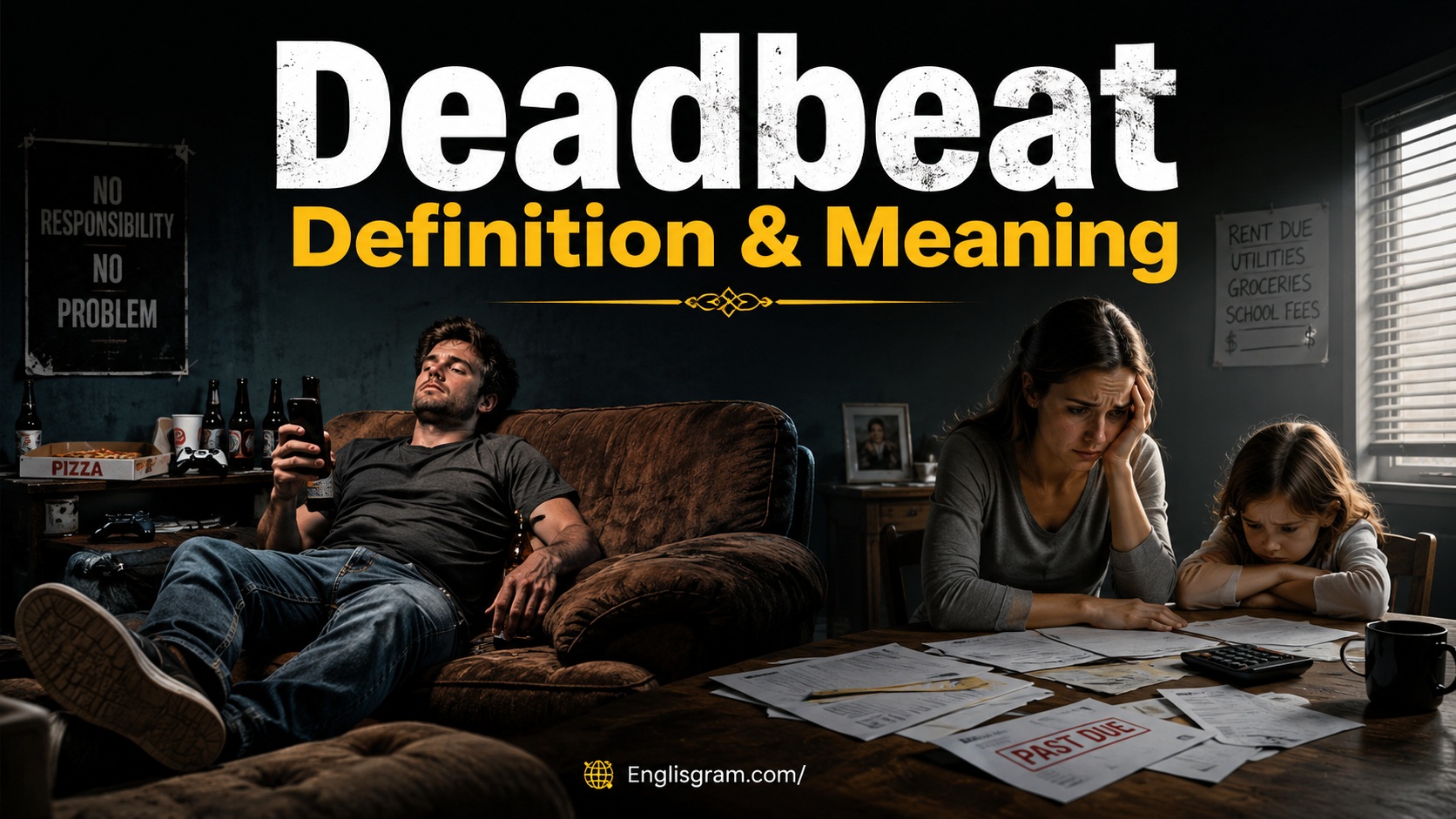
Deadbeat Definition & Meaning explains a person who avoids duties, misses payments, and struggles with financial responsibility in everyday English.The deadbeat definition describes a person who avoids or fails to meet important responsibilities, especially financial responsibility such as pay debts, handling unpaid bills, and managing household responsibilities. In everyday English, this English word and phrase are often used for someone who owes money or shows a pattern of failure to pay.
For example, a person who does not pay rent, utilities, or services may receive this label. The meaning can feel negative because it connects with debt, nonpayment, and neglect, but the real context needs proper explanation because personal situations can affect how people handle their obligations.The origin of the term has an interesting word origin and etymology. The word was connected to a watch escapement, a technical term related to a precise mechanical movement before it developed a social meaning.
During the late 1800s, the term became common in American English and appeared in historical publications such as The Galaxy, January. Its connotation later changed into a negative label for a lazy, unreliable, or irresponsible person. Older meanings included terms like scoundrel, shiftless, swindling, and vagabond man, while modern semantics focus more on financial problems.
What Does Deadbeat Mean?
At its most basic, deadbeat means a person who does not pay what they owe or does not meet their responsibilities.
In modern English, the word often suggests one of these ideas:
- Someone who refuses to repay money
- Someone who avoids child support or family support
- Someone who depends on others without helping
- Someone who acts irresponsible and unreliable
- Someone who makes excuses instead of taking action
The word is not usually flattering. In fact, it is almost always insulting. If someone calls another person a deadbeat, they are usually expressing anger, disappointment, or contempt.
Simple definition
A deadbeat is a person who avoids responsibility, especially financial responsibility.
Short example
- “He is a deadbeat who never pays back the money he borrows.”
- “Her ex is a deadbeat dad who does not support his child.”
Why the word feels so harsh
The word sounds sharp because it combines two strong ideas. Dead suggests something lifeless or completely inactive. Beat can suggest defeat, exhaustion, or failure. Together, the phrase creates a feeling of total uselessness or total failure. That is why it lands so hard in conversation.
Deadbeat Pronunciation
The word is pronounced:
dead-beet
Phonetic form
/ˈdɛd.biːt/
Easy pronunciation tip
Say it in two equal parts:
- dead like in “dead end”
- beat like in “beat the drum”
So the full word sounds like dead-beet.
Deadbeat as a Part of Speech
Deadbeat most often works as a noun.
As a noun
It refers to a person.
- “He is a deadbeat.”
- “Nobody wants to work with a deadbeat.”
As an adjective
It can sometimes appear before a noun in informal speech.
- “deadbeat dad”
- “deadbeat tenant”
- “deadbeat borrower”
This adjective use is very common in phrases, especially when describing someone who fails to meet obligations.
What this means in practice
In most cases, you will see deadbeat used as a label for a person rather than as a general descriptive adjective. That makes it different from words like lazy or irresponsible, which can describe behavior more broadly.
Origin and History of the Word Deadbeat
The word deadbeat has an interesting history. It did not begin as a term for a selfish or irresponsible person. Over time, its meaning shifted.
Historically, deadbeat appeared in American English in the 19th century. Early uses were linked to ideas like being completely exhausted, flat, or beaten down. In some older contexts, dead beat could describe something that had stopped moving or something that was fully completed in a way that left no bounce or rebound.
Eventually, the phrase evolved into slang for someone who failed to pay debts or support obligations. From there, it became a strong insult for an irresponsible person.
How meaning often changes
This is a common pattern in language. Words start with one meaning and slowly pick up new social uses. A term that once described a condition can become a label for a person. Deadbeat followed that path.
Why this history matters
Knowing the history helps you understand the tone. The word is not just a factual description. It carries old-fashioned judgment. That is part of what makes it so forceful in modern speech.
Why Is Someone Called a Deadbeat?
People usually call someone a deadbeat when that person repeatedly fails to do basic things they should do.
Common reasons
- They do not repay borrowed money
- They avoid child support
- They ignore rent or bills
- They borrow often but never give back
- They rely on friends or family for support
- They make promises and never follow through
- They refuse to take responsibility for their actions
A deadbeat is not just someone who is having a hard month. Everyone can struggle financially. The word usually implies a pattern. It suggests the person has chosen not to handle obligations or has built a reputation for avoiding them.
Important distinction
A person with low income is not automatically a deadbeat. Someone can be poor and still be responsible. Someone can lose a job and still try hard to pay bills. Deadbeat is about conduct and character, not just money.
That distinction matters. It is easy to misuse the word if you are angry. However, the word should describe repeated failure, not a temporary setback.
Deadbeat Meaning in Different Contexts
The word shifts depending on the situation. Here are the most common contexts.
Deadbeat person
This is the broadest use. It means a person who avoids responsibility in general.
- “He is a deadbeat who never helps anyone.”
Deadbeat parent
This usually refers to a parent who fails to provide emotional or financial support.
- “She was raised by a deadbeat parent who disappeared early on.”
Deadbeat dad
This phrase is common in everyday speech and media. It usually means a father who does not support his child financially or emotionally.
- “The article described him as a deadbeat dad who skipped child support.”
Deadbeat mom
Less common than deadbeat dad but still used. It refers to a mother who abandons responsibilities.
- “The case involved a deadbeat mom who left her children with relatives.”
Deadbeat tenant
This describes a tenant who does not pay rent.
- “The landlord had trouble evicting a deadbeat tenant.”
Deadbeat customer
This can refer to a customer who orders goods or services and then does not pay.
- “Small businesses often struggle with deadbeat customers.”
Deadbeat borrower
This means someone who borrows money and does not repay it.
- “He became known as a deadbeat borrower among his friends.”
Deadbeat friend
This is informal. It describes a friend who always takes but never gives.
- “She stopped helping him after he proved to be a deadbeat friend.”
Deadbeat vs. Lazy
These two words overlap but they are not the same.
A lazy person avoids effort. A deadbeat person avoids responsibility. Lazy people may still pay their bills. Deadbeats usually fail in a more serious way, especially with money or obligations.
| Word | Main Idea | Tone | Typical Use |
| Lazy | Avoids work or effort | Mild to moderate criticism | Work, chores, habits |
| Deadbeat | Avoids duties or debts | Strong insult | Money, family support, responsibility |
Examples
- “He is lazy and never cleans his room.”
- “He is a deadbeat and never pays his debts.”
A lazy person may be annoying. A deadbeat is usually seen as more harmful because the failure has real consequences for others.
Deadbeat vs. Freeloader
These words are similar but not identical.
A freeloader is someone who takes advantage of others and enjoys benefits without contributing. A deadbeat is more focused on failing responsibility, especially financial or family responsibility.
Main difference
- Freeloader = takes without giving
- Deadbeat = fails obligations and often avoids debts
| Word | Core Meaning | Common Situation |
| Freeloader | Uses others for free benefits | Meals, rides, favors, housing |
| Deadbeat | Fails to pay or take responsibility | Debt, rent, child support |
Example
- “He is a freeloader who always shows up for free food.”
- “He is a deadbeat who has not paid child support in years.”
Sometimes a person can be both. A deadbeat friend might also be a freeloader. Still, the words do not mean exactly the same thing.
Deadbeat vs. Moocher
A moocher is similar to a freeloader. It describes someone who gets things from others without giving back.
Difference in tone
- Moocher often sounds casual or slang-like
- Deadbeat sounds harsher and more serious
Example
- “He is a moocher who never brings cash when friends split the bill.”
- “He is a deadbeat who refuses to pay rent and debts.”
If you want to criticize someone for taking advantage socially, moocher may fit. If you want to stress financial failure or neglect of duty, deadbeat is stronger.
Common Characteristics of a Deadbeat
While every situation is different, deadbeats often share several traits.
- They avoid paying what they owe
- They make excuses
- They break promises
- They depend on others too much
- They ignore important responsibilities
- They blame other people for their own failures
- They repeat the same bad pattern
A simple pattern
A deadbeat often follows the same cycle:
- They borrow or accept responsibility
- They promise to fix it
- They delay or disappear
- Others carry the burden
- The cycle repeats
This pattern is what makes the word so powerful. It suggests more than one bad choice. It suggests a habit.
Examples of Deadbeat in Sentences
Real examples help the meaning stick.
Everyday conversation
- “Don’t lend him money. He’s a deadbeat.”
- “She dumped that deadbeat boyfriend last year.”
Family situation
- “The judge ordered the deadbeat parent to pay support.”
- “Nobody wants to deal with a deadbeat relative who never pays back loans.”
Workplace example
- “The company lost money because of a deadbeat client.”
- “He acted like a deadbeat and skipped the payment deadline.”
Casual use
- “He’s such a deadbeat. He expects everyone else to cover for him.”
News-style tone
- “Authorities pursued the deadbeat debtor after repeated missed payments.”
These examples show something important: deadbeat is usually negative and often emotional. It is not a polite or neutral word.
Common Phrases With Deadbeat
The word often appears in fixed phrases.
- Deadbeat dad
- Deadbeat mom
- Deadbeat parent
- Deadbeat tenant
- Deadbeat borrower
- Deadbeat customer
- Deadbeat friend
These phrases are useful because they quickly tell the reader or listener what kind of failure is involved.
Why phrases matter
When a word gets attached to a role, it becomes more specific. Deadbeat dad is not just any deadbeat. It refers to a father who fails his duty. Deadbeat tenant points to rent problems. The phrase gives the insult sharper focus.
Synonyms of Deadbeat
No synonym matches deadbeat perfectly in every case. Still, several words come close.
- Freeloader
- Moocher
- Shirker
- Slacker
- Sponge
- Idler
- Irresponsible person
- Ne’er-do-well
- Parasite in a figurative sense
Synonym table
| Word | Meaning | Best Use |
| Freeloader | Uses others without contributing | Social situations |
| Moocher | Takes things from others casually | Informal speech |
| Shirker | Avoids duty or work | Workplace or school |
| Slacker | Avoids effort | Casual criticism |
| Sponge | Soaks up resources from others | Informal insult |
| Ne’er-do-well | Unreliable or bad person | Old-fashioned speech |
| Irresponsible person | Fails duties | Neutral description |
Which synonym fits best?
If money is the issue, deadbeat is often the best fit. If social taking is the issue, moocher or freeloader may work better. If effort is the issue, slacker may be more accurate.
Antonyms of Deadbeat
The opposite of a deadbeat is someone who acts responsibly and pays their way.
- Responsible person
- Reliable person
- Dependable person
- Breadwinner
- Contributor
- Hard worker
- Trustworthy person
- Supportive parent
Why antonyms help
Antonyms make the meaning clearer by contrast. A deadbeat avoids duties. A responsible person takes them seriously. That difference is the heart of the word.
Is Deadbeat an Offensive Word?
Yes, deadbeat is usually offensive. It is a rude or harsh word in most settings.
Why people find it insulting
- It attacks character
- It suggests laziness and selfishness
- It often implies a moral failure
- It can shame people publicly
When it may be acceptable
- Casual conversation with close friends
- Opinion writing
- Strong criticism in an informal setting
- Direct discussion of repeated failure
When it may sound too harsh
- Professional communication
- Sensitive family discussions
- Legal or official documents
- Situations where facts matter more than emotion
Better alternatives in formal writing
- Irresponsible
- Unreliable
- Delinquent
- Nonpaying
- Noncompliant
- In default
These words sound more formal and less emotionally charged.
Deadbeat in Pop Culture and Media
The word shows up in movies, TV, gossip, headlines, and everyday speech because it is vivid. It instantly paints a picture.
Writers like the term because it is memorable. Readers understand it fast. Characters described as deadbeats often appear as cautionary figures. They may be comic, frustrating, or tragic.
Why media uses it
- It is short and punchy
- It creates a strong judgment instantly
- It signals conflict
- It is easy for audiences to understand
Example
A tabloid might say, “The actor’s deadbeat reputation followed him for years.”
That sentence is not neutral. It is designed to provoke a reaction.
Read More:When All Is Said and Done: Meaning, Examples, Usage, Origin,
Deadbeat in Legal and Financial Contexts
The word also appears in financial and legal conversations, especially around debt and support obligations.
Common legal contexts
- Child support enforcement
- Rent collection
- Debt recovery
- Court judgments
- Wage garnishment
- Payment delinquencies
Important note
In legal settings, the word deadbeat is often informal rather than technical. Lawyers and courts usually prefer precise language such as:
- delinquent debtor
- noncustodial parent
- defaulting payer
- unpaid support obligor
- tenant in arrears
These terms are more exact and less emotional.
Why precision matters
If you are writing a legal article or talking about a real case, you should use factual language. Calling someone a deadbeat may express opinion. It does not always provide the exact legal status.
Common Mistakes When Using Deadbeat
People often misuse the word because it sounds easy and powerful. Here are the main mistakes.
Mistake: Using it for anyone who is broke
Being broke does not make someone a deadbeat. A deadbeat avoids responsibility. A struggling person may still be trying hard.
Mistake: Using it for one mistake
One late payment does not automatically make a deadbeat. The word usually suggests a pattern.
Mistake: Using it in formal writing
In business, legal, or academic writing, the word may sound too emotional. A more precise term works better.
Mistake: Confusing it with lazy
A lazy person avoids effort. A deadbeat avoids obligations. The difference matters.
Mistake: Using it too loosely
When you overuse strong words, they lose power. Save deadbeat for situations where the behavior really fits.
How to Use Deadbeat Correctly
To use the word well, keep these points in mind.
- Use it when someone repeatedly avoids responsibility
- Use it when money, support, or obligations are involved
- Keep the tone strong and direct
- Avoid using it for temporary hardship
- Use more precise words in formal settings
Good use
- “He is a deadbeat who never repays loans.”
Weak use
- “She was late once so she is a deadbeat.”
The first example fits. The second does not.
A Realistic Case Study of Deadbeat Behavior
Here is a simple case study that shows how the word works in real life.
Case study: The friend who always borrowed money
Sam had a habit of asking friends for small loans. At first, the requests seemed harmless. He asked for gas money. Then lunch money. Then help with rent. Every time, he promised to pay everyone back on Friday.
Friday passed. Then next Friday. Then the next month.
At first, his friends thought he was just having a rough time. But the pattern became clear. Sam bought new clothes. He went out often. He kept borrowing but never repaid. When people confronted him, he blamed bad luck, the economy, and his job.
Soon, people stopped helping him. One friend finally said, “You are acting like a deadbeat.”
That label hurt, but it matched the pattern. Sam was not just unlucky. He had become unreliable with money and trust.
What this case shows
A deadbeat is usually not defined by a single bad moment. It is the repeated refusal to meet obligations that gives the word its force.
A Quote That Captures the Meaning
“A deadbeat is not just someone who owes money. It is someone who keeps shifting the burden to everyone else.”
That idea gets to the heart of the term. The problem is not only debt. It is the repeated choice not to carry one’s share.
Quick Facts About Deadbeat
| Feature | Details |
| Word | Deadbeat |
| Part of speech | Noun, sometimes adjective in phrases |
| Main meaning | A person who avoids responsibility or debts |
| Tone | Strongly negative |
| Formality | Informal to semi-informal |
| Common contexts | Debt, child support, rent, family responsibilities |
| Similar words | Freeloader, moocher, slacker, shirker |
| Opposites | Responsible, reliable, dependable |
| Usage caution | Often insulting and emotionally loaded |
Deadbeat in Everyday English
The beauty of language is that one word can carry a whole attitude. Deadbeat does exactly that. It does not just describe behavior. It judges it.
You will hear it when someone is fed up. You will hear it when a person refuses to pay back borrowed money. You will hear it when family members are frustrated with someone who will not step up. That is why the word has stayed common for so long.
Still, it is wise to use it carefully. It can be accurate. It can also be unfair if you use it too fast. If someone is facing a real hardship, the word may sound cruel. If the problem is repeated avoidance, though, it may be exactly the right label.
FAQs
What is the deadbeat definition in simple words?
A deadbeat is someone who avoids paying what they owe or fails to handle important responsibilities. It is commonly used for people who do not pay debts, bills, or financial obligations.
Is deadbeat a rude or offensive word?
Yes, deadbeat can sound insulting because it usually carries a negative meaning. It is often used as a criticism toward someone seen as lazy, unreliable, or irresponsible.
What does deadbeat mean in financial situations?
In financial situations, a deadbeat refers to someone who fails to make payments, ignores unpaid bills, or avoids meeting money-related responsibilities.
What is a deadbeat dad or deadbeat mom?
A deadbeat dad or deadbeat mom usually refers to a parent who does not provide expected support, especially by avoiding child support or parental responsibilities.
Where did the word deadbeat come from?
The word deadbeat originally had a connection with a watch escapement, a type of mechanical movement. Later, it developed a social meaning in American English during the late 1800s.
Conclusion
The deadbeat definition and meaning is more complex than a simple negative label. While the term usually describes someone who avoids financial responsibilities, fails to pay debts, or ignores important obligations, its true meaning depends on the context and situation. Language can strongly influence how we view people, so understanding the origin, modern meaning, and different uses of the word helps us communicate more fairly.