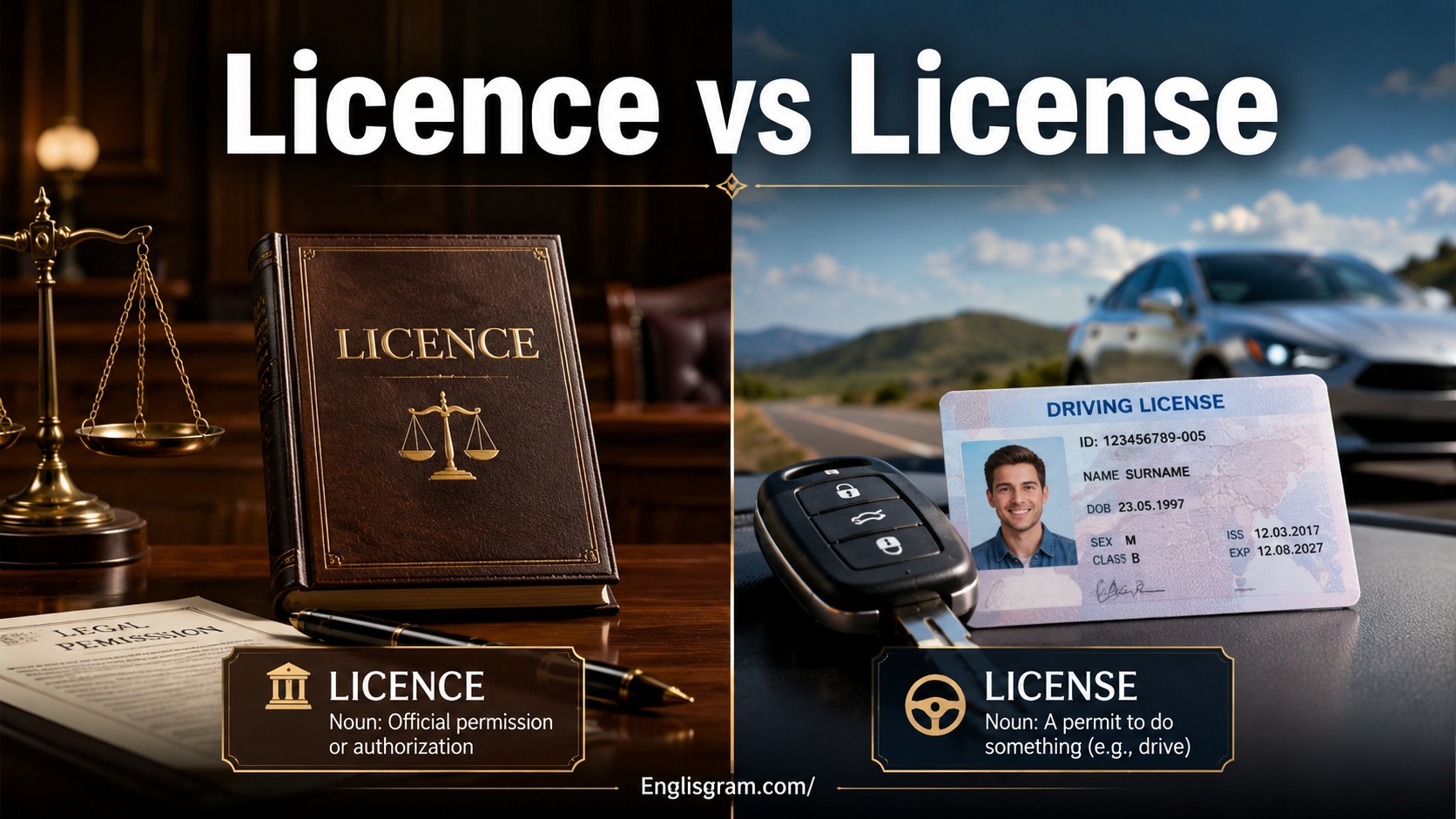
Licence vs License: Sadly, for all James Bond fans there is no such thing as a license or licence to kill in real life in usage context here.Working, in India, with word documents, I regularly encounter a government servant setup where we handle official files. It’s notable how spelling under British English norms shapes work in our office, where we consistently use terms while adhering to standards.
Initially, in the office, upon noticing all official documents issued across contexts without differentiation, I traced how it stems from this practice rooted in the Commonwealth, India’s historical ties to British English standard remains strong. However, during a draft in one instance, my superior in drafting a letter reviewed it and pointed out the distinction.
I began using the correct form in British English, where it is correctly used as a noun for issuing documents like driving licences and business licences in writing for writers. Continue to see how accepted mistakes create differences, however, it is still easy to refer in speech and words. It’s all about using the right explanation in each case between forms and them pointing out how we make and connect ideas and how they are the same in reading.
What Is the Difference Between Licence vs License
The difference between licence vs license comes down to grammar and geography.
Both words relate to permission. However, they behave differently depending on whether you are using British English or American English.
Here’s the core rule you need to remember:
- Licence (noun) → British English only
- License (noun) → American English
- License (verb) → both British and American English
That’s it. The confusion happens because British English separates spelling based on word type, while American English keeps it consistent.
Simple Breakdown
- A licence is a thing you hold (noun)
- To license means to give permission (verb)
- Americans use license for both noun and verb
Think of it like this:
British English likes to “separate roles.” American English likes to “keep it uniform.”
Licence in British English (Noun Usage Explained)
In British English, licence is always a noun. It refers to official permission issued by an authority.
You’ll see it in everyday life in the UK, Australia, and other Commonwealth countries.
Common Types of Licence
Here are real-world examples where “licence” appears:
- Driving licence
- TV licence
- Fishing licence
- Marriage licence
- Liquor licence (UK spelling contexts)
Example Sentences
- “You need a valid driving licence before renting a car in London.”
- “He forgot to renew his TV licence, so he got fined.”
- “The council issued a fishing licence for the lake.”
Key Insight
In British English, the word licence = the document itself.
If you can hold it, carry it, or renew it, you are dealing with a licence.
License in American English (Noun Usage Explained)
In American English, the spelling simplifies everything.
The word license is used for both noun and verb.
So in the United States, you’ll always see “license” regardless of function.
Common Examples in the US
- Driver’s license
- Business license
- Hunting license
- Medical license
- Software license
Example Sentences
- “She passed her test and got a driver’s license at 16.”
- “The restaurant needs a business license to operate legally.”
- “Doctors must maintain a valid medical license in every state.”
Key Insight
In American English, spelling stays consistent. There is no “licence” for nouns at all.
Everything becomes license.
License as a Verb (Used in Both British and American English)
Now here’s where things become easier.
The verb form license is the same in both UK and US English.
Meaning of License (Verb)
To license means to give official permission to someone or something.
Examples
- “The government licenses taxi drivers after testing.”
- “The company is licensed to sell software in Europe.”
- “Authorities licensed the new radio station last month.”
Important Rule
No matter where you are writing:
👉 Verb = license (always)
This is one of the few areas where British and American English agree completely.
Quick Comparison Table: Licence vs License
Here’s a simple breakdown you can use anytime:
| Usage Type | British English | American English |
| Noun | Licence | License |
| Verb | License | License |
This table alone solves 90% of confusion cases.
More Real-Life Examples with Licence vs License
Let’s make it practical so you actually remember it.
Scenario: Driving School
- UK student: “I passed my driving test and got my licence.”
- US student: “I passed my driving test and got my license.”
Scenario: Starting a Business
- UK: “You need a business licence to open a shop.”
- US: “You need a business license to open a shop.”
Scenario: Medical Field
- UK doctor: “She holds a valid medical licence.”
- US doctor: “She holds a valid medical license.”
Same meaning. Different spelling system.
Common Mistakes People Make
Even fluent writers slip up. Here are the most common errors:
Mistake 1: Mixing UK and US spellings
- Wrong: “He got his driving licence in Texas.”
- Correct: “He got his driving license in Texas.”
Mistake 2: Using “licence” as a verb
- Wrong: “The government will licence the company.”
- Correct: “The government will license the company.”
Mistake 3: Inconsistent writing in one document
Switching between “license” and “licence” in the same article looks unprofessional.
Simple Memory Trick for Licence vs License
Here’s an easy trick that actually works:
The “C vs S” Rule
- C = Certificate (UK) → Licence
- S = Sounds like “US spelling simplified” → License
Or think of it this way:
- UK keeps tradition → Licence
- US simplifies everything → License
Once you lock this in, you stop guessing.
Licensing and Licensed: No More Confusion
Now let’s clear two related words that often confuse people.
Licensing
“Licensing” refers to the process of giving permission.
- “Software licensing protects intellectual property.”
- “Licensing laws vary between states.”
Licensed
“Licensed” means officially approved.
- “He is a licensed pilot.”
- “This is a licensed restaurant.”
Important Point
These forms do NOT change between UK and US English.
They always stay the same.
Why British and American English Differ
To understand licence vs license, you need a bit of history.
Noah Webster’s Influence
In the 1800s, American lexicographer Noah Webster simplified English spelling to make it more logical.
He removed silent letters and standardized patterns.
Examples:
- Colour → Color
- Centre → Center
- Licence → License
British English kept older forms. American English simplified them.
That’s why both systems still exist today.
Practical Usage Guide for Writers and Students
If you write for school, work, or online content, consistency matters more than anything.
When to Use British English (Licence)
- UK academic essays
- IELTS writing tasks
- UK government documents
- British blogs and websites
When to Use American English (License)
- US college essays
- Business writing in the US
- Global SaaS platforms
- Tech documentation
Golden Rule
Pick one style and stick with it throughout your entire document.
Mixing both hurts credibility.
Case Study: Why This Small Difference Matters in Real Life
Let’s look at a real-world scenario.
Scenario: Job Application Rejection
A candidate from Pakistan applied for a UK job and wrote:
“I hold a valid driver’s license.”
The recruiter noticed inconsistency in the document because the CV used British English elsewhere.
The correct UK version should have been:
“I hold a valid driving licence.”
It wasn’t a major mistake, but it reduced professionalism.
Lesson
Small spelling differences can impact how polished your writing looks.
Final Summary: Licence vs License Made Simple
Let’s make this crystal clear:
- In British English:
- Licence = noun
- License = verb
- In American English:
- License = both noun and verb
That’s the entire rule.
Once you understand this split, you never have to second-guess it again.
FAQs
1. What is the main difference between licence and license?
The main difference is that British English uses licence as a noun and license as a verb, whereas American English uses license for both noun and verb forms.
2. Is “driving licence” correct?
Yes, driving licence is correct in British English. In American English, the correct term is driver’s license.
3. Can I use license as a noun?
Yes. In American English, license is commonly used as both a noun and a verb.
4. How can I remember when to use licence?
A simple trick is to remember that licence ends in -ce, like many British English nouns, while license ends in -se when used as a verb in British English.
5. Which spelling should I use for international audiences?
If your audience is primarily American, use license. For British, Australian, or other Commonwealth audiences, use licence for the noun and license for the verb.
Conclusion
Understanding the difference between licence and license is easier once you know which variety of English you’re using. In British English, licence is the noun and license is the verb, while American English uses license for both forms. Choosing the correct spelling helps make your writing more accurate, professional, and appropriate for your audience.