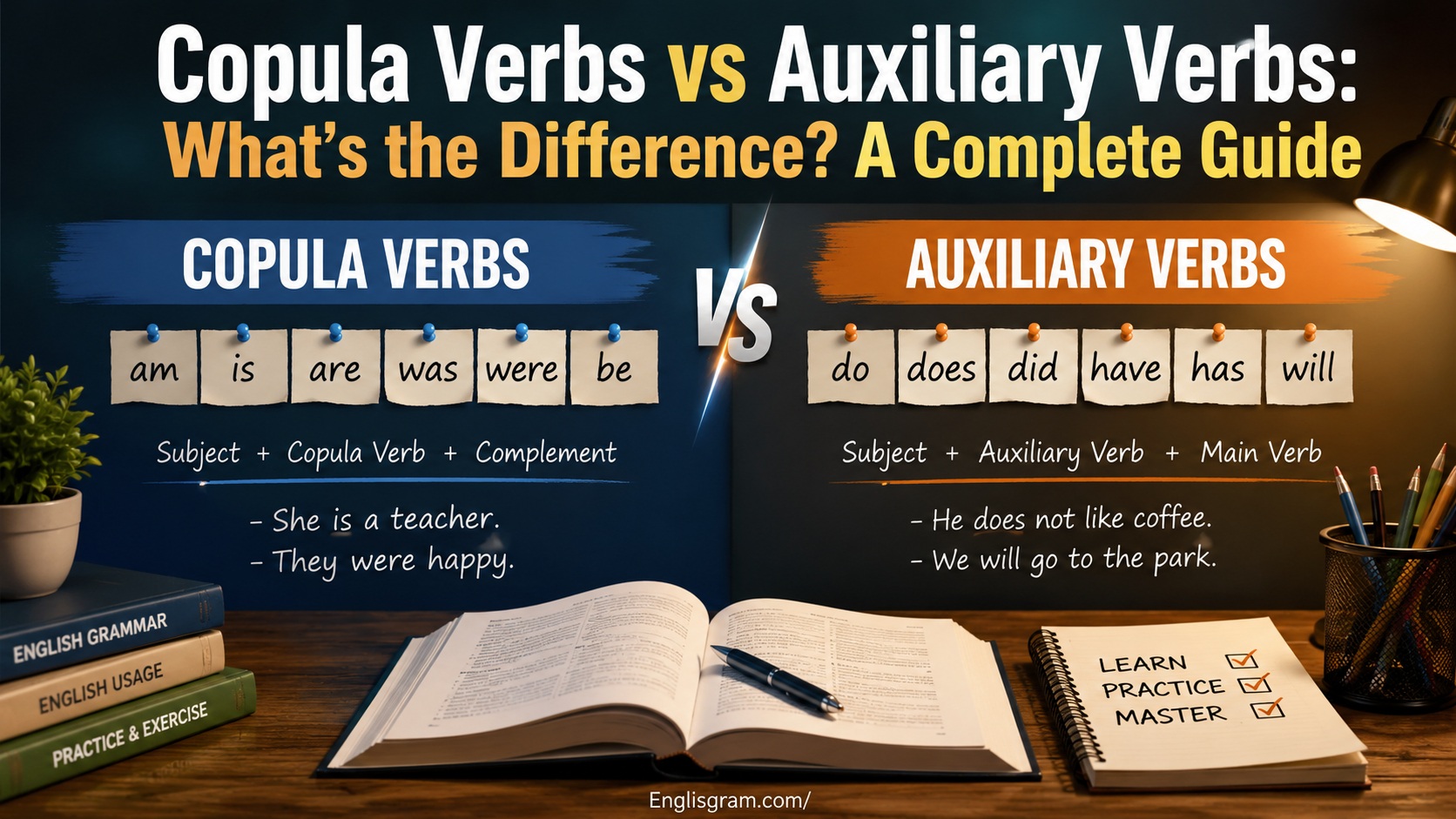
In English grammar, Copula Verbs vs Auxiliary Verbs show how verbs can connect a subject to a complement or support tenses, actions, and meaning. Copula verbs are linking verbs that connect a subject with a predicate or complement to express a state, identity, condition, or essence.
They help describe and identify a subject through forms such as is, am, are, was, were, be, being, and been. In She is happy, is links She with the adjective happy. When learners read a sentence out loud, they can often notice this relationship more easily, improving clarity, comprehension, precision, and understanding.
A copula can remain a powerful tool for expressing ideas, improving writing, strengthening an expression, and creating a natural flow.Auxiliary verbs, also called helping verbs, have a different role and function. They support the formation of tenses, voices, moods, and aspects, while helping express actions, events, questions, negation, and emphasis.
Quick Answer
Copula verbs link a subject to a subject complement, while auxiliary verbs help another verb form a grammatical construction. For example, is acts as a copula in “The soup is hot” because it links soup with hot. It acts as an auxiliary in “The soup is boiling” because it helps the main verb boiling form the progressive.
The most important point is that the same verb can perform different jobs. Forms of be are the clearest example. In “David is a teacher,” is is copular. In “David is teaching,” is is auxiliary.
Primary auxiliaries include be, have, and do. English also has modal auxiliaries such as can, could, may, might, must, shall, should, will, and would. Copular verbs include be and other verbs that can link a subject to a complement, such as become, seem, appear, feel, look, and remain.
What Is a Copula Verb?
A copula verb connects the subject of a sentence with a word or phrase that identifies, describes, or otherwise complements that subject. Because the verb creates this link, grammar books often call a copula a linking verb.
The most common English copula is be. Its forms include am, is, are, was, were, be, being, and been. However, English has other verbs that can function as copulas when they link the subject to a complement.
Consider:
- Maya is happy.
- James became a doctor.
- The plan seems reasonable.
- Your idea sounds interesting.
In each sentence, the verb connects the subject with information about that subject.
A useful way to picture a copula is as a bridge. The subject stands on one side, while the complement stands on the other. The copula connects them rather than describing an action performed on an object.
For example:
The coffee is cold.
Here, is doesn’t describe an action that the coffee performs. It establishes a relationship between coffee and cold.
How Copula Verbs Work
The most basic copular pattern looks like this:
Subject + Copula + Subject Complement
For example:
- Lena is a scientist.
- The children are tired.
- My brother became angry.
- The weather seems pleasant.
The complement after the copula tells you something about the subject.
In “Lena is a scientist,” the noun phrase a scientist identifies Lena. In “The children are tired,” the adjective tired describes the children.
This distinction matters because the complement isn’t functioning like an ordinary direct object. Compare: - Michael is a teacher.
- Michael teaches students.
In the first sentence, a teacher identifies Michael. In the second, students receives the action associated with teaches.
Common Copula Verbs
Be is the central English copula, but several other verbs can serve a linking function depending on how you use them.
| Copula Verb | Example | Complement |
| be | Anna is calm. | calm |
| become | Anna became a doctor. | a doctor |
| seem | The answer seems correct. | correct |
| appear | He appears nervous. | nervous |
| feel | I feel tired. | tired |
| look | You look happy. | happy |
| sound | That sounds strange. | strange |
| smell | The flowers smell wonderful. | wonderful |
| taste | The soup tastes delicious. | delicious |
| remain | She remained silent. | silent |
| The important qualification is that these verbs aren’t always copulas. Their function depends on the sentence. | ||
| For example: |
You look tired. → look functions as a linking verb.- You looked through the window. → looked describes an action.
Likewise: - The soup tastes delicious. → tastes links the soup with a description.
- She tasted the soup. → tasted describes an action.
Copula Verbs With Adjective Complements
Adjectives frequently follow copular verbs because they describe the subject.
Examples include:
- The room is quiet.
- The baby looks sleepy.
- The flowers smell fresh.
- The soup tastes salty.
- The students seem excited.
Notice the relationship between the subject and adjective. The adjective doesn’t describe something being done to an object. It describes the subject itself.
That makes the structure fundamentally different from an ordinary transitive verb construction.
Copula Verbs With Noun Complements
A copula can also connect a subject to a noun or noun phrase.
Examples:
- Maria is an engineer.
- Tom became the captain.
- Her brother remained a student.
- That building is the city library.
These noun phrases are often called subject complements or predicative complements because they provide information about the subject.
The relationship can sometimes work almost like an equals sign:
Maria = an engineer
Tom = the captain
This isn’t a mathematical equation, of course. It’s simply a useful way to understand the identifying relationship created by a copula.
What Is an Auxiliary Verb?
An auxiliary verb is a helping verb that works with another verb to create a larger verb phrase or express grammatical information.
English has three primary auxiliaries:
- be
- have
- do
English also has modal auxiliary verbs, including can, could, may, might, must, shall, should, will, and would.
Auxiliaries can help express tense, aspect, voice, negation, questions, emphasis, possibility, necessity, prediction, and other meanings.
For example: - She is working.
- They have finished.
- Do you understand?
- The window was broken.
- You should leave.
The auxiliary isn’t simply describing the subject. Instead, it participates in the construction of the verb phrase.
What Do Auxiliary Verbs Do?
Auxiliary verbs have several major grammatical jobs.
| Function | Example | Auxiliary |
| Progressive aspect | She is running. | is |
| Passive voice | The car was repaired. | was |
| Perfect aspect | They have arrived. | have |
| Questions | Do you agree? | do |
| Negation | He does not know. | does |
| Modality | You should stay. | should |
| Future reference | We will leave. | will |
| The distinction between tense, aspect, and voice is particularly useful here. Auxiliary verbs often carry grammatical information that the lexical verb itself doesn’t express. | ||
| For example, working tells us about the activity. The auxiliary is helps place that activity into a progressive construction. |
Primary Auxiliary Verbs: Be, Have, and Do
The three primary auxiliary verbs deserve special attention because each can also function as an ordinary lexical verb.
| Verb | Auxiliary Example | Main/Lexical Example |
| be | She is running. | She is tired. |
| have | They have finished. | They have a car. |
| do | Do you agree? | She did her homework. |
| This table reveals an important principle: a verb’s form doesn’t automatically determine its grammatical category. | ||
| You need to examine how the verb behaves within its sentence. | ||
| That becomes especially important with be, which can function as a copula or an auxiliary. |
Be as an Auxiliary Verb
Be functions as an auxiliary when it helps construct a progressive or passive verb phrase.
Examples:
- She is reading.
- They are playing.
- He was sleeping.
- We were waiting.
- The house was sold.
In “She is reading,” is helps create the present progressive construction.
In “The house was sold,” was participates in the passive construction.
So, although is and was look exactly like the forms used in copular sentences, their grammatical jobs differ.
Have as an Auxiliary Verb
Have serves as an auxiliary in perfect constructions.
Examples:
- She has finished.
- They have arrived.
- I had forgotten.
- We have been waiting.
Here, has, have, and had combine with participial forms of another verb.
Compare: - She has finished. → auxiliary has
- She has a car. → main verb has
The first sentence uses has to form a perfect construction. The second uses has to express possession.
Do as an Auxiliary Verb
Do commonly functions as an auxiliary in questions, negatives, and emphatic statements.
Examples:
- Do you know him?
- I do not understand.
- She doesn’t agree.
- He did finish the work.
Notice that the main verb stays in its base form after auxiliary do: - Does she work here?
- Not: Does she works here?
The auxiliary does carries the present-tense agreement, while work remains in the base form.
Read More: Origin Examples and Correct Usage
Copula Verbs vs Auxiliary Verbs: The Main Difference
The clearest distinction is functional.
A copula links the subject to a complement. An auxiliary helps another verb form a grammatical construction.
| Feature | Copula Verb | Auxiliary Verb |
| Primary function | Links subject and complement | Helps form a verb phrase |
| Typical following element | Subject complement | Another verb or verb form |
| Describes subject? | Often | Not necessarily |
| Helps express aspect? | No, when functioning purely as copula | Yes |
| Helps form passive voice? | No, when functioning purely as copula | Yes |
| Example | She is happy. | She is laughing. |
| The contrast becomes obvious when you put similar sentences side by side: | ||
| She is tired. | ||
| Here, is links she with tired. It is copular. | ||
| She is running. | ||
| Here, is combines with running to form the progressive. It is auxiliary. | ||
| The spelling hasn’t changed. The grammatical function has. |
Is “Be” a Copula or an Auxiliary?
The correct answer is both, depending on the construction.
This is one of the most important facts in understanding copula verbs vs auxiliary verbs.
Consider these examples:
| Sentence | Role of “be” | Reason |
| She is happy. | Copula | Links she with happy. |
| She is a doctor. | Copula | Links she with a doctor. |
| She is working. | Auxiliary | Helps form the progressive. |
| She was working. | Auxiliary | Helps form the past progressive. |
| The door was opened. | Auxiliary | Participates in the passive. |
| The door was open. | Copula | Links door with open. |
| This distinction is why simply memorizing “be is an auxiliary” produces problems. So does memorizing “be is a linking verb.” | ||
| Both statements can be correct. Neither statement covers every use. |
Copula Verbs vs Auxiliary Verbs Examples
Paired examples make the distinction much easier to recognize.
Example 1: Tired vs Running
He is tired.
Is links he with the adjective tired. It functions as a copula.
He is running.
Is combines with running. It functions as an auxiliary.
Example 2: Teacher vs Teaching
She was a teacher.
Was connects she with a teacher.
She was teaching.
Was helps form the past progressive.
Example 3: Ready vs Preparing
They are ready.
Are links they with ready.
They are preparing dinner.
Are helps form the present progressive.
Example 4: Open vs Being Opened
The door is open.
Here, is links the door with the adjective open.
The door is being opened.
Now the verb phrase contains multiple grammatical elements. Is helps form the progressive portion of a passive construction, while being and opened contribute to the larger passive-progressive structure.
How to Identify a Copula Verb
You don’t need to memorize every grammatical label. A few practical checks can help.
Step 1: Find the Verb
Start by identifying the verb or verb phrase.
For example:
The child is sleepy.
The relevant verb is is.
Step 2: Look at What Follows It
Ask whether the word or phrase after the verb describes or identifies the subject.
In “The child is sleepy,” sleepy describes the child.
That strongly points toward a copular function.
Step 3: Look for Another Verb
If be, have, or do is helping another verb, you’re likely dealing with an auxiliary.
Compare:
- She is nervous. → no following main verb
- She is running. → running is the main lexical verb
This isn’t an absolute shortcut for every grammatical framework, but it works well for many standard English constructions.
Step 4: Ask What Relationship the Verb Creates
Try paraphrasing the sentence mentally.
The cake is delicious.
The sentence essentially says:
The cake = delicious.
That’s a subject-description relationship.
By contrast:
The cake is baking.
Here, is doesn’t link the cake with an adjective or noun. It helps construct the verb phrase is baking.
How to Identify an Auxiliary Verb
Look for a verb that contributes grammatical structure while another verb carries the main lexical meaning.
Ask these questions:
- Is the verb helping another verb?
- Does it help create progressive aspect?
- Does it help create perfect aspect?
- Does it participate in passive voice?
- Does it form a question or negative?
- Does it express modality?
Examples:
- is running → is is auxiliary.
- has finished → has is auxiliary.
- did leave → did is auxiliary.
- was written → was is auxiliary.
- should go → should is modal auxiliary.
The key is the relationship between the verbs, not simply the appearance of the first verb.
Copula Verbs vs Linking Verbs
In many English grammar resources, copula verb and linking verb are treated as equivalent or near-equivalent terms.
The word copula comes from Latin and means a link or connection. The term captures what the verb does: it connects the subject with a complement.
For example:
The sky became dark.
The verb became links the sky with dark.
The British Council discusses linking verbs such as be, seem, look, and feel, while Cambridge Dictionary describes copular or linking uses within its treatment of English verb types.
For further reference:
- Cambridge Dictionary: Verb types
- Cambridge Dictionary: Be
- British Council: Linking verbs
- Government of Canada: Linking verb / copula verb
Copula vs Auxiliary vs Main Verb
A three-way comparison helps prevent another common misunderstanding.
| Verb category | What it does | Example |
| Copula | Links subject to complement | She is happy. |
| Auxiliary | Helps another verb | She is smiling. |
| Main verb | Carries lexical meaning | She smiled. |
| These categories can overlap in ways that seem confusing at first because a verb’s lexical identity and its syntactic function aren’t always the same thing. | ||
| For example, be is a verb lexeme. In one sentence, it can function as a copula. In another, it can function as an auxiliary. | ||
| Think of it like a tool with multiple jobs. A screwdriver can tighten a screw or remove one. The tool hasn’t changed. Its function has. |
Common Copula and Auxiliary Verb Mistakes
Mistake 1: Calling Every Form of “Be” an Auxiliary
This is probably the most common error.
“She is happy” doesn’t use is as an auxiliary merely because is belongs to the verb be.
There is no separate main verb that is helps in this construction. Instead, is links the subject to happy.
Mistake 2: Calling Every Form of “Be” a Copula
The opposite mistake causes just as much trouble.
In “She is singing,” is helps construct the progressive verb phrase. It doesn’t link she to singing in the same way that is links she to happy.
Mistake 3: Assuming Every Linking Verb Is Always a Copula
Some verbs can switch roles depending on context.
Compare:
- The soup tastes delicious.
- She tasted the soup.
In the first sentence, tastes links the soup with a quality. In the second, tasted describes an action performed by she.
Mistake 4: Confusing Complements With Objects
A subject complement identifies or describes the subject.
James is a pilot.
A pilot describes or identifies James.
A direct object, on the other hand, typically receives the action of a transitive verb:
James flew a plane.
Plane is the object of flew.
The two structures may look similar to beginners, but their grammatical relationships differ.
Mistake 5: Treating “Helping Verb” as the Whole Explanation
“Helping verb” is a useful beginner-friendly term. However, it doesn’t tell you exactly what the auxiliary contributes.
For example, be can help express progressive aspect or passive voice. Have can form perfect constructions. Do can support questions and negation.
Knowing the specific function gives you a much clearer picture.
Copula Verbs vs Auxiliary Verbs in Different Tenses
Tense and aspect can make these constructions more complex because several verbs may appear together.
Present
She is happy.
Is functions as a copula.
She is working.
Is functions as an auxiliary.
Past
She was tired.
Was functions as a copula.
She was working.
Was functions as an auxiliary.
Perfect
She has finished.
Has is an auxiliary forming the perfect construction.
Now consider:
She has been sick.
Here, has is the perfect auxiliary, while been is the past participle of be. The be element has a copular function because sick is a subject complement.
Future
She will be ready.
Will is a modal auxiliary. Be functions as a copula linking she with ready.
This example is particularly useful because it demonstrates that one verb phrase can contain different grammatical roles at the same time.
When a Sentence Contains More Than One Auxiliary
English can stack auxiliary verbs.
Consider:
She has been working.
Here, has helps form the perfect construction, while been participates in the progressive construction with working.
Another example:
They will have finished.
Will is a modal auxiliary. Have helps form the perfect construction.
Now look at a passive construction:
The report will have been completed.
Several grammatical layers appear:
- will → modal auxiliary
- have → perfect auxiliary
- been → form of be used within the passive construction
- completed → lexical verb in its past-participial form
This is where English grammar gets more interesting. A sentence doesn’t have to contain one auxiliary and one main verb. Verb phrases can contain several auxiliaries working together.
FAQs
What is a copula verb?
A copula verb, or linking verb, connects the subject to a complement and expresses a state, identity, or condition. For example, “She is happy” uses is as a copula.
What is an auxiliary verb?
An auxiliary verb, or helping verb, supports the main verb in forming tenses, aspects, moods, questions, negation, and emphasis. Examples include have, has, will, can, and must.
What is the main difference between copula and auxiliary verbs?
A copula links the subject to information that describes or identifies it, while an auxiliary supports another verb to express grammatical meaning.
Can “is” be both a copula and an auxiliary verb?
Yes. In “She is happy,” is is a copula. In “She is reading,” is is an auxiliary verb because it helps form the progressive aspect.
How can I identify a copula verb?
Check whether the verb links the subject to a complement describing or identifying the subject. If it does, it is functioning as a copula.
Conclusion
Understanding Copula Verbs vs Auxiliary Verbs becomes easier when you focus on the job each verb performs. Copula verbs link a subject to a description or identity, while auxiliary verbs help another verb express tense, aspect, mood, questions, or emphasis. With regular practice and clear examples, you can recognize the difference more naturally and use both types accurately in everyday and professional English.