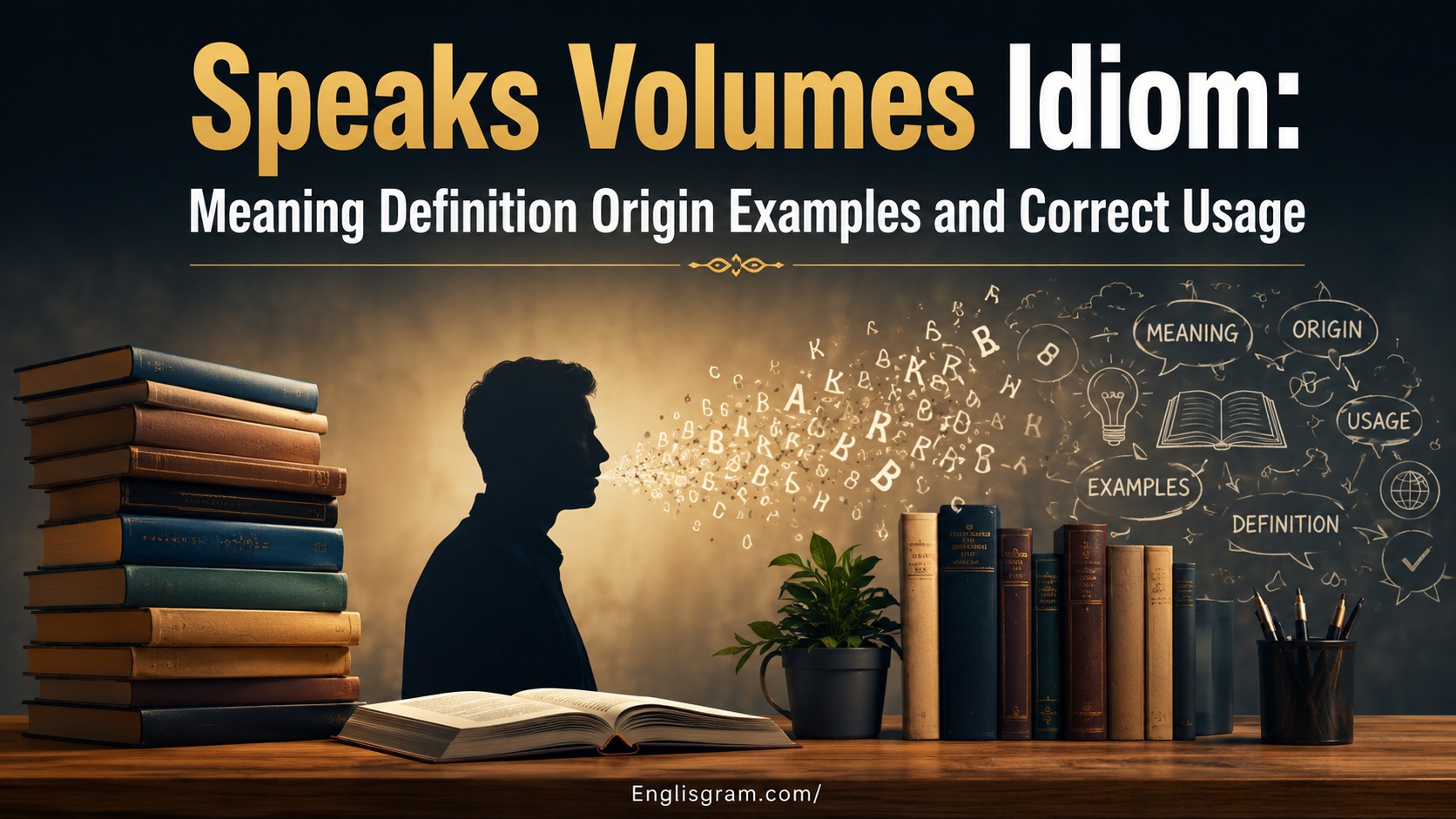
The Speaks Volumes Idiom shows how a simple action glance pause or silence can reveal a great deal of information without many words. The speaks volumes idiom is a common idiom and English idiom used in everyday language conversation professional writing movies and psychology discussions. As an idiomatic expression it explains how her silence his actions gestures choices or behavior can communicate a great deal of information through subtext subtle communication implied information implied meaning implied message inferred meaning hidden meaning or deeper meaning.
In language learning understanding these communication signals behavioral cues nonverbal cues and emotional cues can improve communication skills interpretation skills understanding behavior and behavioral interpretation. In this complete guide you can learn proper usage how to use correctly the expression and how examples practical examples sentence examples and sentence structure make the meaning clear.
A person’s actions choices behavior conduct character intent personality values ethics morality and judgment may speak volumes. For instance refusing to support charitable endeavors charitable causes or charity can provide evidence an indication an implication or an insight into a person’s character. This is figurative language rather than direct verbal communication and it often appears through social interaction observation and discussion.The history and origin of the expression are also useful for understanding its meaning.
What Does “Speaks Volumes” Mean?
“Speaks volumes” means to communicate or reveal a great deal of information without explicitly stating it.
The expression usually describes something that gives you a strong impression about a person situation quality or fact.
Consider this example:
His silence speaks volumes about how he feels.
The silence doesn’t literally speak. Instead it communicates something significant. Depending on the situation his silence might suggest disappointment anger uncertainty sadness or disagreement.
The key idea is indirect communication.
Something doesn’t have to explain itself in detail to be revealing. Sometimes one small action can tell you more than several minutes of conversation.
Simple definition of “speaks volumes”
Speaks volumes: To reveal communicate or indicate a great deal without expressing everything directly.
The phrase can describe both human behavior and nonhuman things.
For instance:
- Her smile speaks volumes about her happiness.
- The statistics speak volumes about the company’s performance.
- His refusal to apologize speaks volumes about his attitude.
- The photograph speaks volumes about life during that period.
In each example the subject communicates something beyond its immediate appearance.
“Speaks Volumes” Idiom Definition at a Glance
| Feature | Explanation |
| Idiom | Speaks volumes |
| Base form | Speak volumes |
| Basic meaning | Reveals or communicates a great deal |
| Literal meaning | Appears to communicate many “volumes” of information |
| Figurative meaning | Shows something strongly without stating it directly |
| Typical subjects | Actions silence behavior expressions evidence results decisions |
| Tone | Usually neutral positive or negative depending on context |
| Grammar | Third-person singular present tense |
| Example | Her actions speak volumes about her character. |
The Cambridge Dictionary defines “speak volumes” as showing or expressing something very clearly especially without using words. You can find its dictionary entry here.
That definition captures the heart of the expression: communication doesn’t always require speech.
Why Do We Say “Speaks Volumes”?
The word “volumes” creates a metaphor based on books.
A volume can mean a book especially one that forms part of a larger collection. If something could fill several volumes with information it would contain a tremendous amount to say.
The idiom transfers that idea to communication.
Imagine someone performing one small act of kindness. Technically the act doesn’t contain words. Yet it may reveal a person’s generosity empathy values and character.
In a figurative sense that single action “speaks volumes.”
The expression therefore creates a vivid comparison:
One action → lots of information → “speaks volumes.”
It’s similar to saying that the evidence could fill many books.
The metaphor behind “speaks volumes”
The metaphor works because speaking represents communication while volumes represent a large quantity of information.
So when something “speaks volumes” it doesn’t make a literal sound. Instead it communicates a substantial amount of meaning.
The expression has been established in English for centuries. Dictionary references commonly place the idiom’s use in the early 19th century. Dictionary.com also records the expression in its established figurative sense. See its entry for speak volumes.
It’s best to avoid overly specific origin stories unless reliable historical evidence supports them. The book-based metaphor provides the clearest explanation of how the phrase works.
“Speak Volumes” vs. “Speaks Volumes”
“Speak volumes” and “speaks volumes” are forms of the same idiom.
The difference comes from subject-verb agreement.
Use speaks with a singular third-person subject:
Her behavior speaks volumes about her personality.
Use speak with plural subjects and with I you we and they:
Their actions speak volumes about their priorities.
Here’s the pattern:
| Subject | Correct form | Example |
| I | speak volumes | I think his actions speak volumes. |
| You | speak volumes | You speak volumes through your work. |
| We | speak volumes | Our results speak volumes. |
| They | speak volumes | Their choices speak volumes. |
| He | speaks volumes | His reaction speaks volumes. |
| She | speaks volumes | Her kindness speaks volumes. |
| It | speaks volumes | The result speaks volumes. |
In the past tense use spoke volumes regardless of the subject:
Her response spoke volumes.
Their actions spoke volumes.
The idiom itself doesn’t change. Only the grammatical form of the verb changes.
How to Use “Speaks Volumes” in a Sentence
The most common structure is:
Subject + speaks volumes
For example:
Her expression speaks volumes.
You can also specify what the subject reveals:
Subject + speaks volumes about + noun
Examples:
- His behavior speaks volumes about his character.
- The decision speaks volumes about the company’s priorities.
- Her reaction speaks volumes about how seriously she takes the issue.
Another useful construction is:
Subject + speaks volumes for + noun
This generally means that something provides strong evidence in favor of a quality person product or idea.
For example:
The restaurant’s loyal customers speak volumes for the quality of its food.
The distinction between about and for matters because the two prepositions can change the focus of the sentence.
Common sentence patterns
| Pattern | Example |
| X speaks volumes. | Her silence speaks volumes. |
| X speaks volumes about Y. | His actions speak volumes about his values. |
| X speaks volumes for Y. | The results speak volumes for the effectiveness of the strategy. |
| X spoke volumes. | His reaction spoke volumes. |
| X can speak volumes. | A person’s choices can speak volumes. |
| X could speak volumes about Y. | That decision could speak volumes about their priorities. |
These structures work particularly well when the reader can infer the unstated message.
Read More:“Not a Problem” vs. “No Problem”: Meaning, Differences, and Correct Usage
What Can “Speak Volumes”?
One of the most useful features of the idiom is its flexibility. Almost anything that communicates meaningful information indirectly can speak volumes.
Actions can speak volumes
Actions often reveal things that words hide.
Someone may describe themselves as generous reliable or supportive. However what they actually do provides stronger evidence.
The way she treated the new employee speaks volumes about her character.
The action reveals something about her attitude toward other people.
This doesn’t mean actions always provide perfect evidence. Context matters. A single event can sometimes be misleading. Still the idiom works particularly well when behavior gives you a meaningful clue about someone’s priorities or personality.
Silence can speak volumes
“Silence speaks volumes” is one of the most recognizable uses of the expression.
For example:
When everyone was asked whether they supported the proposal his silence spoke volumes.
The silence may suggest disagreement. However it could also indicate uncertainty shock discomfort or a desire not to respond.
That’s an important point: silence has no single fixed meaning.
Its interpretation depends on the surrounding circumstances.
Facial expressions can speak volumes
People communicate constantly through facial expressions.
A raised eyebrow a sudden frown a smile or a look of surprise can communicate an emotional response without a spoken sentence.
Her expression spoke volumes when she heard the announcement.
The reader understands that her face revealed a strong reaction.
Body language can speak volumes
Body language can also provide clues about someone’s attitude or emotions.
For example:
His crossed arms and refusal to make eye contact spoke volumes about his discomfort.
Here the physical behavior functions as indirect communication.
Still body language shouldn’t be treated as a foolproof code. The same gesture can mean different things in different situations.
Decisions can speak volumes
A person’s choices often reveal their priorities.
Choosing to cancel the event rather than compromise safety speaks volumes about the organizer’s priorities.
The decision communicates a value: safety matters more than convenience.
Results can speak volumes
Results can reveal the effectiveness of an approach.
The company’s steady growth speaks volumes about the strength of its strategy.
The growth isn’t literally talking. Instead the measurable result provides evidence about the strategy.
Numbers and statistics can speak volumes
Statistics can also communicate a broader reality.
The declining graduation rate speaks volumes about the challenges facing the school district.
Here the numbers act as evidence.
The expression works particularly well in journalism business analysis and commentary because writers often interpret what evidence suggests rather than merely presenting raw information.
Images can speak volumes
A photograph can communicate atmosphere history emotion or social conditions without using words.
The photograph speaks volumes about the hardships people endured during that period.
This use highlights the idiom’s broader meaning: communication doesn’t have to be verbal.
“Speaks Volumes” Examples in Everyday English
Here are practical examples showing how native speakers might use the expression.
Relationships
The way he listens to his partner speaks volumes about how much he cares.
Her decision to check on her friend after the argument speaks volumes about their relationship.
His silence after hearing the news spoke volumes.
Workplace
The manager’s willingness to take responsibility speaks volumes about her leadership.
The company’s investment in employee training speaks volumes about its long-term priorities.
The team’s results speak volumes about the value of consistent preparation.
School
Her dedication to helping classmates speaks volumes about her character.
The students’ improved results speak volumes about their hard work.
Family
The way his parents supported him speaks volumes about their commitment.
Her brother’s immediate response spoke volumes about how worried he was.
Business
The company’s decision to improve customer service speaks volumes about its changing priorities.
The product’s high customer-retention rate speaks volumes about its reliability.
Social situations
Nobody responded to the announcement and that silence spoke volumes.
His decision to leave without saying goodbye spoke volumes about how upset he was.
These examples demonstrate why the idiom remains useful. It allows you to describe meaning that exists beneath the surface.
“Speaks Volumes” Examples With Context
Context makes this idiom much easier to understand.
Case study: A manager helps an employee
Imagine an employee struggling to finish an important project. Instead of leaving at the end of the workday the manager stays behind and helps solve the problem.
You could say:
The manager’s willingness to stay late speaks volumes about her leadership.
What does it reveal?
- She values her employees.
- She takes responsibility seriously.
- She leads by example.
- She cares about the project’s outcome.
The phrase compresses all those implications into three words: speaks volumes.
Case study: A surprising silence
Suppose a team usually debates every major decision. During one meeting the team leader proposes a controversial change. Nobody objects.
You might write:
The team’s silence spoke volumes about how uncertain everyone felt.
The sentence doesn’t claim that silence has one universal meaning. Instead the context gives the silence its significance.
Case study: Business results
Suppose a company introduces a new customer-support system. Complaints fall substantially over the following year.
A business writer might say:
The sharp decline in customer complaints speaks volumes about the effectiveness of the new system.
The result provides evidence. The writer isn’t simply describing a number. They’re interpreting what that number suggests.
“Speaks Volumes” in Different Tenses
The idiom works across several grammatical forms.
Present tense
Use speaks volumes with a singular third-person subject.
Her behavior speaks volumes about her priorities.
Use speak volumes with plural subjects.
Their actions speak volumes about their values.
Past tense
Use spoke volumes.
His reaction spoke volumes about his disappointment.
Their decision spoke volumes about the company’s direction.
Infinitive
Use speak volumes after to.
Her willingness to help seems to speak volumes about her character.
Modal verbs
Modal verbs take the base form:
That decision could speak volumes about their intentions.
His response might speak volumes about how he feels.
You wouldn’t write “could speaks volumes.”
Present progressive
The expression can also appear in progressive constructions when the situation is developing:
Recent results are speaking volumes about the changing market.
This form is grammatically possible although the simple present often sounds more natural when you’re making a general observation.
“Speaks Volumes About” vs. “Speaks Volumes For”
These expressions overlap but their focus differs.
“Speaks volumes about”
Use speaks volumes about when something reveals information about another thing.
His generosity speaks volumes about his character.
The generosity reveals something about his character.
“Speaks volumes for”
Use speaks volumes for when something provides strong evidence in favor of a person quality product method or idea.
The product’s five-year track record speaks volumes for its reliability.
The track record supports the claim that the product is reliable.
Compare the two:
| Expression | Main idea | Example |
| Speaks volumes about | Reveals information about something | Her actions speak volumes about her character. |
| Speaks volumes for | Provides strong evidence in favor of something | The results speak volumes for the strategy’s effectiveness. |
When you’re talking about someone’s personality attitude intentions or qualities about will often be the natural choice.
“Speaks Volumes” vs. “Says a Lot”
“Says a lot” is a straightforward alternative to “speaks volumes.”
Consider:
Her actions speak volumes about her character.
You could also say:
Her actions say a lot about her character.
Both sentences work.
However speaks volumes often feels more vivid and emphatic. It suggests that the evidence communicates a particularly significant amount.
| Expression | Style | Typical effect |
| Speaks volumes | Idiomatic | Vivid and emphatic |
| Says a lot | Conversational | Simple and direct |
| Reveals a great deal | More formal | Analytical |
| Shows a lot | Very simple | Plain and accessible |
| Indicates strongly | Formal | Precise and analytical |
Choose based on your audience.
For everyday conversation “That says a lot about him” sounds completely natural. In an article or commentary “That speaks volumes about him” can add more rhetorical force.
FAQs
What does “speaks volumes” mean?
“Speaks volumes” means that something gives a great deal of information without needing many words. It often describes actions, choices, silence, or behavior that reveal a person’s feelings, character, or intent.
Is “speaks volumes” an idiom?
Yes. “Speaks volumes” is a common English idiom and idiomatic expression. Its meaning is usually figurative rather than literal.
What is an example of “speaks volumes”?
For example: Her decision to help the charity speaks volumes about her character. This means her action reveals a lot about her values and personality.
What are the related forms of “speaks volumes”?
Common forms include speak volumes, speaks volumes, spoke volumes, and speaking volumes. The correct form depends on the tense and sentence structure.
Is “speaks volumes” used in everyday English?
Yes. You can use it in everyday language, conversation, professional writing, and other contexts when an action or statement reveals a deeper meaning.
Conclusion
The idiom Speaks Volumes describes something that communicates a strong message without using many words. A person’s actions, silence, facial expressions, choices, or even a small gesture can speak volumes about their feelings, personality, intentions, or attitude. For example, someone who consistently helps others may speak volumes about their kindness and character.