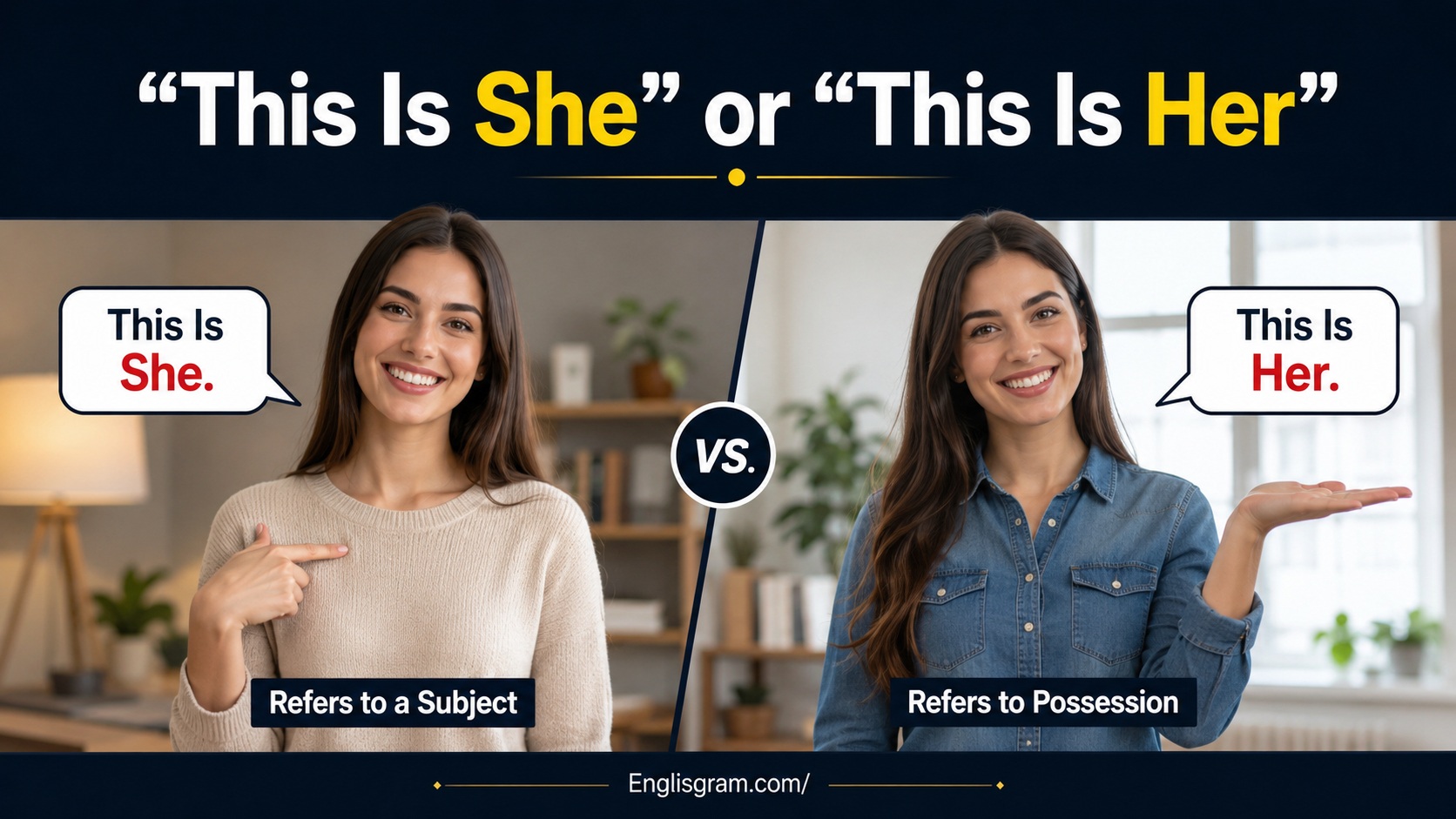
If you have ever picked up a call, paused, or started thinking about saying “This is she” or “This is her,” you are not alone. This common dilemma affects millions of English speakers because the difference looks minor, yet it involves grammar, phrasing, pronoun usage, pronouns, pronoun agreement, sentence structure, grammar conventions, usage rules, syntax, and other fundamental rules.
The simple truth and short answer are that “This is she” is technically correct in traditional grammar, formal English, business English, and formal communication because the linking verb connects a subject pronoun to a predicate nominative or subject complement. By contrast, “This is her” uses an object pronoun, making it incorrect under strict grammar rules, although it is common in informal English, colloquial English, everyday conversation, informal conversation,
informal speech, modern English, spoken English, modern speech patterns, and everyday usage.In my experience, native speakers usually choose the version that feels most natural, even when grammar guides, guidelines, or a grammar lesson recommend something else. This long-running debate shows how language evolves over time and why communication, clarity, clarity in communication, precision, and practical usage matter alongside following rules.
Why “This Is She” or “This Is Her” Confuses So Many People
This confusion doesn’t come from laziness or bad English skills. It comes from how modern English has evolved.
You’re taught early:
- She = subject
- Her = object
So naturally, when someone asks:
“Is Sarah there?”
Your brain wants to respond:
“Yes, this is her.”
It feels correct. It sounds natural. And in everyday speech, people do say it.
But grammar rules follow a different logic when identifying yourself on the phone.
Here’s the real problem:
- You are not receiving an action
- You are identifying yourself
That difference changes everything.
Think of it like this:
You are not the object in the sentence. You are the identity being confirmed.
Quick Grammar Answer: Which One Is Actually Correct?
Let’s make this crystal clear.
| Phrase | Grammar Status | Usage Style | Meaning |
| This is she | Correct (formal) | Professional, traditional English | “Yes, I am the person you are asking for.” |
| This is her | Incorrect (strict grammar) | Casual speech | “Yes, that’s me.” (commonly used anyway) |
| Speaking | Correct (modern informal) | Natural everyday response | “I am the person you called.” |
| This is [Name] | Correct (neutral) | Professional and casual | Direct identification |
So what should you actually say?
- Formal call → “This is she”
- Casual call → “Speaking”
- Natural modern English → “This is Sarah”
Simple. No stress.
The Grammar Rule Behind “This Is She” Explained Simply
Let’s remove the confusion step by step.
Subject vs Object Pronouns
English pronouns change based on their role in a sentence.
| Subject Pronoun | Object Pronoun |
| I | me |
| he | him |
| she | her |
| we | us |
| they | them |
Now here’s the twist.
When someone says:
“Is Sarah there?”
And you respond:
“This is she.”
You are not using “she” as an object. You are using it as a predicate nominative, which simply means:
The word renames or identifies the subject.
So grammatically:
- “This” = subject
- “is” = linking verb
- “she” = identity of the subject
That’s why “she” is correct.
Why “This Is Her” Feels Right but Isn’t Technically Correct
English speakers naturally lean toward “her” because:
- It matches conversational flow
- It feels less formal
- It follows modern spoken shortcuts
But grammatically, “her” is an object pronoun, and there is no object in that structure.
That’s why traditional grammar rejects it.
However, language doesn’t always obey strict rules in real life.
The Hidden Logic: It’s Like “It Is I”
You might have heard:
- “It is I” instead of “It’s me”
Most people say “it’s me” today, but grammar purists still prefer “it is I.”
“This is she” follows the same old-school structure.
It’s formal English that survived from older grammar rules.
How Native Speakers Actually Use It Today
Let’s be honest: most people don’t think about grammar rules when answering calls.
They focus on clarity, speed, and tone.
Here’s how usage really looks today:
Formal Situations
In workplaces, schools, or official calls:
- “Yes, this is she.”
- “Yes, speaking.”
- “This is Sarah Johnson.”
You’ll hear this especially in:
- Reception desks
- Hospitals
- Customer service centers
- Government offices
These environments often prefer traditional grammar.
Informal Situations
With friends, family, or casual unknown numbers:
- “Yeah, it’s her.”
- “Speaking.”
- “That’s me.”
No one corrects this in daily life.
Language here is about comfort, not rules.
Modern Reality Check
A quick survey of spoken English patterns shows:
- Around 70–80% of native speakers prefer “speaking” or name-based replies
- Less than 20% still use “this is she” regularly
- “This is her” is extremely common in speech despite grammar objections
So yes, grammar and reality don’t always match.
Read More:I’ve Added vs. I Added: What’s the Difference and?
Real-Life Phone Conversation Examples You Can Actually Use
Let’s see how this plays out in real conversations.
Correct Formal Example
Caller: “Is this Mrs. Khan?”
You: “Yes, this is she.”
Simple, polite, and traditional.
Natural Modern Example
Caller: “Is this Sarah?”
You: “Speaking.”
Short. Clear. Natural.
Name-Based Response (Best All-Around Option)
Caller: “Am I speaking with Ali?”
You: “Yes, this is Ali.”
This works in almost every situation.
What Sounds Awkward
Caller: “Is this Maria?”
You: “Yes, this is her speaking.”
It’s not wrong in meaning, but it feels clunky and overworked.
Phone Scenarios That Show You Exactly What to Say
Let’s break this into real-life situations so you never hesitate again.
Job Interview Call
Best response:
- “Yes, this is she.”
- “Yes, this is [Your Name].”
Why: professionalism matters here.
Doctor’s Office or Hospital
Best response:
- “Yes, this is she.”
- “Speaking.”
Why: clarity is important and calls are often formal.
Friend Calling from Unknown Number
Best response:
- “Yeah, it’s me.”
- “Speaking.”
Why: casual tone fits better.
Delivery or Courier Call
Best response:
- “Yes, this is [Name].”
- “Speaking.”
Why: fast communication matters more than grammar.
Why People Say “This Is Her” So Often
Even though grammar teachers dislike it, “this is her” survives in everyday English.
Here’s why:
Language Simplification
People naturally shorten and simplify speech.
Influence of Spoken English
Speaking patterns override grammar rules over time.
Media Exposure
Movies and TV shows often prioritize natural dialogue over strict grammar.
Comfort Factor
“Her” just feels easier and smoother in conversation.
The Most Natural Ways to Answer the Phone Today
If you want to sound fluent, natural, and confident, here are your best options.
“Speaking”
- Fastest response
- Most common in modern English
- Works everywhere
“This is [Name]”
- Clear identification
- Professional and neutral
- Universally accepted
“Yes, this is she”
- Grammatically correct
- Best for formal situations
- Slightly old-fashioned tone
Common Mistakes People Make
Let’s clear up the most frequent errors.
Overthinking Grammar in Casual Calls
You don’t need perfect grammar in everyday conversations.
Using Formal English Everywhere
Saying “this is she” to friends can sound stiff.
Mixing Structures
“This is her speaking yes” is unnecessary and confusing.
Panicking on the Spot
Most people hesitate because they don’t prepare simple responses.
Quick Memory Cheat Sheet
Keep this in mind:
| Situation | Best Response |
| Formal call | This is she |
| Casual call | Speaking |
| Any situation | This is [Name] |
| Fast response | It’s me |
Simple. Easy. No stress.
Why English Keeps This Rule Even Today
English is a mix of old grammar and modern usage.
“This is she” survives because:
- It comes from older grammatical structures
- Formal English still respects traditional rules
- Educational systems still teach it
But spoken English evolves faster than grammar books.
That’s why both versions exist side by side today.
Frequently Asked Questions
Is “this is she” still correct in modern English?
Yes. It is grammatically correct in formal English even if it sounds old-fashioned.
Why do people say “this is her” if it is wrong?
Because spoken English prioritizes flow and simplicity over strict grammar rules.
What should I say in a professional call?
Use “this is she” or “this is [your name]” for clarity and professionalism.
Is “speaking” enough when answering the phone?
Yes. It is one of the most natural modern responses.
Which is more common today?
“Speaking” and name-based responses are far more common than “this is she.”
Final Thoughts: What You Should Actually Use
You don’t need to stress over this.
Here’s the real takeaway:
- Use “this is she” when you want to sound formal or traditional
- Use “speaking” when you want to sound natural and modern
- Use your name when you want clarity in any situation
Language is not about perfection. It’s about communication.
So the next time your phone rings, you won’t freeze anymore. You’ll just answer with confidence and move on with your day.
FAQs
Is “This is she” or “This is her” grammatically correct?
“This is she” is grammatically correct in traditional and formal English because she is a subject pronoun linked to the subject by the verb is. However, “This is her” is very common in everyday conversation and is widely accepted in informal speech.
Why do many people say “This is her”?
Most native English speakers use “This is her” because it sounds more natural in casual conversations. Language changes over time, so informal usage has become common even though traditional grammar prefers “This is she.”
Which phrase should I use in a professional setting?
If you are answering a business phone call or speaking in a formal situation, “This is she” is the safer choice. In casual conversations with friends or family, “This is her” is also widely understood and accepted.
Does using “This is her” make my English wrong?
Not necessarily. While some grammar experts consider it technically incorrect, it is a normal part of modern spoken English. Most people will not notice or judge your choice in everyday conversations.
How can I remember the correct rule?
Think of the sentence as “This is she” = “She is speaking.” Since she is the subject, the subject pronoun is the traditional grammatical choice after the linking verb is.
Conclusion
Choosing between “This is she” and “This is her” depends on the situation. “This is she” follows traditional grammar and works best in formal or professional settings, while “This is her” sounds more natural in everyday conversations and is commonly used by native speakers. Understanding the difference helps you answer the phone with confidence and choose the expression that best matches your audience and the level of formality.