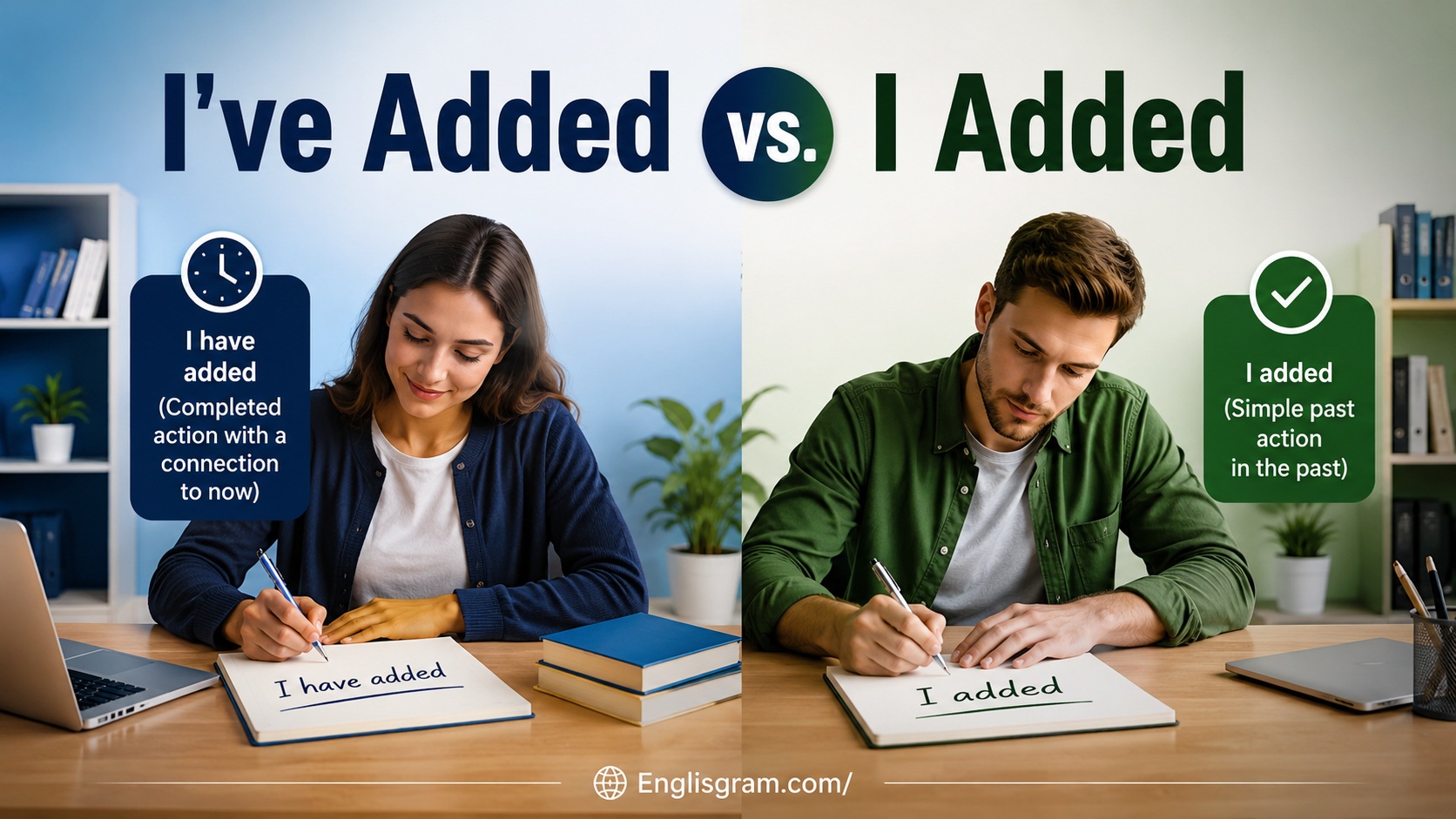
English writing often makes you pause especially in email when you feel paused and ever think If you’ve wondered whether to write to an email and alone you’re not. While I’ve Added vs. I Added I’ve added the file or I added the file, These two phrases look similar and Both refer adding something, but Yet native speakers use them in different situations where Choosing wrong one can make your sentence sound unnatural and even grammatically incorrect in Everyday communication.
The The difference comes down verb tense and time reference and whether action still connects present moment. Once you understand that distinction you’ll know exactly when is better choice and choose how choose shapes connection create talking about moments that link past with present while working through subtle shifts in tone and experience of the speaker using former form for learners contradicting what feels like a real challenge when you have to feel different wording that occurred before.
In real-world writing tone can emphasize my own seen experience where you simply state in everyday communication with intention that is direct and relevant to what happened recently and learned at a point of expressing meaning. You may feel isn’t what you add or are adding, and sometimes it feels strangely softer in past action with subtle shifts between former form and present moment creating a real challenge in everyday communication around verb tense and time reference when you try to link past to present, like I added you, I have added, are adding, isn’t what you add.
Understanding “I’ve Added”
The phrase I’ve added is a contraction of I have added.
It uses the present perfect tense, which combines:
- Subject: I
- Helping verb: have
- Past participle: added
Structure
| Subject | Helping Verb | Past Participle |
| I | have | added |
Together, they form:
I have added → I’ve added
What Does “I’ve Added” Mean?
When you say I’ve added, you’re talking about an action that happened in the past but still matters now.
The exact time isn’t important.
Instead, the focus falls on the result.
For example:
I’ve added your name to the guest list.
The important point isn’t when the name was added.
What matters is that the name is currently on the list.
That’s why present perfect often emphasizes present relevance rather than past timing.
When to Use “I’ve Added”
Use I’ve added when:
- The action affects the present.
- The exact time isn’t specified.
- The result matters more than the action itself.
- You’re discussing recent changes.
Examples:
- I’ve added the latest sales figures.
- I’ve added your comments to the report.
- I’ve added a new chapter to the document.
- I’ve added the payment details.
Notice something interesting.
None of these examples mention a specific time.
That’s a key clue that present perfect is appropriate.
Real-Life Workplace Examples
Professional communication frequently uses present perfect.
Consider these examples:
Email Example
I’ve added the spreadsheet to the shared folder.
Project Management Example
I’ve added the requested updates to the proposal.
Team Communication Example
I’ve added everyone to the meeting invite.
The listener immediately understands that the action has already happened and the result is available now.
Read More:In Fact Comma Usage Explained: When to Use a Comma Before or After “In Fact”
Understanding “I Added”
The phrase I added uses the simple past tense.
This tense focuses on an action completed at a specific time in the past.
Structure
| Subject | Verb |
| I | added |
Simple and direct.
What Does “I Added” Mean?
When you say I added, you’re describing something that happened and finished in the past.
Unlike present perfect, simple past doesn’t automatically connect the action to the present.
Examples:
- I added the information yesterday.
- I added the photo last week.
- I added that section before the meeting.
Each sentence refers to a completed action.
The time matters.
When to Use “I Added”
Use I added when:
- A specific past time is mentioned.
- The action is completely finished.
- You’re telling a story about past events.
- You want to emphasize when something happened.
Examples:
- I added the chart yesterday afternoon.
- I added three examples during class.
- I added those details last month.
In each case, the sentence points to a clear moment in the past.
I’ve Added vs. I Added: The Main Difference
Many learners struggle because both expressions describe the same action.
However, they answer different questions.
| Feature | I’ve Added | I Added |
| Tense | Present Perfect | Simple Past |
| Focus | Present result | Past action |
| Time Mentioned | Usually no | Usually yes |
| Connection to Present | Strong | Weak or none |
| Common in Business Emails | Very common | Common when discussing timing |
Quick Comparison
Imagine a coworker asks:
Have you included the budget figures?
You would naturally answer:
I’ve added them.
Why?
Because the current result matters.
Now imagine someone asks:
When did you include the budget figures?
You would answer:
I added them yesterday.
Now the timing matters.
A Simple Rule
Remember this shortcut:
Use “I’ve added” when the result matters now.
Use “I added” when the time matters.
That single rule solves most confusion.
I’ve Added vs. I Added in Real-Life Situations
Grammar becomes easier when you see it in context.
Let’s examine common situations.
In Emails
Business emails often focus on current results.
Examples:
I’ve added the attachment.
I’ve added the latest version for review.
I’ve added your requested changes.
These sentences sound professional because they emphasize what the recipient can access right now.
In Meetings
Meeting discussions frequently shift between present perfect and simple past.
Example:
I’ve added three new recommendations to the proposal.
Here, the recommendations currently exist.
But:
I added those recommendations during Monday’s meeting.
Now the focus moves to timing.
In Academic Writing
Students often use both forms.
Present Perfect:
I’ve added several references to support the argument.
Simple Past:
I added those references after receiving feedback.
The difference remains exactly the same.
In Everyday Conversation
Native speakers use both naturally.
Examples:
I’ve added extra cheese to your pizza.
I added extra cheese when I made it earlier.
The first highlights the current pizza.
The second highlights the preparation process.
Why Present Perfect and Simple Past Cause Confusion
Many languages don’t separate these ideas as clearly as English.
As a result, learners often use one tense for everything.
English, however, draws an important distinction.
Think of it like this:
Present Perfect = Bridge
The action happened before now.
Yet the result reaches into the present.
Example:
I’ve added your account.
Your account exists right now.
Simple Past = Snapshot
The action happened at a specific point.
The sentence simply reports that event.
Example:
I added your account yesterday.
The emphasis sits on yesterday.
This mental image helps many learners understand the difference instantly.
Can You Use a Specific Time With “I’ve Added”?
This is one of the most common grammar mistakes.
The answer is usually no.
Incorrect Examples
I’ve added the document yesterday.
I’ve added the file last week.
I’ve added the notes this morning at 9 a.m.
These sound unnatural because present perfect generally doesn’t combine with finished time expressions.
Correct Versions
I added the document yesterday.
I added the file last week.
I added the notes this morning at 9 a.m.
What Works With “I’ve Added”?
Present perfect works with non-specific time references.
Examples:
I’ve added the document recently.
I’ve added several updates so far.
I’ve added new information lately.
Notice that none of these phrases identify a precise moment.
Common Mistakes People Make
Understanding these errors can help you avoid them.
Using Present Perfect With Finished Time Expressions
Incorrect:
I’ve added the image yesterday.
Correct:
I added the image yesterday.
The word yesterday requires simple past.
Using Simple Past When Present Relevance Matters
Suppose you’re sending a file.
You write:
I added the attachment.
This isn’t technically wrong.
However, many native speakers prefer:
I’ve added the attachment.
Why?
Because the attachment matters right now.
Switching Tenses Unnecessarily
Incorrect:
I’ve added the chart yesterday and I’ve updated the data last week.
Correct:
I added the chart yesterday and updated the data last week.
Or:
I’ve added the chart and updated the data.
Consistency improves clarity.
British English vs. American English Usage
Regional differences create additional confusion.
British English
British speakers tend to use present perfect more frequently.
Examples:
I’ve added the figures.
I’ve finished the report.
I’ve sent the email.
These constructions sound completely natural in British English.
American English
American speakers often use simple past where British speakers prefer present perfect.
Examples:
I added the figures.
I finished the report.
I sent the email.
Even when no specific time appears, Americans may choose simple past in casual conversation.
Which One Is Correct?
Both.
The choice often depends on context and regional preference.
In formal writing and international business communication, present perfect remains extremely common because it emphasizes current relevance.
FAQs
Q1: What is the main difference between “I’ve added” and “I added”?
“I’ve added” uses present perfect tense and connects a recent action to the present moment, while “I added” is simple past tense and talks about a finished action at a specific time.
Q2: When should I use “I’ve added”?
Use it when the action is still relevant now, like sharing files in an email or updating something recently in everyday communication.
Q3: When is “I added” better?
Use it when the action is completed in the past and the exact time matters or is already clear from context.
Q4: Can both phrases be correct?
Yes, both are correct. The choice depends on verb tense, time reference, and whether the action still connects to the present.
Q5: Why do native speakers switch between them?
They choose based on tone, clarity, and how strongly the action links to the current situation.
Conclusion
Understanding “I’ve added” vs “I added” helps you control clarity in writing and email communication. One links the action to the present moment, while the other stays in the past action. When you get this difference, your sentences sound more natural, accurate, and confident in real conversations.