English learners often try to improve communication through better grammatical function, tone, and everyday speech. These variations help speakers understand the definition of a writing style that can emphasize points with the best placement in business communication. However, common mistakes appear when trying to clarify ideas in practical applications of the English language. Many focus on speaking confidence, journalism, and examples that make statements clearer in academic writing.
The grammatical role of a phrase matters for native speakers, especially in a comprehensive guide to sentence structure, offering benefits, communication accuracy, and significant meaning through a transition phrase, expressions, and its important role with proper guidance in English.Ah, this is one of the trickiest parts of punctuation and it is not easy due to many factors. And people always ask questions about marks and wonder for what is misused or correct about placement.
What Does “In Fact” Mean?
Before discussing commas, it’s important to understand what “in fact” actually means.
The phrase is used to emphasize truth, introduce supporting evidence, correct a misconception, or strengthen a previous statement.
Definition of “In Fact”
In fact means:
Actually; as a matter of truth; indeed.
Writers use it when they want to reinforce a statement or provide information that makes a point even stronger.
Examples
- The movie was good. In fact, it was one of the best films of the year.
- Many people expected delays. In fact, the project finished ahead of schedule.
- She isn’t merely talented. She is, in fact, exceptional.
Notice how the phrase adds emphasis rather than essential meaning.
If you remove “in fact” from many sentences, the sentence still works grammatically.
For example:
- She is, in fact, exceptional.
- She is exceptional.
The core meaning remains intact.
That observation becomes important when deciding whether commas are necessary.
Read More:Simple Present Tense in American English: Complete Guide With Rules, Uses,
Common Uses of “In Fact”
Writers typically use “in fact” in four ways.
Adding Emphasis
The phrase can strengthen a claim.
Example:
- The exam was difficult. In fact, several students left early.
Correcting a Misunderstanding
Sometimes the phrase introduces information that contradicts expectations.
Example:
- Many people assumed the company was struggling. In fact, profits increased by 25%.
Introducing Supporting Evidence
The phrase often provides proof for a previous statement.
Example:
- The neighborhood is growing rapidly. In fact, three new schools opened last year.
Strengthening a Previous Statement
Writers frequently use “in fact” to intensify what came before.
Example:
- The task wasn’t merely challenging. It was, in fact, nearly impossible.
Do You Need a Comma Before or After “In Fact”?
The Short Answer
Usually, yes.
However, the exact placement depends on where “in fact” appears and how it functions within the sentence.
Here is a quick overview:
| Position | Typical Comma Rule |
| Beginning of sentence | Comma after “in fact” |
| Middle of sentence | Comma before and after |
| End of sentence | Usually comma before |
| Essential phrase | Sometimes no commas |
Think of commas as signals to the reader.
When “in fact” interrupts the natural flow of a sentence, commas help mark that interruption.
When the phrase blends naturally into the sentence, commas may be unnecessary.
Comma Before and After “In Fact”
This is the most common punctuation pattern.
When “In Fact” Interrupts a Sentence
When “in fact” acts as a parenthetical expression, it interrupts the sentence to provide emphasis or clarification.
Because the phrase is nonessential, commas generally appear on both sides.
Examples
- The witness, in fact, changed her testimony twice.
- The team, in fact, exceeded every expectation.
- The solution, in fact, was surprisingly simple.
Why Both Commas Matter
Consider this sentence:
- The proposal, in fact, received unanimous approval.
The phrase could be removed without changing the sentence’s basic structure:
- The proposal received unanimous approval.
Since the phrase functions as extra information, commas are appropriate.
Quick Test
Ask yourself:
Can I remove “in fact” without damaging the sentence?
If the answer is yes, commas are usually required.
More Examples
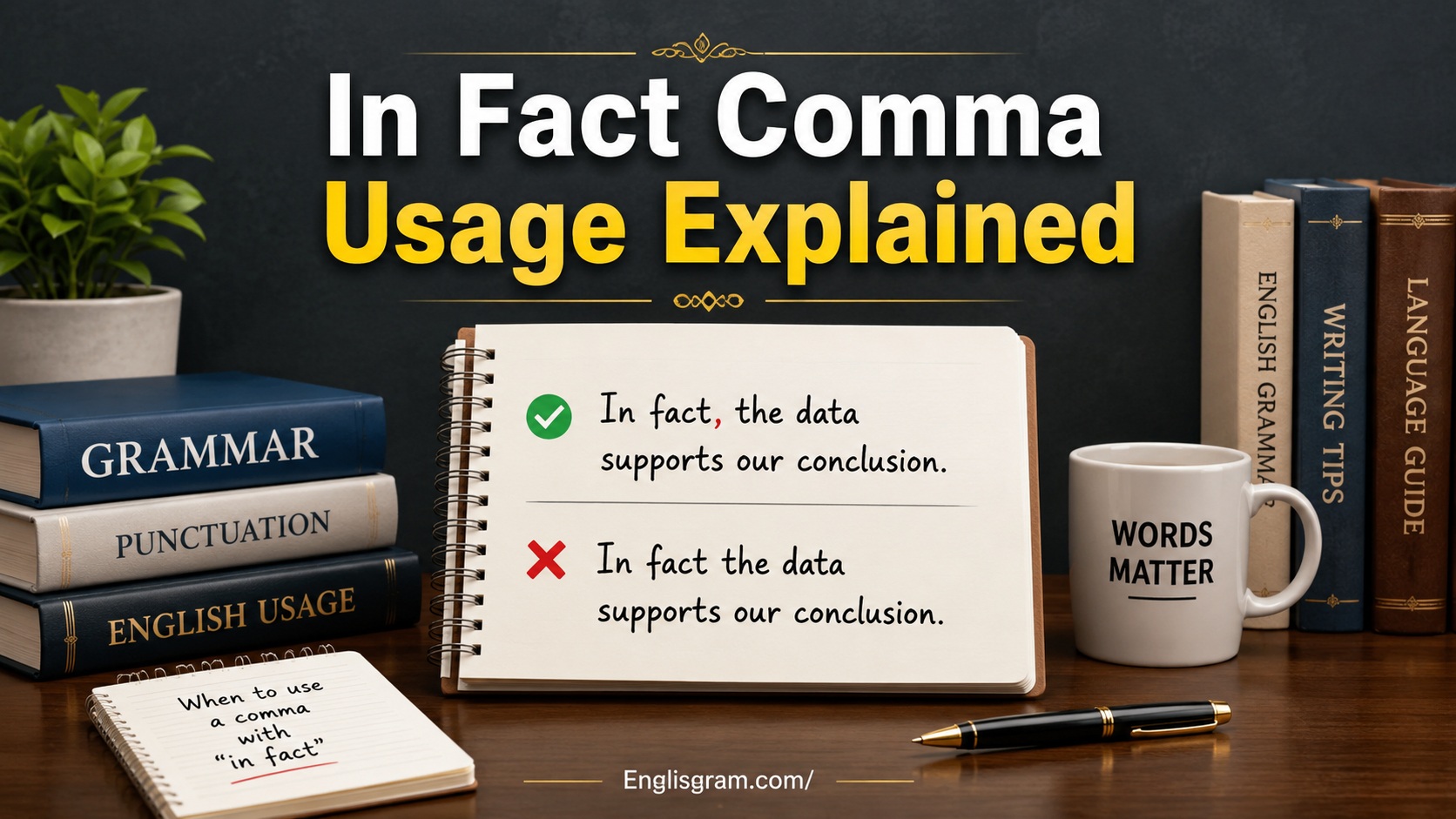
| Correct | Incorrect |
| The report, in fact, supports our conclusion. | The report in fact supports our conclusion. |
| She was, in fact, the youngest member. | She was in fact the youngest member. |
| The results, in fact, surprised everyone. | The results in fact surprised everyone. |
While some style guides allow omission in certain contexts, using both commas improves readability.
Comma After “In Fact” at the Beginning of a Sentence
When “in fact” begins a sentence, it usually functions as an introductory phrase.
Introductory phrases are commonly followed by a comma.
Examples
- In fact, the opposite turned out to be true.
- In fact, researchers discovered a completely different result.
- In fact, sales reached a record high.
The comma creates a brief pause that helps readers process the transition.
Why the Rule Works
Without the comma:
- In fact the opposite turned out to be true.
The sentence feels rushed and less polished.
With the comma:
- In fact, the opposite turned out to be true.
The transition becomes clearer.
Formal Writing Examples
- In fact, recent data supports this conclusion.
- In fact, the evidence suggests a different interpretation.
- In fact, multiple studies reached similar findings.
Business Writing Examples
- In fact, customer satisfaction increased significantly.
- In fact, production costs fell during the quarter.
- In fact, demand exceeded expectations.
Comma Before “In Fact”
Sometimes “in fact” introduces additional information after an independent clause.
In these situations, a comma often appears before the phrase.
Examples
- The plan succeeded, in fact, beyond everyone’s expectations.
- The company expanded rapidly, in fact, faster than analysts predicted.
- The repair worked, in fact, better than the original design.
Here the phrase interrupts the flow and provides emphasis.
Transitional Use
Writers also use “in fact” to connect related ideas.
Example:
- Many experts disagreed. The evidence, in fact, pointed elsewhere.
The phrase helps bridge the relationship between the two thoughts.
When “In Fact” Does Not Need Commas
Although commas often accompany “in fact,” they aren’t mandatory every time.
Context matters.
Integrated Usage
Sometimes the phrase becomes closely integrated into the sentence.
Examples
- This is in fact the best solution available.
- What seemed impossible was in fact achievable.
- The rumor was in fact true.
Many modern style guides consider these constructions acceptable.
Why Commas Are Optional Here
The phrase functions more like an adverb than an interrupter.
Because it contributes directly to the statement, writers may choose not to separate it with commas.
Comparison
| Without Commas | With Commas |
| The rumor was in fact true. | The rumor was, in fact, true. |
| The claim was in fact correct. | The claim was, in fact, correct. |
| The answer was in fact simple. | The answer was, in fact, simple. |
Both versions are grammatically correct.
The comma version generally adds more emphasis.
“In Fact” at the Beginning, Middle, and End of a Sentence
Understanding placement helps eliminate punctuation mistakes.
At the Beginning
Examples:
- In fact, nobody objected.
- In fact, the meeting ended early.
- In fact, the project cost less than expected.
Rule: Use a comma after the phrase.
In the Middle
Examples:
- The committee, in fact, approved the proposal.
- She was, in fact, correct.
- The data, in fact, supports the theory.
Rule: Use commas on both sides.
At the End
Examples:
- The rumor was true, in fact.
- The plan succeeded, in fact.
- He knew the answer, in fact.
Rule: A comma generally precedes the phrase.
FAQs
1. Do I always need a comma before “in fact”?
No, you don’t always need it. It depends on how the phrase is used in the sentence. If it adds extra information or emphasis, a comma is often used.
2. Can “in fact” come in the middle of a sentence?
Yes, it can. When it interrupts the sentence flow, commas usually appear before and after it.
3. Is it wrong to skip commas with “in fact”?
Not always. In some sentences, especially when it flows naturally, writers skip commas without changing meaning.
4. Why do writers get confused with “in fact”?
Because it can act as a transition phrase or an interrupter. Each role changes comma placement.
5. Does meaning change with or without commas?
Sometimes yes. Commas can add emphasis or pause, which slightly changes how the sentence feels.
Conclusion
The phrase “in fact” is flexible in English writing. Its comma usage depends on tone, placement, and sentence structure. Once you understand its role as a transition or interrupter, choosing the right punctuation becomes much easier.