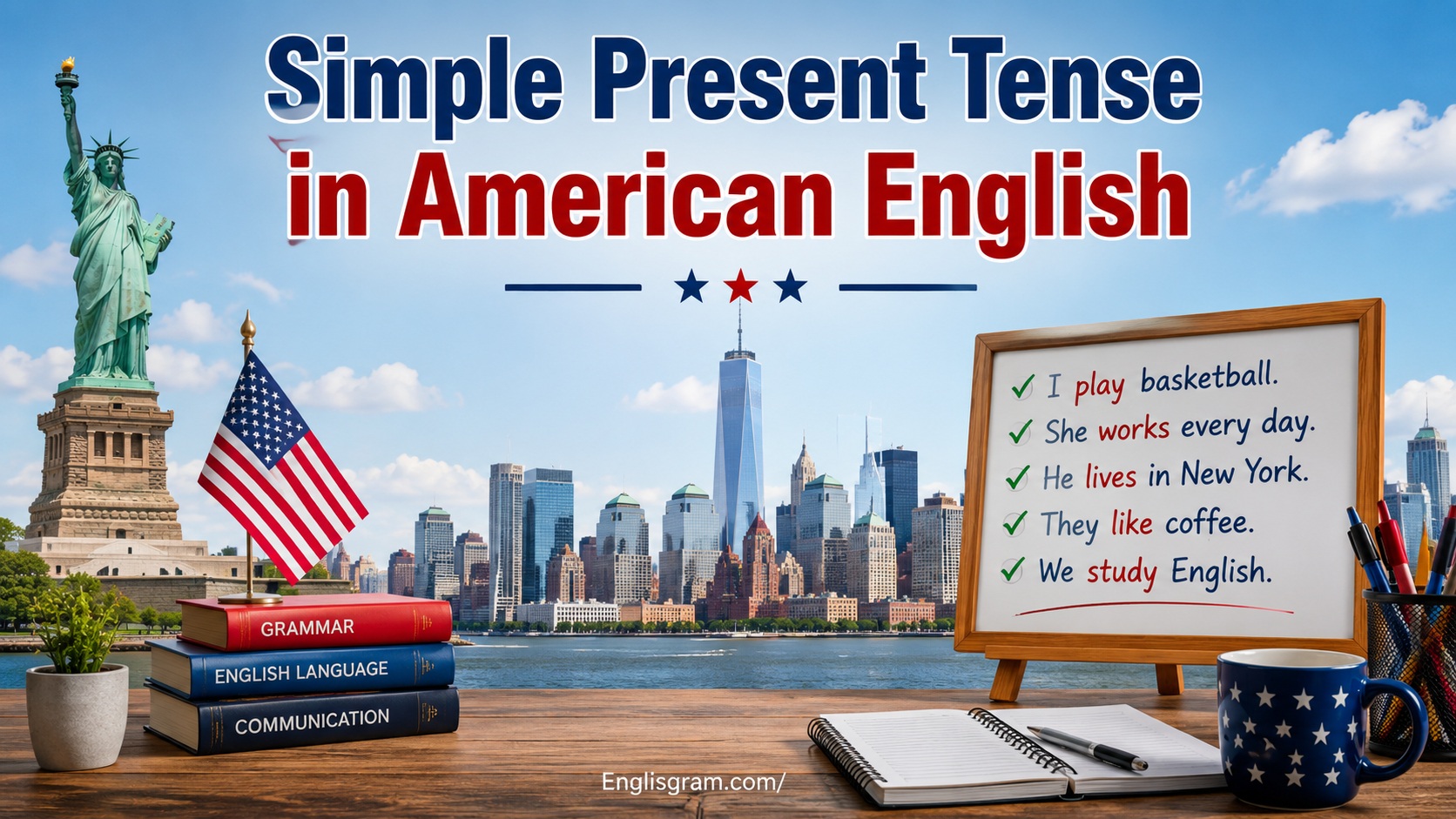
The Simple Present Tense in American English helps you use actions habits and grammar patterns in real communication every day clearly in American English use now.The simple present tense (also called present simple tense) is a key part of English grammar and American English grammar. It connects actions, habits, and everyday patterns in real communication, where learners and students try to form and connect ideas that represent time.
It explains situations, facts, unchanging truths, and general truths used in daily American conversations and social media communication. These forms, usage, and repeating patterns build confidence in sentences when you write or speak. From experience, steady practice and practical examples help beginners improve communication skills and speak more confidently in real life.In American English, this tense is used in formal situations like emails and in informal situations where you express ideas naturally.
It is an essential grammar topic in schools, especially for second language learners who often struggle with verbs forms and verb forms. It describes when something happens regularly, such as routines, habits routines facts schedules truths, and schedules in workplace communication, school communication, and email communication. It also improves communication, writing, and English writing skills, making ideas easy and clearly understood. People say it is essential because it strengthens overall communication.
What Is the Simple Present Tense?
The simple present tense is a verb tense used to describe habits, routines, facts, general truths, feelings, and recurring actions.
Unlike some other tenses, the simple present often focuses on actions that happen regularly rather than actions happening at this exact moment.
Simple Present Tense Definition
The simple present tense expresses:
- Regular actions
- Repeated events
- Permanent situations
- General facts
- Opinions and beliefs
- Scheduled future events
Why It Matters in Everyday American English
Native speakers use the simple present constantly.
You hear it in:
- Daily conversations
- Business meetings
- News headlines
- Academic writing
- Instructions and manuals
- Television broadcasts
Without understanding this tense, everyday communication becomes difficult.
Quick Examples From Real-Life Conversations
- I drink coffee every morning.
- She works from home.
- They live in Texas.
- The train leaves at 8:00 a.m.
- Water boils at 212°F.
When Do We Use the Simple Present Tense?
Understanding when to use the simple present tense is more important than memorizing formulas.
Habits and Daily Routines
The most common use involves habits.
Examples:
- I wake up at 6 a.m.
- She exercises every day.
- We eat dinner at seven.
These actions happen repeatedly.
Example
“I check my email before breakfast every morning.”
Repeated Actions and Regular Activities
Actions that occur frequently use the simple present.
Examples:
- He visits his grandparents every weekend.
- They attend church on Sundays.
- We play basketball after work.
Common frequency words include:
| Frequency Adverb | Example |
| Always | I always arrive early. |
| Usually | She usually drives to work. |
| Often | They often travel together. |
| Sometimes | We sometimes order pizza. |
| Rarely | He rarely watches television. |
| Never | I never smoke. |
Permanent Situations and Facts
Use the simple present for situations that remain generally true.
Examples:
- She lives in New York.
- He owns a bookstore.
- They speak English at home.
Universal Truths and Scientific Facts
Scientific facts never change.
Examples:
- The Earth revolves around the Sun.
- Water freezes at 32°F.
- Gravity pulls objects toward the Earth.
Fact
Scientists, teachers, and textbooks commonly use the simple present because facts remain constant regardless of time.
Feelings, Opinions, and States
The simple present often expresses emotions and beliefs.
Examples:
- I love chocolate.
- She believes in hard work.
- We prefer online learning.
Scheduled Events and Timetables
Many future schedules use the simple present.
Examples:
- The flight departs at noon.
- The meeting starts at 10 a.m.
- School opens next Monday.
Although these events occur in the future, the schedule is fixed.
Giving Instructions and Directions
Instructions commonly use the simple present.
Examples:
- Turn left at the corner.
- Add two cups of water.
- Press the power button.
Sports Commentary and News Headlines
Journalists frequently use the simple present.
Examples:
- Team USA wins the championship.
- Mayor announces new policy.
- Quarterback throws a touchdown pass.
Understanding the Timeline of the Simple Present Tense
Many learners misunderstand the timeline.
The simple present usually does not describe an action happening right now.
Instead, it shows repeated or ongoing patterns.
Visual Timeline
Past ——– Present ——– Future
<—– Repeated Action —–>
Example:
- She studies English every day.
The studying happened yesterday, happens today, and will likely happen tomorrow.
Present Actions vs Repeated Actions
Compare these:
Simple Present
- I work downtown.
Present Continuous
- I am working downtown today.
The first describes a routine.
The second describes a temporary situation.
Read More:Licence vs License: The Real Difference Between Licence and License
Simple Present Tense Formula and Sentence Structure
Understanding sentence structure makes grammar easier.
Affirmative Sentences
Formula
| Subject | Verb | Object |
| Subject | Base Verb | Rest of Sentence |
Examples
- I play soccer.
- They study mathematics.
- We travel frequentl
Negative Sentences
Formula
| Subject | Do/Does + Not | Base Verb |
| Subject | do not / does not | Verb |
Examples
- I do not smoke.
- She does not drive.
- They do not agree.
Contractions
- Don’t = Do not
- Doesn’t = Does not
Examples:
- I don’t like spicy food.
- He doesn’t watch television.
Interrogative Sentences (Questions)
Formula
| Do/Does | Subject | Base Verb |
| Do/Does | Subject | Verb |
Examples
- Do you play tennis?
- Does she work here?
- Do they travel often?
WH-Questions
Formula
WH Word + Do/Does + Subject + Verb
Examples
- Where do you live?
- Why does she leave early?
- When do they arrive?
Subject-Verb Agreement Rules in the Simple Present Tense
One of the biggest challenges involves matching subjects with verbs.
First-Person Subjects
Examples:
- I work.
- I study.
- I travel.
Second-Person Subjects
Examples:
- You work.
- You study.
- You travel.
Third-Person Singular Subjects
This rule causes the most mistakes.
Examples:
- He works.
- She studies.
- It rains.
Plural Subjects
Examples:
- We work.
- They study.
- The students travel.
Special Agreement Cases
Collective nouns can be singular.
Examples:
- The team wins frequently.
- The company operates globally.
Third-Person Singular Verbs Explained
When using he, she, or it, the verb usually changes.
When to Add -S
Examples:
- Work → Works
- Read → Reads
- Run → Runs
When to Add -ES
Add -es after verbs ending in:
- s
- sh
- ch
- x
- z
- o
Examples:
| Verb | Third Person |
| Watch | Watches |
| Go | Goes |
| Fix | Fixes |
| Pass | Passes |
Changing Y to IES
When a verb ends with consonant + y:
Examples:
| Verb | Third Person |
| Study | Studies |
| Carry | Carries |
| Try | Tries |
Irregular Verb Forms
Some verbs behave differently.
Examples:
- Have → Has
- Do → Does
- Be → Is
The Verb “Be” in the Simple Present Tense
The verb be is unique.
| Subject | Form |
| I | Am |
| You | Are |
| He/She/It | Is |
| We | Are |
| They | Are |
Positive Sentences
Examples:
- I am happy.
- She is busy.
- They are ready.
Negative Sentences
Examples:
- I am not tired.
- He is not available.
- They are not late.
Questions With the Verb “Be”
Examples:
- Are you ready?
- Is she home?
- Am I correct?
Stative Verbs in the Simple Present Tense
Some verbs describe states rather than actions.
These are called stative verbs.
Emotion Verbs
Examples:
- Love
- Hate
- Like
- Prefer
Sentence:
- I love music
Possession Verbs
Examples:
- Own
- Belong
- Have
Sentence:
- She owns a restaurant.
Thought and Opinion Verbs
Examples:
- Believe
- Know
- Understand
Sentence:
- He understands the lesson.
Sense and Perception Verbs
Examples:
- Hear
- See
- Smell
Sentence:
- I hear music outside.
Stative Verbs vs Action Verbs
| Stative Verb | Action Verb |
| Know | Learn |
| Believe | Study |
| Own | Buy |
| Love | Play |
Signal Words Commonly Used With the Simple Present Tense
Signal words help identify this tense quickly.
Frequency Adverbs
- Always
- Usually
- Often
- Frequently
- Sometimes
- Rarely
- Never
Time Expressions
- Every day
- Every week
- Every month
- On Mondays
- Once a year
Examples
- She always arrives early.
- We travel every summer.
Simple Present Tense Examples for Every Situation
Everyday Conversation Examples
- I drink tea every morning.
- She walks her dog daily.
- We visit our parents often.
Family and Personal Life Examples
- My brother works remotely.
- My mother cooks dinner every evening.
- Our family celebrates holidays together.
School and Academic Examples
- Students submit assignments online.
- Teachers explain concepts clearly.
- Classes begin at eight.
Workplace Examples
- The manager reviews reports weekly.
- Employees attend meetings regularly.
- The company serves international clients.
Travel Examples
- The bus arrives at 7:30.
- Flights depart every hour.
- Travelers carry identification.
Technology Examples
- Users create accounts online.
- The software updates automatically.
- Customers receive notifications instantly.
Simple Present Tense vs Other English Tenses
Simple Present vs Present Continuous
| Simple Present | Present Continuous |
| I work here. | I am working here today. |
| She drives to work. | She is driving now. |
Simple Present vs Present Perfect
| Simple Present | Present Perfect |
| I live here. | I have lived here for years. |
Simple Present vs Simple Past
| Simple Present | Simple Past |
| I play soccer. | I played soccer yesterday. |
Simple Present vs Simple Future
| Simple Present | Simple Future |
| The train leaves at 9. | The train will leave at 9. |
FAQs
Q1: What is the Simple Present Tense in American English?
It is a grammar form that shows habits, actions, and facts that happen regularly or stay always true in American English.
Q2: When do we use the simple present tense?
You use it for daily routines, general truths, habits, schedules, and real communication in everyday life.
Q3: Why is it important in English grammar?
It helps you build clear sentences, improve communication skills, and speak or write correctly in both formal and informal situations.
Q4: Do beginners find it easy or hard?
Many beginners struggle at first, but steady practice and examples make it much easier to understand.
Q5: Can it be used in American conversations?
Yes, it is widely used in daily American conversations, emails, and workplace communication.
Conclusion
The simple present tense is a core part of English grammar and daily American English use. It helps you express habits, facts, and real communication clearly. Once you understand the rules, structure, and verb forms, your writing and speaking skills improve naturally. With regular practice, you gain more confidence and communicate more effectively in everyday life.