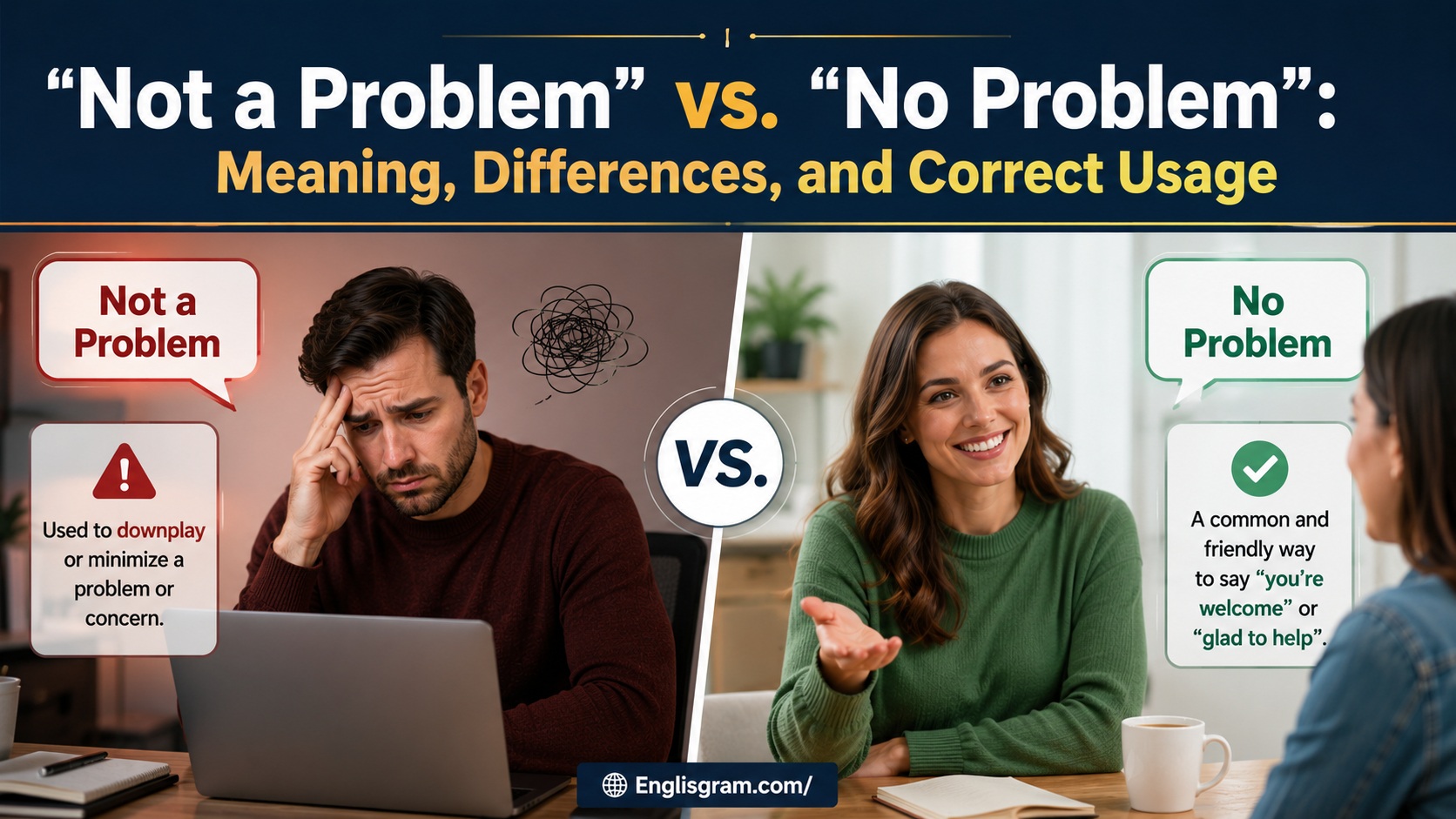
For English learners, “Not a Problem” vs. “No Problem” may seem easy to understand, but their subtle differences in tone, formality, and context can affect how your words are received. Both expressions have a similar meaning and work as interchangeable expressions in many situations, especially when English speakers give a positive response to thanks, requests, or apologies.
In everyday communication, casual conversations, casual speech, and everyday conversation, “No Problem” often sounds natural, friendly, and easy, while “Not a Problem” can sound more polite, calm, and reassuring. From my experience as an English teacher, I’ve heard many questions about these expressions, and the right choice often depends on usage, communication style, and intention.
In customer service, workplaces, and a professional setting, professional communication may favor “Not a Problem” because its reassuring tone can strengthen professionalism. For example, when a colleague is carrying heavy bags, you can open a door, give a smile, make eye contact, and say “No Problem” to create a warm interaction. If someone asks you to fix a small mistake in a report, “Not a Problem” can provide a more measured response.
“No Problem” Meaning and Definition
“No problem” is a common English expression that tells someone that something is acceptable, causes no difficulty, or requires no concern.
Its meaning depends heavily on context.
For example:
“Thanks for helping me with my project.”
“No problem.”
Here, “no problem” means something close to “you’re welcome” or “it was no trouble.”
Now consider another situation:
“Sorry I’m five minutes late.”
“No problem.”
Here, the expression means “That’s okay” or “Don’t worry about it.”
It can also accept a request:
“Could you send me the report this afternoon?”
“No problem.”
In this case, it means “Sure, I can do that.”
So, “no problem” doesn’t have just one conversational meaning. It acts as a flexible response that reassures the other person.
Common meanings of “No Problem”
Depending on the situation, it can mean:
- You’re welcome.
- It’s okay.
- Don’t worry about it.
- Sure, I can do that.
- That causes no difficulty.
- That isn’t an issue.
- I don’t mind.
This flexibility explains why you hear the expression so often in everyday American English.
“Not a Problem” Meaning and Definition
“Not a problem” means that something does not create difficulty, inconvenience, concern, or trouble.
It often refers to a specific situation, request, task, or inconvenience.
For example:
“Would it be possible to move our meeting to Friday?”
“Not a problem.”
The speaker is reassuring the listener that changing the meeting won’t cause difficulty.
You can also use the expression in a complete sentence:
“Changing the appointment is not a problem.”
Here, the grammatical structure is especially clear. The speaker says that changing the appointment does not constitute a problem.
Another example:
“I need to leave work an hour early today.”
“That’s not a problem.”
The phrase directly addresses the situation that the other person mentioned.
Common meanings of “Not a Problem”
Depending on context, “not a problem” can communicate:
- This isn’t difficult.
- This isn’t inconvenient.
- This doesn’t concern me.
- This won’t cause trouble.
- I’m okay with this.
- I can handle this.
- Your request is acceptable.
The expression can stand alone in conversation or appear inside a complete sentence.
“Not a Problem” vs. “No Problem”: What’s the Difference?
The simplest way to understand the distinction is to look at what each expression emphasizes.
| Expression | Main idea | Typical use | Example |
| No problem | There is no issue or trouble | Thanks, apologies, requests, reassurance | “Thanks!” — “No problem.” |
| Not a problem | A particular thing isn’t troublesome | Requests, tasks, situations, inconveniences | “Can we change the date?” — “Not a problem.” |
The meanings overlap considerably. In fact, you can often use either phrase without causing confusion.
Consider:
“Could you help me move these boxes?”
“No problem.”
And:
“Could you help me move these boxes?”
“Not a problem.”
Both responses communicate willingness to help.
However, the feel of the response changes slightly. “No problem” sounds especially natural as a short conversational reply. “Not a problem” points more directly toward the specific request or situation.
Think of the difference this way:
“No problem” is often a broad reassurance.
“Not a problem” often evaluates a particular thing and says that it doesn’t create difficulty.
Neither expression is inherently more correct.
Are “No Problem” and “Not a Problem” Interchangeable?
In many everyday situations, yes.
Suppose a coworker asks:
“Could you review this document before lunch?”
You could respond:
“No problem.”
Or:
“Not a problem.”
Both answers indicate that you can do it.
The same flexibility appears when someone asks for a small favor:
“Can you save me a seat?”
“No problem.”
“Not a problem.”
Both sound natural in American English.
Still, complete interchangeability isn’t always possible. Context can make one expression sound more natural than the other.
For example:
“Thanks for staying late.”
The most natural casual response is:
“No problem.”
“Not a problem” can work too. Yet it sounds more like a statement about the inconvenience involved.
Now consider:
“Will the extra work be difficult for your team?”
A natural answer is:
“No, it’s not a problem.”
Here, “not a problem” directly addresses whether the work creates difficulty.
The difference is subtle. English speakers often choose between these phrases based on conversation flow rather than a strict grammar rule.
When to Use “No Problem”
Responding to “Thank You”
One of the most common uses of “no problem” is responding to gratitude.
“Thanks for picking me up.”
“No problem.”
The phrase tells the other person that the favor wasn’t an inconvenience.
You could also say:
- “You’re welcome.”
- “Of course.”
- “My pleasure.”
- “Anytime.”
- “No worries.”
Among these choices, “no problem” has a casual and friendly quality.
For a formal business email, however, “you’re welcome” or “certainly” may sound more polished.
Accepting a Request
“No problem” can also mean “sure” or “I can do that.”
“Could you print these documents for me?”
“No problem.”
The expression doesn’t merely describe whether something is difficult. It also signals cooperation.
That makes it especially useful in everyday workplace conversations.
“Can you send the invoice again?”
“No problem. I’ll send it now.”
The second sentence makes the response even clearer.
Reassuring Someone After an Apology
Someone might apologize because they made a small mistake or caused a minor inconvenience.
“Sorry I forgot to call you.”
“No problem.”
Here, “no problem” means something like:
“It’s okay. I’m not upset about it.”
The expression helps lower the emotional temperature of the conversation.
Instead of turning a minor mistake into a bigger issue, the speaker dismisses the concern.
Saying Something Causes No Difficulty
“No problem” can also have a more literal meaning.
“Is it a problem if I park here?”
“No problem.”
In this example, the speaker directly answers a question about whether something creates an issue.
That use is closer in meaning to “it isn’t a problem.”
Read More:To Use Your Loaf Meaning, Origin, Usage & Examples
When to Use “Not a Problem”
Saying Something Isn’t Difficult or Inconvenient
“Not a problem” works especially well when someone asks whether a particular task or situation will cause trouble.
“Can you finish this tomorrow?”
“Not a problem.”
The response means that completing the task tomorrow won’t create difficulty.
You can make the connection even clearer:
“Finishing it tomorrow is not a problem.”
That sentence describes the situation directly.
Accepting a Request
“Not a problem” can also accept a request.
“Could you move the meeting to Thursday?”
“Not a problem.”
The expression reassures the person that the requested change is manageable.
You can also use:
“That’s not a problem.”
The addition of “that’s” gives the phrase a complete sentence structure and clearly points back to the request.
Reassuring Someone About an Inconvenience
Imagine that a customer asks:
“Would it be possible to get another copy of the receipt?”
A helpful response could be:
“That’s not a problem. I’ll print another one for you.”
The phrase reassures the customer before explaining the solution.
This pattern is useful:
That’s not a problem + solution
For example:
“That’s not a problem. We can change your reservation.”
The combination sounds more informative than simply saying “Not a problem.”
“No Problem” vs. “Not a Problem” in Everyday Conversation
In casual conversation, both expressions are common.
Consider this dialogue:
Alex: “Sorry I kept you waiting.”
Jordan: “No problem.”
The response is quick and relaxed.
Now compare:
Alex: “Can we meet tomorrow instead?”
Jordan: “Not a problem.”
Here, the second expression fits naturally because it responds to a specific change.
That doesn’t mean “no problem” would be incorrect. It would also work:
“Can we meet tomorrow instead?”
“No problem.”
The difference is mainly one of focus and conversational tone.
Quick rule
If you’re responding casually to thanks or an apology, “no problem” is often the easiest choice.
If you’re reassuring someone about a specific task, request, or inconvenience, “not a problem” often feels especially natural.
“No Problem” vs. “Not a Problem” in the Workplace
Workplace conversations require a little more attention to tone.
Both expressions are perfectly understandable:
“Can you update this spreadsheet?”
“No problem.”
Or:
“Can you update this spreadsheet?”
“Not a problem.”
Neither response is grammatically wrong.
However, professional communication sometimes benefits from more specific wording.
Instead of:
“No problem.”
You might say:
“Absolutely. I’ll have it ready by 3 p.m.”
That response does more than reassure. It establishes a clear expectation.
Likewise:
“Not a problem. I can take care of it before the meeting.”
The second version sounds helpful because it combines reassurance with useful information.
Professional alternatives
Depending on the situation, consider:
- Certainly.
- Of course.
- Absolutely.
- I’d be happy to help.
- That works for me.
- I can take care of that.
- That’s perfectly fine.
The goal isn’t to eliminate “no problem” from professional speech. It’s to choose a response that matches the formality and purpose of the conversation.
“No Problem” vs. “Not a Problem” in Emails
Written communication changes things slightly because readers can’t hear your voice.
In person, a warm “No problem!” can sound friendly.
In an email, a two-word response may seem abrupt depending on the context.
For example:
Thanks for sending the documents.
A reply such as:
No problem.
is perfectly understandable. Yet a slightly fuller response can sound warmer:
No problem at all. I’m glad I could help.
For formal correspondence, consider:
You’re welcome. Please let me know if you need anything else.
Or:
Certainly. I’ll be happy to assist.
A useful email principle
The more formal the situation, the more useful a complete response becomes.
The issue isn’t that “no problem” is grammatically inappropriate. It’s that short conversational expressions can feel less polished in certain professional settings.
“No Problem” in Customer Service
Customer service provides a good example of how tone matters.
A customer might say:
“I need to change my delivery address.”
A representative could say:
“No problem. I can update that for you.”
That sounds friendly and helpful.
Another option is:
“Certainly. I can update your delivery address for you.”
The second response has a more formal tone.
Neither is automatically better. The best choice depends on the brand’s communication style and the situation.
Customer service responses
| Situation | Casual response | More polished response |
| Customer asks for help | “No problem.” | “Certainly.” |
| Customer apologizes | “No problem.” | “That’s perfectly fine.” |
| Customer thanks you | “No problem.” | “You’re very welcome.” |
| Customer requests a change | “Not a problem.” | “Absolutely. I can take care of that.” |
A good customer-service response often combines reassurance + action.
“That’s not a problem. I’ll update your account now.”
That’s stronger than simply saying:
“No problem.”
“No Problem” vs. “You’re Welcome”
These expressions often appear after someone says “thank you”, but they aren’t identical in tone.
“Thanks for your help.”
“You’re welcome.”
This is the traditional and widely accepted response to gratitude.
Now:
“Thanks for your help.”
“No problem.”
This is more casual and conversational.
Both communicate goodwill. Yet “you’re welcome” explicitly acknowledges the person’s thanks, while “no problem” emphasizes that the favor wasn’t troublesome.
Compare the emphasis
You’re welcome → “I’m happy to accept your thanks.”
No problem → “Helping you wasn’t an issue.”
Neither is inherently rude.
However, some people prefer “you’re welcome” in formal situations because it sounds more conventional and polished.
Can “No Problem” Sound Rude?
Usually, no.
Millions of everyday conversations use “no problem” as a friendly response. Still, tone and context can change how a short phrase feels.
Compare:
“No problem!”
with:
“No problem.”
The first might sound enthusiastic. The second can sound neutral. If delivered sharply, it could even sound dismissive.
Written communication creates the same issue because punctuation and brevity influence how readers interpret tone.
For example:
“Thanks for staying late!”
“No problem!”
feels warmer than:
“Thanks for staying late.”
“No problem.”
Again, neither version is grammatically different. The social meaning changes because of context and presentation.
When to use a warmer version
If you want to make your response clearly friendly, try:
- “No problem at all!”
- “Of course!”
- “Happy to help!”
- “Anytime!”
- “No worries!”
Can “Not a Problem” Sound Dismissive?
It can, but the phrase itself isn’t inherently dismissive.
Consider:
“I need to reschedule our appointment.”
“Not a problem. Thursday works for me.”
That sounds cooperative.
Now imagine:
“I’m sorry I caused so much trouble.”
“Not a problem.”
The same words could sound somewhat flat if the situation is emotionally serious.
A warmer response might be:
“It’s really not a problem. Don’t worry about it.”
The lesson is simple: words carry meaning, but context carries tone.
Grammar Breakdown: “No Problem” vs. “Not a Problem”
The two expressions look similar, yet their grammatical structures differ.
“No Problem”
The expression follows this basic pattern:
no + noun
Here, “no” works as a determiner before the noun “problem.”
Compare:
- no problem
- no reason
- no concern
- no difficulty
- no issue
In the phrase “no problem,” the speaker indicates that there is zero problem or no problem to consider.
The phrase can function as a shortened conversational response.
For example:
“Thanks!”
“No problem.”
The complete underlying idea could be expressed as:
“There is no problem.”
Conversation often removes unnecessary words when the meaning is already obvious.
“Not a Problem”
“Not a problem” uses “not” differently.
The basic idea is:
not + a + noun
In a complete sentence:
“It is not a problem.”
The contraction gives us:
“It’s not a problem.”
That can then be shortened conversationally:
“Not a problem.”
The expression therefore has a stronger connection to the statement “It isn’t a problem.”
Compare the structures
| Expression | Basic grammatical idea |
| No problem | no + noun |
| Not a problem | not + a + noun |
| It’s not a problem | subject + linking verb + negation + noun phrase |
| There is no problem | existential structure + no + noun |
The grammar differs even though the conversational meaning can overlap.
FAQS
Is “Not a Problem” correct English?
Yes. “Not a Problem” is grammatically correct and commonly used to say that something is not difficult, inconvenient, or troublesome.
Is “No Problem” correct English?
Yes. “No Problem” is also correct and very common in everyday English. It can mean “that’s okay,” “sure,” or “you’re welcome,” depending on the context.
What is the difference between “Not a Problem” and “No Problem”?
“Not a Problem” usually focuses on a specific situation not causing difficulty, while “No Problem” is broader and often works as a casual response to a request, apology, or expression of thanks.
Can I say “No Problem” instead of “You’re Welcome”?
Yes. In casual conversation, “No Problem” is frequently used instead of “You’re Welcome.” However, “You’re Welcome” may sound more traditional or polite in formal situations.
Which is more casual: “Not a Problem” or “No Problem”?
“No Problem” generally sounds more casual and conversational. “Not a Problem” can sound slightly more reassuring or specific.
Conclusion
Both “Not a Problem” and “No Problem” are correct and natural English expressions, but they’re used slightly differently. “Not a Problem” usually reassures someone that a specific task, request, or situation isn’t difficult or inconvenient, while “No Problem” is more casual and can mean “sure,” “that’s okay,” or “you’re welcome.” When you understand this small difference, you can choose the expression that best fits the situation and communicate more naturally in everyday and professional English.