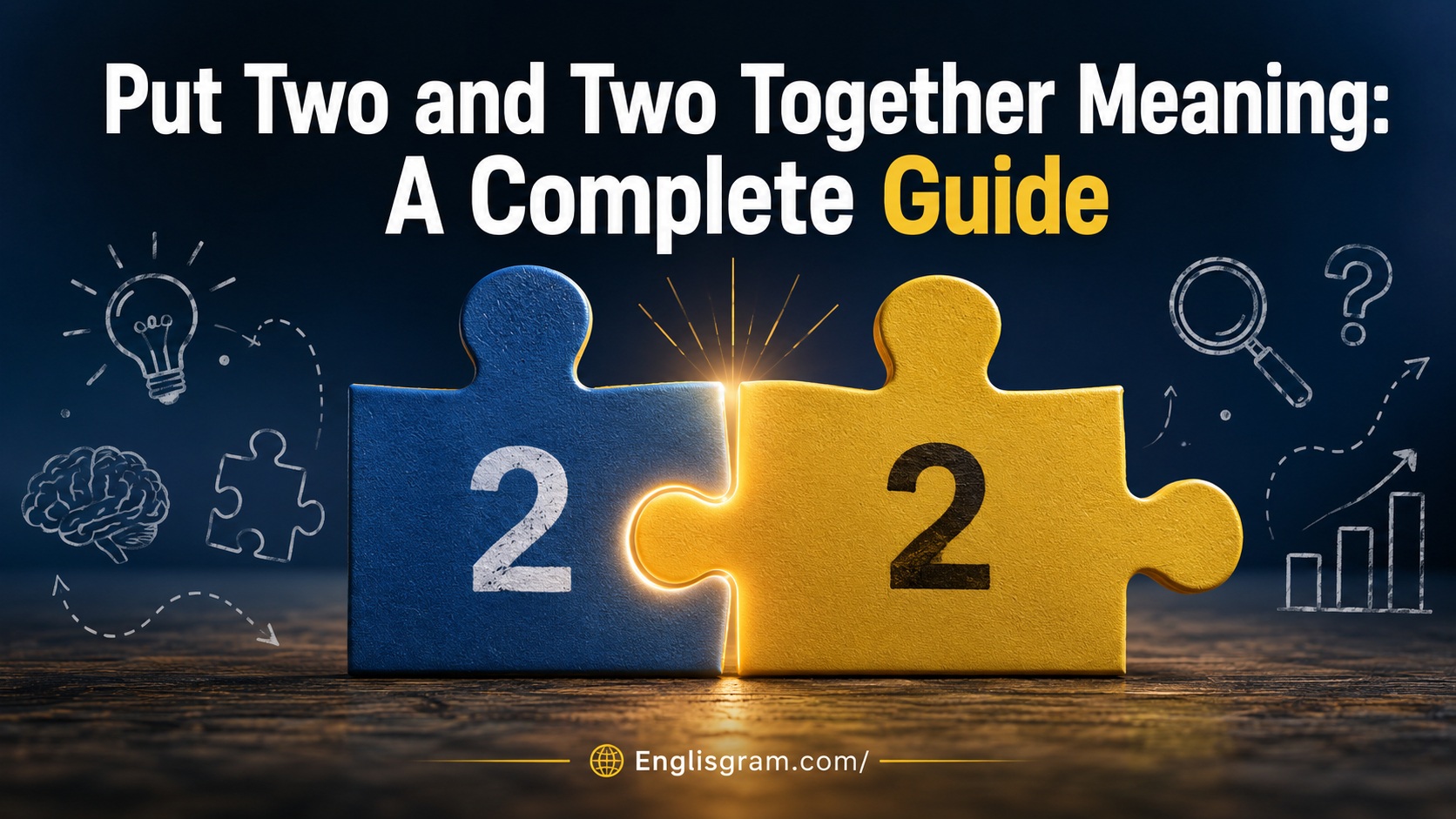
Put Two and Two Together Meaning shows how the idiom in English and everyday language helps learners in communication for native speakers daily use.In English, a puzzle like put two and two together is a phrase that feels simple but needs understanding instead of calculation or math. It often confuses learners because meaning is not literal interpretations but a mental process of figuring out and connecting information.
In daily writing and conversations, it helps in making connections, reaching conclusions, and solving situations where something becomes evident. Many native speakers naturally use it in communication to enrich language, making ideas more vivid, expressive, and relatable through examples and real use.The origin of this phrase is often linked with Sherlock Holmes, who could see pieces of clues and make logical deductions. This shows how people learn to explore situations without calculation, but with thinking that feels practical conversation based.
It helps enrich language and makes speech more useful, where ideas came together in a quick guide style that is easy first, yet becomes full guide for deeper understanding, helping you master tips, comparisons, and apply it in real use. It feels more natural and improves writing, communication, and speaking for native speakers.
What Does “Put Two and Two Together” Mean in English?
The idiom put two and two together meaning refers to the ability to understand something by combining different pieces of information.
In simple terms, it means:
You notice clues and figure out the answer without being told directly.
It describes logical thinking based on evidence you already have.
Simple explanation
- You observe facts
- You connect them in your mind
- You reach a conclusion
Example in daily life
Imagine this situation:
- You see your friend buying candles and a cake
- You also see a “Happy Birthday” card in their bag
- You put two and two together and realize it’s someone’s birthday party
No one tells you directly. You figure it out yourself.
That is the essence of the idiom.
Literal Meaning vs Figurative Meaning of Put Two and Two Together
The phrase sounds mathematical, but its real meaning is symbolic.
Literal meaning
- “Two plus two equals four”
- Basic arithmetic calculation
- No interpretation required
Figurative meaning
- Combine clues or facts
- Understand a hidden situation
- Draw a logical conclusion
Comparison Table
| Type | Meaning | Example |
| Literal | Basic math addition | 2 + 2 = 4 |
| Figurative | Logical deduction | You notice clues and understand the situation |
Key insight
The idiom uses math as a metaphor for thinking clearly. Just like numbers combine to create a result, clues combine to form understanding.
How People Use “Put Two and Two Together” in Real Life
Native speakers use this idiom in conversations where someone figures something out on their own.
Common situations
- Solving a mystery
- Understanding hidden relationships
- Realizing the truth in a situation
- Noticing obvious clues
Real-life examples
- She saw the empty fridge and the missing snacks so she put two and two together.
- He noticed the emails and late-night calls and put two and two together.
- I didn’t need an explanation. I put two and two together quickly.
Tone of usage
- Casual conversations ✔
- Storytelling ✔
- Informal writing ✔
- Business reports (rare but possible) ⚠
Common Sentence Patterns With Put Two and Two Together
English speakers use this idiom in flexible ways. It often appears in past tense or with modals.
Frequent patterns
- “You can put two and two together…”
- “He put two and two together and realized…”
- “It doesn’t take long to put two and two together…”
- “She quickly put two and two together…”
Example breakdown
- She put two and two together after seeing the evidence.
- Subject: She
- Action: put two and two together
- Result: understanding
Why this matters
These patterns help you sound natural when speaking English. Native speakers rarely explain the logic step by step. They use this phrase instead.
Real Examples of Put Two and Two Together in Context
Let’s explore how the idiom works in different storytelling styles.
Conversation example
- A: “Why did Sarah leave early?”
- B: “You saw the argument. Put two and two together.”
Story example
Mark walked into the office and noticed silence. The meeting room was empty. The manager’s door was closed. He saw a resignation email open on the screen. Mark put two and two together. Someone had quit.
News-style usage
Reporters often use this idiom when facts suggest a conclusion without direct confirmation.
Key takeaway
The phrase helps avoid long explanations. It lets the listener infer the meaning.
Variations and Similar Expressions to Put Two and Two Together
English has many phrases that carry a similar idea. However, each one has a slightly different tone.
Common alternatives
- Connect the dots → Focus on linking information
- Figure it out → General problem solving
- Read between the lines → Understand hidden meaning
- Piece things together → Gradual understanding
Comparison table
| Phrase | Meaning focus | Tone |
| Put two and two together | Logical conclusion | Natural and casual |
| Connect the dots | Pattern recognition | Slightly analytical |
| Read between the lines | Hidden meaning | Subtle and interpretive |
| Figure it out | Problem solving | General usage |
Example difference
- You connect the dots when analyzing patterns
- You put two and two together when clues are obvious
Origin of the Idiom Put Two and Two Together
The origin of this idiom comes from basic arithmetic and early English usage.
Historical background
The idea of “two plus two equals four” has been used since early mathematics education became common in Europe. Writers started using this simple logic as a metaphor for reasoning.
First usage idea
Early English speakers used the phrase to describe obvious conclusions. If you can add simple numbers, you can also add simple clues.
Why it stuck
- Easy to understand
- Relatable to everyday thinking
- Strong visual logic
Cultural meaning
It reflects human reasoning ability. People naturally try to connect information, just like solving a small puzzle.
How the Idiom Evolved Over Time
Language changes with culture, and this idiom is no exception.
Early usage
- Focused on basic reasoning
- Used in literature and storytelling
Modern usage
- Common in conversations
- Used in movies and journalism
- Appears in detective and mystery genres
Why it remains popular
- Simple structure
- Easy mental image
- Universally understood idea
Even today, it feels fresh because it describes how people naturally think.
When to Use Put Two and Two Together (And When Not To)
This idiom works well in many situations but not all.
Best situations
- Informal conversations
- Storytelling
- Explaining discoveries
- Casual writing
Avoid using it in
- Formal academic papers
- Legal documents
- Technical manuals
Tone guide
| Situation | Use it? |
| Chat with friends | Yes |
| Business email | Sometimes |
| Research paper | No |
| Novel writing | Yes |
Simple rule
Use it when you want to sound natural and conversational.
Common Mistakes Learners Make
Many English learners misuse this idiom. Let’s fix that.
Mistake 1: Treating it as math
Incorrect: I put two and two together and got four.
Correct: Use it for reasoning, not calculation.
Mistake 2: Overusing it
Too much repetition makes writing dull.
Mistake 3: Using it without clues
The idiom only works when evidence exists.
Better example
- He saw the broken glass and the open window so he put two and two together.
Tips for Using Put Two and Two Together Effectively
You can sound more natural by following simple tips.
Practical tips
- Use it after presenting clues
- Keep sentences short
- Match tone with casual speech
- Don’t overexplain
Example improvement
Weak: After thinking for a long time I finally put two and two together.
Strong: I saw the clues and put two and two together.
Pro insight
Native speakers use this phrase when conclusions feel obvious. If it feels like a “lightbulb moment,” the idiom fits perfectly.
Related Idioms and Expressions
English offers many similar phrases that help express reasoning.
List of related idioms
- Connect the dots
- Piece it together
- Figure it out
- Read between the lines
- Put it all together
Subtle differences
- “Connect the dots” = structured thinking
- “Read between the lines” = hidden meaning
- “Put two and two together” = obvious conclusion
FAQs
What does “put two and two together” mean?
“Put two and two together” means to connect different pieces of information and reach a logical conclusion. It is often used when someone figures out something that was not directly stated.
How do you use “put two and two together” in a sentence?
You can use it like this: “When I saw her suitcase and heard about the new job, I put two and two together and realized she was moving away.”
Is “put two and two together” an idiom?
Yes, it is a common English idiom. The phrase does not refer to actual math but to using clues and reasoning to understand a situation.
Can “put two and two together” be used in formal writing?
Yes, although it is more common in everyday conversation, it can also be used in informal business writing, articles, and stories when appropriate.
What is a synonym for “put two and two together”?
Some common synonyms include figure out, deduce, infer, work out, and connect the dots.
Conclusion
The idiom “put two and two together” means to connect clues or pieces of information to arrive at a logical conclusion. It is widely used in both spoken and written English to describe the process of understanding something through reasoning rather than being told directly. By learning its meaning, usage, and examples, you can confidently use this popular expression in everyday conversations and improve your understanding of English idioms.