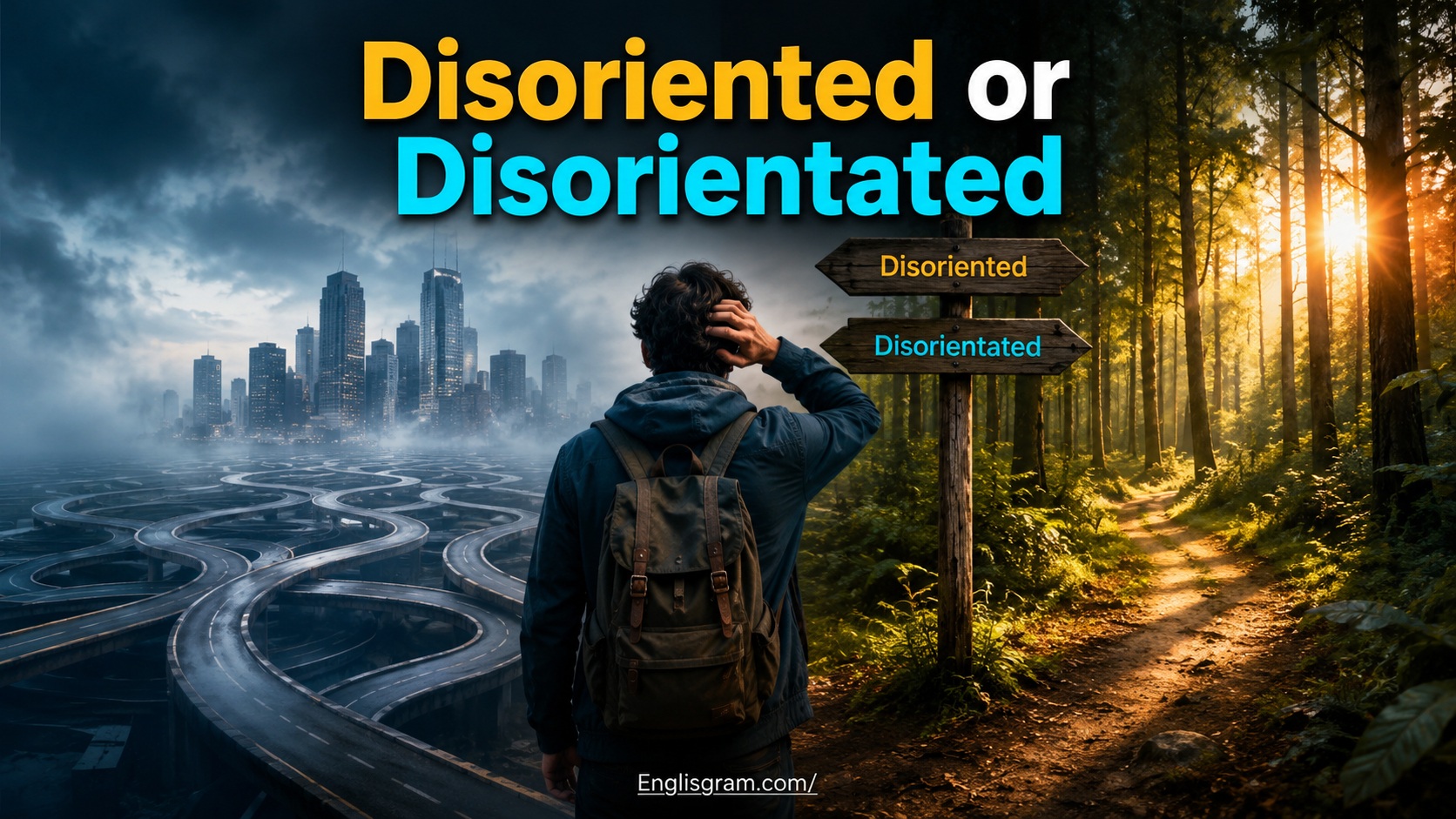
TITLE explains the Disoriented vs Disorientated difference in simple English with clarity, core meaning, regional preference, and real usage. Many people pause because both words sound close, look right, and are commonly accepted. From my teaching experience, I have seen students, learners, and writers face confusion when choosing the correct version, but knowing the definition, meaning, context, language conventions, and choice makes writing much easier.The audience often decides which word fits best. American English in the United States favors Disoriented, while British English, British usage, British readers, and the UK usually prefer Disorientated.
Across the US, global readers, academic paper, blog post, news articles, books, everyday content, or any document, both forms are understood. This variation reflects regional English, preferences, stylistic reasons, and usage frequency, not a change in meaning. Whether describing loss of direction, losing sense of direction, mental uncertainty, feeling mentally unsteady, or being unable to think clearly, the noun disorientation, verb forms disorient and disorientate, participial adjectives, past tenses, and the same state differ only by a subtle spelling difference.
If you are wondering which form to select, rely on trusted dictionaries like Cambridge, Oxford, Collins, Longman, Merriam-Webster, and Fowler’s Dictionary of Modern English Usage. You can compare British National Corpus, Oxford English Corpus,, and other corpora for American contexts and British usage. Reviewing common examples, a comparison table, and practical examples improves understanding, communication, readability, and awareness while avoiding unnecessary language confusion. Follow this simple rule: choose the version that fits your English language setting, write accurately and naturally, keep consistency, and apply it confidently in every sentence.
The Short Answer
Both words are correct in modern English.
However, disoriented is more common in American English, while disorientated is more common in British English. They share the same basic meaning: someone feels confused, lost, or unable to think clearly in space, time, or situation.
So the real question is not, “Which one is grammatical?”
It is, “Which one fits my audience?”
That answer matters because readers notice consistency. A document that mixes American and British forms can feel messy, even when every word is technically valid.
What Does Disoriented Mean?
Disoriented means confused about where you are, what is happening, or how to think clearly. It can describe a physical feeling, a mental state, or a broader sense of being out of place.
A person may feel disoriented after waking up in a strange room. Someone may also feel disoriented after a stressful event, a long flight, a medical issue, or a sudden change.
The word appears often in everyday English, medicine, travel, news writing, and fiction. It is simple, direct, and widely understood.
Definition of Disoriented
You can think of disoriented as “lost in space, time, or thought.”
It often means:
- confused about direction
- mentally unsettled
- unable to focus clearly
- unsure of what is happening
How Disoriented Is Used
Here are common ways people use it:
- Physically disoriented: not sure where you are
- Mentally disoriented: not thinking clearly
- Emotionally disoriented: overwhelmed by a sudden event
- Situationally disoriented: thrown off by new surroundings
Example Sentences
- After the long nap, he felt disoriented for a few minutes.
- The patient looked disoriented and confused.
- She felt disoriented when she stepped out of the train station.
- The bright lights made me feel disoriented.
Pronunciation of Disoriented
It is usually pronounced like this:
dis-OR-ee-en-tid
The exact sound can vary by accent, but the stress usually falls in the middle.
Word Family
You may also see related forms such as:
- disorient
- disorientation
- oriented
- orientation
These words share the same general idea of direction, position, or mental clarity.
What Does Disorientated Mean?
Disorientated means the same thing as disoriented in most modern usage.
It also describes confusion, loss of direction, or a lack of mental clarity. The difference is mainly in regional preference and style history.
Some people assume disorientated is a more “formal” version. That is not really true. It is simply more common in some varieties of English, especially British English.
Definition of Disorientated
Disorientated means:
- confused
- not sure where you are
- mentally unsteady
- unable to get your bearings
The meaning overlaps almost completely with disoriented.
Example Sentences
- She felt disorientated after the ferry ride.
- The driver looked disorientated after the accident.
- I felt disorientated walking through the dark corridor.
- He became disorientated when the route changed suddenly.
Why the Extra “-ate” Exists
The form disorientated comes from the verb disorientate, which developed later than disorient. English often creates parallel forms this way. A shorter form appears first and a longer form emerges later through common use.
That does not make the longer form wrong. It just means English has more than one route to the same meaning. Language does that all the time. It is messy, but in a useful way.
Pronunciation of Disorientated
It is commonly pronounced as:
dis-OR-ee-en-tay-tid
Again, pronunciation may vary slightly depending on accent.
Is There Any Difference in Meaning?
In most everyday writing, no meaningful difference exists.
Both words can describe the same state of confusion or lack of direction. Dictionaries generally treat them as near-equivalents. The main difference comes from usage, not definition.
Still, there are small shades in real-world writing.
Possible Nuance in Use
Some writers feel that disoriented sounds more concise and modern. Others feel that disorientated sounds more natural in British English. These are style impressions, not hard rules.
In practical use:
- disoriented often feels more standard in the U.S.
- disorientated often feels more standard in the U.K.
- both work in many global contexts
- consistency matters more than personal preference
Physical vs Mental Confusion
The words can describe both physical and mental confusion.
For example:
- A person may feel disoriented after spinning in circles.
- A person may feel disoriented after hearing shocking news.
- A person may feel disorientated after waking up in an unfamiliar hotel room.
- A person may feel disorientated after a stressful medical episode.
The core idea stays the same. The person cannot get their bearings.
Disoriented vs Disorientated: Side-by-Side Comparison
| Feature | Disoriented | Disorientated |
| Basic meaning | Confused, lost, mentally unclear | Confused, lost, mentally unclear |
| Correctness | Correct | Correct |
| Common in American English | Yes | Less common |
| Common in British English | Used, but less preferred in some contexts | Yes |
| Tone | Direct, concise | Slightly longer, natural in some regions |
| Formal writing | Very common | Acceptable depending on audience |
| Everyday conversation | Common | Common in some dialects |
| Meaning difference | None in most contexts | None in most contexts |
This table makes the main point clear. The meaning does not change. The audience does.
Why Do Two Versions Exist?
English loves duplicates. It keeps old forms, borrows new ones, and often accepts both.
That is exactly what happened here.
The History of Disorient
The verb disorient came first in common English use. It means to confuse someone or to make them lose their sense of direction.
From that verb, the adjective disoriented developed.
The Later Rise of Disorientate
Later, people also formed disorientate, likely by analogy with other verbs ending in -ate. English often creates such forms because they feel familiar. Once the verb existed, disorientated followed naturally.
Why Both Became Accepted
Language use decides survival. If enough speakers use a form, dictionaries eventually recognize it. That is why both words are now accepted in modern English, even though one may dominate in one region.
A language is not a museum. It is more like a busy street. Words come and go. Some stay because people keep using them.
Which One Is More Common?
In general, disoriented appears more often worldwide, especially in American English. Disorientated appears more often in British English and related varieties.
That said, common use depends on location, publication style, and personal habit.
American English Usage
In American English, disoriented is the safer default.
You will see it in:
- newspapers
- medical writing
- academic papers
- business communication
- everyday speech
Disorientated is not wrong in American English, but it is less common.
British English Usage
In British English, disorientated appears more naturally in many contexts.
You may still see disoriented, especially in global media or international publications. However, disorientated often feels more familiar to British readers.
Australian and Canadian English
Both varieties can use either form. Style often depends on the publication, audience, or institution.
Style Guide Preference
Many style guides lean toward the shorter and more common form in American English, which is disoriented. British publishing often accepts disorientated without issue.
The lesson is simple: use the form your readers expect.
What Major Dictionaries Say
Different dictionaries recognize both words, but they often mark one as more common in a particular region.
Here is the practical takeaway:
- Merriam-Webster treats disoriented as standard in American English.
- Oxford and Cambridge recognize both forms.
- Collins also accepts both.
- Many dictionaries note that disorientated is especially common in British English.
This is why you should not panic when you see either word. The spelling may change, but the meaning stays steady.
Disoriented vs Disorientated in American and British English
| English Variety | Common Choice |
| American English | Disoriented |
| British English | Disorientated |
| Canadian English | Both, with context |
| Australian English | Both, with context |
| International English | Often disoriented for simplicity |
This is one of those word pairs where audience awareness beats rule memorization.
When Should You Use Disoriented?
Use disoriented when you want a clean, widely recognized form, especially for American readers.
Best Situations for Disoriented
- U.S. academic writing
- U.S. journalism
- medical notes
- business emails
- general online content
- international writing with a U.S. audience
Why It Works Well
It is shorter. It looks familiar. It sounds natural in American English.
That makes it a strong default for many writers.
Example Uses
- The child felt disoriented after the ride.
- The team was disoriented by the sudden rule change.
- He looked disoriented after the shock.
When Should You Use Disorientated?
Use disorientated when your audience expects British spelling or when you are writing in a British English style.
Best Situations for Disorientated
- British publications
- UK school writing
- British fiction
- local news in the UK
- audience-specific content in Commonwealth English
Why It Works Well
It sounds natural to many British readers. It fits the rhythm of their language patterns.
Example Uses
- She felt disorientated after landing.
- The man appeared disorientated and confused.
- They became disorientated in the dark alley.
Read More:Learned or Learnt? Unraveling the Correct Usage in American English
Real-Life Examples in Context
Words matter more when you see them in action. Here are real-world-style examples that show the difference is mostly regional.
Medical Example
A doctor might say:
- “The patient is disoriented and needs observation.”
In a British setting, the same idea might appear as:
- “The patient is disorientated and needs observation.”
The message is identical.
Travel Example
After a long flight, you may feel a bit lost.
- “I felt disoriented after the overnight flight.”
- “I felt disorientated after the overnight flight.”
Same feeling. Different regional style.
Emergency Example
After a sudden crash or shock, a person may not know where they are.
- “He was disoriented after the impact.”
- “He was disorientated after the impact.”
Again, the meaning does not change.
Everyday Example
- “I walked into the wrong building and felt disoriented.”
- “I walked into the wrong building and felt disorientated.”
The first line sounds more American. The second sounds more British.
Common Mistakes People Make
This word pair causes a few repeated mistakes. Here are the big ones.
Thinking One Is Wrong
Both are valid. The mistake is assuming disorientated is fake or that disoriented is the only correct form. That is not true.
Mixing Styles in One Piece
A British-style article should not use American spelling in one paragraph and British spelling in the next. That feels sloppy.
For example, avoid this:
- “She felt disoriented after the trip, and the crew said she was disorientated.”
Choose one version and stick with it.
Assuming the Longer Word Is Better
Some people think longer words sound smarter. They usually do not. Clear writing wins.
If disoriented fits your audience, use it. Do not add extra letters just to sound formal.
Confusing Meaning With Spelling
The spelling difference does not create a meaning difference. The feeling of confusion remains the same.
Synonyms of Disoriented and Disorientated
Sometimes you need a different word. Maybe you want variety. Maybe you want a slightly different tone.
Here are useful synonyms.
| Synonym | Best Used For |
| Confused | General use |
| Bewildered | Strong mental confusion |
| Perplexed | Puzzled or uncertain |
| Lost | Direction or certainty |
| Dazed | Shock or exhaustion |
| Dizzy | Physical spinning feeling |
| Mixed up | Informal speech |
| Unsteady | Physical or emotional instability |
| Off balance | Figurative or literal use |
| Flustered | Nervous confusion |
How They Differ
Not every synonym works in every context.
- dizzy often refers to physical sensation
- bewildered sounds more expressive
- perplexed sounds a little more formal
- mixed up feels casual
- lost can be literal or emotional
Choosing the right synonym depends on what kind of confusion you mean.
Antonyms
The opposite of being disoriented is being clear, stable, and aware.
Useful antonyms include:
- oriented
- focused
- alert
- aware
- clear-headed
- composed
- steady
- confident
These words are handy when you want to show recovery or clarity.
Grammar Notes
Both disoriented and disorientated work as adjectives in modern English.
Parts of Speech
- disorient = verb
- disorientate = verb
- disoriented = adjective or past participle
- disorientated = adjective or past participle
- disorientation = noun
- orientation = noun
How They Function in a Sentence
- “The loud noise disoriented him.”
- “He was disoriented by the loud noise.”
- “She felt disorientated after the interview.”
- “The sudden change caused disorientation.”
Why Grammar Learners Get Tripped Up
English learners often expect one “correct” form only. This pair breaks that expectation. Both forms exist because English absorbed them through actual use.
That is one reason grammar can feel strange. It is not always logical in the neat textbook sense.
Pronunciation Guide
Here is a simple pronunciation comparison.
| Word | Simple Pronunciation |
| Disoriented | dis-OR-ee-en-tid |
| Disorientated | dis-OR-ee-en-tay-tid |
They are close enough that most speakers understand both instantly.
Common Collocations
These word pairs often appear together in natural English:
- feel disoriented
- become disoriented
- look disoriented
- suddenly disoriented
- mentally disoriented
- physically disoriented
- temporarily disoriented
- severely disoriented
- appear disorientated
- feel disorientated
- become disorientated
Collocations matter because they help your writing sound natural. They also make your language easier for readers to process.
Mini Case Studies
Case Study: A Traveler in a New City
A traveler steps out of a train station in a city with no familiar signs. For a moment, everything feels strange. Streets blur together. Directions make no sense. The person feels disoriented.
In a British article, the same situation could easily be described as disorientated.
What matters most is not the extra syllable. It is the reader’s understanding of the moment.
Case Study: A Patient After Surgery
After anesthesia, a patient may wake slowly and feel confused. Nurses may describe the person as disoriented or disorientated, depending on regional style.
This is a useful example because it shows how the words carry practical meaning in real settings. They are not just grammar trivia. They show up in actual care, notes, and communication.
Case Study: A Student Under Stress
A student taking several exams in one week may feel mentally overloaded. After a sleepless night, the student may feel disoriented and unable to focus.
Here, the word captures stress, fatigue, and confusion in one clean package.
A Simple Rule to Remember
Use this rule:
- Disoriented for American English
- Disorientated for British English
- stay consistent within one piece
- when in doubt, use the version your audience expects
That rule will solve most problems fast.
FAQs
Is Disoriented or Disorientated correct?
Yes. Both words are correct and mean the same thing. The main difference is regional usage. Disoriented is more common in American English, while Disorientated is often preferred in British English.
Which word should I use in formal writing?
Use the version that matches your audience. For readers in the United States, Disoriented is usually the better choice. For readers in the UK, Disorientated is a natural fit. The most important rule is to stay consistent throughout your writing.
Do trusted dictionaries recognize both spellings?
Yes. Major dictionaries, including Cambridge, Oxford, Collins, Longman, and Merriam-Webster, list both spellings as standard English words.
Do Disoriented and Disorientated have different meanings?
No. Both describe someone who has lost their sense of direction, feels mentally confused, or is unable to think clearly. The meaning remains the same despite the spelling difference.
Why do people confuse these words?
The confusion comes from their nearly identical pronunciation, shared meaning, and different regional preferences. Many writers simply choose the spelling that matches their style guide or target audience.
Conclusion
Choosing between Disoriented and Disorientated is not about finding the only correct word. It is about understanding your audience and using the spelling that fits your writing style. Both forms are accepted in modern English and carry the same meaning. Once you know the regional preference and stay consistent, you can write with confidence in both formal and everyday communication.