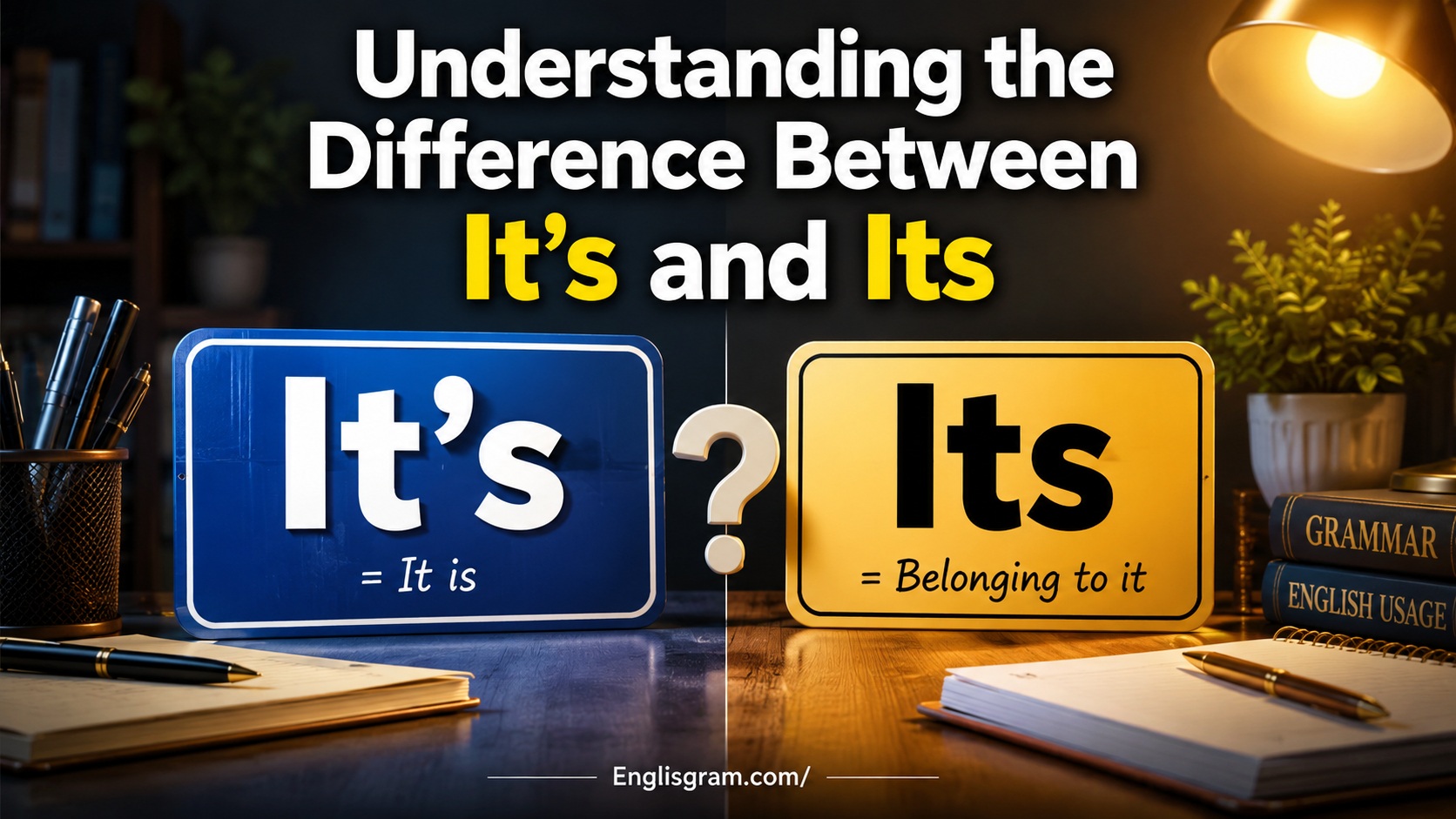
Understanding the Difference Between It’s and Its becomes much easier when you know one simple rule. Many English learners, students, and experienced writers mix up its and it’s, even though the core difference is easy to learn. They are commonly confused words in the English language, are pronounced the same way, share the same root and base pronoun it, and are both three-letter words, but a simple addition of an apostrophe completely changes the meaning.
I have realized that even native English speakers make this mistake in emails, essays, blog posts, social media captions, and business writing, so there is no reason to worry if you feel confused. Clear rules, clear examples, and a good guide will help you understand how to use each form correctly and confidently. It’s is a contraction meaning it is or it has, while its shows possession or ownership.
This rule explains the grammar, spelling, usage, and punctuation, proving why the apostrophe matters.As I review my own writing, I always check for common errors before publishing. Over time, I have found that editing tips, practical practice exercises, extra practice, and reviewing errors improve pronunciation, spelling, and grammar. This approach shows why attention to small details is needed and practical, especially with similar spellings.
It’s vs Its at a Glance
Here is the fastest way to tell them apart.
| Word | Meaning | Grammar Role | Example |
| It’s | It is or It has | Contraction | It’s raining outside. |
| Its | Belonging to it | Possessive determiner | The dog wagged its tail. |
That table gives you the shortcut. But shortcuts only help when you understand the logic behind them.
What It’s Really Means
It’s = It is
The most common use of it’s is as a contraction of it is.
For example:
- It’s cold today.
- It’s a beautiful morning.
- It’s time to leave.
- It’s easy to make this mistake.
In each case, you can expand the contraction and the sentence still makes perfect sense.
Try the substitution:
- It’s cold today → It is cold today
- It’s a beautiful morning → It is a beautiful morning
If the sentence works with it is, then it’s is the right choice.
It’s = It has
Less often, it’s can mean it has.
Examples:
- It’s been a long day.
- It’s already started.
- It’s taken too long to finish.
You can expand these to:
- It has been a long day.
- It has already started.
- It has taken too long to finish.
That second meaning matters because some people assume it’s only means it is. It does not. It can also stand for it has when the grammar fits.
Why contractions matter
English uses contractions all the time in speech and casual writing. They make language sound smooth and natural. That is why it’s feels so common. People say it often. They write it often. They see it so often that they start using it where its belongs.
That is where the trouble begins.
What Its Really Means
Its shows possession
Its is a possessive form. It tells you that something belongs to it.
Examples:
- The cat licked its paw.
- The company changed its policy.
- The tree lost its leaves.
- The phone has lost its battery life.
In each sentence, its shows ownership. The paw belongs to the cat. The policy belongs to the company. The leaves belong to the tree. The battery life belongs to the phone.
This is the key idea: its = belonging to it.
The apostrophe trap
Many people feel tempted to write it’s when they mean possession because other possessive forms often use apostrophes.
For example:
- the dog’s collar
- the girl’s book
- the teacher’s desk
That pattern creates confusion. People expect it’s to work the same way. But English does not treat its like those words.
Its is one of the few possessive forms without an apostrophe.
That is not a typo. That is the rule.
Why Its Has No Apostrophe
This rule looks odd at first. A lot of possessives use apostrophes, so why not its?
The answer is simple: its already works like other possessive pronouns that do not need apostrophes.
Compare these:
- his book
- her bag
- our house
- their car
- its tail
None of those words use apostrophes. They all show possession in a clean, direct way.
So its follows the same pattern.
The apostrophe does not show possession here
People sometimes think apostrophes always mean ownership. That is not true.
An apostrophe can show:
- missing letters in contractions
- possession in many nouns
- plural forms in rare or tricky cases
But its is not a contraction. It is a possessive pronoun. That is why it does not take an apostrophe.
A useful memory tip
Think of it this way:
- it’s = it is / it has
- its = its own thing
That little phrase sounds casual, but it helps many people remember the rule.
The Easiest Trick to Choose the Right Word
You do not need a grammar degree to get this right. You only need one quick test.
The substitution test
Replace it’s with it is or it has.
If the sentence still works, use it’s.
If the sentence does not work, use its.
Example
- The robot lost it’s voice.
Try the test:
- The robot lost it is voice.
That makes no sense. So it’s is wrong here.
Correct sentence:
- The robot lost its voice.
Now the ownership is clear.
Another example
- It’s been a busy week.
Try the test:
- It has been a busy week.
That works. So it’s is correct.
This substitution trick catches the mistake almost every time.
It’s vs Its in Real Sentences
Grammar rules become much easier when you see them in context. Here are plenty of real examples.
Correct uses of it’s
- It’s raining again.
- It’s already noon.
- It’s a great idea.
- It’s been fun to watch.
- It’s not easy to learn grammar overnight.
Correct uses of its
- The bird spread its wings.
- The software updated its interface.
- The bicycle lost its chain.
- The school changed its schedule.
- The forest dropped its leaves in autumn.
Now compare these pairs:
| Incorrect | Correct |
| The dog wagged it’s tail. | The dog wagged its tail. |
| Its a nice day. | It’s a nice day. |
| The store changed it’s hours. | The store changed its hours. |
| The machine lost it’s power. | The machine lost its power. |
These examples show the pattern clearly. If the word means it is or it has, use it’s. If the word shows ownership, use its.
Common Mistakes People Make With It’s and Its
People usually make the same few mistakes. Once you know them, you can avoid them quickly.
Mistake with possession
This is the most common one.
Wrong:
- The company released it’s new app.
Correct:
- The company released its new app.
Why? Because the app belongs to the company. That is possession. No contraction is involved.
Mistake with contractions
Some people write its when they need it’s.
Wrong:
- Its going to rain.
Correct:
- It’s going to rain.
Why? Because the sentence means it is going to rain.
Mistake in fast typing
Text messages and social media posts often cause this error. People type too quickly. The apostrophe lands in the wrong spot or disappears completely.
That does not mean the writer is careless. It usually means they rushed. Still, the mistake can make a sentence look less polished.
Mistake from autocorrect
Sometimes devices “help” too much. Autocorrect may change the word based on a guess instead of the full sentence. That can create errors that slip through during editing.
A quick read-through catches many of these problems.
A Simple Comparison of It’s and Its
This table gives you a cleaner side-by-side look.
| Feature | It’s | Its |
| Apostrophe | Yes | No |
| Meaning | It is / It has | Belonging to it |
| Grammar Type | Contraction | Possessive determiner |
| Example | It’s late. | The dog chased its tail. |
| Replacement Test | Works as it is or it has | Works as a possessive form |
When in doubt, pause and ask one question:
Can I expand this to “it is” or “it has”?
If yes, use it’s.
If no, use its.
It’s vs Its in Different Types of Writing
The same rule applies everywhere, but the impact changes depending on the setting.
In casual writing
Text messages, comments, and social posts often ignore grammar rules. Even so, the difference still matters if you want clear writing.
Example:
- Its crazy out there.
This is wrong. It should be:
- It’s crazy out there.
Even in casual writing, the correct form makes the message easier to read.
In academic writing
Essays, reports, and research papers need precision. Mistakes with it’s and its can distract the reader and weaken confidence in the writing.
Wrong:
- The study improved it’s focus on memory.
Correct:
- The study improved its focus on memory.
That small apostrophe mistake can make a polished paper look sloppy.
In business writing
Emails, proposals, and client documents should look professional. Grammar errors can affect trust.
Wrong:
- The brand has changed it’s logo.
Correct:
- The brand has changed its logo.
This kind of detail matters when you want your writing to sound sharp and credible.
In publishing and content writing
Blog posts, articles, and website copy need clean grammar because readers notice mistakes fast. A single wrong apostrophe can break the flow.
That is why editors watch for it’s vs its carefully.
Common Expressions That Use It’s
Some common phrases use it’s so often that they become easy to recognize.
- It’s up to you
- It’s time
- It’s okay
- It’s not worth it
- It’s a shame
- It’s likely
- It’s true
- It’s been a while
These phrases help train your ear. Since they sound natural, they also help you remember that it’s often behaves like it is or it has.
Words That People Confuse With It’s and Its
Grammar confusion rarely stops with one pair. A few other words cause the same kind of trouble.
| Correct Pair | Common Mistake | Example |
| You’re / Your | Using the wrong one | You’re late. / Is this your bag? |
| They’re / Their / There | Mixing them up | They’re coming. / That is their car. / Put it over there. |
| Who’s / Whose | Confusing contraction and possession | Who’s calling? / Whose phone is this? |
| It’s / Its | Apostrophe confusion | It’s here. / The dog wagged its tail. |
These pairs follow the same general lesson: contractions use apostrophes, while possessive forms often do not.
Why People Keep Getting It’s and Its Wrong
The mistake is common for a few simple reasons.
The apostrophe looks important
Many writers treat apostrophes like decoration. If a word feels incomplete, they add one. If a word looks plain, they think something is missing. That instinct leads to errors.
Speech and writing do not match perfectly
In spoken English, it’s and its sound almost identical. Since you cannot hear the difference, the choice depends on grammar, not sound.
That makes the pair tricky.
Fast writing increases mistakes
Typing speed often beats careful thinking. People write what sounds right instead of what fits the sentence.
English has exceptions
English enjoys breaking its own patterns. Its is one of those exceptions that makes people pause. The language offers no mercy here. You simply memorize the rule and use it.
Practical Rules for Remembering It’s vs Its
Here are the most useful rules in plain English.
Use it’s when you can expand it to it is or it has
Examples:
- It’s warm outside. → It is warm outside.
- It’s been a long time. → It has been a long time.
Use its when something belongs to it
Examples:
- The bird spread its wings.
- The chair lost its cushion.
Never use it’s to show possession
That is the mistake many writers make. A contraction cannot act like a possessive word.
Never add an apostrophe to its for ownership
Its already does the job. The apostrophe would break the rule.
A Quick Editing Checklist for It’s vs Its
Before you publish or send anything, run through this simple checklist.
- Read the sentence aloud.
- Replace the word with it is.
- Replace the word with it has.
- Ask whether the word shows ownership.
- Check for apostrophe errors.
- Review the sentence once more if it still feels off.
That five-second check can save you from a common mistake.
Read More:Disoriented or Disorientated? What’s the Difference and Which One Should You Use?
Mini Case Studies: How the Wrong Word Changes the Sentence
Case study one: a blog post sentence
Wrong:
- The phone lost it’s battery life after the update.
Correct:
- The phone lost its battery life after the update.
Why this matters: the phone owns the battery life in the sentence. No contraction fits here.
Case study two: a student essay
Wrong:
- Its important to understand the water cycle.
Correct:
- It’s important to understand the water cycle.
Why this matters: the writer means it is important. The contraction is required.
Case study three: a business email
Wrong:
- The company has improved it’s customer service.
Correct:
- The company has improved its customer service.
Why this matters: customer service belongs to the company. Possession calls for its.
Case study four: a social media caption
Wrong:
- Its finally Friday.
Correct:
- It’s finally Friday.
Why this matters: the sentence means it is finally Friday. That is a contraction.
These examples show that the rule stays the same across all writing styles.
A Useful Quote to Keep in Mind
If you can say “it is” or “it has,” use “it’s.” If you mean ownership, use “its.”
That one line solves most confusion.
It’s vs Its in Proofreading
Proofreading gets easier when you know what to look for.
Search for apostrophes in the wrong place
Apostrophes often cause the issue. Scan your text for it’s and its whenever you edit.
Check for meaning, not just spelling
A word can look correct and still be wrong in context. That is why spelling alone is not enough.
For example:
- The car lost it’s wheel.
The spelling looks familiar, but the meaning is wrong. The wheel belongs to the car, so the correct word is its.
Read slowly near the end
Many writers catch errors near the end of a draft because they stop rushing. A slower read helps you spot the wrong form.
Practice Examples for It’s and Its
Try these on your own before checking the answers.
Choose the correct word
- The turtle withdrew ___ head.
- ___ a good day for a walk.
- The school updated ___ lunch schedule.
- ___ been a long journey.
- The laptop lost ___ charger.
Correct answers
- The turtle withdrew its head.
- It’s a good day for a walk.
- The school updated its lunch schedule.
- It’s been a long journey.
- The laptop lost its charger.
Why these answers work
- Its shows possession.
- It’s means it is or it has.
That is the whole rule in action.
The Best Way to Master It’s vs Its
The best approach is not memorizing a long grammar lecture. It is practicing the substitution test until it becomes automatic.
Here is a simple routine:
- Write the sentence.
- Ask whether you mean it is or it has.
- If yes, use it’s.
- If the sentence shows ownership, use its.
- Read the sentence one more time.
After a while, the correct choice starts to feel natural.
Frequently Missed Questions About It’s and Its
Can it’s ever show possession?
No. It’s does not show possession. It only stands for it is or it has.
Does its ever take an apostrophe?
No. Its never takes an apostrophe when it means possession.
Why does this rule feel backward?
Because many possessive nouns use apostrophes. Its is one of the exceptions, so it breaks the pattern people expect.
Is its a pronoun?
More precisely, its is a possessive determiner or possessive form. It works like his, her, their, and our.
Can I rely on spellcheck?
Not completely. Spellcheck often misses grammar mistakes because both words are real words.
Common Mistakes to Avoid
Here is a quick list of errors worth watching for.
- Writing it’s when you mean possession
- Writing its when you mean it is
- Trusting sound instead of grammar
- Skipping proofreading because the sentence “looks fine”
- Assuming apostrophes always show ownership
Once you avoid these traps, the difference becomes much easier.
FAQS
Is it’s ever possessive?
No. It’s is always a contraction that means “it is” or “it has.” It never shows possession.
When should I use its?
Use its when you want to show possession or ownership. For example: The dog wagged its tail.
What is the easiest way to remember the difference?
Replace it’s with “it is” or “it has.” If the sentence still makes sense, it’s is correct. If not, use its.
Why do people confuse it’s and its?
They look very similar, sound the same when spoken, and differ by only one apostrophe. That small punctuation mark changes the meaning completely.
Do native English speakers make this mistake?
Yes. Even experienced writers and native English speakers sometimes confuse it’s and its, especially when writing quickly.
Conclusion
Learning the difference between it’s and its is easier than it first appears. Remember that it’s means “it is” or “it has,” while its shows possession. With a simple memory trick, regular practice, and careful proofreading, you can avoid one of the most common grammar mistakes and write with greater confidence.