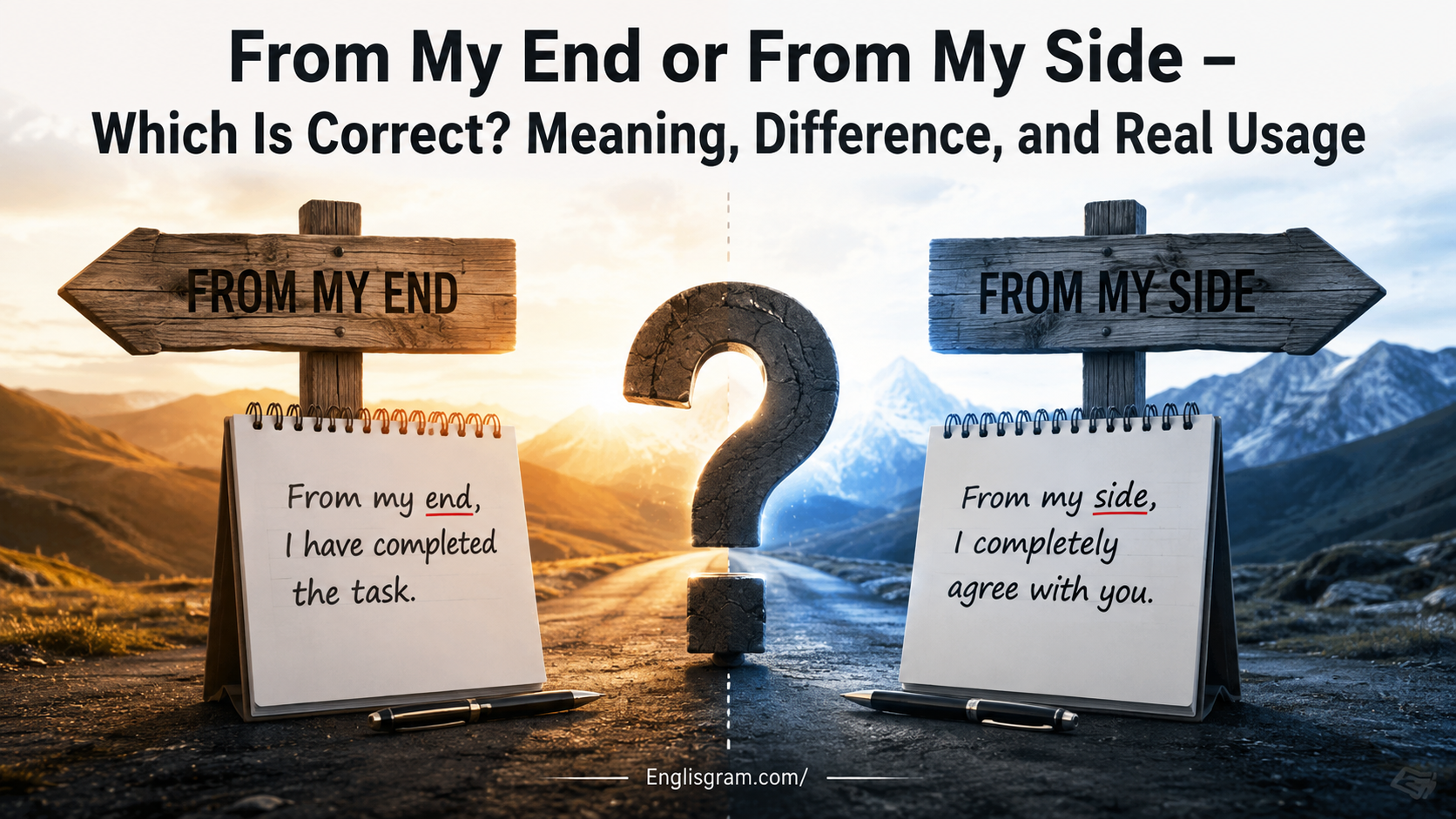
From My End or From My Side – Which Is Correct explains how professionals choose the right phrase in English for workplace communication and emails. When I hear people use From My End and From My Side during daily work talk, the first question is often about which phrase is correct. In a team, both expressions help you communicate your part of the job when a task is done or when someone asks a real question about progress.
In workplace communication, these phrases are commonly used because they are interchangeable phrases in many situations. However, their use depends on context, preference, and the individual meaning a person wants to convey. They may sound similar and have a similar purpose, but they can carry different weights in a professional environment.Choosing between these terms can feel like solving a puzzle in language.
Whether you are writing an email, joining a meeting, chatting with friends, or improving your communication skills, you are navigating a vast ocean of words where a simple map can guide you through tricky choices. These expressions shine light on how people manage a task, project, or shared responsibility with several people. From My End can show that your side of a project is finished, while From My Side can sound more personal, connected with opinions and feelings.
What “From My End” Means
From my end usually refers to your part of a process, your location in a system, or your current status. It often shows up in workplace messages, support chats, and project updates.
Think of it like this: you are reporting what you can see or control on your own side of a connection.
For example:
- “Everything looks fine from my end.”
- “There’s no issue from my end.”
- “I’ve checked from my end, and the file is uploaded.”
In these examples, the phrase points to your side of the process. It is often used when someone wants to say, “I don’t see a problem on my side.”
Common Uses of “From My End”
This phrase appears most often in:
- Technical support
- Workplace communication
- Email updates
- Remote team discussions
- Customer service chats
It often sounds natural when you are talking about a system, account, device, or task you handled.
Example Sentences
- Everything is working from my end.
- I don’t see any errors from my end.
- The document looks complete from my end.
- From my end, the meeting invite was sent.
- I’ve done my part from my end.
What it really suggests
The phrase usually suggests one of these ideas:
- You checked your part.
- You do not see a problem.
- Your section is complete.
- The issue is not on your side.
So, from my end is often about status, access, or troubleshooting.
What “From My Side” Means
From my side usually refers to your perspective, your contribution, your position, or your personal viewpoint. It is broader and often feels more natural in everyday English.
For example:
- “From my side, everything is ready.”
- “There’s no objection from my side.”
- “I’ve completed my part from my side.”
This phrase can work in both casual and professional English. It often sounds more personal and more human than from my end.
Common Uses of “From My Side”
You will often hear it in:
- Personal conversations
- Team discussions
- Negotiations
- Project coordination
- Opinion sharing
Example Sentences
- From my side, the plan looks good.
- I have no concerns from my side.
- I’ve handled everything from my side.
- From my side, we can move ahead.
- There is nothing left from my side.
What it really suggests
This phrase often means:
- Your opinion is clear.
- Your responsibilities are done.
- You are sharing your position.
- You are saying there is no issue on your part.
So, from my side often sounds better when you mean your viewpoint or contribution rather than a system check.
From My End vs. From My Side: The Core Difference
Both phrases are common, but they do not always carry the same feel.
The simplest way to understand it is this:
- From my end = my part of the process, my status, my system, my setup
- From my side = my perspective, my role, my contribution, my point of view
That difference is small but important.
Quick comparison table
| Phrase | Main meaning | Best context | Naturalness in everyday English |
| From my end | My side of a task, system, or process | Tech, support, workplace updates | Common, but slightly specific |
| From my side | My perspective or contribution | General conversation, meetings, opinions | Very natural and flexible |
Easy rule
If you are talking about checking a system or completing your part of a task, from my end often fits.
If you are talking about your view, role, or agreement, from my side usually sounds smoother.
Is “From My End” Grammatically Correct?
Yes, from my end is grammatically correct.
It may sound informal, but that does not make it wrong. English speakers use it regularly, especially in work settings and support conversations.
The phrase works because end here means a person’s side of a communication chain or process. It is a shortened, practical expression. People use it the way they use other everyday phrases that are not fully literal but still make sense.
Why it sounds common in business English
In business and technology, people often want a fast way to say:
- “I checked my part.”
- “I do not see a problem.”
- “I sent what was needed.”
- “My side is complete.”
From my end became a useful shortcut for that idea.
Example in business communication
- “The file has been shared from my end.”
- “There are no updates from my end.”
- “From my end, the task is finished.”
These sentences are normal in professional communication, especially in team chats and emails.
Is “From My Side” Grammatically Correct?
Yes, from my side is also grammatically correct.
It is a natural phrase in English and often sounds softer and more conversational than from my end.
The word side here refers to your viewpoint or role in a situation. It is broader and more flexible.
When it feels especially natural
Use from my side when you are:
- Giving your opinion
- Confirming your contribution
- Saying you agree
- Talking about your responsibilities
- Discussing a shared decision
Example in a work setting
- “From my side, the draft is ready.”
- “I’m fine with that from my side.”
- “There are no changes from my side.”
This phrase is often a little more polished in everyday English.
Which Phrase Sounds More Natural in American English?
In American English, from my side usually sounds more natural in general conversation.
That said, from my end is still widely used in workplaces, especially in IT, support, operations, and project coordination.
A simple way to think about it
- Use from my end when you are reporting status or checking whether something is working on your side.
- Use from my side when you are talking about your role, opinion, or contribution.
More natural examples
- Natural: “Everything looks good on my side.”
- Natural: “From my side, we are ready.”
- Natural: “I do not see any issue on my end.”
- Natural: “From my side, there is nothing else to add.”
Notice something important here.
Native speakers often prefer on my side or on my end in some contexts. That is because on can sound more natural than from in certain sentences.
For example:
- “Everything is fine on my end.”
- “There’s no problem on my side.”
These versions often sound smoother than the “from” versions.
When to Use “From My End”
Use from my end when the sentence is about a process, device, account, or task that you checked.
Best situations
- You are fixing a technical issue
- You are confirming you sent something
- You are reporting that your part is complete
- You are saying no problem appears on your system
Examples
- “I checked the dashboard from my end, and everything loads fine.”
- “The invoice was sent from my end.”
- “There’s no delay from my end.”
- “From my end, the connection is stable.”
Workplace example
A team member writes:
“I’ve shared the updated document from my end.”
That usually means the document has been sent or uploaded on their side.
When to Use “From My Side”
Use from my side when the sentence is about your opinion, your role, or your personal contribution.
Best situations
- You are discussing a plan
- You are agreeing or disagreeing
- You are clarifying your part
- You are sharing your point of view
Examples
- “From my side, the schedule works.”
- “There is nothing more from my side.”
- “I’m ready from my side.”
- “From my side, we can move forward.”
Everyday example
A friend might say:
“From my side, I’m okay with the change.”
That sounds natural because it expresses personal agreement.
Read More:Verklempt Meaning and Usage: Definition, Origin, Examples, and How to Use It Naturally
Common Mistakes People Make
Many people use these phrases as if they are exact twins. They are close, but context matters.
Mistake one: using “from my end” for everything
This can make your writing sound repetitive or slightly stiff.
Example:
- “From my end, the plan is okay.”
- “From my end, I sent the file.”
- “From my end, there are no changes.”
This is not wrong, but it can start to sound mechanical.
Mistake two: using “from my side” for technical status
That can feel too broad if you are talking about a system check.
Example:
- “From my side, the server is fine.”
This is understandable, but on my end or from my end may sound more precise in technical work.
Mistake three: using either phrase in formal writing when clearer wording would help
Sometimes plain English is better.
Instead of:
- “From my end, the report is complete.”
You might say:
- “I have completed the report.”
- “The report is complete on my side.”
- “I have finished my part.”
Clear beats clever.
Better Alternatives to “From My End”
Sometimes you do not need either phrase. A cleaner alternative can sound stronger.
Useful alternatives
- On my end
- I have checked
- I have completed my part
- Everything looks fine here
- I don’t see any issues
- The task is done on my side
- I’ve sent it
- I’ve reviewed it
- My part is complete
- According to my check
When they work best
| Alternative | Best use |
| On my end | Status updates, tech issues, availability |
| I have checked | Clear reporting |
| I’ve sent it | Action confirmation |
| My part is complete | Task ownership |
| I don’t see any issues | Troubleshooting |
Examples
- “Everything is fine on my end.”
- “I have checked, and it’s working.”
- “I’ve sent the file.”
- “My part is complete.”
These phrases often sound more direct and less vague.
Better Alternatives to “From My Side”
You also have plenty of good options here.
Useful alternatives
- From my perspective
- As far as I’m concerned
- On my part
- I agree
- I’m fine with that
- I have no objections
- I’ve done my part
- My view is
- I’m comfortable with that
- I see it differently
When they work best
| Alternative | Best use |
| From my perspective | Opinions and viewpoints |
| As far as I’m concerned | Personal stance |
| I have no objections | Meetings and decisions |
| I’m fine with that | Casual or professional agreement |
| I’ve done my part | Responsibility and completion |
Examples
- “From my perspective, the timing is good.”
- “As far as I’m concerned, we can begin.”
- “I have no objections.”
- “I’ve done my part.”
These expressions often sound sharper and more exact.
Common Email Examples
Email is where these phrases show up a lot.
Professional email with “from my end”
Hi team,
I checked the file from my end, and it opens correctly.
Please let me know if you still see an issue.
This works well because it is about a status check.
Professional email with “from my side”
Hi team,
From my side, the draft is ready for review.
I’ve added the final changes and left comments in the document.
This works because it highlights your contribution.
Customer support style
Hello,
I tested the issue from my end, but I cannot reproduce it.
Could you share a screenshot?
That sounds natural in support communication.
Team update style
Hello everyone,
From my side, everything is complete.
I’m waiting on final approval.
This feels polite and professional.
Everyday Conversation Examples
These phrases are not only for work. People use them in daily talk too.
With friends
- “From my side, I’m good with it.”
- “From my end, the plan works.”
- “There’s nothing else from my side.”
With family
- “From my side, I’ve done the shopping.”
- “Everything’s okay from my end.”
- “I’m done from my side.”
In group chats
- “From my side, we can leave now.”
- “No problem from my end.”
- “I’ve shared the link from my side.”
These examples sound casual and easy.
A Practical Case Study
Imagine a remote team working on a website launch.
The designer says:
“From my side, the homepage is done.”
The developer says:
“From my end, the code is deployed.”
The project manager says:
“Great. From my side, I’ve approved the final version.”
Each person uses a slightly different phrase, but each one fits the job.
Now compare that with a support situation.
A user reports a login issue. The support agent replies:
“I checked from my end, and the system is working. Please clear your cache and try again.”
Here, from my end works better because the person is reporting a system check.
That is the key difference in real use. The phrase should match the situation.
What Native Speakers Often Say Instead
Native speakers do not always use either phrase. In many cases, they choose shorter and more natural expressions.
Common native-style alternatives
- “I checked it.”
- “It’s good on my end.”
- “No issues here.”
- “I’m fine with that.”
- “I’ve completed my part.”
- “That works for me.”
- “I don’t have anything to add.”
Why these sound better
They are:
- shorter
- clearer
- more direct
- less repetitive
That does not mean from my end or from my side are bad. It just means other options may sound more natural in certain situations.
Regional Usage: US English, UK English, and Indian English
These phrases are used in many English varieties.
In American English
- From my side often sounds natural in everyday conversation.
- From my end is common in work and tech contexts.
In British English
Both phrases are understood, but speakers may also prefer simpler options like:
- “on my side”
- “as far as I’m concerned”
- “I’ve done my bit”
In Indian English
From my side and from my end are both very common, especially in office communication and messaging.
That is why you will hear them often in emails, team chats, and client updates.
Important note
None of these phrases is “wrong” just because it appears in one region more than another. Context matters more than geography.
Can You Use These Phrases in Formal Writing?
Yes, but be careful.
In formal writing, clarity matters more than casual speech. So these expressions are fine in emails, workplace notes, and professional chats. But in reports, academic work, or legal-style writing, a clearer sentence is often better.
Better for formal writing
- “I have completed my part.”
- “The issue does not appear on my side.”
- “The file has been uploaded.”
- “I have no objections.”
Less ideal for formal writing
- “From my end, everything is fine.”
- “From my side, we are ready.”
These are not wrong. They just sound more conversational than formal.
FAQS
1. Is “From My End” or “From My Side” correct in English?
Both From My End and From My Side are correct English phrases. The choice depends on the context and the meaning you want to convey. From My End is often used in professional communication to talk about your completed work, responsibility, or progress. From My Side can sound slightly more personal and is commonly used when sharing an opinion, feeling, or viewpoint.
2. When should I use “From My End” in a professional setting?
You can use From My End when discussing tasks, updates, or responsibilities in a workplace environment. For example, “The report is complete from my end” shows that your part of the project has been finished. It works well in emails, meetings, and business conversations where clarity and progress matter.
3. Can “From My Side” be used in formal writing?
Yes, From My Side can be used in formal writing, but it depends on the situation. It is suitable when you are expressing your personal perspective or explaining your position. However, in many professional settings, From My End may sound more direct when referring to completed tasks or actions.
4. Are “From My End” and “From My Side” interchangeable?
These phrases are often interchangeable, especially in casual conversations. However, they have subtle differences. From My End usually focuses on responsibility, completion, or action, while From My Side often highlights personal views, opinions, or a specific perspective.
5. How can I choose the right phrase in daily communication?
To choose the right phrase, consider your purpose, audience, and context. Use From My End when talking about work progress, updates, or completed tasks. Use From My Side when discussing your thoughts, feelings, or personal position. Understanding these small differences helps create clearer and more effective communication.
Conclusion
Understanding the difference between From My End and From My Side helps you make better choices in English communication, especially in professional situations. Both phrases are correct and commonly used, but their meaning can change depending on the context. From My End is often preferred when discussing completed tasks, responsibilities, updates, or progress, while From My Side can feel more personal when sharing opinions, views, or feelings.