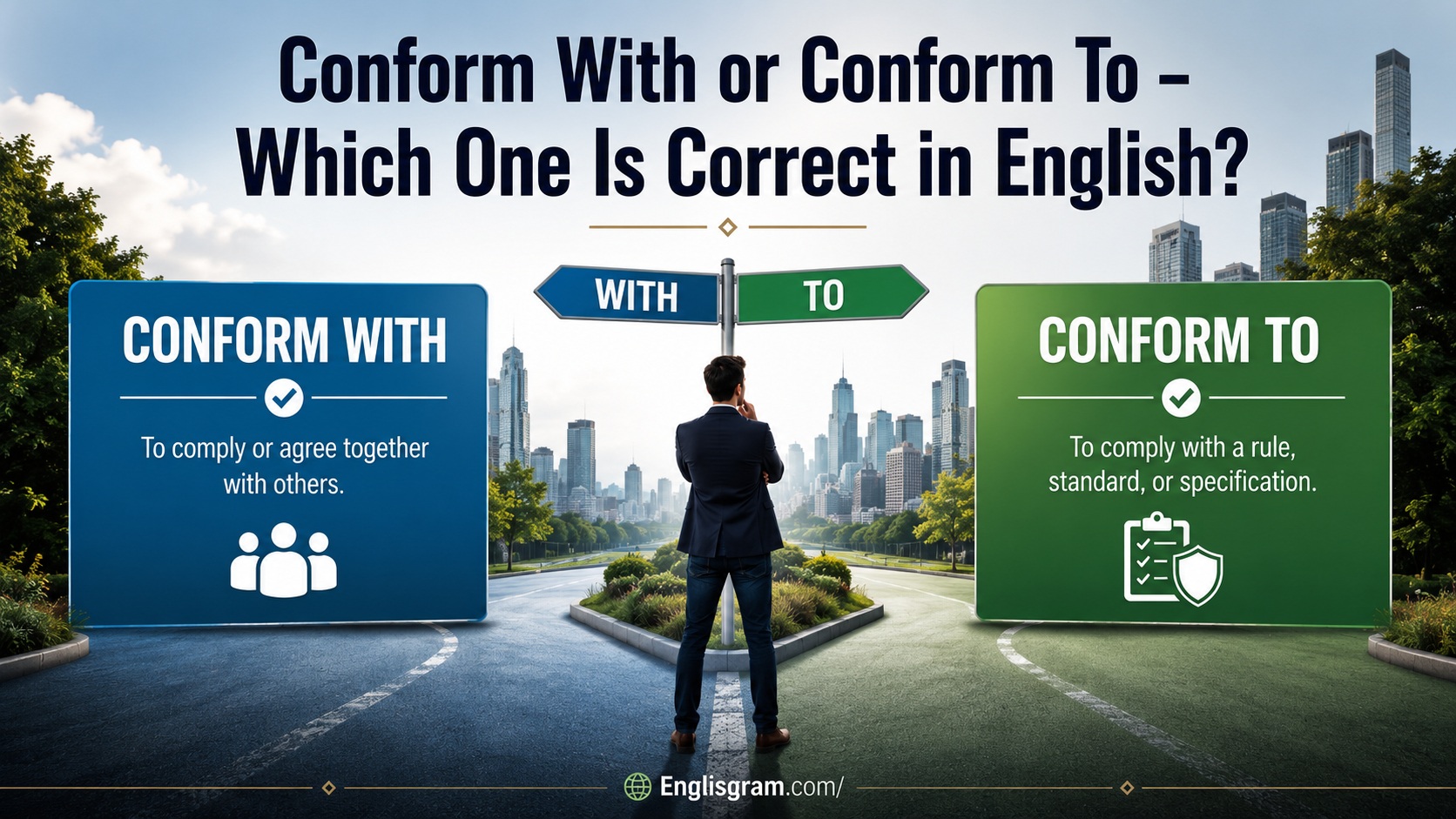
Conform With or Conform shows nuance for English learners where grammar, prepositions, and meaning shift with intentional writing control tone use.
nuance, English learners, arbitrary, intentional, phrase, conformity, writing, control, intended effect, grammatical functions, option, harmony, authority, message, mutually, simple check, surrounding context, guide learners, distinction, meaning shift, conform to, confidence grows, compliance, naturally, styles match, construction, effective, ideas, articulate understanding, practice, prepositions, conform with,
clear language use, reflecting, reading words back, determine, fitting, need for precision, strong adherence, native speakers, difference matters, learners see, control over nuance, expressing ideas, careful choices, meaning stems, choice applies, wrong usage, conversation, language use, clarity, rule, ambiguity, effective communication, version serves goal, intuitively, confusion, writing clarity, sentence structure, idea alignment, tone shift, linguistic precision, message control, usage patterns, grammar awareness, learning,
differences, learners, articulate, purpose, distinct, using, incorrectly, creating, uncertaintyIn real use, conform to connects with obedience, compliance, policy, rules, standards, and authority, while conform with reflects harmony, mutual agreement, alignment, and soft fit, where casual speech, casual usage, and second nature often guide native speakers naturally.
Conform With or Conform To – Quick Answer First
Let’s not waste your time.
- Correct and standard form: 👉 Conform to
- Occasionally used but less natural: 👉 Conform with
Simple rule
If you’re unsure, always use “conform to”.
That choice will be correct in:
- Academic writing
- Business communication
- Legal documents
- Everyday English
What Does “Conform” Mean in Simple English?
The word conform means to follow rules, patterns, or expectations.
Think of it like fitting into a shape that already exists.
Simple meaning
To match or behave according to a standard.
Easy synonyms
Here are words that carry similar meaning:
- Follow
- Match
- Adhere
- Comply
- Align
- Obey
Simple example
- Students must conform to school rules.
That means they must follow the rules set by the school.
Why “Conform To” Is the Standard in English
Now let’s get into the core grammar idea.
English verbs often pair with specific prepositions. These pairs are called collocations.
“Conform to” is a fixed collocation
We say:
- adapt to
- adjust to
- react to
- conform to
Not “adapt with” or “conform with” in standard usage.
Why “to” works better
The preposition “to” shows direction or target.
So when you “conform to something,” you are moving toward a standard or rule.
Real usage examples
- Companies must conform to safety standards.
- Your behavior should conform to social expectations.
- The device conforms to international regulations.
Key idea
“Conform to” shows alignment with a goal or requirement.
When You Use “Conform To” in Real Life
You see this phrase everywhere. It dominates professional English.
Everyday situations
- Students conform to school discipline rules
- Employees conform to workplace policies
- Drivers conform to traffic laws
Business writing
- Products must conform to ISO standards
- Reports conform to company guidelines
Legal usage
- Laws must conform to constitutional requirements
- Contracts conform to regulatory frameworks
Science and technical fields
- Data formats conform to system standards
- Models conform to experimental results
“Conform With” – Does It Ever Make Sense?
Yes, but rarely.
“Conform with” exists, but it sounds less natural in modern English.
Where you might still see it
- Older British English documents
- Some legal drafting variations
- Regional writing styles
- Non-native translations
When it can appear acceptable
It sometimes shows up when the writer focuses on agreement rather than direction.
Example
- The report conforms with international guidelines.
This is understandable but less preferred.
Modern preference
Most style guides still recommend:
👉 conform to guidelines
Why “Conform With” Sounds Less Natural Today
Language evolves. English has shifted toward consistency in verb-preposition pairing.
Main reasons
- “To” is used more consistently across verbs
- “With” creates ambiguity in formal writing
- Style guides prefer uniform grammar patterns
Natural comparison
Compare these:
- Conform to rules ✔ (standard)
- Conform with rules ⚠ (rare or stylistic)
Native speaker behavior
In real usage, native speakers overwhelmingly choose “conform to.”
Key Difference Between Conform To and Conform With
Let’s simplify it further.
| Phrase | Meaning | Usage strength | Naturalness |
| Conform to | Move toward a rule or standard | Very strong | Very natural |
| Conform with | Match or align with something | Weak | Less natural |
Simple explanation
- “To” = direction toward rules
- “With” = comparison or similarity
Easy Analogy to Remember the Difference
Think of it like this:
- Conform to = walking toward a finish line
- Conform with = standing next to someone and comparing posture
One shows movement. The other shows similarity.
That’s why “to” works better in most cases.
Real-World Usage Across Different Fields
Let’s see how professionals actually use it.
Business and Workplace
Companies rely heavily on “conform to.”
- Policies must conform to HR guidelines
- Products conform to quality standards
- Employees conform to company culture
Clear, direct, and widely accepted.
Law and Government
Legal writing demands precision.
- Regulations must conform to federal law
- Policies conform to constitutional principles
Law avoids ambiguity, so “to” dominates.
Science and Research
Scientific language values structure.
- Experimental data conforms to predicted models
- Systems conform to theoretical frameworks
Here, “to” shows alignment with measurable standards.
Everyday English
Even casual speech follows the same pattern.
- Kids conform to classroom rules
- People conform to social norms
- Behavior conforms to expectations
Simple and universal.
Common Mistakes People Make
Many learners mix these forms incorrectly.
Frequent errors
- “The report conforms with standards” (not preferred)
- “Employees must conform with rules” (less natural)
- Overusing “with” due to translation habits
Why it happens
- Direct translation from other languages
- Confusion with phrases like “agree with”
- Lack of exposure to natural collocations
Read More:What Does “Dear All” Mean in Emails? A Complete Guide to Usage, Tone,
Conform To vs Comply With – Critical Difference
This is where many learners get confused.
Both are correct. But they behave differently.
Simple breakdown
| Phrase | Meaning | Preposition | Use case |
| Conform to | Match a standard | to | general alignment |
| Comply with | Follow a rule | with | legal or strict requirement |
Examples
- The product conforms to safety design standards.
- The company complies with government regulations.
Why “comply” uses “with”
“Comply” focuses on obedience to a rule. That’s why “with” works naturally here.
How Often Each Phrase Is Used
Language data from modern English corpora shows a clear trend.
Usage trend summary
- “Conform to” appears far more frequently in academic and business writing
- “Conform with” appears rarely and mostly in older texts
Practical takeaway
If you want natural English, stick with “conform to.”
What This Means in Real Writing
You don’t need complexity here. You need consistency.
Best practice
- Use “conform to” in almost all situations
- Avoid “conform with” unless you are analyzing historical or stylistic text
- Match modern usage patterns
Why it matters
Clear writing improves:
- Professional tone
- Reader trust
- Academic scores
- Business communication clarity
Memory Trick to Never Confuse Them Again
Here’s a simple trick you can remember instantly.
Shortcut method
- To = Target
- With = Weak match
So:
- You conform to a target
- You do not conform with a target
Quick Practice Section
Try filling in the blanks:
- Employees must ___ company policies.
- The device must ___ international standards.
- The report ___ regulatory guidelines.
- Students ___ school rules daily.
Answers with Explanation
- conform to
- conform to
- conform to
- conform to
Why all “to”?
Because each sentence describes alignment with a standard or rule.
Case Study: Why Legal Documents Avoid “Conform With”
Legal language is strict because every word affects interpretation.
What legal experts prioritize
- Clarity
- Consistency
- Predictability
Why “conform to” wins
- It removes ambiguity
- It aligns with international drafting standards
- It avoids regional variation confusion
Example from legal drafting style
- “All actions must conform to applicable law.”
Simple. Direct. Unambiguous.
Expert Insight on Usage Trends
Linguistic research and modern style guides consistently support “conform to.”
Key observations
- Major dictionaries list “conform to” as primary usage
- “Conform with” appears as secondary or regional variant
- Professional writing favors uniform preposition pairing
Practical conclusion
If your goal is modern, natural English, “conform to” is your safest choice.
FAQs
What is the main difference between “conform to” and “conform with”?
“Conform to” is used for rules, policy, obedience, and compliance.
“Conform with” is used for harmony, agreement, and soft alignment between ideas or things.
Why do English learners get confused with these phrases?
Because both look similar and feel interchangeable. But prepositions change meaning shift, which creates confusion, especially for English learners who rely on surface patterns.
Can native speakers also make mistakes with this?
Yes. Even native speakers sometimes mix them in casual speech because the difference feels subtle in everyday conversation.
How can I choose the correct phrase easily?
Do a simple check of context. If it involves rules or authority, use conform to. If it shows agreement or harmony, use conform with.
Does context really matter that much?
Yes. The surrounding context, sentence structure, and intended effect decide the correct usage and ensure clear language use.
Conclusion
The choice between conform to and conform with is not random. It depends on precision, context, and intended meaning. When you focus on careful choices, your writing clarity improves and your message feels more natural and effective.