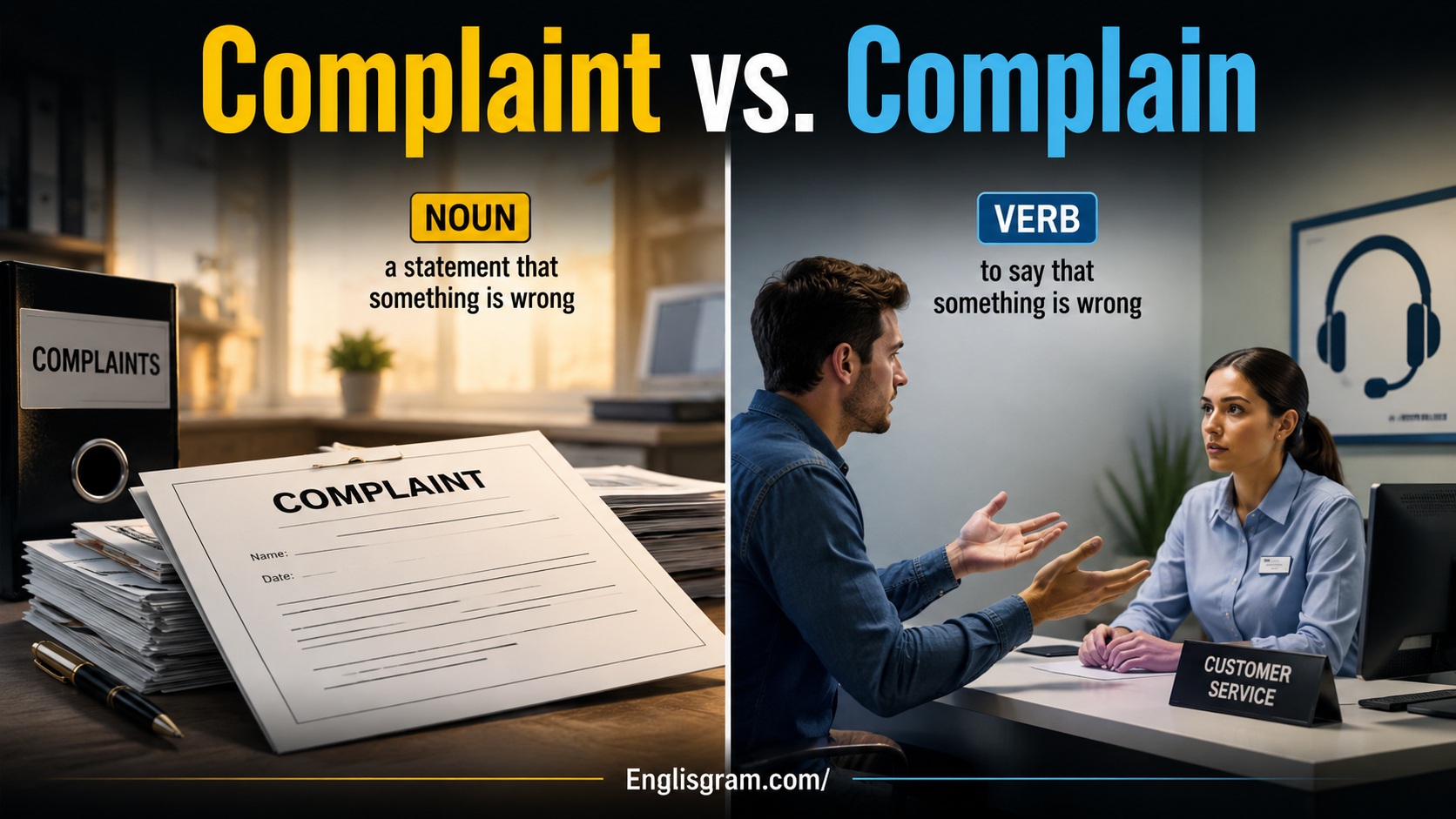
If you are Learning English, complaint and complain may seem almost the same because they look similar, sound alike, are closely related, and share the same root idea. I was once paused mid-sentence, wondering which word to pick, and that experience improved my understanding. The key is to distinguish a noun from a verb. A complaint is the noun form that expresses discontent, dissatisfaction, discomfort, unease, pain, grief, unhappiness, or an issue, including a product issue, service issue, formal grievance, formal grievances, or another grievance.
It may appear in written messages, messages, an email, emails, a review, reviews, a conversation, conversations, or any form of communication. To complain is the verb form, the action of expressing, express, or making an expression about things that make you unhappy. This distinction helps every learner reduce confusion, avoid getting confused, trip up less, and remember the rule with a helpful memory trick.In Complaint vs.
Complain, the fastest way to gain confidence is by studying examples, an example, sentence examples, sentence, sentences, tables, and a table that compare both words side-by-side. This method strengthens English grammar, English usage, grammar, grammar patterns, patterns, pattern, word choice, usage, clear communication, and clearer communication.
Complaint vs. Complain at a Glance
Before going deeper, here is the core difference in one quick view.
| Word | Part of Speech | Meaning | Example |
| complaint | Noun | A statement or expression of dissatisfaction | She filed a complaint about the delay. |
| complain | Verb | To express dissatisfaction or annoyance | She complained about the delay. |
A fast memory trick helps here:
- Complaint = a thing
- Complain = an action
If you can spot whether the sentence needs a thing or an action, you can usually choose the right word.
What Does “Complaint” Mean?
A complaint is a word you use when you talk about the problem itself or the statement made about that problem.
It is a noun, so it can act as the subject or object of a sentence.
Simple definition of complaint
A complaint is:
- a statement showing unhappiness
- a formal report of a problem
- an expression of dissatisfaction
- a written or spoken objection
People use it in both everyday speech and formal settings.
How “complaint” works in real life
You hear complaint in situations like these:
- a customer reporting poor service
- an employee raising a workplace issue
- a patient describing bad treatment
- a tenant reporting a housing problem
- a citizen submitting a formal report
So, when the focus is on the issue, the report, or the message, complaint is usually the right word.
Examples of complaint in sentences
- I have a complaint about the food.
- The manager handled the customer’s complaint quickly.
- We received several complaints about the noise.
- Her main complaint was the slow delivery.
- The company asked for written complaints only.
Common phrases with complaint
Here are some natural collocations:
- file a complaint
- make a complaint
- submit a complaint
- raise a complaint
- receive a complaint
- handle a complaint
- resolve a complaint
- formal complaint
- customer complaint
- noise complaint
These phrases are common in business, legal, and customer service writing.
What Does “Complain” Mean?
Complain means to express dissatisfaction, show annoyance, or say that something is wrong.
It is a verb, so it describes an action.
Simple definition of complain
To complain means:
- to say you are unhappy
- to express irritation or criticism
- to protest about a problem
- to speak or write about something bad or unfair
When someone complains, they are doing something. They are not naming the issue. They are reacting to it.
How “complain” works in real life
You use complain when you want to describe the act of speaking out about something.
For example:
- She complained about the wait.
- He complains every morning.
- They complained to the hotel manager.
- I do not like to complain, but this service is poor.
The action matters here. That is why complain stays in the verb category.
Examples of complain in sentences
- Customers often complain when service is slow.
- He complained about the noise last night.
- She never complains, even when things go wrong.
- They complained to the airline about the delay.
- I do not want to complain, but the room is cold.
Common phrases with complain
These are common and natural:
- complain about
- complain of
- complain to
- complain that
- complain loudly
- complain constantly
- complain bitterly
- complain publicly
Each phrase adds a slightly different shade of meaning, but the base idea stays the same: someone is expressing dissatisfaction.
Complaint vs. Complain: The Grammar Rule That Matters
This is the part that saves you from mistakes.
Complaint is a noun
Use complaint when you need:
- the name of a problem
- the object of a sentence
- a subject in a sentence
- a formal report or statement
Examples
- The complaint was resolved.
- Her complaint was about the bill.
- One complaint is not enough to change policy.
Complain is a verb
Use complain when you need:
- the action of expressing unhappiness
- a verb after the subject
- a sentence describing what someone did
Examples
- She complained about the bill.
- People often complain too late.
- Do not complain without offering a solution.
A simple test
Ask yourself:
- Am I naming a thing? → complaint
- Am I describing an action? → complain
That small question solves most cases.
Complaint vs. Complain in a Side-by-Side Comparison
| Feature | Complaint | Complain |
| Part of speech | Noun | Verb |
| Main job | Names the issue | Shows the action |
| Can take an article? | Yes: a complaint, the complaint | No |
| Can change tense? | No | Yes: complain, complained, complaining |
| Common use | Formal report, objection, dissatisfaction | Expressing dissatisfaction, objecting |
This table gives you the difference in plain English. If the sentence needs a noun, choose complaint. If it needs a verb, choose complain.
How to Use “Complaint” Correctly
Because complaint is a noun, it follows noun rules.
Common sentence patterns with complaint
- a complaint about something
- the complaint of a person
- complaints about something
- a complaint regarding something
- file a complaint against someone
Examples
- She had a complaint about the service.
- There was a complaint regarding the bill.
- The office received many complaints about the delay.
- He filed a complaint against the contractor.
Articles and plural forms
Since complaint is a noun, you can use:
- a complaint
- the complaint
- this complaint
- many complaints
- several complaints
That flexibility is another reason it behaves like a normal noun.
Formal and informal use
You can use complaint in both settings, but it sounds more formal than complain in many contexts.
For example:
- Informal: I have a complaint about the food.
- Formal: The customer submitted a written complaint.
The noun often feels more polished in official communication.
Read More:Is It Correct to Say “Thanks for Letting Me Know”? Grammar, Meaning, Tone, and Better Alternatives
How to Use “Complain” Correctly
Because complain is a verb, it changes depending on tense and subject.
Verb forms of complain
- base form: complain
- third-person singular: complains
- past tense: complained
- present participle: complaining
- past participle: complained
Examples in different forms
- She complains every morning.
- He complained about the traffic.
- They are complaining again.
- I have complained twice already.
Common sentence patterns with complain
- complain about + problem
- complain to + person
- complain of + symptom or trouble
- complain that + full clause
Examples
- He complained about the noise.
- She complained to the waiter.
- The patient complained of pain in the chest.
- They complained that the service was too slow.
A useful grammar note
You do not say “make a complain.”
You say “make a complaint.”
You also do not say “I want to complaint.”
You say “I want to complain.”
That mistake happens often because the words look similar. Still, the grammar is not the same.
Common Mistakes People Make
Here are the mistakes that show up most often.
Using complaint as a verb
Incorrect: I want to complaint about the noise.
Correct: I want to complain about the noise.
Using complain as a noun
Incorrect: Your complain was logged.
Correct: Your complaint was logged.
Using the wrong pattern
Incorrect: She made a complain.
Correct: She made a complaint.
Incorrect: He complaint to the manager.
Correct: He complained to the manager.
These errors are easy to make when you are writing quickly. However, once you know the rule, they become easy to fix.
Complaint vs. Complain in Everyday English
In real life, people often use both words in close connection.
For example:
- I have a complaint.
- I want to complain.
That is a natural pair. One names the issue. The other shows the action.
Everyday examples
- The complaint is about the service.
- She complained about the service.
- His complaint was the long wait.
- He complained because the wait was long.
This pair is common in restaurants, stores, hotels, and online reviews.
A useful memory trick
Think of it this way:
- complaint = the letter
- complain = the writing
The letter is the thing you send. The writing is the action you do.
That image helps many people remember the difference quickly.
Complaint vs. Complain in Business English
In business writing, these words matter a lot.
A company may receive a complaint from a customer. An employee may complain about a policy. A support agent may handle a complaint. A manager may hear someone complain during a meeting.
Why the difference matters at work
Using the wrong word can make a message sound careless. In a professional setting, that does not help.
Business examples
- We received a complaint about delayed shipping.
- The customer complained about the delay.
- The support team resolved the complaint within one day.
- Several staff members complained about the schedule.
Useful business collocations
- customer complaint
- formal complaint
- internal complaint
- unresolved complaint
- complaints department
- complain to HR
- complain about policy
- complain of poor communication
These combinations appear often in workplace writing, emails, and reports.
Complaint vs. Complain in Legal and Formal Writing
In legal and formal contexts, complaint is very important.
A complaint can mean a formal legal document or a written allegation. In that world, the word carries more weight than a casual objection.
Complaint in formal settings
- legal complaint
- civil complaint
- criminal complaint
- official complaint
- written complaint
Complain in formal settings
Complain is still a verb, but it usually describes the act of reporting or objecting rather than the document itself.
Example
- The plaintiff filed a complaint in court.
- The witness complained about the delay in the process.
Here, the noun refers to the document or formal claim. The verb refers to the action.
That distinction is useful in law, administration, and public services.
Complaint vs. Complain vs. Complaining
Sometimes you also see complaining. That word is the present participle of complain.
| Word | Part of Speech | Example |
| complaint | Noun | I submitted a complaint. |
| complain | Verb | I complain about the noise. |
| complaining | Verb form / gerund | Complaining will not fix it. |
How complaining works
You can use complaining as:
- part of a continuous tense
- a gerund that acts like a noun
Examples
- She is complaining again.
- Complaining does not solve the problem.
- They kept complaining about the weather.
That word sits in the verb family, not the noun family.
Common Collocations You Should Know
Collocations are word pairs or groups that sound natural together. Learning them helps you sound fluent.
With complaint
- file a complaint
- submit a complaint
- receive a complaint
- resolve a complaint
- handle a complaint
- customer complaint
- formal complaint
- valid complaint
- written complaint
- complaint form
With complain
- complain about
- complain to
- complain of
- complain that
- complain loudly
- complain bitterly
- complain constantly
- complain publicly
- complain unfairly
- complain without reason
These combinations are especially useful in writing, customer service, and conversation.
A Small Case Study: The Restaurant Review Mix-Up
Here is a simple real-world example.
A customer writes:
“I have a complain about the cold soup.”
The writer wants to express a problem. Still, the sentence uses the wrong noun form.
The correct version is:
“I have a complaint about the cold soup.”
Now look at another sentence:
“I want to complaint to the manager.”
This one needs the verb complain instead.
The correct version is:
“I want to complain to the manager.”
What this case shows
The writer knew the idea. The grammar got in the way.
That is the whole problem with complaint and complain. People usually understand the meaning, but they choose the wrong part of speech. Once you train your eye to spot noun vs. verb, the error becomes much easier to avoid.
How to Remember the Difference Easily
You do not need a complicated trick. A few simple ideas work well.
Memory trick one
- Complaint has -aint
- Think of a thing you can point to
Memory trick two
- Complain ends like an action word
- Think of doing something
Memory trick three
Use this quick question:
- Is it a thing? → complaint
- Is it an action? → complain
Memory trick four
Try this pair:
- I have a complaint.
- I need to complain.
Read it a few times. The difference starts to feel natural.
Practice Examples: Choose the Right Word
Here are a few quick examples to test your understanding.
Fill in the blank
- She filed a __________ about the service.
- He likes to __________ when the room is too hot.
- The customer’s __________ was handled quickly.
- They __________ to the hotel manager last night.
- We received several __________ about the noise.
Answers
- complaint
- complain
- complaint
- complained
- complaints
If you got them all right, the rule is already starting to stick
FAQs
Is complaint a noun or a verb?
Complaint is a noun. It refers to a statement of dissatisfaction, concern, or grievance. For example, The customer filed a complaint about the delayed delivery.
When should I use complain?
Use complain as a verb when talking about the action of expressing dissatisfaction. For example, Many people complain when they receive poor customer service.
Why do people confuse complaint and complain?
These words have the same root, look similar, and are closely related in meaning. The main difference is that complaint names the problem, while complain describes the action of talking about the problem.
Can I use complaint and complain in business writing?
Yes. Complaint is common in business emails, customer service, legal writing, and formal reports. Complain is used when describing someone’s action, such as A customer complained about the product.
How can I remember the difference between complaint and complain?
A simple memory trick is to remember that complaint is the thing (a noun), while complain is the action (a verb). If someone expresses dissatisfaction, they complain. What they make is a complaint.
conclusion day
Conclusion
Understanding Complaint vs. Complain becomes much easier once you remember that complaint is a noun and complain is a verb. Although the two words look and sound similar, they have different roles in a sentence. Using the correct form helps you write more clearly, speak with confidence, and avoid common grammar mistakes in everyday conversations, emails, schoolwork, and professional writing.The best way to master this pair is through regular practice and real-life examples. As you continue learning English, choosing between complaint and complain will soon become natural, making your communication more accurate, polished, and effective.