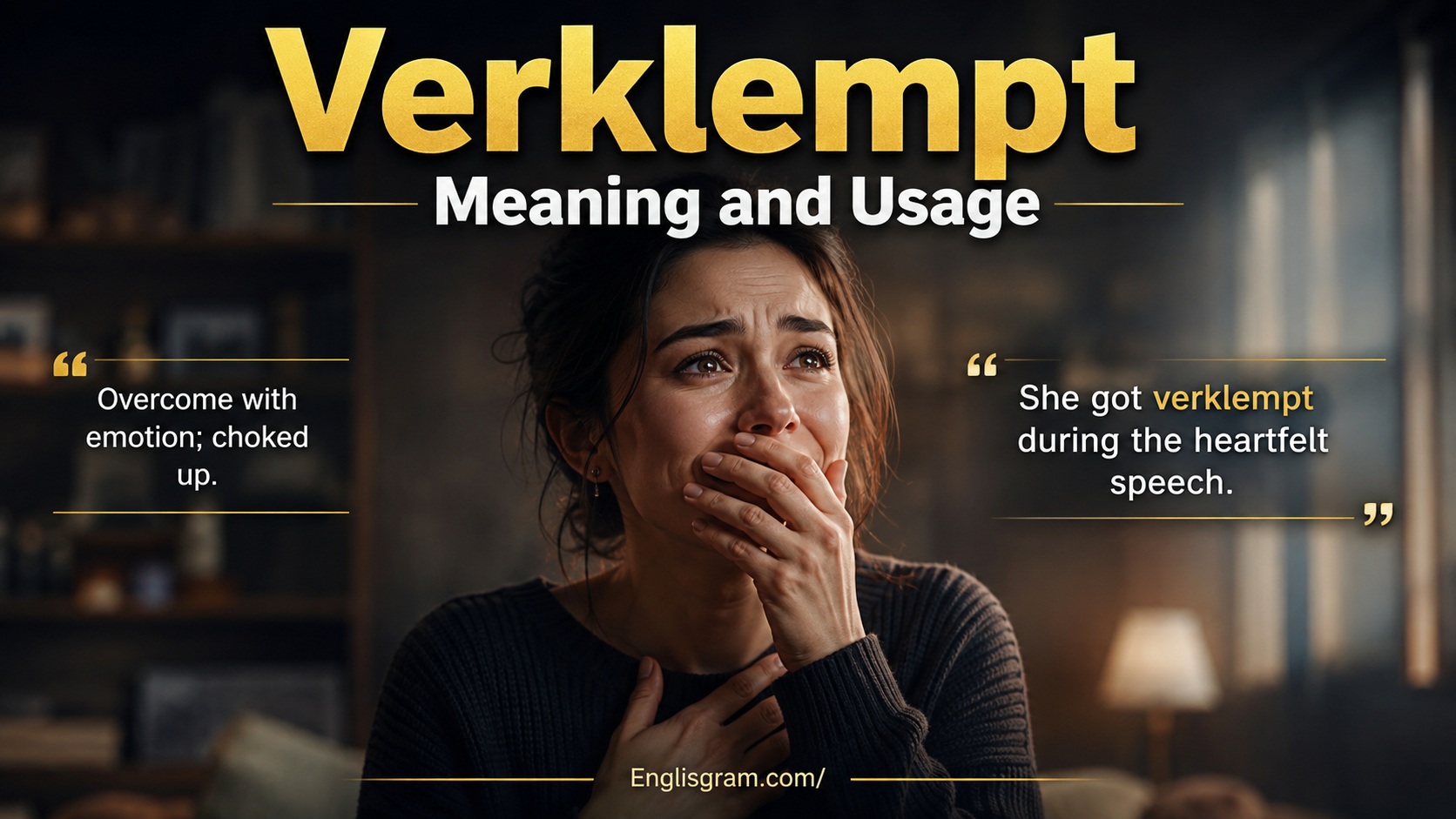
People often discover Verklempt Meaning and Usage when reading about unusual English expressions with Yiddish roots. In my experience, this Yiddish-derived term is far richer than simply saying someone is sad. Its history, origins, and essence connect farklempt, the past tense of farklemen, with the German verb verklemmen, meaning to grip, press, or squeeze. Some experts even link it to Old English words such as clam and clom, reflecting a bond, fetter, and linking of language, culture, and time.
The word describes a strong feeling or emotion that leaves someone speechless as they try to regain composure after happiness, pride, grief, nostalgia, a wedding, breakup, graduation, reunion, or retirement party. Because this emotional reaction is universal, it has become part of the English vernacular and fits naturally into daily life.The expression became more popular through media, writers, millennials, and famous names such as Barbara Streisand, Oprah, and Trump.
It has appeared in TV shows, a Bachelor-style reality show, and publications including the Huffington Post, Variety, and the Chicago Tribune. Many style guides have acknowledged it as an italicized example of linguistic importation. You can also find real-world examples shared by journalists, curators, and peers during cultural events like a Smithsonian exhibition. Whether people discuss an Oscar, an Oscar snub, a touching movie or movie scene, or even chat over avocado toast at breakfast, the word encapsulates and captures shock, bewilderment, joy, sadness, and a brief disconnecting moment.
Verklempt Meaning in Simple Words
In simple English, verklempt means:
- emotionally stirred up
- choked up
- too moved to speak easily
- full of feeling
- briefly overwhelmed by emotion
It usually appears in situations where emotion is positive or tender, though it can also appear during sad moments.
A useful shortcut is this:
If emotion makes your voice wobble, your throat tighten, or your words get stuck, you may be verklempt.
That said, the word is often used with a bit of humor too. Someone might say it lightly even when they are not truly on the edge of tears. Tone matters.
Verklempt Pronunciation and Spelling
The pronunciation is usually given as:
ver-KLEMPT
It has two main beats. The stress falls on the second syllable.
A few pronunciation tips:
- Say the first part softly: ver
- Hit the middle harder: KLEM
- End with a crisp pt sound
People sometimes misread it as something like “ver-clempt” or “ver-klemp.” Those versions are understandable in casual speech, but the common pronunciation keeps the middle sharp and clear.
The spelling can also feel unusual at first. That is normal. It comes from Yiddish, so it does not follow the most familiar English spelling patterns.
Origin of Verklempt
Verklempt comes from Yiddish, a language with deep roots in the Jewish communities of Central and Eastern Europe. Many Yiddish words have entered American English over time, especially in cities where Jewish culture helped shape everyday speech.
The original sense of the word is tied to being emotionally squeezed up, blocked, or constricted. That is why it feels so exact. It suggests more than a general mood. It suggests pressure inside the throat and chest, almost as if emotion has physically closed in.
That image is powerful. It is one reason the word survived.
Yiddish has contributed many lively English words that people use for tone, personality, or emotion. Verklempt fits that group perfectly. It adds flavor without needing a long explanation.
Why Verklempt Has Stuck Around in English
Not every borrowed word lasts. Some sound awkward outside their original setting. Verklempt did the opposite. It found a place because it does something English needed.
English has many words for emotion, but not all of them feel personal, textured, or conversational. Emotional is broad. Tearful focuses on tears. Speechless focuses on silence. Overwhelmed can be emotional, practical, or stressful.
Verklempt sits in a sweet spot. It describes emotional blockage with personality.
It feels especially natural in:
- storytelling
- family conversations
- comedy
- memoir writing
- heartfelt speeches
- informal speech
That flexibility keeps it alive.
What Verklempt Really Feels Like
The best way to understand verklempt meaning is to think about what it feels like in the body and mind.
A person who is verklempt may:
- pause mid-sentence
- swallow hard
- feel a lump in the throat
- blink back tears
- smile while trying not to cry
- laugh nervously because the feelings are too strong
- struggle to find words
The feeling is rarely flat. It often includes several emotions at once.
For example, someone at a wedding may feel:
- joy for the couple
- nostalgia about their own life
- pride in their child
- gratitude for the moment
- a little sadness because time passes quickly
That mix is classic verklempt territory.
When to Use Verklempt
You should use verklempt when emotion is strong enough to affect speech, but the moment still feels warm, human, or personal.
Here are situations where it fits well:
- a wedding toast
- a graduation speech
- a retirement party
- a family reunion
- a surprise birthday celebration
- a touching movie scene
- a heartfelt interview
- a reunion after a long absence
- a proud parent moment
- a sentimental memory
It works best when the feeling is real and vivid.
A simple rule for using verklempt
If you could say, “I got a little choked up,” then verklempt may also work.
If the moment is more clinical, formal, or detached, another word may fit better.
When You Should Not Use Verklempt
Even though verklempt is a wonderful word, it is not perfect for every setting.
It may feel out of place in:
- formal business writing
- legal documents
- scientific reports
- technical manuals
- highly serious news writing
- very plain professional communication
For example, in a report about workplace feedback, saying “the team was verklempt” would sound strange. In that case, moved, emotional, or overcome would probably be better.
The word also may not fit when the emotion is not warm or tender. If someone is stressed, angry, or panicked, verklempt is usually not the cleanest choice.
Verklempt in a Sentence
Here are different ways to use the word naturally.
Everyday examples
- She got verklempt when her son gave the speech.
- I was a little verklempt after hearing that story.
- He looked verklempt when he thanked his parents.
- The bride’s father got verklempt during the vows.
- I always get verklempt at that final scene.
More conversational examples
- Don’t mind me. I’m just a little verklempt.
- That message left me totally verklempt.
- She tried to speak, but she was verklempt.
- I thought I was fine until I got verklempt halfway through the toast.
- He gets verklempt every time he talks about his grandmother.
Light, humorous examples
- The dog came home after a week away and I got verklempt.
- I was verklempt over a cup of coffee and a kind text. It was that kind of day.
- That old photo made me verklempt in under five seconds.
These examples show an important point: verklempt is flexible, but it still keeps an emotional core.
Verklempt in Dialogue
Words often become easier to understand when you see them in conversation.
Family conversation
“Why are you quiet?”
“I’m fine. I just got a little verklempt during the speech.”
Friend conversation
“You’re tearing up.”
“I know. Don’t laugh. This is a verklempt moment.”
Workplace conversation
“How was the retirement party?”
“Honestly? Pretty verklempt. The whole room was emotional.”
These examples show how people use the word naturally. It sounds informal, expressive, and slightly playful.
Verklempt Meaning Compared With Similar Words
The word is often confused with nearby terms. They overlap, but they are not identical.
| Word | Core Meaning | How It Differs From Verklempt |
| Emotional | Full of feeling | Broader and less specific |
| Choked up | Temporarily unable to speak because of feeling | Very close in everyday use |
| Moved | Touched by emotion | Softer and less vivid |
| Overwhelmed | Emotionally or mentally flooded | Can be positive or negative |
| Tearful | Close to crying | Focuses on tears more than speech |
| Speechless | Unable to speak | Not always emotional |
| Sentimental | Warmly emotional about memories | More memory-based |
The difference between verklempt and choked up
These two are close cousins.
Choked up is more common in everyday speech. It is direct and easy to understand.
Verklempt feels richer and more distinctive. It often carries a stronger emotional color and a little more personality.
A person can be choked up without sounding dramatic.
A person who is verklempt usually sounds more emotionally involved, and often a little more expressive.
The difference between verklempt and overwhelmed
Overwhelmed can mean a lot of things. You can be overwhelmed with work, noise, grief, joy, responsibility, or emotion.
Verklempt is narrower. It points to emotional blockage or emotional flooding, usually with a human, intimate tone.
So while every verklempt person is emotionally overwhelmed in some sense, not every overwhelmed person is verklempt.
Is Verklempt Positive or Negative?
The word is mostly neutral, but the feeling it describes often leans positive or tender.
Positive uses
- A mother hearing her child speak at a graduation
- A friend seeing a reunion after years apart
- A parent hearing “thank you” from a grown child
Sad uses
- A farewell after loss
- A memory of someone no longer present
- A moment of emotional reflection
Mixed uses
- Pride with sadness
- Joy with nostalgia
- Gratitude with tears
This mix is what gives the word depth. It is not locked into one mood.
Is Verklempt Formal or Informal?
Verklempt is generally informal.
You will hear it in:
- casual conversation
- comedy
- storytelling
- family settings
- interviews
- social media captions
- entertainment writing
It can appear in polished writing too, especially when a writer wants voice and warmth. Still, it usually sounds more natural in speech than in stiff formal prose.
That is part of its charm. It feels like a word people say when they mean it, not when they are trying to sound impressive.
Common Situations That Make People Verklempt
There are certain moments that practically invite the word.
| Situation | Why It Triggers Verklempt Feelings |
| Wedding vows | Love, memory, and emotional commitment |
| Graduation speeches | Pride and the sense of a chapter ending |
| Military homecoming | Relief, joy, and deep reunion |
| Retirement parties | Appreciation and the weight of time |
| Family reunions | Nostalgia and shared history |
| Baby announcements | Joy and emotional surprise |
| Farewell moments | Tenderness and parting sadness |
| Awards speeches | Gratitude and public emotion |
These moments have one thing in common: they connect people to something bigger than the immediate room.
A Few Realistic Case Studies of Verklempt Usage
Case study: the wedding toast
A man stands to toast his sister at her wedding. He starts with a joke, but his voice changes halfway through. He looks at her, pauses, and laughs through the emotion.
“I’m getting verklempt,” he says.
That works because the moment is real, warm, and personal. The word fits the room.
Case study: the graduation stage
A mother watches her son walk across the stage. She has held herself together all day, but when he spots her and smiles, her eyes fill up.
Later she says, “I was totally verklempt.”
Again, the word fits because it describes a strong emotional response that affects speech.
Case study: the reunion video call
An older woman sees her childhood friend on video for the first time in decades. They both laugh, cry, and interrupt each other.
One of them says, “I can’t even talk. I’m verklempt.”
That usage feels natural because the emotion is immediate and strong.
Verklempt in Pop Culture and Casual Speech
People often hear verklempt in comedy or sentimental storytelling. It has a slightly theatrical sound, which makes it useful for humor as well as emotion.
A speaker might use it to describe:
- a touching family moment
- a sentimental memory
- a dramatic pause in conversation
- a funny exaggeration of being emotional
This dual life matters. Some words stay serious all the time. Verklempt can do both. It can be sincere or lightly comic depending on delivery.
That gives it unusual range.
Common Mistakes People Make With Verklempt
Even though the word is simple once you know it, people still make a few errors.
Mistake: using it for ordinary stress
Wrong:
- I was verklempt because my inbox was full.
Better:
- I was overwhelmed because my inbox was full.
Mistake: using it for anger
Wrong:
- He was verklempt after the argument.
Better:
- He was upset or angry after the argument.
Mistake: using it in a stiff, official tone
Wrong:
- The project manager was verklempt during the budget review.
That sounds odd unless it is being used playfully or in quoted speech.
Mistake: thinking it always means crying
Not true. A person can be verklempt without actually crying. Sometimes the voice catches before the tears fall.
What Makes Verklempt a Strong Word
A strong word does more than label a feeling. It creates a scene.
Verklempt gives you all of this at once:
- emotion
- speech trouble
- vulnerability
- warmth
- intimacy
- a hint of humor
- a touch of cultural color
That is a lot of work for one word.
It does not just say someone is emotional. It shows the emotional pressure building in the body.
That is why writers and speakers like it. It paints fast, and it paints well.
FAQS
What does verklempt mean?
Verklempt means feeling so emotionally overwhelmed that it becomes difficult to speak clearly. People often use it when they feel touched, proud, joyful, or tearful.
Is verklempt an English word?
The word comes from Yiddish, but it has become widely accepted in English conversation, media, and writing. Many English speakers recognize and use it naturally.
When should I use the word verklempt?
You can use verklempt when describing moments filled with strong emotions, such as weddings, graduations, reunions, retirement parties, heartfelt speeches, or emotional movie scenes.
Is verklempt only used for sadness?
No. Although it can describe sadness, verklempt also expresses happiness, pride, gratitude, nostalgia, surprise, or any emotion that leaves someone briefly speechless.
How do you pronounce verklempt?
A common pronunciation is vur-KLEMPT (IPA: /vərˈklɛmpt/). The second syllable is stressed, and the word is spoken as a single, smooth expression.
Conclusion
Understanding Verklempt Meaning and Usage helps you recognize a word that expresses far more than ordinary emotion. Its Yiddish roots, rich history, and widespread use in modern English make it a vivid way to describe moments when feelings become too powerful for words. Whether you encounter it in books, conversations, movies, or news stories, verklempt adds warmth, personality, and precision to emotional expression. Using it correctly can make your writing and speech sound more natural, engaging, and memorable.