Foul or Fowl – What’s the Difference and learn how these homophones create confusion through different meanings, spellings, and context in English. When studying word origins and their uses, the foul and fowl difference becomes a useful example of how homophones can confuse readers.
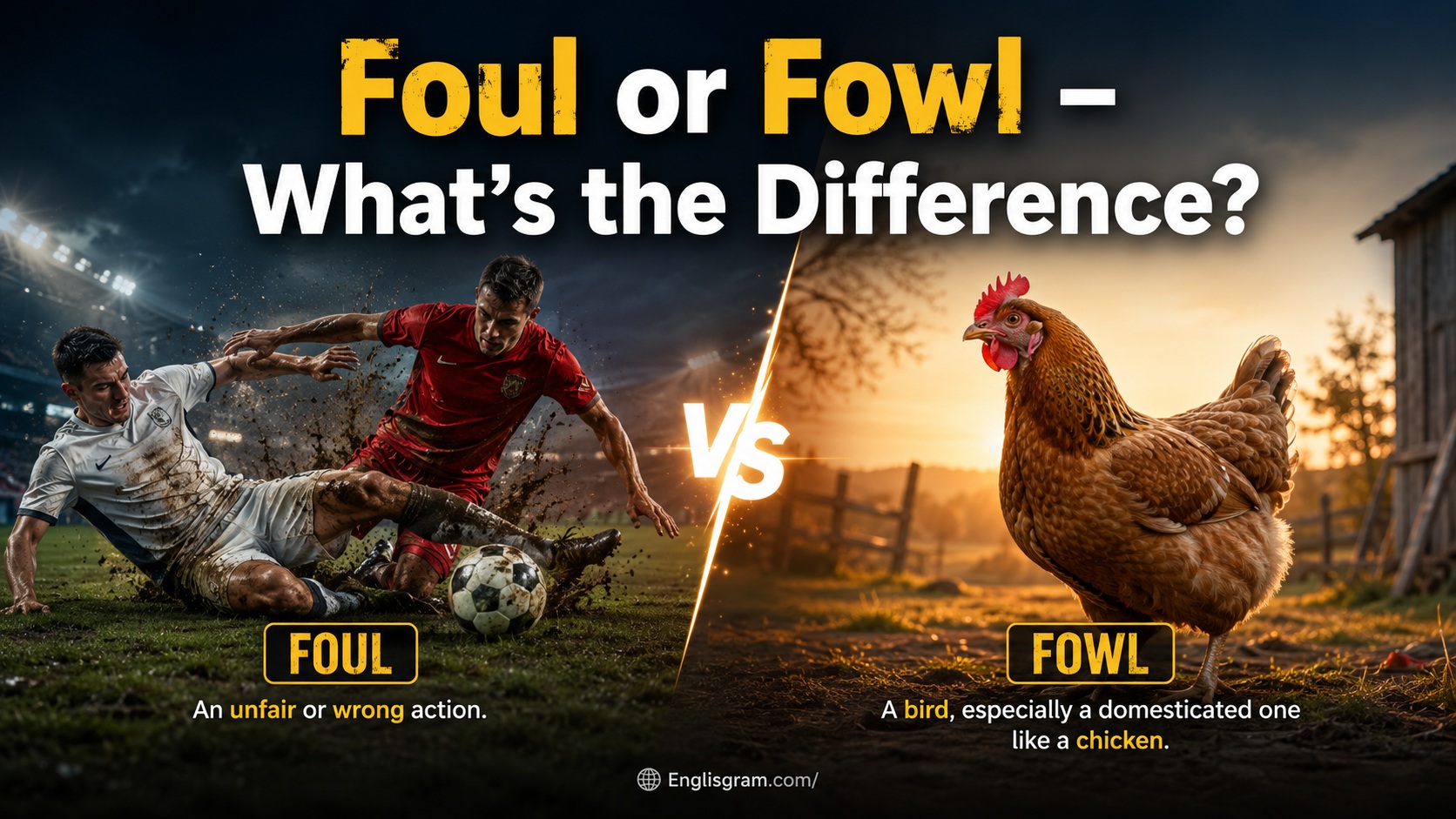
These words have the same sound but completely different meanings and spellings. In English, the correct phrase depends on the context because foul refers to something offensive, disgusting, or dirty and can describe actions that are not in accordance with rules, particularly in sports.
Meanwhile, fowl is a noun that pertains to birds, especially those raised for eggs and meat, including chickens and ducks.During the early days of learning language, many learners became puzzled because these words were sharing one sound. A person may have heard about a foul move in a game and later see fowl mentioned on a farm, creating a mix of meanings.
Foul vs. Fowl – The Key Difference at a Glance
Here’s the fastest way to understand these commonly confused words.
| Feature | Foul | Fowl |
| Meaning | Something unpleasant, dirty, offensive, unfair, or against the rules | A bird, especially one raised for food or hunting |
| Part of Speech | Adjective, noun, verb | Noun |
| Pronunciation | /faʊl/ | /faʊl/ |
| Common Contexts | Sports, weather, smells, behavior, pollution | Farming, cooking, wildlife, birds |
| Example | That was a foul tackle. | The farmer keeps fowl on his land. |
Quick Rule
- Foul = Bad, dirty, unfair, offensive
- Fowl = Bird
If you’re talking about rules, smells, language, weather, or behavior, choose foul.
If you’re talking about birds, choose fowl.
What Does “Foul” Mean?
The word foul has several meanings. Even though they look different at first, they all share one idea: something unpleasant or wrong.
Modern English uses foul to describe bad smells, offensive language, unfair actions, polluted environments, and violations in sports. It can even function as a verb or noun depending on the sentence.
Definition
Foul generally means:
- Dirty
- Offensive
- Rotten
- Unfair
- Against the rules
- Polluted
- Morally wrong
Origin and Etymology
The word comes from the Old English word fūl, meaning filthy, rotten, corrupt, or unclean. Over time, English speakers expanded its meaning to include unethical behavior, bad weather, and sports violations.
Common Meanings of Foul
Unpleasant or Offensive
Examples:
- The garbage produced a foul smell.
- His foul language shocked everyone.
- The water became foul after the flood.
Against the Rules
Sports officials call a foul whenever a player breaks the rules.
Examples:
- The referee called a personal foul.
- She committed a foul during the final minute.
Dirty or Polluted
Examples:
- The river became foul after the chemical spill.
- Smoke filled the room with foul air.
Morally Wrong
Examples:
- Police suspected foul play.
- The company used foul tactics.
What Does “Fowl” Mean?
Unlike foul, the word fowl has only one primary meaning.
It refers to birds, especially those raised for food or hunted for sport.
Definition
Fowl means:
- Domestic birds
- Poultry
- Certain wild birds
Origin and Etymology
The word comes from the Old English word fugol, which originally referred to birds in general. Today, the meaning has narrowed and usually describes domestic or game birds.
Types of Fowl
Common examples include:
- Chickens
- Ducks
- Turkeys
- Geese
- Pheasants
- Quail
Everyday Examples
- Farmers raise fowl for eggs.
- Wild fowl migrate every winter.
- Roast fowl remains popular during holidays.
Read More:Masonary vs Masonry – Which is Correct?
Foul vs. Fowl: Side-by-Side Comparison
| Question | Foul | Fowl |
| Refers to birds? | ||
| Used in sports? | ||
| Means dirty? | ||
| Means poultry? | ||
| Can describe behavior? | ||
| Used in cooking? | Sometimes (bad food) | Yes |
When to Use “Foul”
The easiest way to choose foul is to ask yourself whether something seems unpleasant, unfair, or illegal.
Sports
Examples:
- A flagrant foul
- Personal foul
- Technical foul
- Offensive foul
Officials use the word because a player violated the game’s rules.
Everyday Conversations
People often say:
- foul mood
- foul smell
- foul language
- foul temper
These phrases describe negative situations.
Environmental Contexts
Examples include:
- foul water
- foul air
- foul pollution
The word suggests contamination.
Legal Writing
One common phrase appears in police reports:
Foul play
It means authorities believe someone intentionally caused harm instead of an accident.
When to Use “Fowl”
Choose fowl whenever you’re discussing birds.
Talking About Birds
Examples:
- Domestic fowl
- Wild fowl
- Waterfowl
Cooking
Recipes sometimes use fowl instead of poultry, especially in traditional writing.
Example:
- Roast fowl with herbs
Agriculture
Farmers often refer to chickens, ducks, and turkeys collectively as fowl.
Wildlife
Wildlife experts commonly discuss:
- Waterfowl migration
- Game fowl
- Native fowl species
Is “Foul” an Adjective, Noun, or Verb?
One reason foul causes confusion is that it performs several jobs.
As an Adjective
Examples:
- foul smell
- foul weather
- foul language
As a Noun
Examples:
- The referee called a foul.
- That foul changed the game.
As a Verb
Examples:
- Oil fouled the river.
- Seaweed fouled the boat’s propeller.
Is “Fowl” a Noun?
Yes.
Unlike foul, fowl functions almost exclusively as a noun.
Examples:
- One fowl
- Several fowl
- Many fowls
Sometimes fowl acts as a collective noun, much like fish.
Common Phrases and Idioms with “Foul”
Several English expressions use foul.
| Phrase | Meaning |
| Foul play | Criminal or dishonest action |
| Foul language | Offensive words |
| Foul odor | Bad smell |
| Foul weather | Stormy weather |
| Foul mood | Irritable attitude |
| Foul up | Make a mistake |
| Fair or foul | By honest or dishonest means |
Examples
- Police ruled out foul play.
- The kitchen had a foul odor.
- He apologized for using foul language.
Common Expressions Using “Fowl”
Popular expressions include:
- Domestic fowl
- Wild fowl
- Waterfowl
- Game fowl
These terms appear frequently in farming, biology, and hunting.
Foul vs. Fowl in Sports
Sports never use fowl.
Only foul applies because it describes a rule violation.
Examples:
- Basketball foul
- Soccer foul
- Baseball foul ball
- Boxing foul blow
Whenever someone breaks the rules, choose foul.
Foul vs. Fowl in Cooking and Food
The word fowl often appears in older recipes, restaurant menus, and culinary writing.
Examples include:
- Roast fowl
- Game fowl
- Domestic fowl
Meanwhile, foul describes spoiled food.
Example:
“The milk smelled foul.”
Why Do People Confuse Foul and Fowl?
Several reasons explain the confusion.
- They sound identical.
- They differ by only one letter.
- Both are common English words.
- Many spell-checkers can’t catch the mistake because both spellings are correct.
This makes context your best guide.
Memory Tricks to Remember the Difference
These simple tricks work well.
Trick One
Fowl contains “owl.”
An owl is a bird.
Bird = Fowl
Trick Two
Foul begins with Fou-, reminding many learners of foul smell.
Bad smell = Foul
Trick Three
Think of sports.
Referees call a foul, not a fowl.
Common Mistakes to Avoid
| Incorrect | Correct |
| The referee called a fowl. | The referee called a foul. |
| The farmer raises foul. | The farmer raises fowl. |
| The soup tasted fowl. | The soup tasted foul. |
| Ducks are foul. | Ducks are fowl. |
Real-Life Examples of Foul and Fowl
At School
“The basketball player committed a foul.”
At Home
“The refrigerator produced a foul odor.”
On the Farm
“The fowl wandered around the yard.”
During Dinner
“The restaurant specializes in roasted fowl.”
In the News
“Investigators found no evidence of foul play.”
Foul vs. Fowl in American and British English
American English and British English treat these words almost identically.
The meanings remain the same.
The biggest difference is frequency.
American speakers usually say chicken or poultry instead of fowl in everyday conversation. British English also favors specific bird names outside formal, agricultural, or culinary contexts.
Synonyms of “Foul”
Depending on context, suitable alternatives include:
| Meaning | Synonyms |
| Bad smell | Stinky, putrid, rancid |
| Dirty | Filthy, grimy, polluted |
| Offensive | Vulgar, obscene, abusive |
| Unfair | Illegal, dishonest, unjust |
| Bad weather | Stormy, rough, harsh |
Synonyms of “Fowl”
Possible alternatives include:
- Bird
- Poultry
- Chicken
- Waterfowl
- Game bird
- Domestic bird
- Avian species
Choose the synonym that best fits the context.
Antonyms of “Foul”
Common opposites include:
- Clean
- Fair
- Honest
- Pleasant
- Pure
- Fresh
- Fragrant
Words Commonly Confused with Foul and Fowl
Many English homophones create similar problems.
| Word Pair | Difference |
| Foul vs Fair | Bad vs honest |
| Fowl vs Poultry | General bird category vs birds raised for food |
| Bird vs Fowl | Bird is broader |
| Foul vs Fall | Different pronunciation and meaning |
Practice Quiz
Choose the correct word.
Questions
- The referee called a ______.
- The kitchen had a ______ smell.
- The farmer keeps ducks and other ______.
- Police found no evidence of ______ play.
- Wild ______ migrate south every winter.
Answers
- foul
- foul
- fowl
- foul
- fowl
Quick Recap
Here’s the simplest way to remember the difference.
| Foul | Fowl |
| Bad smell | Bird |
| Dirty | Poultry |
| Offensive | Waterfowl |
| Illegal in sports | Domestic birds |
| Unfair behavior | Wildlife |
Whenever you’re unsure, ask one question:
Am I talking about something bad or about a bird?
If it’s bad, use foul.
If it’s a bird, use fowl.
FAQs
1. What is the main difference between foul and fowl?
The main difference is their meaning and usage. Foul describes something unpleasant, wrong, dirty, or against rules, while fowl refers to birds, especially domestic birds raised for food.
2. Are foul and fowl homophones?
Yes, foul and fowl are homophones because they have the same pronunciation but different spellings and meanings.
3. How can I remember the difference between foul and fowl?
A simple memory trick is to connect fowl with flying birds because it contains the word idea of birds. Use foul for bad smells, offensive actions, or rule-breaking situations.
4. Can foul be used in sports?
Yes, foul is commonly used in sports when a player breaks the rules, such as a foul move or a foul action during a game.
5. Is fowl only used for chickens?
No, fowl includes different birds, but it is commonly used for domestic birds such as chickens, ducks, and other birds raised for eggs or meat.
Conclusion
Understanding the difference between foul and fowl becomes simple when you focus on context, meaning, and spelling. Although these two homophones have the same sound, they represent completely different ideas. Foul is connected with something offensive, dirty, or a violation of rules, especially in sports, while fowl refers to birds like chickens and ducks raised for eggs and meat. By practicing examples and using simple memory tricks, you can avoid common spelling mistakes and confidently choose the correct word in your writing, conversations, and everyday sentences.