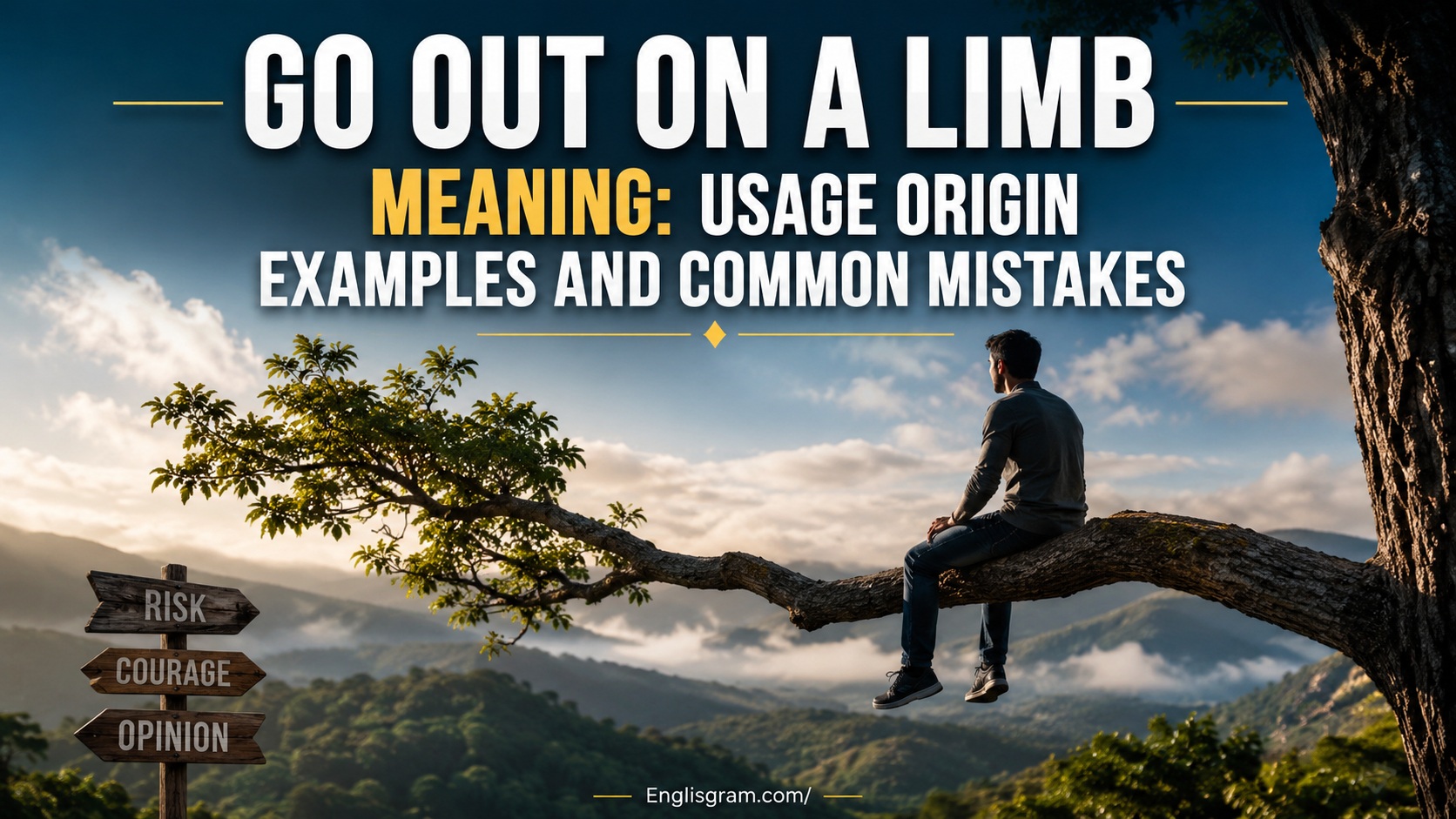
Go Out on a Limb Meaning shows how one simple idiom uses a tree image to explain risk communication and confident choices. When you first come across Go Out on a Limb the phrase may sound unusual because its literal words describe someone climbing a tree leaving the sturdy trunk for a branch moving toward the edge of a fragile branch instead of remaining on safer branches.
The idiom meaning Meaning and overall expression come from a figurative sense not a literal way. It is a common expression famous term popular English idiom valuable expression and descriptive phrase used in English American English formal English casual English everyday English and everyday language.
Through figurative language figurative expressions colorful phrases natural phrases and different meanings it strengthens communication everyday communication communication abilities dialogue speech daily speech conversation conversations office conversations
Go Out on a Limb Meaning
Simple definition
Go out on a limb means to take a risk by saying something bold unpopular or uncertain. It often means you are sticking your neck out by giving an opinion or prediction that may not be safe or fully supported.
In simple English:
- You make a claim before you are fully sure.
- You support an idea that others may not agree with.
- You take a personal or professional risk by speaking up.
The phrase often appears when someone says:
- “I’ll go out on a limb and say this is the best movie of the year.”
- “She went out on a limb by defending the new policy.”
- “I’m going out on a limb here but I think the deal will fall through.”
In each case the speaker is not pretending to know everything. Instead they are making a bold statement while admitting some uncertainty.
Literal vs. figurative meaning
Literally a limb is a branch of a tree. If you climb far out on a branch you get farther away from the trunk. That part of the tree is thinner and less stable. The farther you go the more dangerous it becomes.
Figuratively the idiom describes the same idea in human life. The “tree branch” becomes a risk and the “trunk” becomes the safe position. When you move away from safety you are “going out on a limb.”
That image is powerful because it is easy to understand. Even someone hearing the phrase for the first time can guess the meaning from the picture alone.
What the phrase really suggests
This idiom usually suggests one or more of these ideas:
- Uncertainty: You are not completely sure.
- Courage: You still speak up anyway.
- Risk: You could be wrong or criticized.
- Confidence: You believe your opinion is worth sharing.
- Exposure: You may have something to lose if the guess fails.
That mix is exactly why the phrase feels so useful. It sits in the space between caution and boldness.
The Origin of Go Out on a Limb
The tree branch image behind the idiom
The origin of go out on a limb comes from the literal danger of climbing a tree. If you climb too far out on a branch you leave the sturdy part of the tree behind. The branch may bend or break. You are no longer on solid ground.
That physical danger became a metaphor for social and mental risk. Over time people started using the image to describe someone who takes a chance with their words or actions.
Why the idiom stuck
The phrase survived because the image is vivid. It is short. It is easy to remember. And it works in many situations.
Other idioms lose their power because they sound too old or too tied to one setting. This one stayed useful because risk is a universal human experience. People take chances at work in relationships in sports in politics and in daily conversation.
How the meaning evolved
The phrase once may have felt more physical. Today it is mostly figurative. When someone says “I’m going out on a limb” they are rarely talking about trees. They are usually talking about:
- an opinion
- a guess
- a defense of someone else
- a business decision
- a bold prediction
That shift from literal danger to social or professional risk is what gives the idiom its modern strength.
When to Use Go Out on a Limb
In everyday conversation
This idiom works naturally when you are talking casually with friends family or coworkers. It sounds relaxed and human.
You might say:
- “I’m going out on a limb here but I think she’s upset.”
- “He went out on a limb and guessed the ending before anyone else.”
- “Let me go out on a limb and say this plan won’t work.”
It adds personality to speech without sounding too formal.
In the workplace
The phrase is especially useful in meetings brainstorming sessions and strategy discussions. It can signal that you are about to share an idea that is not fully proven yet.
For example:
- “I’m going out on a limb but I think customers will respond better to a simpler design.”
- “She went out on a limb by recommending a complete overhaul of the system.”
- “We may be going out on a limb if we launch before testing is finished.”
In business settings the phrase often softens a bold opinion. It shows confidence without sounding arrogant.
In writing and commentary
Writers analysts and commentators use this phrase when they want to make a prediction or offer a strong view without claiming certainty.
It can work well in:
- opinion columns
- blog posts
- interviews
- reviews
- business analysis
- sports commentary
A sentence like “I’ll go out on a limb and predict a tight election” tells the reader that the speaker is making a reasoned guess not stating a hard fact.
Why people use it
People often choose this idiom because it does several jobs at once:
- It admits uncertainty.
- It adds style.
- It makes speech sound natural.
- It shows bravery or conviction.
- It keeps the tone conversational.
That is a strong combination. No wonder the phrase has lasted so long.
When You Should Not Use Go Out on a Limb
When facts matter more than opinion
If you are giving exact information this idiom may weaken your message. It signals uncertainty which can be a bad fit when precision matters.
Avoid it when you need to sound firm in situations like:
- legal statements
- technical reports
- safety instructions
- scientific writing
- financial disclosures
In those settings people want clarity not a casual risk marker.
When the context is too serious
This idiom can sound too light if the topic is sensitive. For example if you are talking about someone’s health a legal matter or a major crisis the phrase may feel off.
A phrase like “I’m going out on a limb and saying this case will settle soon” might sound careless in a formal legal context. A more direct phrase would be better.
When you need maximum credibility
Sometimes you want to sound measured and authoritative. In that case it is better to use plain language.
Instead of:
- “I’m going out on a limb and saying this is the best solution.”
Try:
- “Based on the evidence this appears to be the best solution.”
That version sounds more direct and less speculative.
Read More:What Are Conjunctive Adverbs? Definition, Rules, Examples, and Easy Usage Guide
Examples of Go Out on a Limb in Sentences
Here are real-feeling examples that show how the idiom works in different settings.
| Context | Example Sentence | What It Means |
| Casual conversation | “I’m going out on a limb here but I think he forgot the meeting.” | The speaker is making a guess |
| Workplace | “She went out on a limb by recommending the new supplier.” | She took a risk by supporting the idea |
| Sports | “I’ll go out on a limb and say the home team wins by two goals.” | The speaker is making a bold prediction |
| Opinion writing | “I’m going out on a limb but this is the strongest album of the year.” | The writer is expressing a risky opinion |
| Debate | “He went out on a limb when he defended the unpopular policy.” | He took a stand that might bring criticism |
| Everyday life | “I’d go out on a limb and guess you’re tired after that trip.” | The speaker is making an educated guess |
A few more natural examples
- “I’m going out on a limb but I think the manager already knows.”
- “She went out on a limb to support a colleague she barely knew.”
- “He always goes out on a limb when he believes in an idea.”
- “I don’t want to go out on a limb but this feels like the wrong move.”
- “They went out on a limb and launched the product early.”
Notice how the phrase often appears with words like think say guess predict or support. That is because the idiom usually involves a judgment call.
Go Out on a Limb in Real-Life Situations
Case study: a team meeting
A marketing team is discussing whether to change a brand slogan. Most of the team likes the old one because it feels safe. One employee says “I’m going out on a limb here but I think the old slogan makes the brand sound dated.”
That sentence does two things at once. It shows the speaker knows the opinion may not be popular. It also invites discussion instead of forcing agreement.
This is a great example of how the idiom works in real life. It softens the risk while still making the point strong.
Case study: a sports prediction
A commentator says “I’ll go out on a limb and say the underdog wins tonight.”
The speaker is not claiming certainty. In fact the phrase signals the opposite. The prediction is bold enough to stand out but the speaker is leaving room to be wrong.
That balance is part of the charm. The phrase makes the statement more interesting than a plain guess.
Case study: defending a person
A coworker may say “She went out on a limb for him when everyone else stayed silent.”
Here the phrase does not mean prediction. It means the person took a risk by supporting someone who was unpopular or under pressure.
This shows the idiom can describe both speech risks and action risks.
Go Out on a Limb vs Similar Expressions
Many idioms share the same general idea of risk but they are not identical. The differences matter.
| Expression | Meaning | Difference from Go Out on a Limb |
| Go out on a limb | Take a risk by stating an opinion or supporting an idea | Often about a bold opinion or prediction |
| Stick your neck out | Put yourself at risk by speaking or acting | Slightly more personal and vulnerable |
| Take a chance | Accept the possibility of loss or failure | Broader and less specific |
| Take a leap of faith | Act without full proof trusting the outcome | More about belief and trust |
| Put yourself on the line | Risk your reputation position or safety | Stronger and more serious |
| Roll the dice | Accept uncertainty and let chance decide | Often used for decisions with high unpredictability |
How to choose the right one
Use go out on a limb when the risk is tied to an opinion prediction or public stance.
Use stick your neck out when the person is exposing themselves to criticism or danger.
Use take a chance when the idea is broader and less about speech.
Use leap of faith when trust matters more than doubt.
That difference may seem small but in writing it matters a lot. The right idiom gives your sentence the right shade of meaning.
Synonyms and Alternative Phrases
Close synonyms
These phrases are close in meaning though not always identical:
- take a risk
- make a bold claim
- venture an opinion
- speak up
- take a stand
- put yourself on the line
- make a daring guess
Natural alternatives in conversation
Sometimes you may want to avoid repeating the same idiom. These alternatives can help:
- “I’m guessing here…”
- “This may be a stretch but…”
- “I’ll say this much…”
- “I’m willing to bet…”
- “I may be wrong but…”
These options sound more direct or more casual depending on the tone you want.
When a synonym is better
A synonym can be a better choice when:
- you want to sound less idiomatic
- you are writing for an international audience
- you need a clearer tone
- you want to avoid repetition
Sometimes plain English does the job better than a colorful phrase. There is no prize for using an idiom just because it exists.
Antonyms of Go Out on a Limb
If the phrase means taking a risk then the opposite is acting cautiously or staying safe.
Here are strong antonyms:
- play it safe
- stay on the safe side
- keep quiet
- avoid taking risks
- follow the crowd
- hold back
- stay neutral
Example contrasts
- Go out on a limb: “I’ll go out on a limb and say the project will fail.”
- Play it safe: “I’ll play it safe and wait for more data.”
The first sentence is bold. The second is careful. That contrast helps show how much tone this idiom carries.
Common Mistakes People Make
Thinking it only means physical danger
Some learners assume the phrase always refers to climbing a tree or getting hurt. That is not how most people use it today.
The modern meaning is usually about social professional or verbal risk.
Using it when there is no risk
If there is no real uncertainty the phrase can sound strange.
Weak example:
- “I’m going out on a limb and saying the sun rises in the east.”
That is not a risky opinion. It is a fact. So the idiom does not fit.
Better example:
- “I’m going out on a limb and saying the new product will beat expectations.”
That is an actual prediction.
Overusing it
Like any idiom this one loses power if you repeat it too often. If every other paragraph says “go out on a limb” the writing starts to feel forced.
Use it where it fits. Let it breathe.
Misplacing the phrase in a sentence
It usually works best with verbs like say guess predict support or recommend.
Strong examples:
- “I’m going out on a limb and saying yes.”
- “He went out on a limb to support her idea.”
Weaker example:
- “The report went out on a limb about the results.”
A report does not usually “go out on a limb.” A person does.
Is Go Out on a Limb Positive or Negative?
The answer is: it depends.
Positive use
The phrase can be positive when it shows courage originality or loyalty.
Examples:
- A manager backs a new idea.
- A friend supports someone no one else trusts.
- A writer makes a sharp prediction with confidence.
In these cases going out on a limb shows bravery.
Negative use
The phrase can also carry a negative warning. It may suggest:
- poor judgment
- unnecessary risk
- weak evidence
- overconfidence
Example:
- “He went out on a limb with a prediction that had no support.”
Here the phrase feels more doubtful.
The tone comes from context
The idiom itself is neutral. The context decides whether it sounds brave or reckless.
That is one reason it remains so useful. It can flex depending on the speaker’s intent.
FAQs
1. What does Go Out on a Limb mean?
It means taking a risk by expressing an opinion, making a prediction, or supporting an idea without being completely certain.
2. Where did the phrase Go Out on a Limb come from?
The expression originated in the United States during the late 19th century and was first used in political writing before becoming a common English idiom.
3. Is Go Out on a Limb a positive or negative idiom?
It can be either. It often describes courage and confidence, but it can also refer to taking a risk that may not succeed.
4. Can I use Go Out on a Limb in professional writing?
Yes. It is suitable for business discussions, meetings, academic writing, journalism, and everyday communication when talking about taking a calculated risk or expressing an uncertain opinion.
5. What is an example sentence using Go Out on a Limb?
I’ll go out on a limb and say this project will become our most successful one this year.
Conclusion
Go Out on a Limb Meaning reminds us that taking a chance is sometimes necessary for growth. This idiom is commonly used when someone shares an opinion, makes a prediction, or supports an idea without complete certainty. Understanding its history, figurative meaning, and real-life use helps you recognize it in everyday conversations, writing, and professional settings. Once you know the context, you’ll be able to use this expression naturally and confidently.