What Are Conjunctive Adverbs help connect ideas smoothly, improve English grammar, and make every sentence clearer, stronger, and easier to follow.When I began improving my English grammar, I noticed that Conjunctive Adverbs changed the way my writing flowed. Conjunctive Adverbs Made Easy is a practical guide to this useful grammar topic because these words connect related ideas by connecting ideas across sentences.
They create an idea connection, build a logical connection, and strengthen every relationship between thoughts and your message. In plain English, they work as connectors, linking words, transition words, transitions, and discourse markers, improving sentence structure, sentence flow, flow, clarity, coherence, organization, and overall communication. Unlike coordinating conjunctions or other conjunctions, they serve different purposes and make your writing more effective.
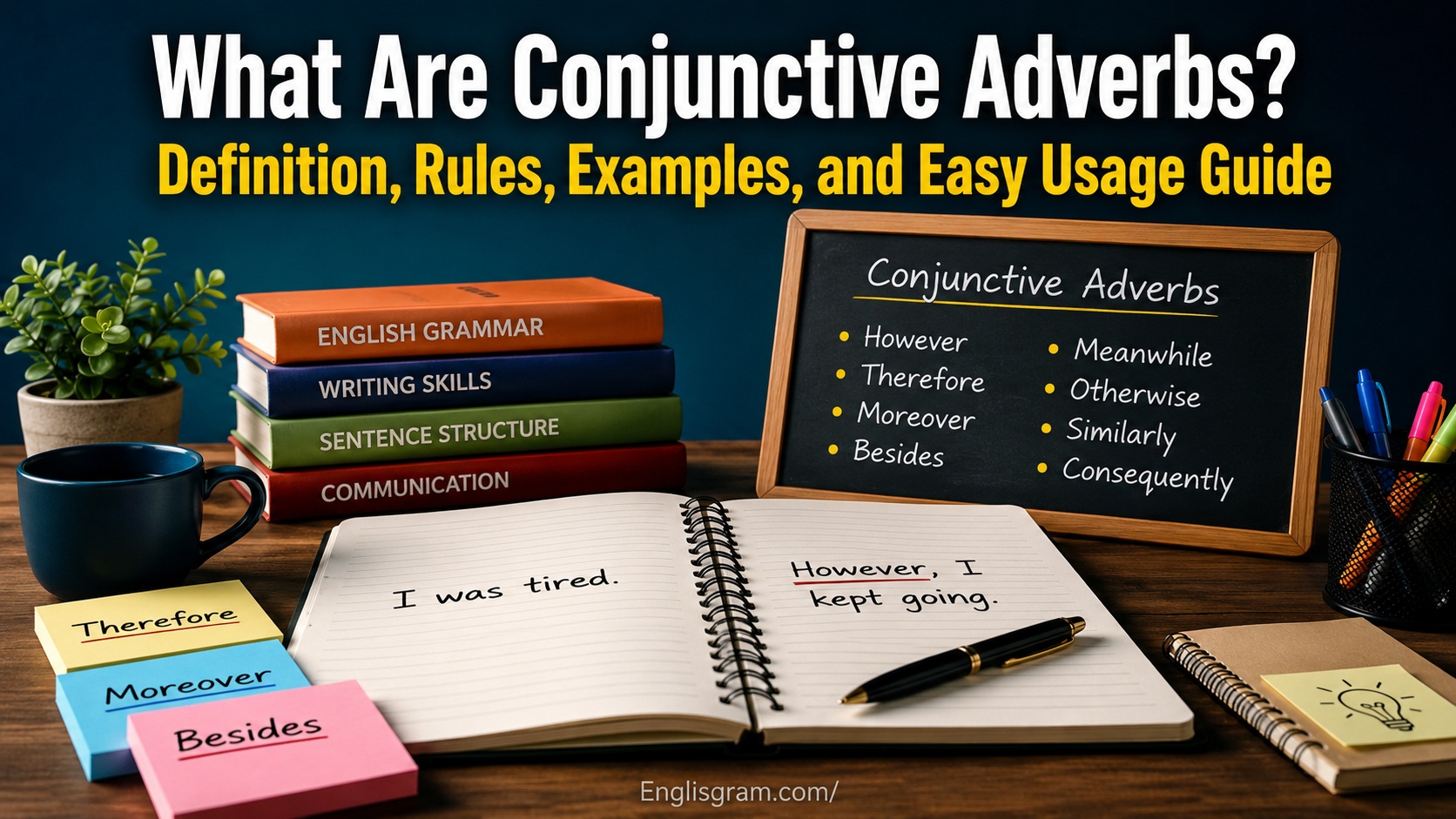
To understand this part of advanced grammar, learn common conjunctive adverbs like however, therefore, moreover, meanwhile, instead, and consequently. They express contrast, cause, effect, addition, sequence, and emphasis, helping every link become easier to follow. Using proper punctuation and correct punctuation rules makes these useful words valuable for effective writing.
What Is a Conjunctive Adverb in Grammar?
A conjunctive adverb is a word that joins two independent clauses or connects one idea to another idea in a sentence. It does not work exactly like a coordinating conjunction such as and or but. It does not behave like a subordinating conjunction either. It sits in its own lane.
That is what makes it special.
A conjunctive adverb often signals the writer’s intent. It tells the reader, “Pay attention. These two ideas are related in a specific way.” That small signal can change the whole feel of a sentence.
Here is the key point:
- An independent clause can stand alone as a sentence.
- A conjunctive adverb connects two such clauses or adds a clear transition between them.
Examples:
- The lights went out; therefore, we used candles.
- He wanted to help; however, he was too late.
- The test was difficult; still, many students did well.
Notice how the punctuation helps the sentence work. That is not decoration. It is part of the grammar.
Why Conjunctive Adverbs Matter in Writing
They do more than connect clauses. They shape meaning.
A writer can use a conjunctive adverb to:
- show contrast
- explain a result
- add information
- compare two ideas
- move a story forward
- soften or sharpen a statement
That makes them useful in essays, emails, articles, reports, and everyday writing.
A sentence like this:
The team missed the deadline. The client was unhappy.
is understandable. But this version is stronger:
The team missed the deadline; as a result, the client was unhappy.
The second sentence gives the reader the relationship immediately. No guesswork. No confusion.
That is why good writers use conjunctive adverbs carefully. They are not just grammar tools. They are clarity tools.
How Conjunctive Adverbs Work in a Sentence
Conjunctive adverbs usually appear in one of three positions:
- at the beginning of a second clause
- in the middle of a clause
- at the end of a clause in some contexts
The most common pattern is:
Independent clause; conjunctive adverb, independent clause.
Example:
- I wanted to go for a walk; however, it started raining.
This structure works because each clause can stand alone. The conjunctive adverb simply shows the connection.
Another common pattern is:
Independent clause. Conjunctive adverb, independent clause.
Example:
- I wanted to go for a walk. However, it started raining.
This version uses a period instead of a semicolon. It is perfectly correct when the writer wants a stronger pause.
You can also place the conjunctive adverb inside a sentence:
- The project was, in fact, finished early.
This kind of placement usually needs commas on both sides.
Rules for Using Conjunctive Adverbs Correctly
Many people know these words but still punctuate them wrong. That is where mistakes happen.
Use a semicolon before a conjunctive adverb when joining two independent clauses
This is the most important rule.
Correct:
- She wanted to stay longer; however, she had to leave.
Incorrect:
- She wanted to stay longer, however, she had to leave.
That second sentence uses only a comma to join two full clauses. That is a comma splice. It is a common error.
Read More:Honor or Honour: What’s the Difference? Spelling, Meaning, and Correct Usage
Use a comma after the conjunctive adverb
When the conjunctive adverb begins the second clause, place a comma after it.
Correct:
- He was tired; therefore, he went to bed early.
Correct:
- The cake looked perfect. Nevertheless, it tasted dry.
Do not confuse conjunctive adverbs with coordinating conjunctions
Words like and, but, or, so, yet, and for are coordinating conjunctions. They connect words, phrases, or clauses in a different way.
Compare:
- I was hungry, so I ate.
- I was hungry; therefore, I ate.
Both are correct, but they are not the same kind of connector.
A conjunctive adverb does not always need to connect two clauses
Sometimes it just helps move the thought forward.
Example:
- Meanwhile, the children kept playing outside.
Here, the word works as a transition. It is still useful, even though it is not joining two complete clauses in the same way.
Common Conjunctive Adverbs List
Here is a useful list of common conjunctive adverbs grouped by meaning.
Addition
These add more information.
- furthermore
- moreover
- additionally
- also
- besides
- indeed
Examples:
- The plan is affordable; moreover, it is practical.
- She is talented; besides, she works hard.
Contrast
These show opposition or exception.
- however
- nevertheless
- nonetheless
- still
- instead
- conversely
- otherwise
- yet
Examples:
- The task looked simple; however, it took all day.
- He studied little; nevertheless, he passed.
Cause and effect
These show a result or conclusion.
- therefore
- thus
- consequently
- hence
- accordingly
- as a result
Examples:
- The roads were icy; therefore, schools closed.
- The company lost money; consequently, it cut costs.
Sequence and time
These show order or timing.
- then
- next
- meanwhile
- afterward
- subsequently
- finally
Examples:
- She packed the bags; then, she locked the door.
- The chef prepared the meal; meanwhile, the guests arrived.
Comparison
These show similarity.
- similarly
- likewise
Examples:
- He loves swimming; likewise, his sister enjoys the water.
- The first draft was rough; similarly, the second needed work.
Clarification or emphasis
These strengthen or explain an idea.
- indeed
- in fact
- namely
- specifically
Examples:
- The evidence was strong; in fact, it was overwhelming.
- The trip had one goal; namely, to finish the training.
Conjunctive Adverbs Table
| Function | Common Conjunctive Adverbs | Example |
| Addition | furthermore, moreover, additionally, also | The data was useful; moreover, it was easy to read. |
| Contrast | however, nevertheless, nonetheless, still | The route was long; however, it was scenic. |
| Cause and effect | therefore, thus, consequently, hence | The alarm failed; therefore, the team missed the warning. |
| Sequence | then, next, meanwhile, afterward | She submitted the form; then she waited for a reply. |
| Comparison | similarly, likewise | He likes chess; likewise, his brother enjoys strategy games. |
| Clarification | namely, specifically, in fact | The plan had one purpose; namely, to save time. |
A table like this helps because conjunctive adverbs are easier to learn when you see their function side by side.
Examples of Conjunctive Adverbs in Sentences
Academic writing
- The experiment produced unexpected results; however, the method remained valid.
- The author made a strong argument; therefore, the theory deserves attention.
Business writing
- The proposal meets the budget requirements; moreover, it supports the company’s goals.
- The client requested a revision; accordingly, the team updated the draft.
Everyday writing
- I was running late; so, I took a taxi.
- She forgot her keys; therefore, she had to call a friend.
Formal email
- We reviewed your request; however, we need additional documents.
- The report is complete; therefore, we can move to the next step.
These examples show how flexible conjunctive adverbs are. They work in almost every type of writing.
Conjunctive Adverbs vs. Coordinating Conjunctions
This is one of the most useful comparisons to understand.
| Feature | Conjunctive Adverbs | Coordinating Conjunctions |
| Example words | however, therefore, moreover | and, but, or, so, yet |
| Connects independent clauses | Yes | Yes |
| Needs semicolon in many cases | Usually yes | No |
| Needs comma before it | Often yes when joining clauses | Often yes |
| Tone | Slightly more formal | More direct and casual |
Examples:
- It was raining; however, we still went outside.
- It was raining, but we still went outside.
Both are correct. The difference is style and punctuation.
Use but when you want a simple, direct feel. Use however when you want a more formal or polished tone.
That small choice can change the voice of the sentence.
Conjunctive Adverbs vs. Subordinating Conjunctions
These two are easy to confuse, but they are not the same.
A subordinating conjunction creates a dependent clause. Words like because, although, since, and while do this job.
Examples:
- We left because it was late.
- Although it was late, we stayed.
A conjunctive adverb, on the other hand, connects two independent clauses or transitions between ideas.
Examples:
- It was late; therefore, we left.
- The weather was cold. Nevertheless, we stayed.
The main difference is sentence structure.
- Subordinating conjunctions create dependency.
- Conjunctive adverbs show relationships between complete thoughts.
That is a big grammar distinction, even if the final meaning feels similar.
Where Can You Place a Conjunctive Adverb?
Placement matters. The sentence needs to sound smooth and look correct on the page.
At the beginning of a sentence
Example:
- However, the plan did not work.
This is common and clean. It often starts a new thought.
After a semicolon
Example:
- The plan looked solid; however, it had one weakness.
This is the classic use.
In the middle of a clause
Example:
- The plan was, in fact, stronger than expected.
When placed in the middle, the word usually gets commas on both sides.
At the end of a sentence
Less common, but sometimes possible in casual writing or dialogue:
- We were exhausted, afterward.
In most formal writing, beginning or middle placement is better.
Punctuation with Conjunctive Adverbs
Punctuation is where many writers slip.
Here are the main rules in simple form:
- Use a semicolon before the conjunctive adverb when it connects two independent clauses.
- Use a comma after the conjunctive adverb when it appears at the start of the second clause.
- Use commas on both sides when the adverb is placed in the middle of a clause.
- Use a period before the adverb if you want to start a new sentence.
Correct examples
- The forecast changed; therefore, we canceled the picnic.
- The forecast changed. Therefore, we canceled the picnic.
- The forecast was, however, not as bad as expected.
Incorrect examples
- The forecast changed, therefore, we canceled the picnic.
- The forecast changed therefore we canceled the picnic.
That first mistake is a comma splice. The second lacks proper punctuation altogether.
Good punctuation keeps the reader from stumbling.
FAQS
What are conjunctive adverbs?
Conjunctive adverbs are words that connect related ideas and show relationships such as contrast, cause and effect, addition, sequence, or emphasis between sentences or clauses.
What are some common conjunctive adverbs?
Some common conjunctive adverbs include however, therefore, moreover, meanwhile, instead, consequently, otherwise, thus, and nevertheless.
Are conjunctive adverbs the same as conjunctions?
No. Conjunctive adverbs are different from coordinating conjunctions. They connect ideas while also showing the relationship between them and usually require specific punctuation.
Why is punctuation important with conjunctive adverbs?
Proper punctuation helps readers understand the connection between ideas. Conjunctive adverbs are often used after a semicolon and before a comma when joining two independent clauses.
How can I improve my use of conjunctive adverbs?
Read well-written English, practice writing with different conjunctive adverbs, and pay attention to punctuation. Over time, you’ll use them naturally and create clearer, more polished writing.
Conclusion
What Are Conjunctive Adverbs are simple but powerful words that improve the flow and clarity of your writing. They connect ideas, show logical relationships, and make sentences easier to read and understand. By learning how to use words like however, therefore, meanwhile, and consequently with proper punctuation, you can avoid choppy writing and express your thoughts more effectively. Regular practice will help you write with greater confidence, stronger organization, and more natural English.