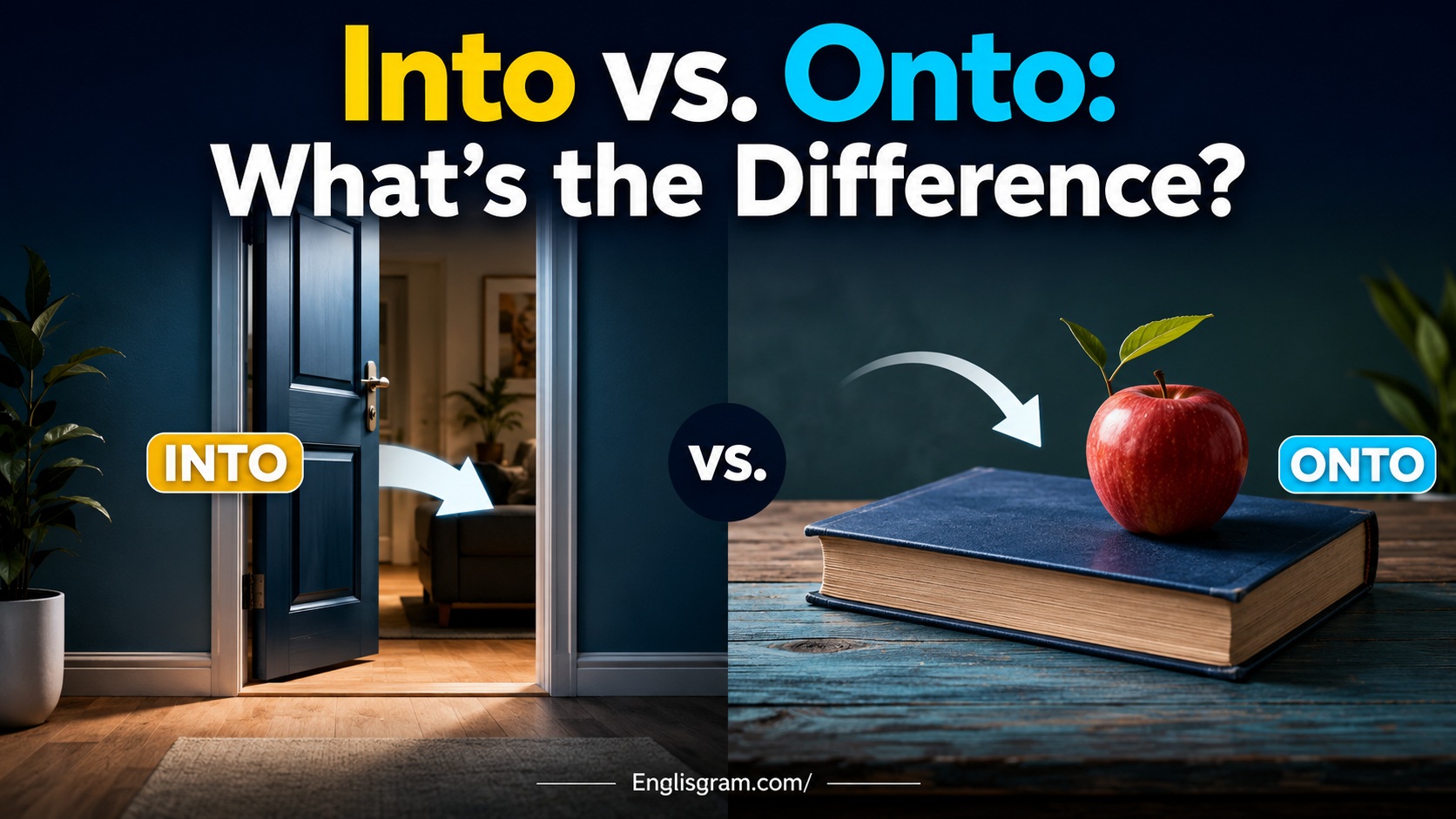
Into vs. Onto: What’s the Difference explains these small words in simple English, helping learners write with confidence every day.Many learners, native speakers, writers, researchers, and scientists struggle with Into and Onto because both prepositions describe movement, yet each has a different meaning. In English grammar, these grammar prepositions point in different directions. Into usually means entering inside a place, area, or room, while Onto describes movement toward a surface, top, or above something.
This Guide builds understanding through deep yet easy explanations so you can understand, communicate clearly, precisely, and correctly in an email, conversation, or while completing an assignment. Good communication begins with the right choice, because even tiny words can shape a sentence.Instead of memorizing definitions, focus on practical examples, comparisons, and real usage.
A person walked into a room, a cat can jump onto a bed, and someone climbed onto a roof. An object may enter a new state or condition when it turn into something else. Phrases such as get into, hold onto, and turn into show why these words are not always interchangeable. Although they appear similar, they carry distinct meanings, and using them interchangeably can cause confusion, make a sentence sound wrong or unnatural, and change the intended position, physical transition, or direction.
Into vs. Onto: The Basic Difference
The easiest way to think about the two words is this:
- Into describes movement inside a space, container, room, area, or state
- Onto describes movement onto a surface or to a position on top of something
That means the main question is not just “Where is the object going?” The better question is, “What kind of destination is it reaching?”
A door, room, box, car, pool, and tunnel often call for into because the movement ends inside something. A table, roof, stage, bed, shelf, or platform often calls for onto because the movement ends on a surface.
A simple comparison
| Word | Main idea | Typical destination | Example |
| Into | Movement inward | A space or container | She walked into the office. |
| Onto | Movement upward or toward a surface | A top or surface | She stepped onto the stage. |
That table gives the short answer. Still, the real value comes from seeing how these words work in everyday English.
What “Into” Means in Real Use
Into is one of those words that appears everywhere. It is a preposition, and it usually suggests entry, direction, or transformation.
Into for physical movement
Use into when something moves from the outside to the inside of a place.
Examples:
- The dog ran into the house.
- She put the letter into the envelope.
- He jumped into the pool.
- The child climbed into the car.
- A bird flew into the room.
In each case, the movement crosses a boundary. The object does not just reach the place. It enters it.
That boundary matters. It is what makes into different from words like in or to.
- Into = movement
- In = location
- To = direction without entry
Compare these:
- She walked into the kitchen.
- She is in the kitchen.
- She walked to the kitchen.
Same general area. Different grammar. Different meaning.
Into for change or transformation
Into does not only describe literal movement. It also describes a change from one thing to another.
Examples:
- The caterpillar turned into a butterfly.
- The meeting turned into a debate.
- Their small idea grew into a business.
- The quiet evening changed into a disaster.
Here, into signals a shift in state. Something becomes something else. That is why you hear phrases like turn into, grow into, and change into.
Think of it like a before-and-after line. The first form is left behind. The second form takes over.
Into for investigation or interest
You also see into in expressions where the meaning is more abstract.
Examples:
- She looked into the issue.
- He is really into photography.
- They got into politics in college.
- The police are digging into the case.
Here, the word still carries a sense of movement or deep focus. In look into, the mind goes inward toward a topic. In be into, the idea is interest or involvement.
That is one reason into is so flexible. It works in physical, emotional, and intellectual contexts.
Common expressions with “into”
Here are some of the most useful into phrases:
| Phrase | Meaning | Example |
| look into | investigate | We need to look into the complaint. |
| run into | meet unexpectedly or collide with | I ran into an old friend yesterday. |
| get into | enter, become interested in, or become involved in | She got into law after college. |
| turn into | become | The plan turned into a mess. |
| break into | enter forcefully or start suddenly | Someone broke into the house. |
Notice how each phrase still carries the idea of movement, entry, or transition.
Read More:Minoot or Minute – What Is the Word That Means Small?
What “Onto” Means in Real Use
Onto is closely related to into, but it points in a different direction. It usually means movement toward a surface or top.
Onto for physical movement on a surface
Use onto when something moves and ends up on top of something else.
Examples:
- The cat jumped onto the sofa.
- She climbed onto the roof.
- He placed the cup onto the table.
- The child stepped onto the sidewalk.
- The ball rolled onto the floor.
In each example, the destination is not inside something. It is on a surface.
That is the key difference. A pool is something you go into. A bed is something you climb onto.
Onto for motion and boarding
Onto often appears with vehicles, platforms, steps, stages, and similar surfaces.
Examples:
- She got onto the bus.
- He stepped onto the train platform.
- The performer walked onto the stage.
- The hiker climbed onto the ledge.
In everyday English, speakers sometimes use into with vehicles like cars and taxis because those are enclosed spaces. But onto often appears with buses, trains, and boats because you step onto a surface before you move inside or along it.
That is why context matters. English is not always neat. It likes exceptions. Of course it does.
Onto for discovering or realizing something
Onto also has a figurative use.
Examples:
- The detective is onto something.
- She seems onto the answer.
- I think you’re onto a good idea.
Here, onto means someone has discovered, found, or become aware of something important. It suggests progress, insight, or a promising lead.
This use is common in spoken English. It sounds natural and conversational.
Common expressions with “onto”
Here are a few useful phrases:
| Phrase | Meaning | Example |
| hold onto | keep or retain | Hold onto the railing. |
| hang onto | keep a grip on something | Hang onto your ticket. |
| be onto something | have found a good idea or clue | I think you’re onto something. |
| move onto | continue to the next stage | Let’s move onto the next topic. |
One note here: move onto in the sense of “continue to the next thing” is often written as move on to, not move onto, because it involves the verb phrase move on plus to. That is a common point of confusion and a useful one to remember.
Into vs. Onto: Side-by-Side Comparison
When people confuse into and onto, they are usually reacting to the motion itself instead of the destination shape.
Here is the simplest way to separate them:
| Situation | Correct word | Why |
| Entering a room | into | A room is a space inside walls |
| Jumping on a bed | onto | A bed is a surface |
| Putting papers in a folder | into | A folder holds things inside |
| Stepping on a stage | onto | A stage is a top surface |
| Falling in a lake | into | A lake is a space of water |
| Landing on a mat | onto | A mat is a surface |
A good rule of thumb is this:
- Use into when the action ends inside
- Use onto when the action ends on top
That rule will handle most situations with ease.
Into vs. Onto in Everyday Sentences
Grammar sticks better when you see it in real sentences. So let us compare common cases.
Entering a place
- She walked into the library.
- He stepped into the elevator.
- They rushed into the restaurant.
These are all about entry. The person moves from outside to inside.
Moving to a surface
- She climbed onto the counter.
- He jumped onto the couch.
- The dog leaped onto the bed.
These are all about landing on a surface.
Carrying or placing something
- Put the tools into the box.
- Place the vase onto the shelf.
- Drop the coin into the jar.
- Set the tray onto the table.
Again, think about the final position. Inside calls for into. On top calls for onto.
A Case Study: The Office Moving Day Mix-Up
Imagine a team moving into a new office.
One employee says, “Let’s carry the boxes onto the storage room.”
That sounds wrong because the storage room is a space. The boxes go into the storage room, not onto it.
Now imagine another employee says, “Put the sign into the wall.”
That also sounds wrong. A sign is mounted onto the wall because the wall is a surface.
This kind of mistake happens because speakers focus on movement and forget the final destination. But once you picture the end position, the answer becomes clear.
- Boxes go into the storage room
- Signs go onto the wall
That mental picture saves time and prevents awkward writing.
Into vs. Onto: Common Grammar Mistakes
Even fluent speakers mix these up sometimes. Here are the main problem areas.
Using “into” when you really mean “in”
This is a big one.
- Correct: She walked into the room.
- Correct: She is in the room.
The first sentence shows movement. The second shows location.
Using into without movement usually sounds wrong.
- Incorrect: She is into the room.
- Correct: She is in the room.
Using “onto” when you really mean “on”
Same idea here.
- Correct: The cat jumped onto the table.
- Correct: The cat is on the table.
Again, movement versus position.
- Incorrect: The cat is onto the table.
- Correct: The cat is on the table.
Confusing “into” and “in to”
These two look similar but do different jobs.
- Into is one word and shows movement inward.
- In to is two words, usually because in belongs to the verb and to begins the next part.
Examples:
- She walked into the store.
- She came in to talk.
In the second sentence, came in is the verb phrase and to talk explains the purpose.
That tiny space between words changes the whole sentence.
Confusing “onto” and “on to”
This is another common issue.
- Onto = movement toward a surface
- On to = continuation toward the next thing
Examples:
- He climbed onto the roof.
- After lunch, we moved on to the report.
The first is physical movement. The second is about progressing to the next topic.
This distinction matters a lot in editing and professional writing.
How to Remember the Difference
A few memory tricks can make the choice automatic.
The doorway trick
Think of into as walking through a doorway.
A doorway leads inside. That is into.
- Into = inside
The surface trick
Think of onto as stepping on a platform.
A platform supports you from below. That is onto.
- Onto = on top
The letter clue
Some people like letter patterns:
- in is right there in into
- on is right there in onto
That is not a perfect rule, but it helps when you are writing quickly.
A simple image
Picture this:
- A marble rolls into a cup.
- A marble rolls onto a tray.
One ends inside the cup. The other rests on the tray.
That is the whole idea in two images.
Quick quote to remember:
Into is about entering. Onto is about landing.
Into vs. Onto in American English
In everyday American English, both words are very common. Native speakers use them naturally without thinking too hard about the rule. That is exactly why learners sometimes find them tricky.
American English often prefers:
- into the room
- onto the stage
- get into the car
- step onto the platform
But spoken English can get a little looser, especially in casual conversation. Even so, the logic stays the same.
If the destination is a space, into makes sense. If the destination is a surface, onto makes sense.
That simple pattern works in formal writing, casual speech, academic work, and everyday messages.
Real-World Examples You Can Use
Below are practical examples grouped by situation.
Places and rooms
- She went into the kitchen.
- He ran into the hallway.
- They entered into the conference room.
Containers and enclosed spaces
- Put the coins into the jar.
- She dropped the keys into her bag.
- He poured the milk into the glass.
Surfaces and tops
- The book landed onto the desk.
- The child climbed onto the chair.
- The snow fell onto the roof.
Abstract uses
- He got into trouble.
- She is onto a new theory.
- The team dug into the data.
- Hold onto that idea.
That range shows how flexible these words really are.
A Closer Look at Figurative Meaning
One reason English learners struggle with into vs. onto is that both words go beyond physical space.
Into as deep involvement
When someone is into a topic, hobby, or activity, they are deeply interested in it.
Examples:
- He is really into jazz.
- She got into coding last year.
- They are into fitness and nutrition.
The meaning here is not literal movement. It suggests emotional or mental investment.
Onto as discovery or awareness
When someone is onto something, they are on the trail of a good idea, clue, or solution.
Examples:
- The journalist is onto a bigger story.
- I think you’re onto the right answer.
- That analyst is onto a useful pattern.
This use feels energetic and confident. It suggests momentum.
A Mini Quiz on Into vs. Onto
Try these examples in your head before reading the answers.
Fill in the blanks
- The boy ran ___ the house.
- The cat jumped ___ the chair.
- She is really ___ science.
- The detective is ___ a clue.
- He threw the ball ___ the basket.
- The child climbed ___ the slide.
Answers
- The boy ran into the house.
- The cat jumped onto the chair.
- She is really into science.
- The detective is onto a clue.
- He threw the ball into the basket.
- The child climbed onto the slide.
If you got most of them right, the pattern is becoming natural.
FAQS
Is into the same as onto?
No. Into shows movement from outside to inside, while onto shows movement to a surface or the top of something.
When should I use into?
Use into when someone or something enters an enclosed space, place, or new state.
Example: She walked into the office.
When should I use onto?
Use onto when movement ends on a surface.
Example: The child climbed onto the table.
Can into and onto be used interchangeably?
Usually not. Although both describe movement, they express different directions, so using the wrong one can change the meaning of a sentence.
What is the easiest way to remember the difference?
Think of into = inside and onto = on top. If something goes inside, use into. If it moves to a surface, use onto.
conclusion day
Conclusion
Understanding Into vs. Onto: What’s the Difference becomes much easier once you focus on the direction of movement. Use into when something moves from outside to inside, and use onto when something moves to a surface or the top of something. Although these prepositions look similar, they are not interchangeable in most situations. Choosing the correct one makes your writing clearer, more natural, and more accurate. With regular practice and real-life examples, you’ll start using into and onto confidently without having to stop and think.