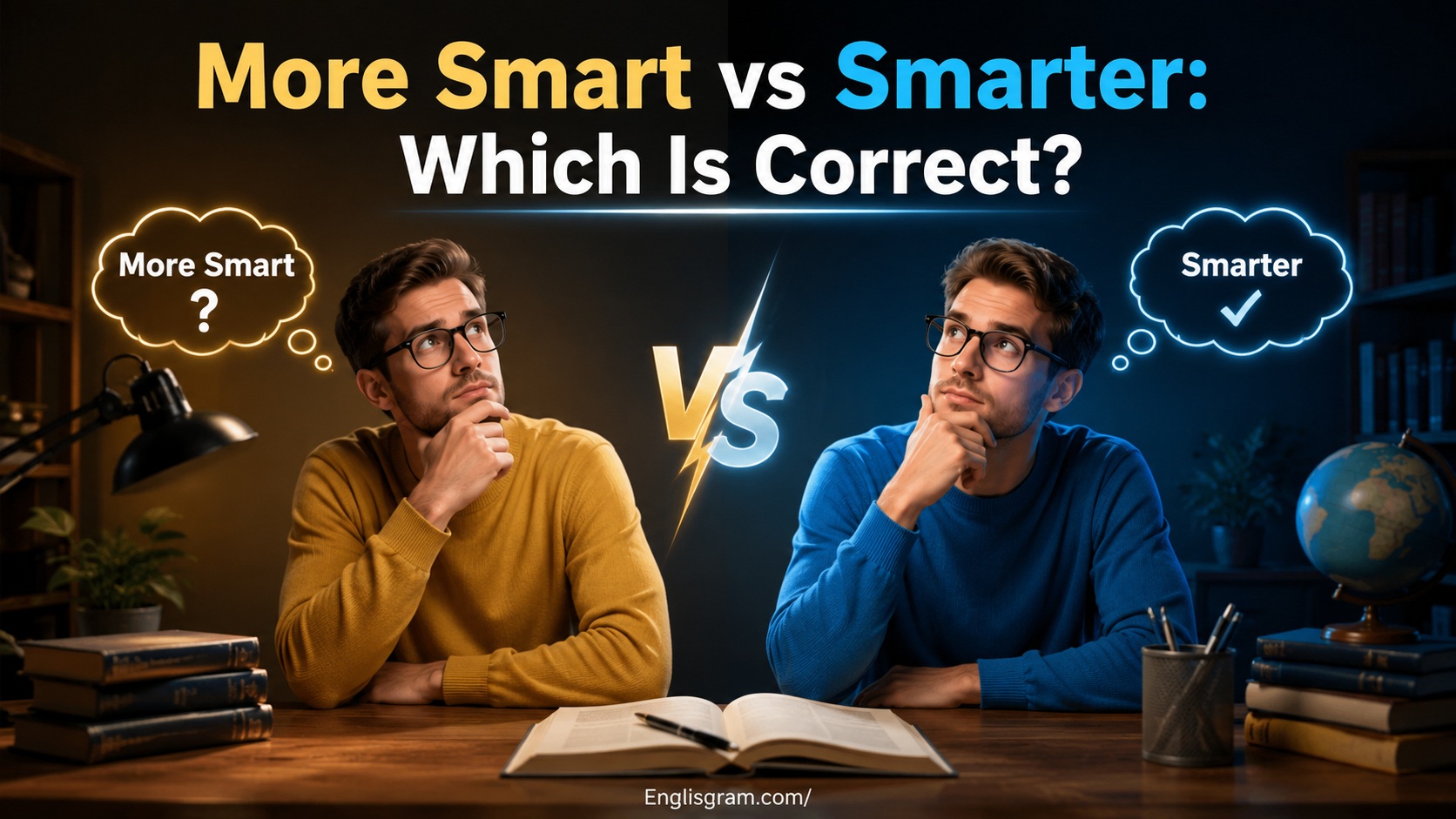
More Smart vs Smarter often confuses learners, but smarter is the preferred choice in English grammar, making your writing clearer and natural. Many people ask this common question because the surface answer looks simple, yet the real story is more interesting. This article breaks down the idea to improve understanding as you discover, learn, and continue learning through learning English and language learning.
You soon understand the difference, realize why common misunderstandings and misunderstanding happen, and see how comparison, comparisons, comparative, comparatives, comparative form, comparative forms, comparative adjective, comparative adjectives, comparative forms of adjectives, and comparative grammar work together. The preferred comparative is the correct comparative because you compare, keep comparing, compare someone, compare someone else, and compare things that are compared while expressing, express, describe, and describing ideas.
Instead of more smart, choose smarter because smart is a one-syllable adjective. Most one-syllable adjectives add -er at the end, following the rule, rules, grammar logic, and every reliable grammar guide. This adjective pattern belongs to English grammar, standard English grammar, and the English language, giving you the correct, right form, and a better choice that supports correctness, improve correctness, and correctness in English.
More Smart vs Smarter: The Core Rule
The adjective smart is usually compared as:
- smart
- smarter
- smartest
That pattern follows the normal rule for short adjectives in English. Most one-syllable adjectives add -er for the comparative and -est for the superlative.
Examples:
- tall → taller → tallest
- fast → faster → fastest
- bright → brighter → brightest
- smart → smarter → smartest
That is why smarter sounds right. It matches the rhythm of standard English.
By contrast, more smart is not the normal form. It may still appear in unusual writing, poetic phrasing, or speech where a speaker wants emphasis. Even then, it often sounds less natural than smarter.
More Smart vs Smarter: Why Smarter Wins
To understand why smarter is the preferred form, it helps to look at how English builds comparatives.
English adjectives usually follow one of these patterns:
| Adjective type | Comparative form | Example |
| One-syllable adjectives | Add -er | smart → smarter |
| Many two-syllable adjectives ending in -y | Add -er | happy → happier |
| Longer adjectives | Use more | careful → more careful |
| Irregular adjectives | Change form | good → better |
The adjective smart is short. It has a clean, one-syllable shape. English almost always treats words like that with -er.
So instead of saying:
- more smart
you say:
- smarter
That is the version that feels natural in real conversation.
A simple memory trick
If the adjective is short, think -er.
If the adjective is longer, think more.
That is not a perfect rule for every single adjective, but it works well for most common cases.
More Smart vs Smarter: What “Smart” Really Means
Before comparing the two forms, it helps to understand the base word itself.
The word smart has more than one meaning.
Smart as intelligent
This is the most common meaning in American English.
Examples:
- She is smart.
- That was a smart answer.
- He made a smart decision.
In this sense, smarter means more intelligent, more insightful, or better at understanding things.
Smart as stylish or neat
In British English, smart can also mean well-dressed, neat, or polished.
Examples:
- He looks smart in that jacket.
- The office looked smart and modern.
- She wore a smart outfit to the interview.
In this case, smarter can mean more polished or more stylish.
Smart as clever or practical
Smart can also describe something that works well or solves a problem efficiently.
Examples:
- a smart plan
- a smart move
- smart technology
- a smart strategy
Here again, smarter means better designed, more effective, or more thoughtful.
So when you compare more smart vs smarter, you are not only comparing grammar. You are also comparing the common ways English speakers actually use the word smart.
More Smart vs Smarter: Correct Examples in Real Sentences
The easiest way to learn the difference is to see it in action.
Correct uses of smarter
- She is smarter than her brother.
- That was a smarter choice.
- We need a smarter plan.
- The new software is smarter than the old version.
- He looked smarter after changing his outfit.
Unnatural or less natural uses of more smart
- She is more smart than her brother.
- That was a more smart choice.
- We need a more smart plan.
Native speakers will understand those sentences, but most will not say them that way unless they are speaking carefully, unusually, or trying to place emphasis on smart itself.
That is the key difference: understandable does not always mean natural.
More Smart vs Smarter: When More Smart Appears
Even though smarter is the standard choice, more smart can occasionally show up in special situations.
Emphasis in speech
Sometimes a speaker may want to stress the word smart for dramatic effect.
For example:
- We need to be more smart about this.
That sentence is understandable. But most people would still say:
- We need to be smarter about this.
The second sentence sounds smoother and more idiomatic.
In phrases with another modifier
Sometimes more modifies the whole expression rather than the adjective alone.
For example:
- a more smart-looking design
- a more smartly arranged room
These are not the same as saying more smart. In these examples, more works with a larger phrase.
That distinction matters. English grammar often depends on the exact structure of a phrase, not just the individual word choice.
In poetic or unusual writing
A writer might use more smart for rhythm, voice, or artistic effect. Creative writing sometimes bends standard usage on purpose.
That said, blog posts, essays, academic writing, and business content should almost always prefer smarter.
Read More:Into vs. Onto: What’s the Difference? A Clear, Practical Guide With Real Examples
More Smart vs Smarter: A Grammar Breakdown
Grammar can look dry at first. Once you break it down, though, the logic is simple.
Comparative adjectives
Comparative adjectives compare two things.
Examples:
- bigger
- faster
- lighter
- smarter
Superlative adjectives
Superlatives compare three or more things.
Examples:
- biggest
- fastest
- lightest
- smartest
Smart fits the short-adjective pattern
Since smart is short and direct, English forms its comparative by adding -er.
So the full set is:
- smart
- smarter
- smartest
That is the natural grammatical family.
More Smart vs Smarter: Table of Differences
| Feature | Smarter | More Smart |
| Grammar | Standard comparative form | Uncommon and less natural |
| Everyday speech | Very common | Rare |
| Formal writing | Preferred | Usually avoided |
| Native-speaker usage | Natural | Sometimes understandable, but awkward |
| Best choice for SEO content | Yes | Usually no |
| Example | She is smarter than him. | She is more smart than him. |
This table captures the heart of the issue. Smarter is the safe, standard choice. More smart may be understood, but it is not the form most readers expect.
More Smart vs Smarter: Common Mistakes People Make
This topic often leads to a few predictable errors.
Using more smart because more feels logical
Many learners know that more creates comparisons in English. So they apply it everywhere.
That leads to sentences like:
- This idea is more smart.
- He is more smart than his classmate.
The logic is understandable. The grammar is not ideal.
Using more smarter
This is another common error.
Incorrect:
- She is more smarter than her sister.
Correct:
- She is smarter than her sister.
Why is the first one wrong? Because it doubles the comparative idea. The word smarter already means “more smart.” Adding more on top repeats the same function.
Using most smartest
This one is even more common in casual speech.
Incorrect:
- He is the most smartest student.
Correct:
- He is the smartest student.
Again, the problem is duplication. You only need one superlative marker.
More Smart vs Smarter: Everyday Examples by Context
Grammar becomes easier when you see how it works in real life.
School and learning
- The second explanation is smarter.
- A smarter study plan can save time.
- Good students do not always work harder. Sometimes they work smarter.
That last sentence is especially common in English. It sounds natural because smarter fits the idiom of efficient effort.
Work and business
- The team chose a smarter strategy.
- A smarter pricing model increased sales.
- This company needs a smarter way to handle customer support.
In business writing, smarter often means more efficient, more practical, or more effective.
Technology
- New phones are getting smarter every year.
- Smart devices are becoming smarter and more useful.
- The app uses a smarter recommendation system.
Here, smarter can mean more advanced or more capable.
Personal decisions
- It would be smarter to save the money.
- A smarter response would calm the situation.
- She made a smarter choice by waiting.
This use is very common in advice and self-improvement writing.
More Smart vs Smarter: What Native Speakers Usually Say
In natural English, people almost always choose smarter.
That includes:
- casual conversation
- school writing
- emails
- articles
- speeches
- social media posts
You will hear phrases like:
- be smarter than that
- work smarter, not harder
- a smarter move
- smarter choices
- smarter ways to do it
These are common because they sound smooth and idiomatic.
By contrast, more smart feels like a structure someone may produce while thinking through the grammar instead of speaking naturally.
That difference matters if the goal is clear, polished English.
More Smart vs Smarter: Is More Smart Ever Correct?
This is the question people really want answered.
The practical answer is this: more smart is not the standard or preferred comparative form of smart.
It is not the form you should use in normal writing. It is not the version most editors would choose. It is not the form most readers expect.
Could it ever appear? Yes, in special, limited, or stylistic contexts. But that does not make it the best choice.
A useful rule to remember:
- If you want to sound natural, use smarter.
- If you want to sound awkward, use more smart.
- If you want to sound correct, use smarter.
More Smart vs Smarter: Style, Tone, and Audience
Grammar is not only about rules. It is also about tone.
Smarter sounds fluent
The word smarter flows easily. It fits common speech patterns. It sounds modern, smooth, and confident.
More smart sounds forced
Because the phrase is uncommon, it can slow a sentence down. It may feel like the speaker is translating directly from another language or overthinking the construction.
Audience expectations matter
If your readers are native speakers, they will expect smarter.
If your readers are English learners, they may be testing the phrase against a rule they know. In that case, it helps to explain that English usually treats smart like other one-syllable adjectives.
In other words, the form you choose should match the audience and the purpose. For most writing, smarter is the clear winner.
More Smart vs Smarter: A Mini Case Study
Imagine two students writing the same sentence in an essay.
Student A writes:
- She is more smart than the other candidate.
Student B writes:
- She is smarter than the other candidate.
Both sentences communicate the same basic idea. But the second one sounds cleaner, more natural, and more polished.
Now imagine an editor reviewing the two versions.
The editor almost certainly keeps smarter. Why?
Because it matches standard English usage, it reads smoothly, and it sounds like a sentence a native speaker would actually say.
That is the practical test.
When two choices mean the same thing, the better one is usually the one that sounds the most natural to the reader.
More Smart vs Smarter: Quotes and Common Sayings
A few familiar sayings use smarter because that is the form English naturally prefers.
Work smarter, not harder.
That phrase is widely used in business, productivity, and self-improvement writing.
It works because smarter suggests better methods, not just more effort.
Another common idea is:
Be smarter than the problem.
That kind of line works in advice writing because it sounds direct and memorable.
A sentence like be more smart than the problem would not carry the same natural force.
More Smart vs Smarter: Easy Rules to Remember
Here is the simplest possible way to remember the difference.
Use smarter when:
- comparing intelligence, cleverness, style, or effectiveness
- speaking or writing normally
- you want natural English
Avoid more smart when:
- writing essays
- writing blog posts
- speaking in formal or everyday situations
- you want a native-like sentence
Think of it this way
- smart is the base word
- smarter is the natural comparison
- smartest is the top form
That is all you usually need.
FAQS
Is more smart ever correct?
In modern English, smarter is almost always the correct choice. More smart sounds unnatural in most everyday situations.
Why do we say smarter instead of more smart?
Because smart is a one-syllable adjective. English grammar normally forms its comparative by adding -er, giving smarter.
Are there any exceptions?
In rare cases, writers may use more smart for emphasis or a specific style, but it is not the standard form and should generally be avoided.
How can I remember the correct form?
A simple trick is to remember that most one-syllable adjectives take -er. If smart becomes smarter, you’ll rarely make this mistake.
Does using smarter improve my English?
Yes. Using smarter makes your writing and speech sound more natural, fluent, and grammatically correct.
Conclusion
When choosing between More Smart vs Smarter, the correct and natural option is smarter. Since smart is a one-syllable adjective, English grammar forms its comparative by adding -er instead of using more. Learning this simple rule helps you write with greater confidence, communicate more clearly, and sound more like a fluent English speaker in both everyday and professional situations.