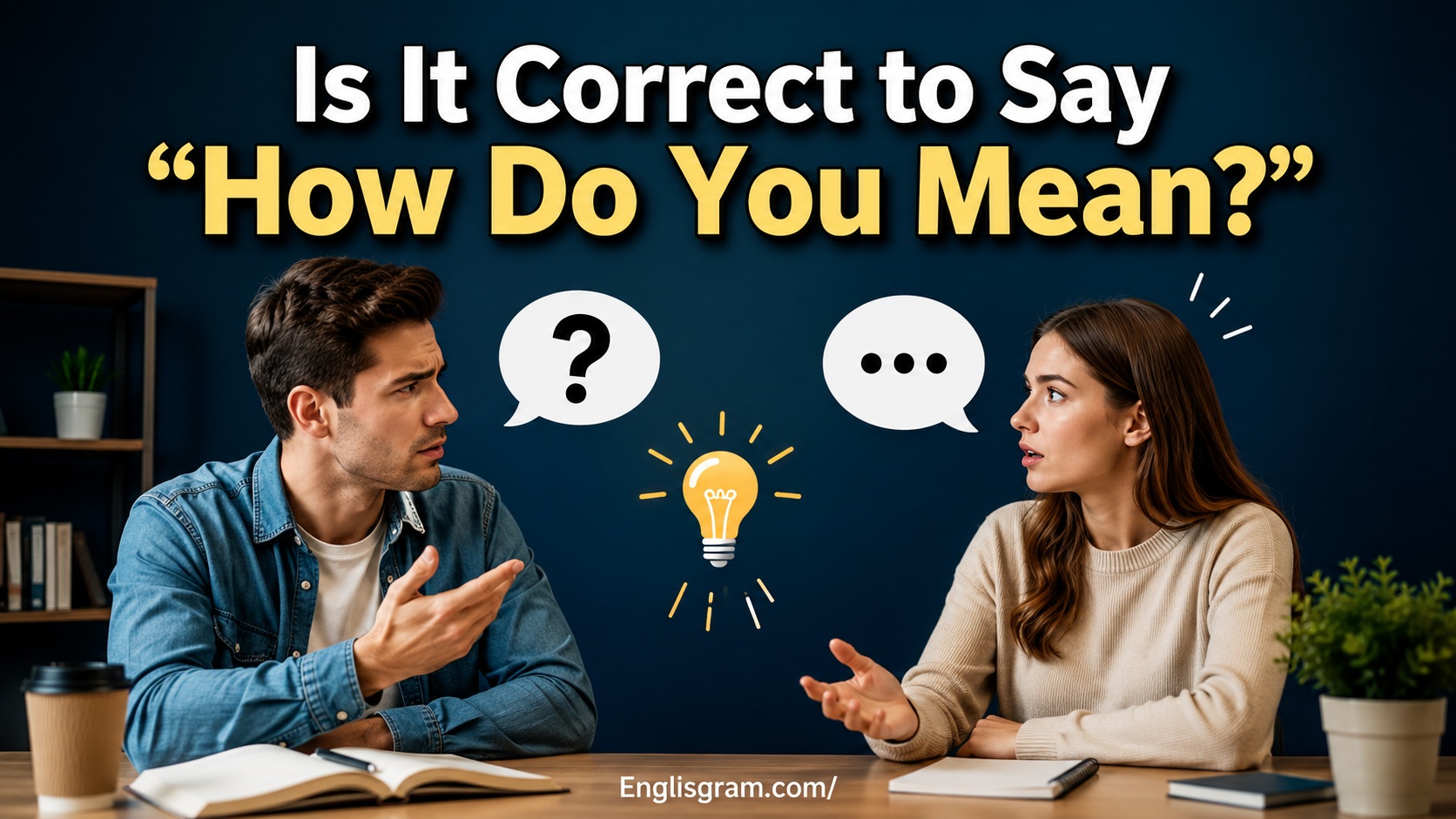
Is It Correct to Say “How Do You Mean?” explains the phrase, its meaning, correct usage, context, and better alternatives in everyday English clearly.If you have ever searched How do you mean meaning, What does How do you mean mean, Is How do you mean correct, or Is It Correct To Say “How Do You Mean?”, you are not alone. From my experience, many language learners stop when they hear or heard someone say how do you mean because the phrase may sound odd as an uncommon phrase in everyday English.
In many situations, English speakers and native speakers prefer What do you mean, although it can still work in the right context when the speaker intent, statement, or recent statement needs more explanation. Learning the difference, how the usage differs, and when to use each common English phrase builds understanding, clarity, and confidence in spoken English and English conversation.
The meaning of this powerful expression depends on conversational context, contextual appropriateness, intent, semantics, pragmatics, grammar, grammar explanations, structure, phrasing, linguistic expression, linguistic form, linguistic awareness, and cultural background. It is often a question or simple question used to ask for clarification, ask for more information, or request more information about a statement itself.
What Does “How Do You Mean?” Mean?
At its core, “How do you mean?” is a question for clarification. You use it when you want someone to explain their meaning more clearly.
It usually carries one of these ideas:
- You are not fully sure what the speaker intends.
- You want more detail.
- You think the person may be saying something indirect.
- You want them to rephrase their point in a clearer way.
The phrase is not asking about how in the sense of method or process. Instead, it works more like:
- “What do you mean?”
- “Can you explain that?”
- “What are you trying to say?”
Simple example
If someone says:
“I do not think that plan will work.”
You might reply:
“How do you mean?”
In this case, you are asking for the reason behind the statement. You want the speaker to explain their point.
What the phrase really asks
When you say “How do you mean?” you are often asking:
- In what way?
- What exactly do you mean by that?
- Can you explain your point more clearly?
- What is the intended meaning here?
So while the wording looks unusual to some ears, the purpose is very practical.
Is “How Do You Mean?” Correct English?
Yes, it is correct English. It follows standard question structure:
- How = question word
- do = auxiliary verb
- you = subject
- mean = main verb
That makes the grammar sound perfectly fine.
Here is the structure:
| Part | Function | Example |
| How | Question word | How |
| do | Auxiliary verb | do |
| you | Subject | you |
| mean | Main verb | mean |
So from a grammar point of view, nothing is wrong with it.
However, grammar and natural usage are not the same thing. A phrase can be correct but uncommon. It can also sound more British, more formal, or more old-fashioned depending on the context.
That is why native speakers sometimes hesitate. They do not reject the phrase because it is “wrong.” They simply reach for a more familiar version.
Why Does “How Do You Mean?” Sound Different?
The phrase feels different because English speakers do not always use how to ask for clarification in this way. In modern everyday American English, what often does that job more naturally.
Compare these:
- How do you mean?
- What do you mean?
Both are understandable. But the second one is more common in casual conversation.
Why “what” often sounds more natural
“What” is simpler and more direct when someone wants clarification. It asks for the meaning itself, not the manner of expression.
For example:
- What do you mean? = Please explain your meaning.
- How do you mean? = In what sense are you using that idea?
The first sounds more common in daily speech. The second sounds a little more reflective, slightly more formal, or sometimes a bit old-fashioned.
That does not make it bad English. It just means the phrase has a particular flavor.
When to Use “How Do You Mean?”
You can use “how do you mean?” when the conversation calls for clarification of intention, sense, or implication.
Good situations for the phrase
You may use it when:
- Someone makes a vague statement.
- You think the person is implying something.
- You want them to explain a comment more carefully.
- You are discussing an opinion or interpretation.
- You want to know the exact sense of a word or idea.
Examples in context
Example one
A: “That answer is a little too simple.”
B: “How do you mean?”
Here, the speaker wants to know what makes the answer too simple.
Example two
A: “He is not exactly reliable.”
B: “How do you mean?”
Now the speaker is asking for more detail about the judgment.
Example three
A: “Your report is fine, but it needs work.”
B: “How do you mean?”
This is a natural way to ask what needs improvement.
When the phrase works best
It works best when:
- You want the other person to explain their intent.
- You are in a thoughtful discussion.
- You are not trying to sound overly casual.
- You want to show that you are listening carefully.
When You Should Avoid Saying “How Do You Mean?”
Even though the phrase is correct, it does not fit every situation.
Avoid it when you want a warmer tone
Sometimes “How do you mean?” can sound slightly sharp, especially if spoken with a flat voice. It may come across as skeptical or defensive.
For example, if someone gives you feedback and you answer too quickly with “How do you mean?” it may sound like you are challenging them instead of inviting explanation.
Avoid it in very casual American conversation
In the U.S., people often say:
- What do you mean?
- What do you mean by that?
- Can you explain?
- Could you clarify that?
These usually sound more natural than “How do you mean?”
Avoid it when you only need repetition
If someone spoke too fast or too softly, you probably do not want to ask “How do you mean?” That phrase asks about intention, not repetition.
Instead, say:
- Sorry, could you say that again?
- I did not catch that.
- Can you repeat that?
That keeps the conversation smooth.
Grammar Breakdown of “How Do You Mean?”
Let’s look at why the phrase works grammatically.
The word order is standard
English questions often use auxiliary verbs like do, does, or did.
Examples:
- How do you know?
- What do you want?
- Why did she leave?
So “How do you mean?” follows a normal English pattern.
Why “do” is necessary
Without do, the sentence sounds wrong:
- How you mean? → incorrect in standard English
- How do you mean? → correct
The auxiliary verb helps form the question properly.
Why it is not about method
Some learners assume how always means method or process. That is not always true. In this phrase, how points to the sense or interpretation of the meaning.
So the phrase does not ask “by what method do you mean?” It asks “in what sense do you mean that?”
That is a subtle but important difference.
Is “How Do You Mean?” Formal or Informal?
It sits somewhere in the middle, but it often leans slightly formal or old-fashioned in some dialects.
In casual speech
It can sound normal in conversation, especially in parts of the UK and in some English-speaking communities.
In professional settings
It is understandable, but it may not be the best choice if you want to sound polished and neutral.
Better workplace options include:
- Could you clarify what you mean?
- Can you explain that a bit more?
- What exactly do you mean by that?
- Could you elaborate?
In writing
In emails, reports, and formal messages, “How do you mean?” is usually less common than the alternatives above.
That does not mean you can never use it. It just means the tone may not always match the setting.
British English vs. American English Usage
This phrase is often associated more with British English than American English.
British English
In British conversation, “How do you mean?” can sound fairly natural. It may appear in everyday speech when someone wants clarification or wants to challenge a vague idea politely.
American English
In American English, “What do you mean?” is much more common. Americans still understand “How do you mean?” but many would not use it first.
That difference is important for learners. You may be perfectly correct and still sound a little unusual to a listener depending on the region.
Practical takeaway
- Use “How do you mean?” if you have heard it around you or it matches your speaking style.
- Use “What do you mean?” if you want the safest, most widely recognized option in casual American English.
How “How Do You Mean?” Differs from Similar Questions
This is where many learners get stuck. Several clarification questions look similar, but they do different jobs.
“How do you mean?” vs. “What do you mean?”
These are close, but not identical.
- How do you mean? asks for the sense or interpretation.
- What do you mean? asks for the meaning directly.
In real life, “What do you mean?” is more common and more direct.
“How do you mean?” vs. “What do you mean by that?”
This version adds a little more precision.
- What do you mean by that? = Please explain that specific remark.
It sounds clear and natural, especially when you want to be precise.
“How do you mean?” vs. “Could you explain?”
This one is softer and often better in professional settings.
- Could you explain? = Please give more detail.
It is polite, simple, and widely usable.
“How do you mean?” vs. “Can you clarify?”
This version sounds even more formal.
- Can you clarify? = Please make the meaning clearer.
You might use it in meetings, emails, or academic settings.
“How do you mean?” vs. “I’m not sure I understand.”
This phrase is gentle and honest.
- I’m not sure I understand. = I need more explanation.
It feels less confrontational than “How do you mean?”
Better Alternatives to “How Do You Mean?”
Here is a practical guide to better alternatives depending on tone and setting.
| Phrase | Tone | Best Use |
| What do you mean? | Neutral, direct | Everyday conversation |
| What do you mean by that? | Neutral, specific | When a remark needs explaining |
| Could you explain that? | Polite | General clarification |
| Could you clarify that? | Formal | Work, email, meetings |
| Could you elaborate? | Professional | Detailed discussion |
| I’m not sure I follow. | Friendly | Casual or semi-formal talk |
| In what sense? | Precise | Academic or analytical discussion |
| How so? | Casual | Informal conversation |
| What exactly do you mean? | Clear and direct | When you need exact meaning |
| Can you give me an example? | Practical | When the idea feels vague |
Which one sounds most natural?
In most everyday American English conversations, “What do you mean?” or “What do you mean by that?” usually sounds most natural.
In work settings, “Could you clarify that?” or “Could you explain what you mean?” often works better.
If you want the safest all-purpose choice, go with:
What do you mean?
It is simple. It is familiar. It rarely sounds odd.
Read More:Give Someone the Third Degree Idiom Definition: Meaning, Origin,
Examples of “How Do You Mean?” in Real Conversation
Let’s look at the phrase in different situations.
Casual conversation
A: “She is not really your type.”
B: “How do you mean?”
Here, the second speaker wants the person to explain the comment.
At work
A: “This section is not strong enough.”
B: “How do you mean?”
The speaker wants specific feedback.
In class
A: “That theory does not fully support the argument.”
B: “How do you mean?”
The student is asking for a deeper explanation.
In family conversation
A: “I think you are being a bit stubborn.”
B: “How do you mean?”
Now the phrase can sound a little defensive depending on the tone.
In text messages
A: “That sounded kind of harsh.”
B: “How do you mean?”
This works, but it may feel less natural than “What do you mean?” in texting.
When “How Do You Mean?” Can Sound Rude
The phrase is not rude by itself. Tone changes everything.
A calm voice can make it sound thoughtful. A sharp voice can make it sound like a challenge.
It may sound rude when:
- You say it too fast.
- You raise your voice.
- You use it after a criticism.
- You sound skeptical or annoyed.
- You are interrupting someone.
A better softening version
Try one of these instead:
- Sorry, what do you mean by that?
- Could you explain what you mean?
- I’m not sure I understand what you mean.
- Can you say that another way?
These versions reduce friction. They also keep the conversation moving.
A Small Case Study: Choosing the Right Phrase
Imagine three people hear the same comment:
“Your presentation was decent, but it missed the point.”
Person A says
“How do you mean?”
This is understandable. It asks for clarification. But it may sound slightly tense.
Person B says
“What do you mean by that?”
This sounds clearer and more natural in most English-speaking settings.
Person C says
“Could you explain what you mean?”
This sounds polished and calm. It is the best fit for a professional environment.
What this shows
All three responses are valid. The difference is not grammar. The difference is tone, style, and social fit.
That is the real lesson. Good English is not just about correctness. It is also about matching the moment.
Common Mistakes Learners Make with “How Do You Mean?”
Mistake one: using it to ask for repetition
If someone mumbles, “How do you mean?” is not the best choice.
Say:
- Sorry, could you repeat that?
- I did not catch that.
Mistake two: using it in every clarification
Repeating the same phrase too often can make your speech sound stiff. Variety helps.
Mistake three: confusing it with “how” as method
The phrase does not ask about the process. It asks about the meaning.
Mistake four: ignoring tone
Even a correct phrase can sound rude if your voice is sharp.
Mistake five: using it where “what do you mean” is more natural
That can make your English sound a little less natural, especially in casual American speech.
How Native Speakers Hear “How Do You Mean?”
Native speakers usually understand it right away. They may also notice that it sounds a bit different from the most common American phrasing.
To many ears, it can feel:
- slightly British,
- slightly formal,
- slightly old-fashioned,
- or slightly deliberate.
That does not mean people avoid it completely. It simply means it carries a particular tone.
In other words, the phrase is like wearing a blazer to a coffee shop. It is not wrong. It just gives a different impression than a T-shirt would.
Useful Alternatives by Situation
Here is a simple guide you can keep in mind.
For casual talk
- What do you mean?
- How so?
- What do you mean by that?
For polite clarification
- Could you explain that?
- I’m not sure I follow.
- Could you clarify that?
For work or formal settings
- Could you elaborate?
- What exactly do you mean?
- Could you explain your point?
For academic or analytical discussion
- In what sense?
- What is meant by that?
- Can you clarify the interpretation?
Quotes on Clear Communication
“The biggest problem with communication is the illusion that it has taken place.”
That idea fits this topic perfectly. A phrase may sound correct, but if the listener interprets it differently, the conversation still misses the mark.
Another useful truth:
Clear communication is not about sounding impressive. It is about being understood.
That is why choosing the right clarification question matters so much.
Quick Reference Table
| Situation | Best Phrase | Why |
| Casual conversation | What do you mean? | Most natural and direct |
| Mild confusion | How so? | Short and conversational |
| Asking for detail | What do you mean by that? | Specific and clear |
| Workplace discussion | Could you clarify that? | Polite and professional |
| Academic discussion | In what sense? | Precise and analytical |
| Friendly but confused | I’m not sure I follow. | Gentle and natural |
Final Answer: Should You Say “How Do You Mean?”
Yes, you can say it. It is correct English. The phrase is understandable and useful when you want clarification about someone’s intended meaning.
Still, in many everyday situations, “What do you mean?” sounds more natural, especially in American English. In professional or polite contexts, “Could you clarify that?” or “Could you explain what you mean?” often works even better.
So the best choice depends on the moment:
- Use “How do you mean?” when you want to ask about a person’s intended sense or implication.
- Use “What do you mean?” when you want the most natural everyday option.
- Use “Could you clarify?” when you want a more polished tone.
That is the real key. English is not just about rules. It is about choosing the right words for the right moment.
FAQS
Is it grammatically correct to say “How do you mean?”
Yes, it is grammatically possible, but it is less common in modern English. Most native speakers prefer “What do you mean?” because it sounds more natural in everyday conversation.
What does “How do you mean?” mean?
The phrase asks someone to explain their meaning or clarify what they intended to say. It requests more detail so the listener can better understand the speaker’s point.
When should I use “How do you mean?”
You can use it when you want someone to explain how they arrived at a statement or what they specifically meant. However, in casual English, “What do you mean?” is usually the better choice.
Is “What do you mean?” better than “How do you mean?”
In most situations, yes. “What do you mean?” is more common, sounds more natural, and is widely used by native English speakers in both spoken and written communication.
Why does “How do you mean?” sound unusual?
It sounds unusual because it is less frequently used in modern English. While people may still understand it, many speakers naturally choose “What do you mean?” instead.
Conclusion
Is It Correct to Say “How Do You Mean?” Yes, it can be correct depending on the context, but it is not the phrase most English speakers use in everyday conversation. If your goal is to sound natural and clear, “What do you mean?” is usually the better option. Understanding the difference between these expressions will help you communicate with more confidence and avoid confusion in both casual and formal conversations.