See vs. Look vs. Watch can confuse English learners, but each verb has a clear role in describing perception, direction, or sustained attention. When you first study these verbs, they may seem interchangeable because they all connect with vision, the eyes, and sight, but their difference becomes clear through context, action, and meaning. In English, choosing the correct word helps you communicate your ideas clearly and sound natural in speech, writing, and everyday conversations.
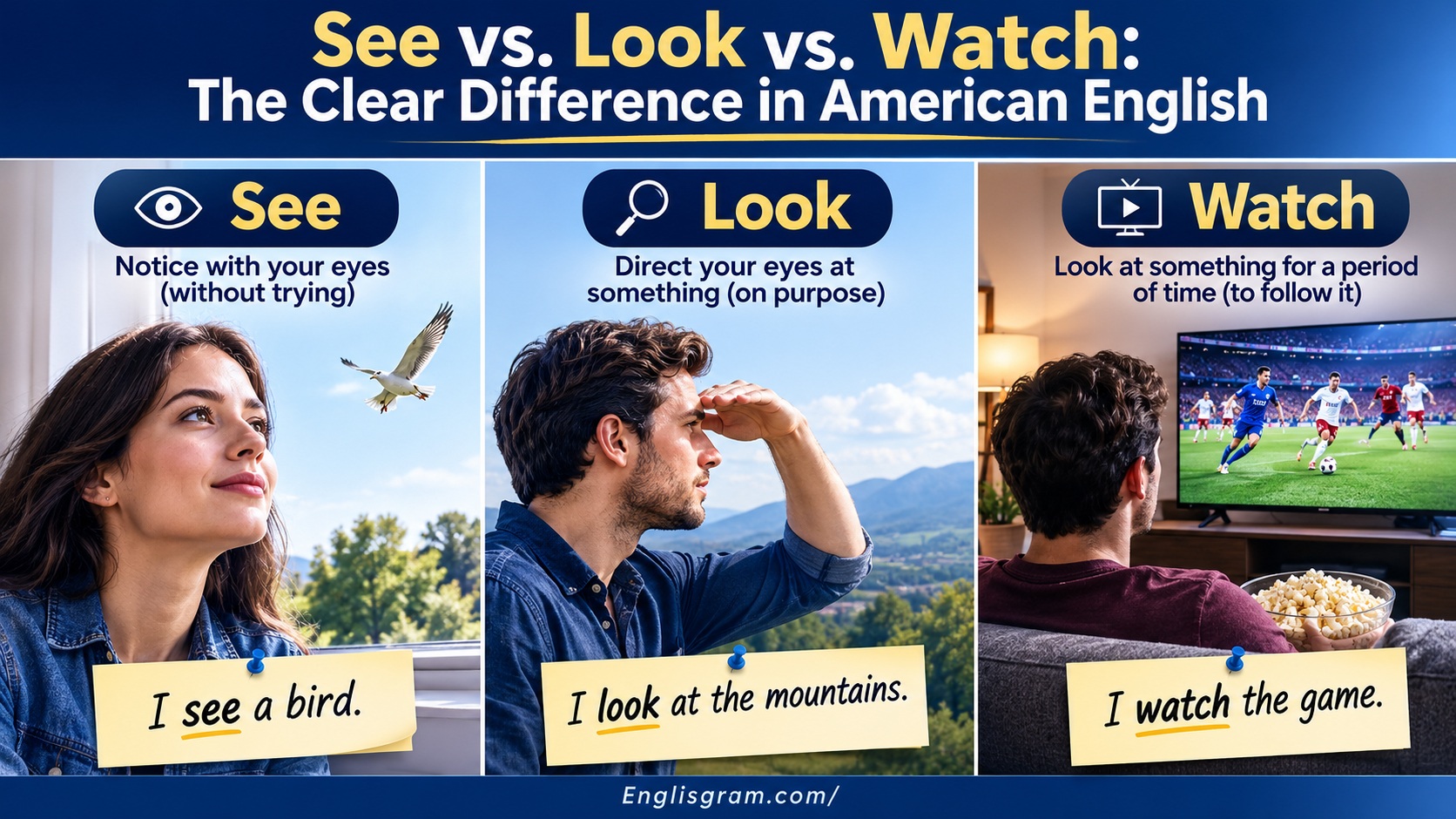
See works as a perception verb connected with visual perception, while look is a directional verb connected with visual direction, and watch is an attention verb connected with sustained attention and continuous observation. At first glance, the three may appear to have the same purpose, but seeing usually describes something you notice through normal perception, looking involves directing your eyes toward something intentionally, and watching involves observing something through sustained observation, intentional viewing, and continued attention.
A useful rule of thumb is that see often happens without effort, look involves a deliberate direction, and watch involves continued attention. For example, you might see a bird in your visual experience, look at it by turning your eyes toward it, and watch it as its movement continues or as it moves or changes over time. This practical way of understanding the key differences can help you discover why one choice sounds far more natural in particular situations.
See vs. Look vs. Watch at a Glance
Before diving deep, here is the quick version.
| Verb | Core meaning | Focus | Time involved | Common example |
| see | perceive with your eyes | noticing | usually brief or unplanned | I see a bird outside. |
| look | direct your eyes toward something | attention | usually immediate | Look at that sign. |
| watch | observe something over time | monitoring | longer or ongoing | We watched the game. |
That table gives the big picture. Now let’s look at each verb in detail.
What Does See Mean?
See is the most basic of the three. It means to perceive something with your eyes. Often, you do not make a special effort. Something simply enters your field of vision.
For example:
- I see the mountains from my window.
- Did you see that bird?
- She saw a man crossing the street.
In each case, the idea is not “I intentionally aimed my eyes there.” Instead, the speaker noticed something visually.
See is often unplanned
That is what makes see different from look. You can see things without trying. A shape appears in front of you, and your eyes catch it.
Think of it like this: see is the result of vision. It is what happens when your eyes register something.
See can also mean understand
This verb has an important second meaning in American English. It can mean “understand” or “realize.”
Examples:
- Oh, I see what you mean.
- Now I see why you were upset.
- Do you see the problem?
Here, the word has nothing to do with physical vision. It means mental clarity. That is one reason see is so common in conversation. It works both literally and figuratively.
Common ways people use see
Here are a few natural patterns:
- see a person
I saw my cousin yesterday. - see a doctor
You should see a doctor about that cough. - see a movie / show / concert
We saw a movie last night. - see the point
I see the point of your argument.
Why “see a movie” sounds normal
People often say see a movie and watch a movie, but the two do not feel identical. See a movie often means attending the movie or experiencing it as an event. Watch a movie focuses more on the act of viewing it from start to finish.
Both are correct. The tone changes slightly.
- We saw a movie last night.
- We watched a movie last night.
The second sentence feels more active and direct. The first sounds a little more like “we went and had the movie experience.”
What Does Look Mean?
Look means to direct your eyes toward something on purpose. That intention matters. You are not just noticing something by accident. You are choosing where to place your attention.
Examples:
- Look at the sky.
- She looked at the screen.
- Look over there.
This verb almost always suggests a deliberate action.
The key pattern: look at
In everyday English, look usually appears with at when you mean “direct your eyes toward.”
- Look at me.
- Look at the painting.
- He looked at the clock.
Without at, the sentence usually needs a different meaning.
- Look for the keys.
- Look after the child.
- Look into the issue.
Those phrases are real and common, but they do not mean the same thing as “direct your eyes toward.”
Look can describe appearance
This verb also works in a different way. It can describe how someone or something appears.
Examples:
- You look tired.
- That looks expensive.
- The soup looks great.
Here, look does not mean you are actively aiming your eyes at something. It means something gives a visual impression.
Common expressions with look
These are worth knowing because they show how flexible the verb is:
- look at = direct your eyes toward
- look for = search
- look after = take care of
- look into = investigate
- look like = resemble
- look out = be careful
That flexibility makes look useful, but it also creates confusion for learners. The safest first step is to remember the core idea: look is usually intentional.
What Does Watch Mean?
Watch means to observe something with attention over a period of time. The thing you are watching usually moves, changes, or unfolds.
Examples:
- We watched the game.
- She watched the children play.
- I watched the sunset.
This verb suggests ongoing attention. You are not just glancing. You are following what happens.
Watch often involves action or change
That is why watch fits so well with sports, movies, performances, and people doing things.
- watch TV
- watch a movie
- watch a play
- watch a game
- watch a tutorial
- watch a child
In each case, the object of attention is not static. Something is happening.
Watch can also mean stay alert
This verb has another useful meaning: to monitor carefully or stay on guard.
Examples:
- Watch your step.
- Watch the baby.
- Watch out!
That meaning is common in everyday speech. It gives the verb a slightly protective tone.
Why “watch TV” sounds natural
You do not usually say “look at TV” when you mean “view television programming.” Watch TV is the normal expression because TV involves an ongoing stream of images and sound. The point is not a quick glance. The point is sustained viewing.
Compare these:
- I watched TV for an hour.
- I looked at the TV.
The first means you viewed the program. The second means you directed your eyes toward the television set itself.
See vs. Look: What Is the Real Difference?
This is where many learners get stuck. The easiest answer is this:
- See is about noticing.
- Look is about choosing where to aim your eyes.
That means see is often less deliberate, while look is almost always intentional.
Compare these pairs
- I saw a dog in the park.
I noticed the dog there. - I looked at the dog in the park.
I intentionally turned my eyes toward it. - I saw the sunset.
The sunset entered my view. - I looked at the sunset.
I paid attention to it on purpose.
That difference may seem small, but it changes the feel of the sentence.
A simple way to test them
Ask yourself:
- Did the thing simply come into view? Use see.
- Did you deliberately direct your eyes there? Use look.
That quick test works in most ordinary situations.
Look vs. Watch: When Should You Use Each?
At first, look and watch may feel close. Both involve direction and attention. But the time element separates them.
- Look is usually about a moment.
- Watch is usually about a process.
Look is often immediate
Use look when you want someone to direct attention to something now.
- Look at this picture.
- Look over there.
- Look at the mistake.
The action is quick and focused.
Watch is usually ongoing
Use watch when attention continues over time.
- Watch the children play.
- Watch the road.
- Watch the movie.
Here, the verb suggests patience, follow-through, and sustained observation.
A memorable contrast
- Look at the bird.
You want someone to direct attention to it. - Watch the bird.
You want someone to keep observing it as it moves.
That distinction is simple, but powerful.
Read More:Please Advise or Please Advice: Understanding the Right Choice in American English
See vs. Watch: Why Both Can Work With Movies
This is one of the most confusing areas for many learners, because both verbs sound natural with movies and performances.
- We saw a movie.
- We watched a movie.
Both are correct, but they highlight different things.
See a movie often means experience the event
This phrase can sound a little broader. It may refer to going to the theater or having the movie experience.
- We saw a movie downtown.
- Have you seen the new Spider-Man film?
Watch a movie emphasizes the viewing process
This version puts the focus on the act of sitting down and following the story.
- We watched a movie at home.
- They watched the whole film together.
The same pattern appears with shows and performances
- I saw a concert last night.
- I watched the concert online.
Both may work, but the second one feels more focused on the act of viewing. The first can sound more like attending the event.
A Case Study: Three Verbs in One Real Situation
Imagine you are at a park with a friend.
A dog runs across the grass. You notice it immediately. Then you turn and point to it. After that, you keep following it as it chases a ball.
Here is how the verbs work:
- I saw a dog running across the grass.
- Look at that dog!
- Watch it chase the ball.
That sequence shows the difference clearly.
- See = notice it.
- Look = turn attention to it.
- Watch = keep observing it as the action continues.
That is the core pattern.
See, Look, and Watch With People
These verbs also behave differently with people.
See someone
This can mean noticing someone, meeting someone, or having an appointment.
- I saw my teacher at the store.
- I need to see a dentist.
- Have you seen your brother today?
Look at someone
This means directing your eyes toward that person.
- Look at me when I’m talking.
- She looked at her friend.
- He looked at the judge.
Watch someone
This means observing their actions over time.
- She watched the children play.
- The guard watched the doorway.
- I watched him finish the work.
The last one often implies sustained attention. You are not just seeing the person. You are following what they do.
See, Look, and Watch in Everyday American English
Let’s make the differences even more practical.
At home
- I saw a spider on the wall.
- Look at this message.
- Watch the kids while I cook.
At school or work
- Did you see the email?
- Look at the chart.
- Watch how she solves the problem.
While traveling
- We saw the mountains from the highway.
- Look out the window.
- Watch the road.
At an event
- We saw the concert from the front row.
- Look at the stage.
- Watch the performer.
These examples show how the verbs depend on context. English speakers choose them based on what the sentence is really trying to say.
Common Mistakes With See, Look, and Watch
A lot of confusion comes from using these verbs as if they were direct replacements. That usually leads to awkward phrasing.
Mistake with see
Incorrect:
- I saw at the sky.
Correct:
- I looked at the sky.
Why? Because see does not need at in that structure.
Mistake with look
Incorrect:
- Look me.
Correct:
- Look at me.
The preposition matters here.
Mistake with watch
Incorrect:
- Watch at the picture.
Correct:
- Look at the picture.
You normally look at a picture. You do not watch a picture, because a picture does not unfold over time.
Mistake with ongoing action
Incorrect:
- I saw the kids playing all afternoon.
Better:
- I watched the kids play all afternoon.
Why? Because the second sentence captures sustained observation. The first sounds incomplete or less precise.
Grammar Patterns You Should Remember
Here is a simple chart that can help you choose the right verb quickly.
| Verb | Common pattern | Example |
| see | see + object | I saw a car. |
| look | look at + object | I looked at the car. |
| watch | watch + object | I watched the car race. |
That table is useful because it shows the most common structures at a glance.
A few more patterns
- see + person / event / object / idea
I saw your brother.
I see the problem. - look at + object / person / image
Look at this photo. - watch + event / movement / person / screen
Watch the waves.
These are not the only patterns, but they are the ones you will use most often.
A Fast Memory Trick
If you want a simple way to remember the difference, use this:
- See = something comes into view.
- Look = you aim your eyes.
- Watch = you stay with it over time.
Or even shorter:
- See = notice.
- Look = direct.
- Watch = follow.
That little formula solves a lot of everyday grammar problems.
More Real-Life Examples
Example set one
- I saw a cat on the fence.
- Look at that cat!
- Watch it jump down.
Example set two
- Did you see the email?
- Look at the attachment.
- Watch the tutorial before you start.
Example set three
- We saw the sunrise.
- We looked at the clouds.
- We watched the colors change.
These examples show the verbs working side by side without forcing them to do the same job.
FAQs
What is the main difference between see, look, and watch?
See usually means noticing something through your eyes without deliberately trying. Look means directing your eyes toward something, while watch means paying attention to something for a period of time.
Is see intentional?
Usually, no. See often describes something that enters your visual awareness naturally. For example, “I see a bird outside.”
When should I use look?
Use look when you intentionally direct your eyes toward something. For example, “Look at that beautiful painting.”
When should I use watch?
Use watch when you observe something that continues, moves, or changes. For example, “We watched the football match.”
Can see, look, and watch be interchangeable?
Not always. Although they all relate to vision, their meanings and usage are different. Choosing the wrong verb can make a sentence sound unnatural.
conclusion day
Conclusion
Understanding See vs. Look vs. Watch becomes much easier when you focus on the action behind each verb. See describes perception, look describes intentionally directing your eyes, and watch describes sustained attention to something that continues or changes. Although these words overlap in some situations, they aren’t completely interchangeable.With regular practice, you can recognize the difference naturally and choose the correct verb with confidence. Remember the simple rule: see happens, look is intentional, and watch continues.